

P0017 Holden Commodore (2006-2013) LY7 3.6L V6: Crankshaft Camshaft Correlation Fixes
On the Holden Commodore with the LY7 V6, code P0017 almost always means the timing chains have stretched. This is a common and serious issue requiring a complex repair. Expect costs to range from $1,500 to $2,500 at an independent shop for a full timing chain replacement. It is a well-documented and widespread problem.
- P0017 on a VE Commodore with the LY7 V6 is a very strong indicator of stretched timing chains, a well-known factory flaw.
- Before committing to the expensive timing chain replacement, always check the engine oil level/condition and try swapping the Bank 1 and Bank 2 VVT solenoids to rule out a simpler, cheaper fix.
- Do not ignore this code. While the car may run, a complete failure of the timing chain can destroy the engine.
- This repair is not DIY-friendly. The cost at a professional shop in Australia typically ranges from $1,500 to $2,500.
- When replacing the chains, it is critical to use a quality kit (from brands like INA or ACDelco) that includes all three chains, tensioners, and guides.
What's Unique About the 2006-2013 Holden Commodore
The early 3.6L Alloytec V6 (engine code LY7), developed primarily by Holden, is infamous for premature timing chain failure. In January 2006, GM switched from a robust 9.5mm pitch roller chain to a 7.7mm inverted tooth design that was susceptible to stretching. Engines produced between engine number H053340001 and H071380576 are particularly prone. This stretching can occur in as few as 10,000-20,000 kilometers, though failures at higher mileage are also common. Because this issue is so prevalent, a P0017 code on this specific vehicle is a very strong indicator of stretched chains, rather than the more benign sensor or solenoid failures that might cause it on other vehicles. To compound the issue, Holden released a software update (GM Bulletin H08-0601-01) to widen the acceptable tolerance for the sensor readings, which would temporarily hide the check engine light without fixing the underlying mechanical wear, allowing the chains to stretch further before a fault is registered.
Generation note: The 2006-2013 year range covers the entire VE Commodore series. However, the LY7 engine was primarily used in the VE Series I (approx. 2006-2009). The VE Series II (approx. 2009-2013) used different, direct-injection V6 engines (LLT and LFX). While those engines can also suffer from timing chain issues, the parts and specific failure rates may differ. This guide is most accurate for the 2006-2009 VE Commodore with the LY7 V6.
Symptoms You May Notice
- Check Engine Light or 'Check Powertrain' message on the dash.
- Rough or unstable idle.
- Engine rattling noise, especially on startup or at idle, sometimes described as 'marbles in a can'.
- Noticeable loss of engine power and poor acceleration.
- Increased fuel consumption.
- Engine may hesitate or stall.
- Car may enter 'limp mode', limiting RPMs to around 4000.
- Replacing only the camshaft or crankshaft position sensors without diagnosing further. On this engine, the sensors are rarely the root cause; they are usually just accurately reporting the mechanical timing error caused by stretched chains. Many owners replace sensors only to have the code return.
Most Likely Causes
- Stretched Timing Chains 🔴 High Probability → Shop Engine Timing Chain Early LY7 engines were fitted with timing chains made from materials that did not meet design specifications, causing them to elongate prematurely. Poor oil quality or extended oil change intervals (Holden's recommended 15,000km interval is considered too long by many enthusiasts) can accelerate this wear by causing sludge to block tensioners.
How to confirm: The definitive test is to use an oscilloscope to compare cam and crank sensor signals against a known good waveform. A significant deviation confirms a timing issue. Physical inspection for slack requires removing the front timing cover, a labor-intensive job. If simpler causes are ruled out, the chains are almost certainly the culprit.
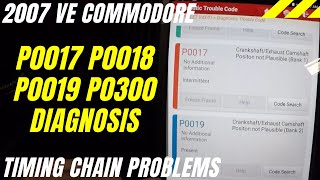
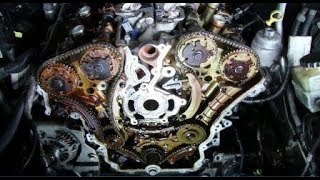
Typical fix: Replacement of all three timing chains, along with all tensioners and guides. It is highly recommended to use an updated, genuine GM or high-quality aftermarket kit (e.g., Mace Engineering, INA, Cloyes) to prevent recurrence. This is a major, engine-out or front-of-engine-disassembly job. 🎬 Watch: A detailed step-by-step guide to replacing VE Commodore timing chains.
Est. part cost: $300-$800 for a quality aftermarket or OEM kit. - Low or Dirty Engine Oil 🟡 Medium Probability The camshaft phasers (part of the Variable Valve Timing system) are operated by oil pressure. If oil is low, dirty, or the wrong viscosity, the phasers can't adjust cam timing correctly, leading to a correlation error. Sludge can block the small passages in the VVT solenoids and phasers.
How to confirm: Check the oil level on the dipstick and inspect its condition. If it's low or looks like sludge, this could be the cause. An oil change is the first and cheapest diagnostic step.
Typical fix: Perform an oil and filter change using a quality full synthetic oil that meets GM's specifications. Clear the codes and see if the problem returns.
Est. part cost: $50-$100 - Faulty Camshaft Actuator Solenoid (VVT Solenoid) 🟡 Medium Probability → Shop Engine Camshaft
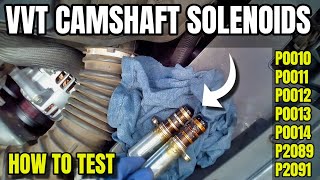
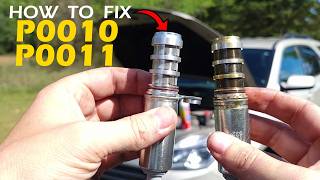
How to confirm: A common diagnostic trick is to swap the Bank 1 (passenger side) exhaust solenoid with the Bank 2 (driver's side) exhaust solenoid. Clear the codes and drive the vehicle. If the code changes to P0019 (Bank 2, Sensor B), the solenoid you moved is faulty. When removing the solenoid, inspect the mesh screens for metallic debris, which indicates a more serious internal engine problem. 🎬 See these quick and easy checks to confirm faulty VVT solenoids.
Typical fix: Replace the faulty solenoid. They are located on the front of the cylinder heads and are relatively easy to access, held by a single 10mm bolt.
Est. part cost: $40-$100 - Faulty Camshaft Position Sensor ⚪ Low Probability → Shop Engine Camshaft Position Sensor
How to confirm: Similar to the solenoid test, you can swap the Bank 1 exhaust camshaft sensor with the Bank 2 exhaust sensor. If the code changes to P0019, the sensor is bad. However, this is a less likely fix than a solenoid.
Typical fix: Replace the faulty sensor. They are located on the back of the cylinder heads.
Est. part cost: $30-$70
Rare But Worth Checking
- Worn Camshaft Phaser (Actuator Gear): → Shop Engine Camshaft The gear itself at the end of the camshaft can fail, but this is much less common than chain, solenoid, or oil issues. It is typically replaced during a full timing chain service.
- Faulty Crankshaft Position Sensor: → Shop Engine Crankshaft Position Sensor While possible, a failure of this sensor usually causes more severe issues like a no-start condition and is likely to be accompanied by other specific codes. It is rarely the cause of an isolated P0017.
- Blocked Oil Pickup Tube: In high-mileage or poorly maintained engines, sludge can clog the oil pickup tube in the sump, leading to low oil pressure for the entire engine, which can starve the VVT system and trigger timing codes.
Diagnosis Steps
- Read the code with an OBD-II scanner and document all active and pending codes. 🎬 Watch: A professional diagnostic walkthrough for P0017 on the LY7 engine.
- Check engine oil level and condition. If low, dirty, or overdue for a change, perform an oil and filter change with a quality full synthetic oil. Clear codes and re-test.
- Locate the camshaft actuator solenoids on the front of each cylinder head. They are held by a single 10mm bolt. Swap the Bank 1 exhaust solenoid with the Bank 2 exhaust solenoid.
- Clear the codes and drive the vehicle. If the fault code changes to P0019, the solenoid is faulty and must be replaced.
- If the code remains P0017, perform the same swap test with the camshaft position sensors located on the rear of the cylinder heads.
- If the code still remains P0017 after swapping both the solenoid and sensor, the cause is almost certainly mechanical (stretched timing chains, worn guides, or bad tensioners).
- Professional diagnosis from this point would involve using an oscilloscope to graph the cam and crank sensor outputs to visually confirm the timing deviation or performing a physical inspection of the timing components, which requires significant disassembly.
Parts You'll Likely Need
- Timing Chain Kit
(OEM #12700435, 95712563)— This is the most common failure item. A complete kit should include three chains, three tensioners, and all six guides. Ensure the kit is for the LY7 and not the later SIDI engines.
Trusted brands: ACDelco (GM), INA, Mace Engineering, Gates, Cloyes
OEM price range: $600-$900
Aftermarket price range: $300-$550 - Camshaft Actuator Solenoid (VVT Solenoid)
(OEM #12636175)— A common and relatively simple part to fail that can cause this code. It's a frequent first replacement before committing to the full timing chain job.
Trusted brands: ACDelco (GM), Bosch, Wells, Gates
OEM price range: $80-$150
Aftermarket price range: $40-$90 - Camshaft Position Sensor
(OEM #12589722)— Less common to fail than the solenoid, but still a possibility. Often replaced as a pair (intake/exhaust) or a set of four.
Related Codes That Often Appear With This One
- P0016 — This code is for Bank 1 Intake cam correlation. If both P0016 and P0017 appear, it strongly points to a stretched primary or Bank 1 timing chain affecting both cams on that bank.
- P0008 — This is a more general engine position system performance code for Bank 1. It often appears with P0016/P0017 as an indicator of the timing chain issue and is a classic sign of chain stretch on GM V6 engines.
- P0018 / P0019 — These are the equivalent correlation codes for Bank 2 (driver's side). Seeing codes for both banks simultaneously (e.g., P0017 and P0018) is a near-certain sign that the primary timing chain is stretched and requires replacement of all three chains.
Technical Service Bulletins (TSBs) & Recalls
- GM Bulletin H08-0601-01: Addresses timing chain elongation and provides details on affected engine numbers and the controversial ECM software update to widen fault code tolerances.
Platform-Specific Known Issues
- A technical document indicates that LY7 engines built after engine number H053340001 were fitted with a 7.7mm pitch timing chain, which is the design prone to stretching.
- Holden issued a software update for the ECM (GM Bulletin H08-0601-01) that increased the deviation tolerance for cam/crank signals. This can prevent the Check Engine Light from appearing until the chains have stretched even further, potentially masking a serious mechanical issue.
- Owner experiences on forums like 'Just Commodores' are filled with threads from owners who tried replacing sensors first, only to find the issue was, in fact, the timing chains.
Mechanic-Grade Diagnostic Values
- Camshaft Angle Variance (Bank 1 Exhaust) via Scan Tool Live Data — expected: Should be close to 0 degrees at idle and respond quickly to RPM changes.. Failure: A consistent reading of 8-15 degrees or more at idle or steady RPM indicates the camshaft's position is lagging behind the crankshaft's, strongly suggesting a stretched timing chain. The ECM will typically set the P0017 fault when the deviation exceeds a pre-set threshold (often around 10 degrees) for several seconds.
- Engine Oil Pressure — expected: At minimum: 24 psi (165 kPa) at 1,000 RPM; 30 psi (207 kPa) at 2,000 RPM; 34 psi (234 kPa) at 4,000 RPM. These are general specs for the Alloytec V6.. Failure: Pressure below these minimums, especially at idle, indicates a potential oil pump, pickup tube, or bearing wear issue, which will starve the VVT phasers of the pressure needed to operate, causing timing correlation codes.
Scan Tool Commands That Help
- GDS2 / Tech2: Camshaft Position Actuator Solenoid Control — This bidirectional command allows a technician to manually activate the Bank 1 exhaust VVT solenoid in increments (e.g., 10%, 20%). While commanding the solenoid on, the technician should watch the 'Camshaft Angle Variance' live data PID. If the angle changes in response to the command, it confirms the solenoid and phaser are mechanically capable of moving. If the angle does not change, it points to a faulty solenoid, a stuck phaser, or a lack of oil pressure to the phaser.
Wiring & Ground Locations
- G103 and G104 — On the front of the cylinder heads. These are the main engine block to chassis ground straps.. A loose or corroded ground at these points can create electrical noise and voltage drops, potentially causing the ECM to receive erratic signals from the camshaft and crankshaft position sensors, leading to false correlation codes.
- E38 ECM Connector X1 — The Engine Control Module (ECM) is located in the engine bay, near the battery. Connector X1 is one of the main harness connectors to the ECM.. For advanced diagnosis, a technician can probe the specific pins for the Bank 1 exhaust camshaft position sensor at this connector to check for correct voltage, ground, and signal output directly at the ECM. This rules out any wiring harness issues between the sensor and the computer.
Real Owner Repair Stories
- Just Commodores Forum (2007 Holden Commodore VE SV6 (LY7)) — Check engine light with codes P0008, P0016, P0017, P0018. Engine rattle on startup.
❌ Tried (didn't work) The owner immediately suspected timing chains based on the combination of codes.
✅ What actually fixed it A full timing chain replacement was performed by a workshop. All three chains, guides, and tensioners were replaced. This completely resolved all fault codes and the engine rattle. - Just Commodores Forum (Holden Commodore VE with LY7 V6) — Check engine light with P0017.
❌ Tried (didn't work) Replacing the camshaft position sensors., Replacing the VVT solenoids.
✅ What actually fixed it The owner reported that after the sensor and solenoid swaps failed, the problem was confirmed to be stretched timing chains. A full replacement was the ultimate fix. This highlights the common misdiagnosis of blaming sensors first. - YouTube Comment Section (Mechanic's Channel) (Holden Captiva with 3.2L Alloytec (similar architecture to LY7)) — P0017 and other timing codes after a recent timing chain replacement.
❌ Tried (didn't work) Re-checking the timing marks, which appeared correct.
✅ What actually fixed it The root cause was found to be low oil pressure. The oil pickup tube O-ring had been damaged during the sump re-installation after the timing job, causing the oil pump to suck air. Replacing the small O-ring restored oil pressure and fixed the VVT correlation codes.
OEM Part Supersession History
Various (related to early 7.7mm pitch chains)→Various updated kits (e.g., ACDelco 12700435)— The original timing chains used in early LY7 engines were made of a softer metal that was prone to premature stretching. Updated kits from GM and quality aftermarket suppliers use improved materials and manufacturing processes to prevent this.
Heads up: It is critical to replace all timing components (chains, guides, tensioners, and sometimes sprockets) as a complete, matched kit. Using new chains on old, worn sprockets or guides can lead to rapid failure of the new components.
Model Year Variations Within This Range
- 2006-2008: Engines manufactured between engine numbers H053340001 and H071380576 are identified by GM as having the highest risk of premature timing chain failure due to the use of chains made from inferior materials. While later LY7 engines (2009+) can still suffer from chain stretch, particularly with poor oil maintenance, the failure rate is lower than in the initial production run.
Diagnostic Flowchart
Other Known Issues on This Vehicle
Issues unrelated to this code that are worth knowing about as an owner of this generation:
- Failing Starter Motor 🟠 Medium — Common failure, especially over 150,000 kms. The location under the exhaust manifold exposes it to heat, which can shorten its life.
- Leaking Oil Pressure Switch/Sensor 🟡 Low — A very common oil leak source on the Alloytec V6. The sensor itself fails and leaks oil down the back of the engine.
- Cracked Plastic Radiator End Tanks 🟠 Medium — Common as the vehicle ages. The plastic end tanks become brittle from heat cycles and can crack, causing coolant leaks.
- Failed Engine Mounts 🟠 Medium — The passenger side (right-hand) mount is particularly prone to failure due to engine torque.
- ECU Water Damage 🔴 High — Less common but a known catastrophic failure point. Can occur if the plenum chamber drains are blocked with leaves and debris.
- Alternator and Battery Drain Issues 🟠 Medium — Particularly common on early VE models.
Used vs. New Parts: Buying Guide for This Vehicle
When a used part is the smart pick: A used part is a reasonable choice only for the Camshaft Position Sensors or the VVT Actuator Solenoids, as they are external to the engine and easy to replace if they are faulty. Never use used timing chains, tensioners, or guides.
Donor-vehicle mileage cap: roughly under 60000 miles for the part to have meaningful remaining life.
What to inspect on the donor part:
- For a VVT Solenoid, inspect the small mesh screens at its base. They must be perfectly clean and free of any metallic particles or sludge. Debris indicates the donor engine had internal wear, and the solenoid should be rejected.
- For a Camshaft Sensor, check for any cracks in the plastic housing or corrosion on the electrical connector pins.
OEM-only on this vehicle (don't cheap out):
- While not strictly 'OEM-only', the Timing Chain Kit is a component where using a high-quality, reputable brand is absolutely critical. Cheap, unbranded kits from online marketplaces are known to fail very quickly, forcing a repeat of a very expensive and labor-intensive job.
Aftermarket brands forum-validated for this vehicle:
- Timing Chain Kits: Mace Engineering (Australian specialist), Cloyes, INA, Gates.
- Sensors/Solenoids: Bosch, Delphi, ACDelco (Original GM), NTK.
Brands owners have reported issues with on this vehicle:
- Any unbranded 'white box' timing chain kits, especially those found on eBay or Amazon at a price significantly lower than reputable brands. Forum consensus is overwhelmingly against them due to high failure rates.
Real Owner Stories
Aggregated from forums and TSBs cited above. Mileages and costs reflect what owners reported in those sources.
Holden VE Commodore LY7 3.6L V6
Symptoms: The owner experienced P0017 and P0018 codes and attempted to resolve the issue through sensor cleaning and oil changes first.
What fixed it: A full timing chain replacement was ultimately required to resolve the codes.
Source hint: Just Commodores thread titled 'Timing chain or faulty sensor? codes P0017, P0018 and P0697'
Holden VE Commodore LY7 3.6L V6
Symptoms: The vehicle displayed a P0017 code; forum members advised the owner to perform a solenoid and sensor swap as the first diagnostic step before assuming the chains were stretched.
What fixed it: Diagnostic swap of solenoids and sensors to rule out electrical faults before proceeding to mechanical repair.
Source hint: Just Commodores thread titled 'Ve engine code Poo17'
2006-2013 Holden Commodore LY7 3.6L V6 — ~93205 miles
Symptoms: The car entered 'limp mode', which limited the engine speed to approximately 4000 RPM.
What fixed it: Replacement of all three timing chains, tensioners, and guides due to elongation of the 7.7mm pitch chain.
Source hint: Just Commodores thread titled 'Timing chain stretching ( Article ) For those who may be interested ....'
Related OBD-II Codes
Frequently Asked Questions
Does GM Bulletin H08-0601-01 apply to my Holden Commodore LY7 engine?
I heard Holden released a software update for the ECM; will this fix my P0017 code?
Can I just swap parts between banks to diagnose the P0017 code on my V6 Commodore?
Why is the 15,000km oil change interval a concern for P0017 codes?
What specific timing chain kits are recommended for the LY7 3.6L V6?
Is the rattling noise at startup related to the P0017 code?
Helpful Videos

The information in this article is provided for general reference and educational purposes only. Vehicle specifications, procedures, and part compatibility can vary by production date, trim level, and region. Always consult your vehicle's factory service manual and verify part numbers before purchasing or performing repairs. Safety-critical components such as airbags, seat belts, and braking systems should be installed by a qualified professional.
- Holden Commodore:
- 🧭 Diagnostic Flowchart
- 🎬 Helpful Videos
- What's Unique About the 2006-2013 Holden Commodore
- Symptoms You May Notice
- Most Likely Causes
- Rare But Worth Checking
- Diagnosis Steps
- Parts You'll Likely Need
- Related Codes That Often Appear With This One
- Technical Service Bulletins (TSBs) & Recalls
- Platform-Specific Known Issues
- Mechanic-Grade Diagnostic Values
- Scan Tool Commands That Help
- Wiring & Ground Locations
- Real Owner Repair Stories
- OEM Part Supersession History
- Model Year Variations Within This Range
- Other Known Issues on This Vehicle
- Used vs. New Parts: Buying Guide for This Vehicle
- Real Owner Stories
- Holden VE Commodore LY7 3.6L V6
- Holden VE Commodore LY7 3.6L V6
- 2006-2013 Holden Commodore LY7 3.6L V6 — ~93205 miles
- Related OBD-II Codes
- Frequently Asked Questions
- 🎟️ Get 5% Off