

P0017 on 2020-2024 Hyundai Palisade 3.8L: Causes and Fixes for Crank-Cam Correlation
On a 2020-2024 Hyundai Palisade, code P0017 is most often caused by a faulty exhaust camshaft oil control valve (OCV) on Bank 1 or low/dirty engine oil. Bank 1 is the cylinder bank closer to the firewall. Replacing the OCV is a common, straightforward fix and relatively inexpensive, costing around $50-$100 for the part. Always check oil level and condition first.
- P0017 on your Palisade means the exhaust camshaft on Bank 1 is out of sync with the crankshaft.
- Before buying any parts, check your engine oil. Low or dirty oil is a very common cause.
- The most likely failed part is the Bank 1 exhaust Oil Control Valve (OCV), which is relatively easy and inexpensive to replace.
- A simple diagnostic step is to swap the exhaust OCVs between Bank 1 and Bank 2 to see if the trouble code follows to the other bank.
- While a stretched timing chain is a possible cause, it is much less likely than an oil issue or a bad sensor/solenoid and should be considered last.
What's Unique About the 2020-2024 Hyundai Palisade
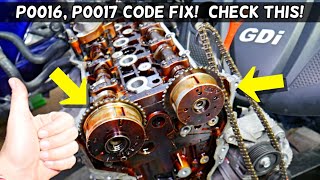
🎬 Watch: A deep dive into Palisade 3.8L GDI engine reliability.The Hyundai Palisade's 3.8L Lambda II is a Gasoline Direct Injection (GDI) engine, which is generally reliable but can be sensitive to oil quality and level. The Continuously Variable Valve Timing (CVVT) system, which this code relates to, uses oil pressure to adjust cam timing. Issues like dirty oil, failing oil control valves (OCVs), or, less commonly, timing chain stretch are known weak points in the broader Lambda V6 engine family. Some owners on Reddit have experienced this code leading to a diagnosis of a stretched timing chain or a broken CVVT phaser pin, though this is less common than OCV failure.
Symptoms You May Notice
- Check Engine Light is on
- Rough idle or stalling
- Reduced engine power and poor acceleration
- Increased fuel consumption
- Engine making rattling or tapping noises, especially on startup
- Replacing the camshaft position sensor when the oil control valve (OCV) is the actual faulty component.
- Replacing timing components when the issue is simply low or dirty engine oil.
- Immediately assuming a stretched timing chain without first testing the much more common and cheaper OCVs and sensors.
Most Likely Causes
- Low or Dirty Engine Oil 🔴 High Probability The CVVT system is entirely dependent on clean oil and proper pressure. GDI engines can be tough on oil, making regular changes with the correct filter critical. Using a non-OEM oil filter has been anecdotally linked to oil pressure issues and CVVT-related noises in the Lambda engine family.
How to confirm: Check the oil level on the dipstick and inspect its condition. If it's low, black, or sludgy, this is a likely contributor.
Typical fix: Top off or change the engine oil and replace the oil filter. Use the manufacturer-recommended oil viscosity and an OEM or equivalent quality filter. Clear codes and see if P0017 returns.
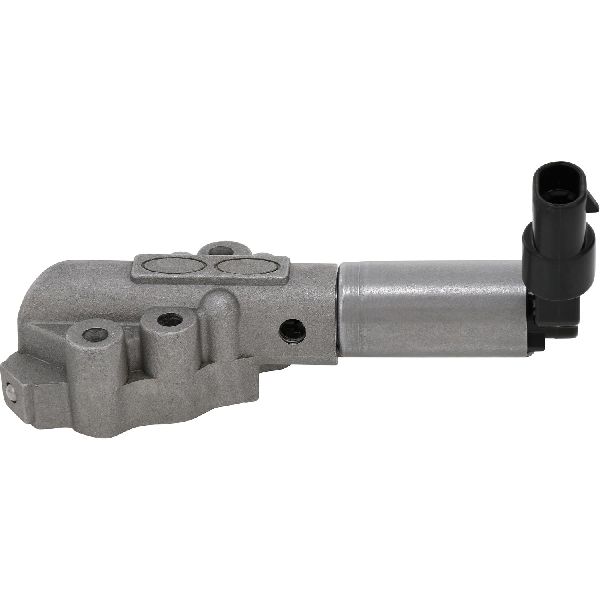
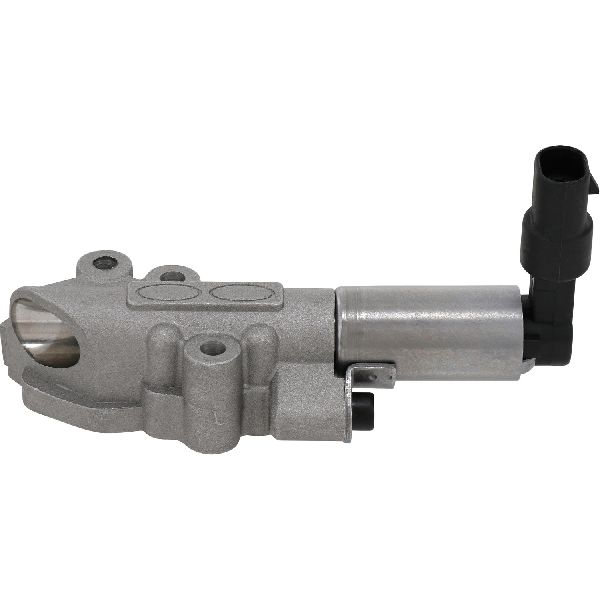
Est. part cost: $40-$80 - Failed Camshaft Oil Control Valve (OCV) 🔴 High Probability → Shop Engine Variable Valve Timing (VVT) Solenoid The OCV (also called a VVT solenoid) can get clogged with sludge or fail electronically, which is a common issue on many modern engines with VVT. It is the most frequent cause of P0017 after oil-related issues.
How to confirm: A mechanic can command the solenoid with a scan tool. A DIY method is to apply 12V power to the valve to see if it clicks audibly. The most definitive DIY test is to swap the Bank 1 and Bank 2 exhaust OCVs (they are identical and accessible) and see if the code changes to P0019 (Bank 2 Exhaust). If it does, the OCV is confirmed faulty.
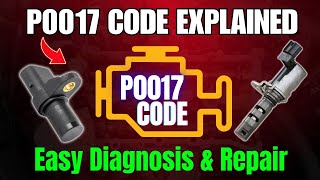
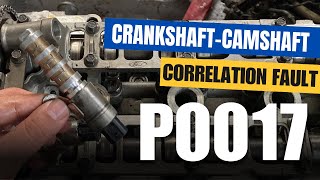
Typical fix: Replace the Bank 1 exhaust Oil Control Valve. 🎬 See this easy walkthrough for replacing the VVT solenoid. It is typically held in by a single 10mm bolt and is accessible on top of the engine's valve cover.
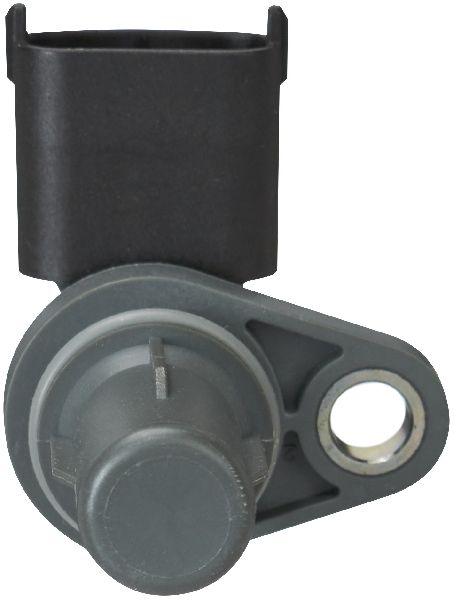
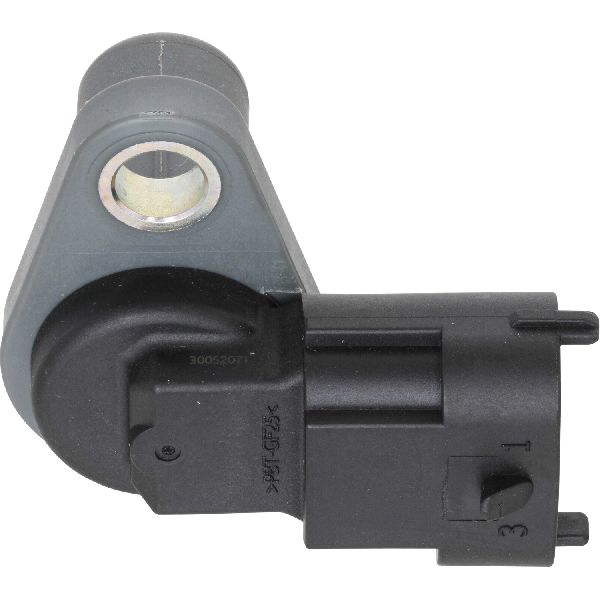
Est. part cost: $50-$120 - Failed Camshaft Position Sensor (CPS) 🟡 Medium Probability → Shop Engine Camshaft Position Sensor
How to confirm: Test the sensor's resistance with a multimeter against the manufacturer's specifications. A more definitive test is to swap the Bank 1 and Bank 2 exhaust camshaft sensors to see if the code follows and changes to P0019.
Typical fix: Replace the Bank 1 exhaust camshaft position sensor.
Est. part cost: $40-$90 - Stretched Timing Chain or Failed Tensioner ⚪ Low Probability → Shop Engine Timing Chain While less common on newer models, the Lambda V6 family has a known history of timing chain tensioner issues that can lead to chain stretch over time, especially with higher mileage or poor maintenance. This is usually preceded by a rattling noise on cold starts.
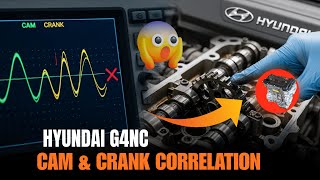
How to confirm: This is a complex diagnosis. It often starts with a rattling noise on cold starts. A mechanic must physically inspect the timing components by removing the timing cover, which requires significant engine disassembly. An oscilloscope can also be used to compare cam and crank signals to a known-good waveform to spot timing deviations.
Typical fix: Replace the timing chain, guides, and tensioners. This is a labor-intensive job.
Est. part cost: $400-$800
Rare But Worth Checking
- Failed Crankshaft Position Sensor (CKP): → Shop Engine Crankshaft Position Sensor This is less likely as a CKP failure usually causes more severe running issues or a no-start condition, but it can't be ruled out.
- Damaged CVVT Cam Phaser/Actuator: → Shop Engine Timing Gear The gear on the end of the camshaft can get stuck, fail internally, or shear its locating pin, causing a sudden and significant timing misalignment. This is usually diagnosed after all other more common causes are eliminated and may require an oscilloscope to identify the erratic cam signal.
- Wiring or Connector Issue: A damaged wire or corroded connector for the camshaft sensor or OCV can mimic a failed component. Always inspect the harness before replacing parts.
Diagnosis Steps
- Check the engine oil level and condition. Top up or change the oil and filter if necessary. Use an OEM-spec filter. Clear the code and see if it returns.
- Scan for any other DTCs that could provide more clues.
- Inspect the wiring and connectors for the Bank 1 exhaust camshaft position sensor and oil control valve for any visible damage or corrosion.
- Swap the Bank 1 exhaust OCV with the Bank 2 exhaust OCV. They are located on the valve covers and are interchangeable. Clear the codes and drive the vehicle. If the code changes to P0019 (Bank 2 Exhaust), the OCV is faulty and needs replacement.
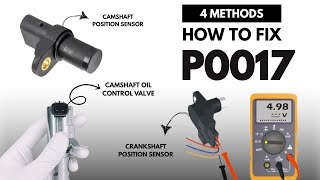
- If the code does not change, perform the same swap test with the camshaft position sensors (swap Bank 1 exhaust with Bank 2 exhaust). 🎬 Watch: How to test and fix the P0017 correlation code. If the code changes to P0019, the sensor is faulty.
- If sensors and OCVs test good, the next step is to suspect a mechanical timing issue. Listen for a rattling chain on startup. A professional diagnosis using an oscilloscope to compare cam/crank waveforms or physical inspection of the timing marks is required.
Parts You'll Likely Need
- Camshaft Oil Control Valve (VVT Solenoid)
(OEM #24375-3LAA1)— This part is a frequent failure point due to clogging from engine oil debris or electronic failure, directly causing the P0017 code.
Trusted brands: Hyundai OE, Dorman (e.g., 918-033)
OEM price range: $80-$120
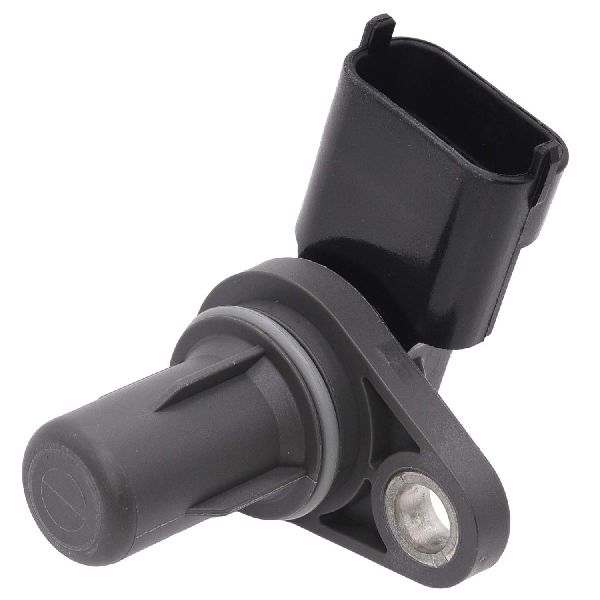
Aftermarket price range: $50-$90 - Camshaft Position Sensor
(OEM #39350-3LAA0)— This sensor provides the camshaft position data to the ECM. If it fails or sends an erratic signal, it will trigger a correlation code.
Trusted brands: Hyundai OE, Bosch, NGK/NTK
OEM price range: $60-$90
Aftermarket price range: $40-$70 - Timing Chain Kit — In less common, higher-mileage cases, the timing chain can stretch or a tensioner can fail, causing a permanent correlation fault that sensors or solenoids cannot fix.
Trusted brands: Hyundai OE
OEM price range: $400-$800
Aftermarket price range: $250-$500
Related Codes That Often Appear With This One
- P0016 — Crank/Cam correlation error for the Bank 1 *intake* camshaft. Seeing both codes together points to a more significant timing issue on Bank 1, like a jumped tooth, failing phaser, or a problem with the timing chain affecting that entire bank.
- P0018 / P0019 — These are the equivalent correlation codes for Bank 2. If you see codes for both banks (e.g., P0017 and P0019), it strongly suggests a systemic problem like a stretched timing chain, low oil pressure from a failing pump, or a faulty crankshaft sensor affecting the entire engine.
Technical Service Bulletins (TSBs) & Recalls
- TSB 23-EM-005H (NHTSA ID: 10247189): While not for P0017 directly, this TSB provides updated, important checkpoint guidelines for technicians when performing engine oil and filter changes, underscoring Hyundai's focus on proper oil service to prevent engine issues.
- TSB 23-EM-003H (NHTSA ID: 10241799): Pertains to radiator coolant leaks on 2020-2022 Palisades. While unrelated to P0017, it's a known issue for the platform. An engine that has overheated due to coolant loss can suffer oil breakdown and sludging, which could indirectly lead to CVVT system problems.
Platform-Specific Known Issues
- The 3.8L GDI engine, like other direct injection engines, can be susceptible to carbon buildup on intake valves, though this is not a direct cause of P0017, it speaks to overall engine health and the importance of quality oil and fuel.
- Some owners of vehicles with the wider Lambda II engine family have reported timing chain tensioner wear, leading to chain rattle and timing codes, though this is more of a concern at higher mileage (over 100,000 miles).
- A Reddit user with a P0017 code on a related Hyundai engine was advised by a technician that the fix often requires replacing both the exhaust CVVT gear and the exhaust camshaft itself, indicating a known failure pattern beyond just the OCV.
Mechanic-Grade Diagnostic Values
- Exhaust Oil Control Valve (OCV) Coil Resistance — expected: 6.7 - 7.7 Ohms at 20°C (68°F). Some sources state a general range of 6-12 Ohms.. Failure: A reading of infinity (open circuit), zero (short circuit), or a value significantly outside the specified range indicates a failed solenoid coil.
- Scan Tool Live Data: CVVT Timing Error — expected: The difference between 'Cam Actual Position' and 'Cam Desired Position' should be less than 20 degrees while the engine is running.. Failure: A persistent difference greater than 20 degrees will trigger the P0017 fault code and indicates a correlation problem.
Scan Tool Commands That Help
- Hyundai GDS (or equivalent professional scanner): CVVT Solenoid Actuation Test — This bidirectional test forces the OCV solenoid to operate with the engine running. A healthy component will cause the engine to stumble or stall, confirming the solenoid, oil passages, and phaser are responding. If there's no change in engine operation, it points to a failure in that circuit.
- Hyundai GDS (or equivalent professional scanner): VVT System Relearn/Reset — After replacing a CVVT component like an OCV or phaser, this function should be performed to reset learned adaptations and allow the ECM to learn the new component's characteristics.
Wiring & Ground Locations
- Bank 1 Exhaust OCV Connector — On the Bank 1 (firewall side) valve cover, connecting to the exhaust oil control valve.. The wiring harness to this connector can become brittle or damaged. A technician in one video identified the signal wires as yellow and orange, which is critical for testing for voltage and ground at the connector before condemning the OCV.
- Transmission Ground Cable — A specific ground cable for the 3.8L engine/transmission assembly.. A poor engine ground can cause a host of electrical issues and erratic sensor readings. Ensuring this ground is clean and tight is a fundamental step in diagnosing any electrical fault, including sensor correlation codes.
Real Owner Repair Stories
- Reddit r/Hyundai (Hyundai with 3.8L Lambda engine (specific model not mentioned, but failure is common to the engine family)) — P0017 code that won't clear after trying common fixes.
❌ Tried (didn't work) Implied replacement of sensors and OCVs.
✅ What actually fixed it Technician diagnosed a sheared dowel pin on the CVVT (cam phaser). The pin, which aligns the phaser to the camshaft, breaks and allows the phaser to spin independently on the camshaft, causing a loss of timing. The fix required replacing the exhaust camshaft, the exhaust CVVT phaser, the CVVT bolt, and the timing chain tensioner as a precaution. - Go-Parts article citing r/Hyundai (2014 Hyundai Santa Fe V6 (3.3L Lambda GDI, a related engine)) — Oil light on and multiple CVVT codes (P0011, P0014, P0021, P0024) appeared immediately after an oil change.
❌ Tried (didn't work) Initial diagnosis might point to simultaneous failure of all four CVVT components, which is highly unlikely.
✅ What actually fixed it The cartridge-style oil filter was installed incorrectly. This caused a massive drop in oil pressure to the entire CVVT system, triggering the codes. Correctly installing the oil filter and its housing components resolved the issue.
Documented NHTSA Reports
- An owner reported receiving code P0017 on a vehicle with 28,000 miles, noting the car appeared to have problems changing gears (NHTSA ODI #11499629).
- NHTSA ODI #11677887 describes a vehicle experiencing major engine problems and a check engine light with code P0017, which refers to crankshaft-camshaft correlation issues.
- In NHTSA ODI #11729808, an owner detailed recurring P0017 codes that required the replacement of the CVVT Assembly-Exhaust and the Timing Chain Tensioner under warranty.
- One owner reported a clanking sound while driving, which was accompanied by code P0017 and misfire codes P0302 and P0303 (NHTSA ODI #11675752).
- NHTSA ODI #11450502 notes an instance where a P0017 code was cleared after an oil change but returned within 50 miles.
OEM Part Supersession History
39350-3LAA0 (from Pass 2)→39318-3L000— Part number variation or update.
Heads up: Multiple OEM parts sites list 39318-3L000 as the correct Camshaft Position Sensor for the 2020-2024 Palisade. While 39350-3LAA0 may fit other Lambda engines, 39318-3L000 appears to be the specific part for this application. Always verify with VIN.
Model Year Variations Within This Range
- 2020-2024: No significant variations in the 3.8L Lambda II V6 powertrain or CVVT system have been identified within this model year range that would affect the diagnosis or repair of code P0017. A mid-cycle refresh in 2023 primarily involved cosmetic and feature updates, not the core engine components.
Diagnostic Flowchart
Other Known Issues on This Vehicle
Issues unrelated to this code that are worth knowing about as an owner of this generation:
- Foul Interior Odor from Headrests 🟡 Low — Common on early 2020-2021 models with Nappa leather (Limited/Calligraphy trims). Less common on newer builds after a manufacturing process change. (Ref: Hyundai addressed this via a TSB, not a recall. The fix involves dealers applying an odor-neutralizing agent or, in persistent cases, replacing the headrests.)
- Wind/Whistling Noise from Doors/Mirrors 🟡 Low — Frequently reported on 2020-2021 models at highway speeds. Multiple TSBs have been issued with evolving fixes. (Ref: Multiple TSBs exist (e.g., 19-BD-010H, 21-01-003H) which detail procedures for adding foam pads and replacing door/mirror seals to resolve the noise.)
- Tow Hitch Wiring Harness Fire Risk 🔴 High — Affects 2020-2022 models equipped with the optional factory tow hitch wiring harness. A significant number of vehicles were recalled. (Ref: Hyundai Safety Recall 235 (NHTSA 22V-633). Debris and moisture can cause a short circuit in the harness module, increasing fire risk even when parked. Owners were advised to park outside until a remedy (installing a new fuse and wire kit) was performed.)
- Radiator Coolant Leak 🟠 Medium — Affects certain 2020-2022 models, with leaks typically appearing at the bottom corners of the radiator. (Ref: TSB 23-EM-003H instructs dealers to inspect for pink coolant residue and replace the radiator assembly if a leak is confirmed.)
- Cooling Fan Runs Continuously, Draining Battery 🟠 Medium — Reported on 2020-2022 models. The fan control module, which is part of the fan assembly, can fail and cause the fan to run after the vehicle is shut off. (Ref: No specific TSB, but a widely acknowledged issue in the community. The standard fix is to replace the entire cooling fan assembly.)
Used vs. New Parts: Buying Guide for This Vehicle
When a used part is the smart pick: For repairing code P0017, using used parts is strongly discouraged. The primary culprits (OCVs, sensors, timing components) are either wear items or electronic parts where the remaining lifespan is unknown and the cost of new parts is not prohibitive compared to the labor involved.
Donor-vehicle mileage cap: roughly under 60000 miles for the part to have meaningful remaining life.
What to inspect on the donor part:
- Not applicable for this repair, as new parts are the only recommended path.
OEM-only on this vehicle (don't cheap out):
- Timing Chain
- Timing Chain Tensioners and Guides
- CVVT Cam Phaser/Actuator
Aftermarket brands forum-validated for this vehicle:
- Bosch (Sensors)
- NGK/NTK (Sensors)
- Dorman (Oil Control Valves)
Brands owners have reported issues with on this vehicle:
- Unnamed, no-brand 'white box' electronic parts from online marketplaces should be avoided due to high rates of DOA (dead on arrival) or premature failure.
Real Owner Stories
Aggregated from forums and TSBs cited above. Mileages and costs reflect what owners reported in those sources.
2020-2024 Hyundai Palisade 3.8L V6
Symptoms: The vehicle experienced a no-start condition and threw a P0017 code.
What fixed it: A technician indicated the exhaust cam was out of time, requiring a teardown to inspect for a jumped timing chain or a damaged CVVT pin.
Source hint: Reddit r/Hyundai - Thread 'Permanent Codes P0017 & P2118'
Hyundai Lambda II Engine (Related Model)
Symptoms: The P0017 code was triggered alongside excessive oil consumption.
What fixed it: The issue was ultimately covered under warranty after a lengthy process involving the manufacturer.
Source hint: Reddit r/Hyundai - Thread 'Asking for advise P0017 code'
2020-2021 Hyundai Palisade 3.8L V6 — ~115000 miles
Symptoms: Rattling noise on cold starts and timing-related codes.
What fixed it: Replacement of timing chain tensioners and components due to wear.
Source hint: palisadeforum.com and vehicle_specific_issues
Related OBD-II Codes
Frequently Asked Questions
Can I use any oil filter on my 3.8L Palisade to clear the P0017 code?
Is there a quick way to tell if the Oil Control Valve (OCV) is the problem on my Palisade?
Does the 3.8L Lambda II engine have a history of timing chain issues?
Could an overheating issue lead to this P0017 code?
Is it true that I might need to replace the entire camshaft for a P0017 code?
Will my Kia Telluride have the same P0017 issues as the Palisade?
Helpful Videos


We Have This Part in Stock

The information in this article is provided for general reference and educational purposes only. Vehicle specifications, procedures, and part compatibility can vary by production date, trim level, and region. Always consult your vehicle's factory service manual and verify part numbers before purchasing or performing repairs. Safety-critical components such as airbags, seat belts, and braking systems should be installed by a qualified professional.
- Hyundai Palisade:
- 🧭 Diagnostic Flowchart
- 🎬 Helpful Videos
- 🛍️ Shop This Part
- What's Unique About the 2020-2024 Hyundai Palisade
- Symptoms You May Notice
- Most Likely Causes
- Rare But Worth Checking
- Diagnosis Steps
- Parts You'll Likely Need
- Related Codes That Often Appear With This One
- Technical Service Bulletins (TSBs) & Recalls
- Platform-Specific Known Issues
- Mechanic-Grade Diagnostic Values
- Scan Tool Commands That Help
- Wiring & Ground Locations
- Real Owner Repair Stories
- Documented NHTSA Reports
- OEM Part Supersession History
- Model Year Variations Within This Range
- Other Known Issues on This Vehicle
- Used vs. New Parts: Buying Guide for This Vehicle
- Real Owner Stories
- 2020-2024 Hyundai Palisade 3.8L V6
- Hyundai Lambda II Engine (Related Model)
- 2020-2021 Hyundai Palisade 3.8L V6 — ~115000 miles
- Related OBD-II Codes
- Frequently Asked Questions
- 🎟️ Get 5% Off