

P0017 on 2018-2023 Mitsubishi Eclipse Cross 1.5L: Crank-Cam Correlation Causes and Fixes
For the 2018-2023 Eclipse Cross, code P0017 is often related to a known software issue mentioned in TSB TIN-20-13-001REV for 2018-2022 models. Before replacing parts, check with a dealer for a potential ECM update. If that's not the cause, the next most likely fix is replacing the exhaust oil control valve (VVT solenoid), which costs around $60-$120 for the part and requires a scan tool reset procedure afterward.
- Your first step should be to contact a Mitsubishi dealer to check if TSB TIN-20-13-001REV applies to your vehicle; a simple software update may be the only fix needed.
- Before attempting major repairs, ensure your engine oil is full, clean, and the correct type (full synthetic 0W-20). The VVT system is very sensitive to oil condition.
- The most common part to fail is the exhaust oil control valve (VVT solenoid), which is relatively inexpensive and accessible for DIY replacement.
- Do not immediately replace the camshaft or crankshaft sensors, as they are rarely the cause of a P0017 correlation code.
What's Unique About the 2018-2023 Mitsubishi Eclipse Cross
The 2018-2023 Eclipse Cross is unique for code P0017 due to a manufacturer Technical Information Notice, TIN-20-13-001REV, issued in July 2021 for 2018-2022 models. This TSB highlights that related timing codes can be triggered by software glitches, not just mechanical failures. It mandates that dealers collect extensive diagnostic data (Freeze Frame Data and ALL-DTC Data) and submit it to a Techline case for any P0010-P0017 warranty claim, showing that Mitsubishi is closely monitoring this specific issue. This makes checking the vehicle's software status at a dealership a critical and unique first step, potentially avoiding unnecessary parts replacement.
Symptoms You May Notice
- Check Engine Light illuminated
- Rough or unstable idle
- Reduced engine power and sluggish acceleration
- Increased fuel consumption
- Engine may be difficult to start
- Engine stalling, especially at low speeds
- Rattling noise from the engine on cold starts (often indicates timing chain issue)
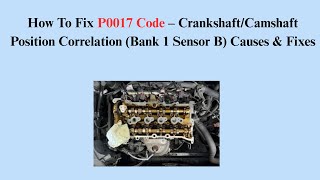
- Replacing the camshaft position sensor or crankshaft position sensor. These sensors are often not the root cause for a correlation code like P0017 on this engine, as the fault lies in the *relationship* between their signals, which usually points to a mechanical or hydraulic issue. 🎬 Watch: Understanding P0017 causes and common fixes
Most Likely Causes
- Engine Control Module (ECM) Software Issue 🔴 High Probability → Shop Engine Control Module (ECM) Mitsubishi issued TSB TIN-20-13-001REV for 2018-2022 models, indicating a known software sensitivity can falsely trigger or contribute to timing codes P0010-P0017. The TSB requires dealers to gather extensive data before performing warranty repairs, confirming this is a known issue.
How to confirm: Contact a Mitsubishi dealer and provide your vehicle's VIN. They can check if TSB TIN-20-13-001REV applies and if a software update has been performed or is available. This should be the first diagnostic step.
Typical fix: Reprogramming the ECM with the latest software version at a dealership.
Est. part cost: $0 - Faulty Exhaust Oil Control Valve (OCV) / VVT Solenoid 🟡 Medium Probability → Shop Engine Variable Valve Timing (VVT) Solenoid The VVT system relies on these solenoids to direct oil flow. They can become clogged with sludge from infrequent oil changes or fail electrically over time, which is a common failure point in many modern engines and is listed as a likely cause in Mitsubishi's own diagnostic hints. A confirmed repair story for a 2018 Eclipse Cross showed a faulty OCV was the root cause.
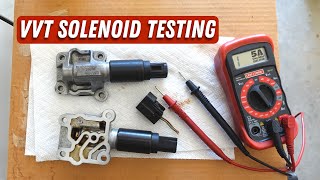
How to confirm: Remove the solenoid (located on the valve cover) and inspect its mesh screens for sludge or debris. You can test its mechanical function by applying 12V power to its terminals to see if the internal plunger clicks. A multimeter can be used to check its resistance, which should be between 6.9-7.9 ohms at 68°F (20°C). 🎬 See three easy ways to test a VVT solenoid
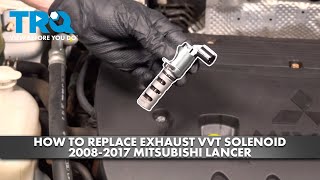
Typical fix: Replace the exhaust camshaft oil control valve. A 'Timing Chain Learned Value Reset' must be performed with a scan tool after replacement to prevent the code from returning.
Est. part cost: $60-$120 - Low or Dirty Engine Oil 🟡 Medium Probability The 4B40 engine's MIVEC (VVT) system is hydraulic and highly sensitive to oil pressure and cleanliness. Incorrect oil viscosity or extended oil change intervals can lead to sludge buildup that clogs the fine passages in the OCV and cam phasers.
How to confirm: Check the engine oil level on the dipstick. Inspect the oil's color and consistency. If it is low, very dark, or past the recommended service interval, this is a likely contributing factor.
Typical fix: Perform an engine oil and filter change using a high-quality full synthetic oil of the manufacturer-specified viscosity (e.g., 0W-20). Clear codes and drive to see if the issue is resolved.
Est. part cost: $40-$80 - Stretched Timing Chain ⚪ Low Probability → Shop Engine Timing Chain While not common on low-mileage vehicles, timing chains are a known wear item that can stretch over time, typically becoming a concern after 100,000 miles (160,000 km). A stretched chain creates a permanent timing deviation that the VVT system cannot correct. Mitsubishi's own diagnostic hints list a loose or out-of-place timing chain as a primary potential cause.
How to confirm: This requires a physical inspection by removing the valve cover or timing cover to check for chain slack and proper alignment of timing marks. A scan tool can also show the cam/crank deviation angle, which can indicate a stretch if it's consistently off. This is a labor-intensive diagnosis.
Typical fix: Replace the timing chain, tensioner, and all related guides. This is a significant and expensive repair 🎬 Watch: A mechanical review of the Eclipse Cross engine that also requires the 'Timing Chain Learned Value Reset' procedure.
Est. part cost: $300-$600
Rare But Worth Checking
- Failed Camshaft or Crankshaft Position Sensor: → Shop Engine Crankshaft Position Sensor While possible, Mitsubishi's own diagnostic logic confirms these sensors are working *before* setting a P0017 code, making them an unlikely cause. Owners and shops often replace these first, but it rarely fixes a correlation issue on this specific engine.
- Damaged Camshaft Phaser (VVT Sprocket): → Shop Engine Camshaft The sprocket that actually adjusts the cam timing can fail mechanically or become clogged with debris, but this is less common than the OCV solenoid failing. Mitsubishi lists 'Exhaust variable valve timing sprocket tooth coming off' as a possible cause.
Diagnosis Steps
- Check for TSBs: Contact a Mitsubishi dealer with your VIN to check for an available ECM software update related to TSB TIN-20-13-001REV (applies to 2018-2022 models). This should always be the first step.
- Verify Engine Oil: Check the oil level and condition. If low, dirty, or of the wrong type, perform an oil and filter change with the correct full synthetic oil. Clear the code and see if it returns.
- Scan Tool Analysis: Use an OBD-II scanner to view freeze frame data, which shows the engine conditions when the code was set. This can provide valuable clues. Also check for other pending or stored codes.
- Inspect and Test the Exhaust OCV: Remove the exhaust oil control valve (solenoid). Inspect the mesh screens for metal shavings or sludge. Test its operation by applying 12V and listening for a click. Check its resistance with a multimeter; it should be between 6.9-7.9 ohms.
- Inspect Wiring: Check the wiring harness and connector for the OCV and the camshaft/crankshaft sensors for any signs of damage, corrosion, or loose connections. Pay attention to connector B-107 (Exhaust Camshaft Position Sensor) and B-105 (Crankshaft Position Sensor).
- Perform Learned Value Reset: If you have a capable scan tool, perform the 'Timing Chain Learned Value Reset' procedure. In some cases, especially after an oil change or minor repair, resetting the learned adaptation can resolve the code.
- Mechanical Timing Inspection: If all else fails, the engine must be inspected for a stretched timing chain, worn guides, or a failed tensioner. This is an advanced step best left to a professional.
Parts You'll Likely Need
- Exhaust Engine Oil Control Valve (VVT Solenoid)
(OEM #1028A134)— This is the most common hardware component to fail or become clogged, directly causing the timing correlation issue.
Trusted brands: Mitsubishi Genuine, Hitachi, Dorman, NTK
OEM price range: $90-$150
Aftermarket price range: $50-$100 - Engine Timing Chain Kit — If the timing chain has stretched (more common on higher mileage vehicles), a complete kit including the chain, tensioner, and guides is required to restore proper base engine timing.
Trusted brands: Mitsubishi Genuine, Cloyes
OEM price range: $400-$600
Aftermarket price range: $250-$400
Related Codes That Often Appear With This One
- P0016 — This is the equivalent correlation code for the intake camshaft (Bank 1, Sensor A). If both appear, it may point more strongly toward a base timing issue like a stretched chain or jumped timing.
- P0014 — This code indicates 'Exhaust Camshaft Position Timing - Over-Advanced'. It can appear with P0017 if the OCV or phaser is stuck in a position that advances timing too much.
Technical Service Bulletins (TSBs) & Recalls
- TIN-20-13-001REV (July 2021): Titled 'DTC: P0010-P00017 Troubleshooting - Revision'. This document instructs dealers on the procedure for investigating these codes, which includes mandatory data collection (FFD, ALL-DTC data) for warranty approval, and points towards potential ECM reprogramming for related codes like P0011/P0014. According to Bulletin #TIN-20-13-001REV, this notice provides specific instructions for reprogramming the Engine Control Module pertaining to DTC P0010 - P0017.
- Bulletin #TIN-20-13-001 (October 2020): This notice was sent to dealerships to remind technicians that FFD DATA and ALL-DTC Data is required for warranty approval for all P0010 – P0017 codes.
Platform-Specific Known Issues
- A Technical Information Notice (TIN-20-13-001REV) was issued for 2018-2022 models due to the ECM's sensitivity, which can cause timing-related codes. A software update at a dealership may be the required fix.
Mechanic-Grade Diagnostic Values
- ECM Fault Setting Conditions — expected: Engine speed: 594-1,500 r/min; Engine coolant temp: 20°C-88°C (68°F-190°F); Exhaust OCV commanded 'OFF'.. Failure: These conditions must be met for the ECM to run the correlation check that sets P0017.
- Exhaust Camshaft Timing Deviation Threshold — expected: Within approx. +/- 15 degrees of crankshaft position. Some documents specify -6.0 to +14.0 degrees, or different values for California-spec vehicles.. Failure: If the deviation exceeds the specified range for 10 seconds, the code is set.
- Exhaust Oil Control Valve (OCV) Resistance — expected: 6.9 - 7.9 Ohms at 20°C (68°F). Failure: A resistance reading outside this range indicates an electrical failure in the solenoid coil.
- Crank/Cam Sensor Oscilloscope Test Points — expected: Test at terminal 3 of connector B-105 (Crankshaft) and terminal 3 of connector B-107 (Exhaust Camshaft).. Failure: A distorted, missing, or erratic waveform compared to the known-good pattern indicates a sensor or wiring issue.
Scan Tool Commands That Help
- Mitsubishi MUT-III (or equivalent professional scan tool): Timing Chain Learned Value Reset — This is required after replacing the timing chain or OCV to make the ECM relearn the base timing position and prevent the code from returning. The menu path is typically: ENGINE -> Special Function -> Reset -> Timing chain learned value reset.
- Professional Scan Tool: VVT Solenoid Actuation Test / OCV Duty Cycle Control — To functionally test the exhaust OCV without removing it. The technician can command the solenoid on and off to listen for a click and monitor changes in cam timing PIDs to confirm mechanical operation.
Wiring & Ground Locations
- B-105 — The electrical connector for the Crankshaft Position Sensor.. This is a key connection point to check for damage or corrosion when diagnosing P0017. An oscilloscope can be connected to terminal 3 to check the sensor's output waveform.
- B-107 — The electrical connector for the Exhaust Camshaft Position Sensor.. This is the primary connector for the 'Sensor B' part of the code. Check for damage here. An oscilloscope can be connected to terminal 3 to check the sensor's output waveform.
Real Owner Repair Stories
- StartMyCar.com user 'Novascoots' (2018 Mitsubishi Eclipse Cross SE 1.5L AWD, 78,000 miles) — Check Engine Light with code P0017. No rough idle or starting issues were reported.
❌ Tried (didn't work) Replaced both camshaft position sensors., Cleaned and tested the crankshaft position sensor.
✅ What actually fixed it The exhaust Oil Control Valve (VVT Solenoid) was found to be barely moving when 12V was applied. Replacing the exhaust OCV resolved the P0017 code.
OEM Part Supersession History
1028A134→N/A— This appears to be the current and original part number for the Oil Control Valve for the entire generation.
Heads up: An aftermarket seller suggests this part may be interchangeable with 1028A034, 1028354, and 10284534, but strongly recommends using 1028A134 specifically for the 4B40 engine to ensure correct flow rate and pressure thresholds.
Model Year Variations Within This Range
- 2018-2022 vs. 2023: The key Technical Service Bulletin (TIN-20-13-001REV) regarding ECM software sensitivity only lists the 2018-2022 model years. This strongly implies the software was updated from the factory for the 2023 model year, making a software-induced P0017 less likely on the newest models in the range.
Diagnostic Flowchart
Other Known Issues on This Vehicle
Issues unrelated to this code that are worth knowing about as an owner of this generation:
- Electrical and Infotainment System Glitches 🟠 Medium — Most common in the 2018-2019 model years. Complaints include frozen screens, Bluetooth connectivity failure, and spontaneous system restarts.
- CVT Transmission Hesitation and Noise 🟠 Medium — Owners report delayed acceleration, hesitation, and vibrating noises, particularly between 30,000 and 60,000 km.
- Air Conditioning System Malfunctions 🟡 Low — Reports of insufficient cooling capacity, unusual noises from the compressor, or complete failure, sometimes occurring as early as 25,000 km.
- Forward Collision Mitigation (FCM) System Errors 🔴 High — NHTSA complaints include the FCM system engaging erratically or displaying warnings without cause, which falls under the broader category of 'Safety Systems Issues'. (Ref: May be related to various software update TSBs.)
Used vs. New Parts: Buying Guide for This Vehicle
When a used part is the smart pick: For a major failure requiring engine replacement, a complete, low-mileage used 4B40 engine from a reputable salvage yard can be a cost-effective solution compared to rebuilding.
Donor-vehicle mileage cap: roughly under 60000 miles for the part to have meaningful remaining life.
What to inspect on the donor part:
- Verify the donor vehicle's VIN to confirm the model year and check for accident history.
- Ask for video of the engine running before it was pulled, if possible.
- Inspect for external signs of oil leaks, especially around the valve cover and timing cover.
- If possible, remove the oil fill cap to check for heavy sludge, which indicates poor maintenance.
OEM-only on this vehicle (don't cheap out):
- Timing Chain Kit: Given the critical nature of this component and the requirement for a 'Learned Value Reset', using a genuine Mitsubishi kit is the safest choice to ensure longevity and compatibility.
- Engine Control Module (ECM): Due to software and VIN-locking, a used ECM is often not a viable plug-and-play option and requires specialized dealer programming.
Aftermarket brands forum-validated for this vehicle:
- Hitachi (Often the OEM supplier for VVT solenoids)
- NTK (A reputable brand for engine management sensors and solenoids)
- Cloyes (A well-regarded brand for timing chain components)
Brands owners have reported issues with on this vehicle:
- No-name, unbranded VVT solenoids from online marketplaces. A confirmed repair story showed a faulty solenoid was the cause, and using a poor-quality replacement risks having the code return quickly.
Real Owner Stories
Aggregated from forums and TSBs cited above. Mileages and costs reflect what owners reported in those sources.
2018 Mitsubishi Eclipse Cross 1.5L Turbo
Symptoms: The vehicle was throwing a P0017 code and required diagnostic troubleshooting of the VVT system.
What fixed it: The root cause was identified as a faulty Exhaust Oil Control Valve (OCV), which was replaced to resolve the issue.
Source hint: Article context reference regarding a confirmed repair story for a 2018 Eclipse Cross.
Mitsubishi Outlander 1.5L Turbo
Symptoms: The owner reported a P0017 code and noted that the engine oil level was low.
What fixed it: The owner discussed official Mitsubishi troubleshooting hints which point toward oil level and software as primary factors.
Source hint: Reddit thread titled 'DTC P0017' in r/MitsubishiOutlander
Mitsubishi 4B40-equipped vehicle
Symptoms: Persistent P0017 code remained even after mechanical timing components were addressed.
What fixed it: The code was finally cleared by resetting the ECU learned values (Timing Chain Learned Value Reset) after the timing chain replacement.
Source hint: EvolutionM.net forum discussion regarding P0017 code after timing chain replacement
Related OBD-II Codes
Frequently Asked Questions
Does TSB TIN-20-13-001REV apply to my 2018-2022 Mitsubishi Eclipse Cross?
What is the specific resistance range for the Exhaust Oil Control Valve on the 4B40 engine?
Is there a specific procedure required after replacing the VVT solenoid on my Eclipse Cross?
Can low engine oil cause a P0017 code on the 1.5L Turbo engine?
At what mileage does the timing chain typically become a concern for the Eclipse Cross?
Which electrical connectors should I check for the P0017 code?
Helpful Videos


The information in this article is provided for general reference and educational purposes only. Vehicle specifications, procedures, and part compatibility can vary by production date, trim level, and region. Always consult your vehicle's factory service manual and verify part numbers before purchasing or performing repairs. Safety-critical components such as airbags, seat belts, and braking systems should be installed by a qualified professional.
- Mitsubishi Eclipse Cross:
- 🧭 Diagnostic Flowchart
- 🎬 Helpful Videos
- What's Unique About the 2018-2023 Mitsubishi Eclipse Cross
- Symptoms You May Notice
- Most Likely Causes
- Rare But Worth Checking
- Diagnosis Steps
- Parts You'll Likely Need
- Related Codes That Often Appear With This One
- Technical Service Bulletins (TSBs) & Recalls
- Platform-Specific Known Issues
- Mechanic-Grade Diagnostic Values
- Scan Tool Commands That Help
- Wiring & Ground Locations
- Real Owner Repair Stories
- OEM Part Supersession History
- Model Year Variations Within This Range
- Other Known Issues on This Vehicle
- Used vs. New Parts: Buying Guide for This Vehicle
- Real Owner Stories
- 2018 Mitsubishi Eclipse Cross 1.5L Turbo
- Mitsubishi Outlander 1.5L Turbo
- Mitsubishi 4B40-equipped vehicle
- Related OBD-II Codes
- Frequently Asked Questions
- 🎟️ Get 5% Off