

P0019 on 2007-2010 Saturn Outlook: Causes and Fixes for Timing Correlation Errors
On the 2007-2010 Saturn Outlook, code P0019 almost always indicates a stretched timing chain. This is a well-documented issue with the 3.6L V6 engine and is a serious, labor-intensive repair that should not be ignored. The root cause is often premature wear of the chain links themselves. Expect repair costs to be significant, often exceeding $1,500-$2,500.
- P0019 on a 2007-2010 Saturn Outlook is a serious code that almost certainly points to a stretched timing chain.
- Do not continue to drive the vehicle, as you risk catastrophic engine failure.
- Replacing just the sensors is a common misdiagnosis and will not fix the underlying mechanical problem.
- The repair is expensive and complex, requiring the replacement of the timing chains, tensioners, and guides with updated parts.
- To prevent future issues, use high-quality full synthetic 5W-30 oil and change it every 5,000 miles.
What's Unique About the 2007-2010 Saturn OUTLOOK
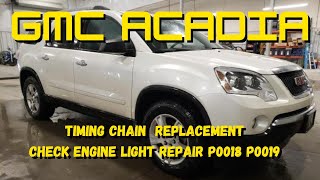
🎬 Watch: Motorweek's original review of the 2007 Saturn OutlookThe Saturn Outlook, along with its GM Lambda platform siblings (GMC Acadia, Buick Enclave, Chevrolet Traverse), uses a 3.6L V6 engine (LY7 and LLT) that is notoriously prone to premature timing chain stretching. The original timing chains used in the 2007-2009 models were particularly susceptible due to the design of the chain links, which could wear and effectively 'stretch' over time. This, combined with an often optimistic Oil Life Monitoring (OLM) system leading to longer oil change intervals, created a perfect storm for this failure. This makes P0019 a very common and serious code for these vehicles, pointing directly to this known mechanical flaw rather than a simple sensor failure.
Diagnostic Flowchart
Tap your situation to follow the diagnostic path that matches what you're seeing on this vehicle.
Symptoms You May Notice
- Check Engine Light illuminated
- Engine running rough or unstable idle
- Rattling or whining noise from the engine, especially on startup
- Hesitation or lack of power during acceleration
- Reduced fuel economy
- Engine may be hard to start or may stall
- "Service Stabilitrak", "Service Traction Control", and "Reduced Engine Power Mode" messages on the dash.
- Replacing only the Bank 2 exhaust camshaft position sensor. This will not fix a mechanical timing correlation error caused by a stretched chain.
- Replacing only the VVT solenoid. While a possible cause, it's much less likely than the primary timing chain failure on this engine.
- Performing an oil change and expecting it to fix the problem. While important, an oil change cannot reverse mechanical stretching of a timing chain.
Most Likely Causes
- Stretched Timing Chains 🔴 High Probability → Shop Engine Timing Chain As documented in GM Technical Service Bulletins like #12-06-01-009F, the 3.6L V6 engines in this era are known for premature timing chain wear. The original chains were of a design that was prone to wear, and GM later released updated, more robust chains to correct this.
How to confirm: A technician can use a scan tool to view live data for camshaft/crankshaft deviation. A significant deviation (typically more than 4-5 degrees) confirms a timing issue. Physical inspection revealing slack in the chains is the definitive confirmation.
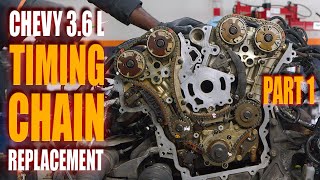
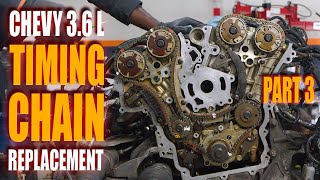
Typical fix: Replace all three timing chains, along with the tensioners, guides, and sprockets using the updated OEM parts. It is critical to use the latest revised parts from GM or a reputable aftermarket supplier like Cloyes.
Est. part cost: $300-$700 for a complete, high-quality kit - Worn Timing Chain Tensioners and Guides 🔴 High Probability → Shop Engine Timing Chain The tensioners, which rely on oil pressure, can weaken or fail, allowing the chains to become slack. The plastic guides can also wear down or break, especially if the chain has been loose for a while. This is part of the same common timing system failure.
How to confirm: Diagnosed along with the stretched chains. A rattling noise is a strong indicator of failed tensioners or guides. TSB #12-06-01-009F notes that guides should only be replaced if they show significant wear marks.
Typical fix: Always replaced as part of a complete timing chain service. A full kit will include these components.
Est. part cost: $0 (included in timing chain kit) - Low or Degraded Engine Oil 🟡 Medium Probability The camshaft phasers and timing chain tensioners are hydraulically operated. Low, dirty, or incorrect viscosity oil can impede their function and dramatically accelerate wear on the timing components. Early GM Oil Life Monitor algorithms were often too optimistic, leading to extended drain intervals that contributed to oil breakdown and sludge, exacerbating the chain wear issue.
How to confirm: Check the oil level and condition on the dipstick. If the oil is low, excessively dark, or sludgy, it is a significant contributing factor.
Typical fix: Perform an oil and filter change with a full synthetic 5W-30 oil meeting GM's Dexos specification. This is a critical preventive measure and necessary for the health of new parts, but it will not fix chains that are already mechanically stretched.
Est. part cost: $50-$100
Rare But Worth Checking
- Failed Camshaft Position Actuator Solenoid (VVT Solenoid): → Shop Engine Camshaft This solenoid controls oil flow to the camshaft phaser. It can get clogged with sludge or fail electrically. While less common than chain stretch on this platform, it's easier to check and replace before committing to a timing chain job.
- Failed Camshaft Position Sensor: → Shop Engine Camshaft Position Sensor It is rare for the sensor itself to fail in a way that causes this specific correlation code without setting a sensor-specific circuit code. Misdiagnosing a stretched chain as a bad sensor is a common and costly mistake.
- Damaged Camshaft Phaser/Actuator: → Shop Engine Camshaft The phaser is the gear on the end of the camshaft that can change its angle. It can fail mechanically, but this is usually a consequence of the larger timing system failure and a loose chain beating against the gear teeth.
- Slipped Crankshaft Reluctor Ring: → Shop Engine Crankshaft The reluctor ring (or tone ring) on the crankshaft is what the crankshaft position sensor reads. In some rare cases, this ring can slip or break, causing a timing correlation code even if the chains are perfectly fine. This is an advanced diagnosis that should only be considered after the timing chains have been verified.
Diagnosis Steps
- Verify engine oil level and condition. If low or dirty, correct this first, clear codes, and see if the code returns. This is a critical first step.
- Scan for all DTCs. Note if P0019 is accompanied by other timing codes like P0008, P0016, P0017, or P0018, which strongly suggests a base timing issue (stretched chains).
- Use a professional scan tool to monitor live data for crankshaft and camshaft desired vs. actual angles for Bank 2. A consistent deviation, especially one that increases with RPM, confirms a timing problem.
- Listen for abnormal engine noises. A rattle from the front of the engine (passenger side on the Outlook) on a cold start is a classic sign of a loose timing chain and failing tensioners.
- If data and noise point to a timing issue, the next step is to prepare for physical inspection, which involves significant engine disassembly to check timing chain slack and guide condition.
- Only after confirming base timing is correct should you diagnose sensors or solenoids. Swapping sensors is a common misdiagnosis for this specific problem on this engine.
Parts You'll Likely Need
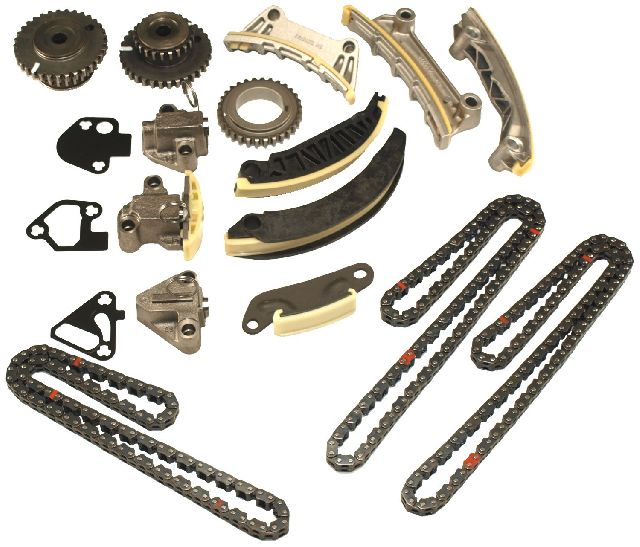
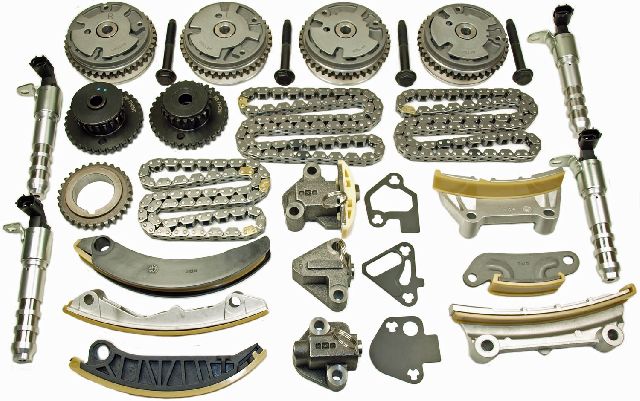
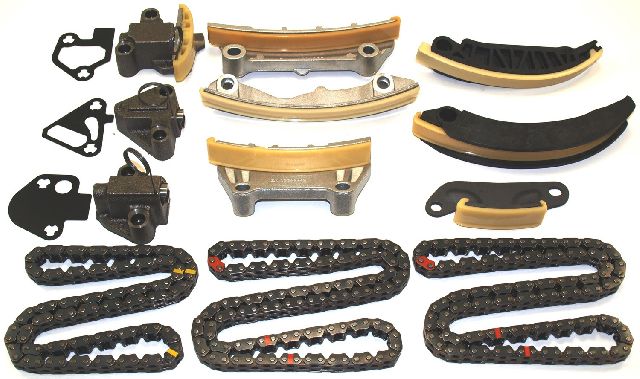
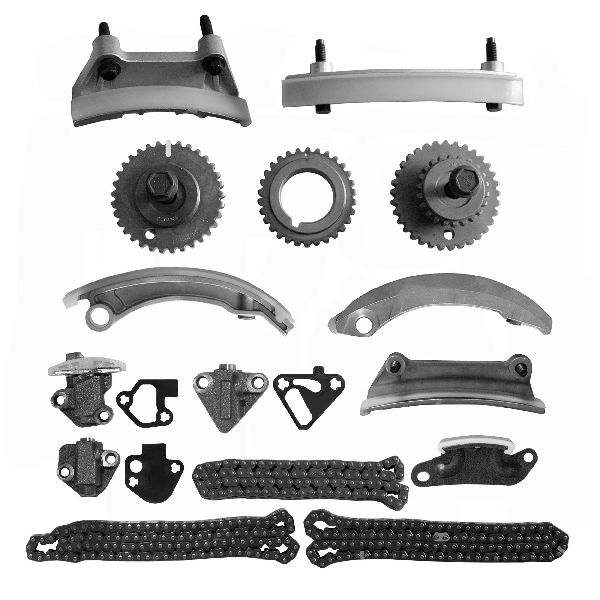
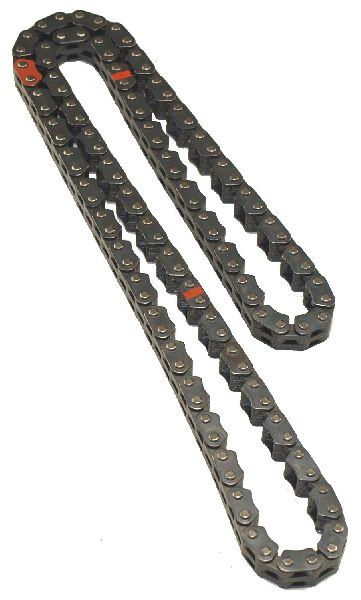
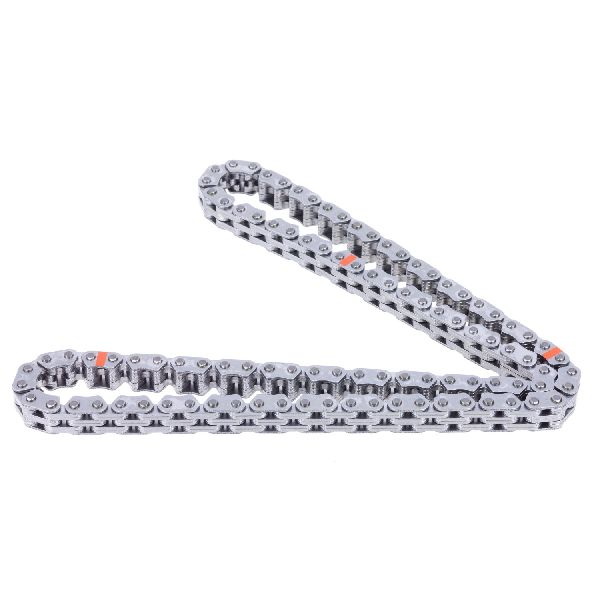
- Timing Chain Kit
(OEM #12651450 (superseded by 12700436, and later included in kits like 12693218))— This is the primary failure point. A complete kit includes all three chains, tensioners, guides, and sometimes gears, ensuring the entire system is renewed with updated, more durable parts.
Trusted brands: ACDelco (GM Original Equipment), Cloyes
OEM price range: $450-$700
Aftermarket price range: $300-$500
Related Codes That Often Appear With This One
- P0008 — Indicates a general engine position system performance error, often the first code to appear before more specific codes like P0019 are triggered.
- P0016 — Correlation error on Bank 1, Intake Cam. It's common for multiple chains to have issues, triggering codes for other positions.
- P0017 — Correlation error on Bank 1, Exhaust Cam. Often appears with other timing codes as the chains stretch.
- P0018 — Correlation error on the same bank as P0019, but for the intake camshaft ('Sensor A'). Its presence makes a shared mechanical fault, like a stretched timing chain on Bank 2, highly likely.
Technical Service Bulletins (TSBs) & Recalls
- PIP3423P: Notes that codes P0016, P0017, P0018, P0019, P0008 or P0009 may be set and directs technicians to inspect for loose timing chains or tensioners.
- 12-06-01-009F: A comprehensive bulletin detailing the timing chain issue across a wide range of GM vehicles with the 3.6L V6. It announces the availability of updated service parts.
Platform-Specific Known Issues
- Premature Timing Chain Failure: As noted in TSB #12-06-01-009F, the 3.6L V6 in 2007-2009 models was highly susceptible to stretched timing chains. While later models had some improvements, the issue can still occur. The failure is primarily due to wear in the chain links themselves.
- Optimistic Oil Life Monitor (OLM): The factory OLM settings on early models allowed for excessively long oil change intervals (often 10,000+ miles), which contributed to oil breakdown and accelerated wear on timing components. Many owners and technicians recommend changing the oil every 5,000 miles with full synthetic oil, regardless of what the OLM indicates.
- Special Coverage Adjustment 11340C: For some vehicles, GM issued a special coverage adjustment that extended the warranty for timing chain wear to 10 years or 120,000 miles. Owners of affected vehicles should check with a GM dealer to see if their VIN is covered, though this program may have expired for most of these models by now.
Mechanic-Grade Diagnostic Values
- Camshaft Position Actuator Solenoid (VVT Solenoid) Resistance — expected: 7 to 12 Ohms. Some sources state a tighter range of 6.9 to 7.9 Ohms.. Failure: A reading outside the specified range, or an open/infinite resistance, indicates a failed solenoid coil.
- Camshaft Position Sensor (CMP) 5-Volt Reference Circuit — expected: 4.8 - 5.2 Volts between the 5-volt reference circuit terminal and ground with the ignition on.. Failure: Voltage significantly higher or lower than 5V points to a short, open, or issue with the ECM.
- Camshaft Position Sensor (CMP) Signal Circuit Voltage — expected: 4.8 - 5.2 Volts between the signal circuit terminal and ground.. Failure: If voltage is higher, it may indicate a short to voltage. If lower, it may indicate a short to ground or an open circuit.
Scan Tool Commands That Help
- GDS2/Tech2 or equivalent professional scan tool: Cam/Crank Relearn — This procedure should be performed after replacing the timing chains, phasers, sensors, or the ECM. It allows the PCM to learn the new correlation between the crankshaft and camshaft positions. Failure to perform this can sometimes lead to persistent correlation codes even after a successful mechanical repair.
Wiring & Ground Locations
- Engine Block Grounds — The 3.6L engine typically has several small ground wires bolted directly to the engine block or cylinder heads. One common location is on the back side of the head.. A poor or corroded engine ground can cause erratic behavior from sensors like the camshaft and crankshaft position sensors, leading to incorrect signals being sent to the ECM. While not a primary cause, it's a foundational check.
- ECM Ground — The Engine Control Module (ECM) has its own ground connections. On a 2009 Outlook, a key ground point is G101, located on the left side of the engine.. The ECM relies on a clean ground reference to interpret sensor data correctly. A faulty ECM ground could corrupt the signals from the cam and crank sensors, potentially leading to a false correlation code.
- Main Harness Ground Bolt — There is often a 15mm ground bolt for the main harness located on the engine.. This central grounding point for the engine harness is critical. If loose or corroded, it can cause a wide range of electrical issues, including sensor faults that could trigger a P0019.
Real Owner Repair Stories
- Ford Truck Enthusiasts Forums (on a different engine, but illustrates a key failure mode) (2012 Ford 3.5L EcoBoost) — After a timing chain replacement, the vehicle had delayed acceleration, overheating, and a P0019 code.
❌ Tried (didn't work) Replacing the Camshaft Position Sensor (CPS)., Replacing the VVT solenoid.
✅ What actually fixed it The issue persisted even after a second teardown to re-time the engine. The user discovered the camshaft phaser itself was put on wrong initially. Although they corrected the phaser alignment, the code returned, indicating the initial mis-installation may have damaged the new phaser or that another underlying issue was present. This highlights the complexity and sensitivity of phaser installation during a timing job. - Chevrolet Forum (2009 Chevrolet Equinox 3.6L) — Persistent Bank 2 intake camshaft correlation code after replacing chains, phasers, tensioners, and guides.
❌ Tried (didn't work) Replacing timing chains, phasers, tensioners, and guides., Replacing VVT solenoids., Replacing tensioners with new GM parts., Replacing chains with new GM parts.
✅ What actually fixed it The user noticed excessive 'wiggle' in the new aftermarket intake cam phaser. After replacing the aftermarket phasers with genuine GM phasers, the excessive movement was reduced, though slight rotational play was noted as normal. The final resolution was not posted, but the strong implication was that the aftermarket phaser was the source of the persistent code. This underscores the importance of using high-quality or OEM phasers, as even new aftermarket parts can be faulty.
Model Year Variations Within This Range
- 2007-2008: These models exclusively used the 3.6L LY7 V6 engine, which features standard multi-port fuel injection. These early LY7 engines are the most cited for premature timing chain stretch.
- 2009: For the 2009 model year, the Saturn Outlook was upgraded to the 3.6L LLT V6 engine. The primary difference is the introduction of direct injection (DI). While based on the LY7, the LLT has a higher compression ratio (11.3:1 vs 10.2:1) and different pistons. While the timing chain issue was still prevalent in early LLT engines, some internal components differ from the LY7.
- 2010: The 2010 model year continued with the 3.6L LLT V6. A small number of 2010 Outlooks were produced to use up remaining parts before the Saturn brand was discontinued.
Helpful Videos



We Have This Part in Stock

The information in this article is provided for general reference and educational purposes only. Vehicle specifications, procedures, and part compatibility can vary by production date, trim level, and region. Always consult your vehicle's factory service manual and verify part numbers before purchasing or performing repairs. Safety-critical components such as airbags, seat belts, and braking systems should be installed by a qualified professional.
- Saturn OUTLOOK:
- 🧭 Diagnostic Flowchart
- 🎬 Helpful Videos
- 🛍️ Shop This Part
- What's Unique About the 2007-2010 Saturn OUTLOOK
- Symptoms You May Notice
- Most Likely Causes
- Rare But Worth Checking
- Diagnosis Steps
- Parts You'll Likely Need
- Related Codes That Often Appear With This One
- Technical Service Bulletins (TSBs) & Recalls
- Platform-Specific Known Issues
- Mechanic-Grade Diagnostic Values
- Scan Tool Commands That Help
- Wiring & Ground Locations
- Real Owner Repair Stories
- Model Year Variations Within This Range
- 🎟️ Get 5% Off