

P0021 on 2012-2019 Buick LaCrosse: Causes, Fixes, and Parts
For a Buick LaCrosse with a P0021 code, the most common fixes are replacing a faulty camshaft position actuator solenoid or performing an ECM reprogram as specified in manufacturer TSBs. Always check for low or dirty engine oil first, as this is a simple, frequent cause. A solenoid replacement costs around $40-$80 for the part.
- P0021 on a Buick LaCrosse means the Bank 2 intake camshaft timing is too far advanced.
- Before buying any parts, check your engine oil. Low or dirty oil is the most common and cheapest-to-fix cause.
- The most likely failed part is the camshaft position actuator solenoid for the Bank 2 intake.
- Check for open TSBs. Your vehicle may only need an ECM software update from a GM dealer, not a mechanical repair.
- This code is often seen with P0011, P0014, and P0024, which can help narrow down the cause.
What's Unique About the 2012-2019 Buick LACROSSE
For this generation of Buick LaCrosse, particularly those with the 3.0L and 3.6L V6 engines (LFX and LGX), General Motors has issued multiple Technical Service Bulletins (TSBs) that are highly relevant to P0021. These bulletins suggest that the cause is not always a mechanical part failure. In many cases, especially on 2018 models with the 3.6L LGX V6, the issue is related to the Engine Control Module (ECM) software logic during auto stop/start events, and the prescribed fix is an ECM reprogram. This makes it crucial to check for software updates before replacing more expensive hardware like camshaft phasers. Additionally, earlier 3.6L V6 engines had known issues with timing chain stretch, which can also trigger this code.
Diagnostic Flowchart
Tap your situation to follow the diagnostic path that matches what you're seeing on this vehicle.
Generation note: This range covers the end of the second generation (2012-2016) and the entire third generation (2017-2019) LaCrosse. The second-gen often used the 2.4L I4 and 3.6L LFX V6, while the third-gen used a 2.5L I4 and the 3.6L LGX V6. While the causes are similar, the TSBs regarding ECM reprogramming are particularly relevant for the 2018 3.6L LGX V6. The earlier LFX V6 engines are more noted for timing chain stretch issues.
Symptoms You May Notice
- Check Engine Light is on
- Engine runs rough or idles poorly
- Engine may stall, especially when stopped or at idle
- Reduced engine power or hesitation during acceleration
- Decreased fuel economy
- Rattling or knocking noise from the engine, especially on startup
- Hard starting, where the engine cranks longer than usual
- Replacing the camshaft position sensor when the issue is the actuator solenoid.
- Replacing camshaft phasers or timing chains before verifying oil quality, solenoid function, or checking for required ECM updates.
- Ignoring TSBs that point to a simple software fix, leading to unnecessary and expensive hardware replacement.
Most Likely Causes
- Low or Dirty Engine Oil 🔴 High Probability The Variable Valve Timing (VVT) system is entirely dependent on clean engine oil at the correct pressure to adjust camshaft timing. If the oil is low, dirty, sludgy, or the wrong viscosity, the actuator solenoids and phasers cannot function correctly, causing them to stick or respond slowly.
How to confirm: Check the engine oil level and condition using the dipstick. If the oil is low, black, or sludgy, it needs to be changed. This is the first and most important check.
Typical fix: Perform an oil and filter change using the manufacturer-specified oil viscosity (e.g., SAE 5W-30 dexos1 approved for many GM engines).
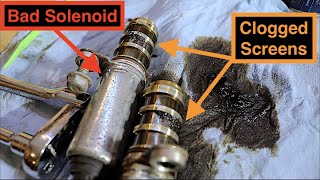
Est. part cost: $40-$80 - Faulty Camshaft Position Actuator Solenoid (VVT Solenoid) 🔴 High Probability → Shop Engine Camshaft These solenoids can become clogged with debris from dirty oil or fail electrically over time, causing them to stick internally. This prevents them from accurately controlling oil flow to the cam phaser.
How to confirm: You can test the solenoid's resistance with a multimeter (should be within a specific range, often 7-12 ohms). Applying 12V power should cause the internal plunger to audibly click or move. A common diagnostic trick is to swap the Bank 2 intake solenoid with the Bank 2 exhaust solenoid (if they are identical parts) and see if the code changes to P0024. If it does, the solenoid is confirmed bad.
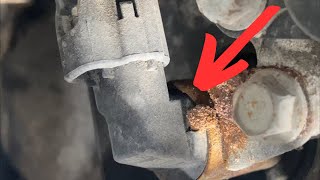
Typical fix: Replace the Bank 2 intake camshaft position actuator solenoid. 🎬 Watch: 3.6L V6 solenoid location and replacement walkthrough Many owners replace both intake and exhaust solenoids on the affected bank at the same time as a preventative measure.
Est. part cost: $40-$80 - Engine Control Module (ECM) Software Issue 🟡 Medium Probability → Shop Engine Control Module (ECM) As per GM TSBs #N192266190 and #N192266190 02, an issue in the ECM software can cause this code to set on 2018 models, often accompanied by rough running or stalling after an auto-stop/start event.
How to confirm: A GM dealership or a qualified shop with access to GM's TIS2Web programming tools can check if your vehicle's VIN is affected and if the ECM has the latest software version.
Typical fix: Reprogram the Engine Control Module (ECM) with the updated software. According to the TSB, no parts are required for this specific fix.
Est. part cost: $0-$200 (dealer labor, may be covered under warranty)
Rare But Worth Checking
- Stretched Timing Chain: → Shop Engine Timing Chain While less common than solenoid failure, the 3.6L V6 engines in earlier models (primarily pre-2016 LFX) had known issues with timing chain stretch. This is often caused by extended oil change intervals and results in a correlation mismatch between the crank and cam sensors. Symptoms often include a startup rattle. The later LGX engine has a revised timing system that is less prone to this issue.
- Failed Camshaft Phaser: → Shop Engine Camshaft The phaser is the mechanical gear at the end of the camshaft that the solenoid acts upon. It can fail mechanically by getting stuck in an advanced position due to sludge or internal failure, but this is less common than a solenoid or oil issue. This is a much more involved and expensive repair.
- Faulty Camshaft Position Sensor: → Shop Engine Camshaft Position Sensor This sensor reports the camshaft's position to the ECM. While it can fail, it's more likely to trigger its own specific sensor circuit codes (like P0346) rather than a performance/correlation code like P0021. Misdiagnosing this is common.
- Clogged Oil Passages: In cases of severe oil sludging, the small oil passages leading to the VVT solenoids and cam phasers in the cylinder head can become blocked, starving the components of the oil pressure needed to operate. This usually requires significant engine cleaning or disassembly.
Diagnosis Steps
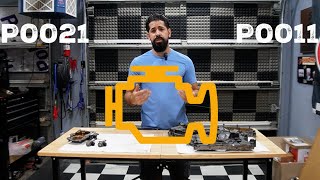
- Check Engine Oil: Verify the oil level is correct and the oil is clean and of the proper viscosity (dexos1 approved). If low or dirty, perform an oil and filter change. This is the first and most critical step. 🎬 See this guide on fixing P0021 and P0011 codes
- Scan for Other Codes: Use an OBD-II scanner to check for any other stored codes that could provide more context, such as codes for the exhaust cam (P0024) or the other bank (P0011).
- Check for TSBs: Contact a GM dealer or use a professional database to check if TSBs #N192266190 (for 2018 models) or #PIP5096C apply to your VIN. An ECM reprogram or specific solenoid replacement might be the required fix.
- Inspect Wiring: Check the wiring and connector for the Bank 2 intake camshaft position actuator solenoid for any damage, corrosion, or loose connections.
- Test the Solenoid: Swap the intake and exhaust solenoids on Bank 2 (they are often identical parts, P/N 12655420 and 12655421 for the 2.4L). Clear the codes and drive. If the code changes to P0024 (Exhaust Camshaft), the solenoid is confirmed faulty and needs replacement. Alternatively, apply 12V to the solenoid terminals to check for an audible click.
- Advanced Diagnostics: If the above steps don't resolve the issue, further diagnosis is needed. This involves checking cam/crank correlation with a lab scope to look for a stretched timing chain, or measuring oil pressure at the cylinder head to check for blockages. This level of diagnosis may require professional help.
Parts You'll Likely Need
- Intake Camshaft Position Actuator Solenoid
(OEM #12655420 (for 2.4L), 12679099 (supersedes 12655420))— This solenoid controls oil flow to the cam phaser and is a very common failure point, either by sticking from sludge or failing electrically. It is often the primary cause of P0021. Part number 12679099 is an updated part number for the 2.4L engine. 🎬 Watch: Easy DIY solenoid replacement for 2.4L engines
Trusted brands: ACDelco, Delphi
OEM price range: $50-$90
Aftermarket price range: $30-$60 - Exhaust Camshaft Position Actuator Solenoid
(OEM #12655421 (for 2.4L), 12679100 (supersedes 12655421))— Often replaced at the same time as the intake solenoid as a preventative measure, since they are subjected to the same conditions and wear. It is the cause for the related P0024 code. Part number 12679100 is an updated part number for the 2.4L engine.
Trusted brands: ACDelco, Delphi
Related Codes That Often Appear With This One
- P0011 — This is the equivalent code for Bank 1 ('A' Camshaft Position - Timing Over-Advanced). Seeing both P0011 and P0021 together strongly indicates a systemic issue affecting the whole engine, such as low oil pressure, incorrect oil viscosity, or an ECM problem.
- P0024 — This is for the 'B' (Exhaust) camshaft on the same bank (Bank 2). If P0021 and P0024 appear together, it suggests an issue common to Bank 2, such as oil flow to that cylinder head or a problem with the timing on that bank.
- P0008 or P0009 — These are engine position performance codes. P0008 indicates a bank 1 issue, while P0009 indicates a bank 2 issue. Seeing these alongside P0021 can be a strong indicator of a stretched timing chain, as the ECM is detecting a general misalignment between the crankshaft and camshafts on one or both banks.
Technical Service Bulletins (TSBs) & Recalls
- N192266190 02: Recommends ECM reprogram for rough running, reduced power, or stall with DTCs P0011, P0021, P0014, and P0024 on certain 2018 models with the 3.6L V6.
- N192266190: Similar to the above, points to an ECM reprogram as the fix for drivability concerns related to these codes after an auto stop/start event.
- PIP5568E: Notes an investigation into these codes setting together or in pairs.
- PIP5096C: Instructs technicians to check the engine EUN sticker on certain models; if marked with an 'A', replace the solenoid with an updated part rather than swapping for diagnosis.
Platform-Specific Known Issues
- Multiple TSBs (#N192266190, #PIP5568E, #PIP5096C) have been issued by GM for the 2012-2019 model years concerning codes P0021, P0011, P0014, and P0024.
- TSB #N192266190 02 explicitly states that for 2018 models with the 3.6L V6 experiencing rough running, reduced power, or stalling with these codes, the fix is to reprogram the Engine Control Module (ECM). This TSB also applies to the Buick Enclave, Cadillac XT5, and Chevy Traverse.
- TSB #PIP5096C applies to earlier models and notes that if these codes appear without other drivability issues, a technician should inspect the engine's EUN sticker. If it has an 'A' before the sequence number, the oil control valve (solenoid) should be replaced with an updated service part, and swapping solenoids for diagnosis is discouraged in this specific case.
Mechanic-Grade Diagnostic Values
- Camshaft Position Actuator Solenoid internal resistance — expected: 5-12 Ohms. Failure: A reading outside this range, or a reading that fluctuates wildly when wiggling the connector, indicates a faulty solenoid.
- Scan Tool Live Data: Camshaft Position Variance — expected: Less than 2-3 degrees at idle. Failure: If the variance between the desired and actual camshaft position angle is greater than 5 degrees for more than a few seconds, the DTC will set.
- VVT Solenoid Control Circuit Voltage — expected: Battery voltage on the power supply pin with ignition on.. Failure: Less than battery voltage on the supply circuit indicates an open or high resistance in the wiring.
Scan Tool Commands That Help
- GDS2 / Tech2 (or equivalent professional scan tool): Camshaft Position Actuator Solenoid Control — This bidirectional command allows a technician to command the solenoid ON and OFF (or to a specific degree of advance) while the engine is running. If commanding the solenoid causes the engine to hesitate or stall, it confirms the solenoid and phaser are mechanically responding. If there is no change in engine operation, it points to a stuck solenoid, a clogged oil passage, or a failed phaser.
- GDS2 / Tech2 (or equivalent professional scan tool): View Camshaft Position Variance Parameter — While commanding the actuator from 0 to 20 degrees, this parameter should show a variance of less than 2 degrees. A value greater than this indicates a mechanical issue with the camshaft phaser itself, not the solenoid.
Wiring & Ground Locations
- Engine to Chassis/Bellhousing Ground — There are major ground terminals that attach to the rear of the passenger side cylinder head and to a bellhousing bolt. Another key ground is from the battery negative terminal directly to the chassis near the battery tray.. A poor engine ground can cause erratic behavior in all engine sensors, including the camshaft and crankshaft position sensors and their actuators. Voltage fluctuations and high resistance in the ground circuit can lead the ECM to receive incorrect data, potentially triggering false performance codes like P0021.
- VVT Solenoid Connector — On the 3.6L V6, the Bank 2 (front) solenoids are on the driver's side of the front cylinder head. The intake solenoid connector is often gray, while the exhaust is black. On some models, the wire colors are Brown (BN) and Tan (TN).. This is the direct connection point for testing. Knowing the location and wire colors is essential for performing resistance and voltage checks without swapping parts. The connector itself can also be a point of failure due to corrosion or loose pins.
Real Owner Repair Stories
- Forum User Experience (2012 Buick LaCrosse 2.4L) — Check Engine Light with code P0021.
❌ Tried (didn't work) Initial diagnosis pointed to the solenoid.
✅ What actually fixed it The owner swapped the Bank 2 intake solenoid (gray connector) with the Bank 2 exhaust solenoid (black connector). After clearing the codes and driving, the trouble code changed to P0024 (Exhaust Camshaft Position Performance). This confirmed the original intake solenoid was faulty. Replacing the intake solenoid with a new part (ACDelco P/N 12655420) resolved the issue permanently.
OEM Part Supersession History
12655420→12679099— Updated design by the manufacturer (GM/ACDelco) for improved reliability or manufacturing process.12655421→12679100— Updated design by the manufacturer (GM/ACDelco) for improved reliability or manufacturing process.12628347 (Intake)→12655420— Earlier part number for the same component on 2.0L, 2.2L, and 2.4L engines.12628348 (Exhaust)→12655421— Earlier part number for the same component on 2.0L, 2.2L, and 2.4L engines.
Model Year Variations Within This Range
- 2012-2016 (LFX Engine): These earlier 3.6L V6 engines are more commonly associated with stretched timing chains as a cause for P0021, especially if oil change intervals were extended. A startup rattle is a key symptom to watch for.
- 2018 (LGX Engine): As noted in TSB #N192266190, these models can set P0021 due to an ECM software glitch related to the auto stop/start system. The primary recommended fix from the manufacturer is an ECM reprogram, not hardware replacement.
Helpful Videos

We Have This Part in Stock

The information in this article is provided for general reference and educational purposes only. Vehicle specifications, procedures, and part compatibility can vary by production date, trim level, and region. Always consult your vehicle's factory service manual and verify part numbers before purchasing or performing repairs. Safety-critical components such as airbags, seat belts, and braking systems should be installed by a qualified professional.
- Buick LACROSSE:
- 🧭 Diagnostic Flowchart
- 🎬 Helpful Videos
- 🛍️ Shop This Part
- What's Unique About the 2012-2019 Buick LACROSSE
- Symptoms You May Notice
- Most Likely Causes
- Rare But Worth Checking
- Diagnosis Steps
- Parts You'll Likely Need
- Related Codes That Often Appear With This One
- Technical Service Bulletins (TSBs) & Recalls
- Platform-Specific Known Issues
- Mechanic-Grade Diagnostic Values
- Scan Tool Commands That Help
- Wiring & Ground Locations
- Real Owner Repair Stories
- OEM Part Supersession History
- Model Year Variations Within This Range
- 🎟️ Get 5% Off