

P0021 on 2015-2019 Ford Transit 3.5L EcoBoost: Causes and Fixes for Over-Advanced Timing
On a 2015-2019 Ford Transit with the 3.5L EcoBoost V6, code P0021 is most often caused by low or dirty engine oil, or a faulty Variable Camshaft Timing (VCT) solenoid on Bank 2 (driver's side). Replacing the VCT solenoid is a common DIY fix costing around $30-$70 for the part. Always start by checking the oil, as 5,000-mile oil change intervals are critical for this engine's timing system health.
- Always check your engine oil level and condition first. Low or dirty oil is the most common cause of P0021 on this engine.
- The most likely failed part is the Bank 2 (driver's side) intake VCT solenoid. It is relatively inexpensive and accessible.
- A simple diagnostic trick is to swap the Bank 2 and Bank 1 intake solenoids; if the code changes to P0011, you have confirmed the solenoid is faulty.
- Do not immediately assume a major mechanical failure like a stretched timing chain unless you also hear a distinct startup rattle or have other correlating trouble codes like P0018.
What's Unique About the 2015-2019 Ford Transit
The 3.5L EcoBoost V6 engine relies heavily on its Variable Camshaft Timing (VCT) system for both power and efficiency. This system uses engine oil pressure to adjust the camshafts. Ford has issued multiple Technical Service Bulletins (TSBs) acknowledging that the VCT system is highly sensitive to oil quality, level, and maintenance schedules. Specifically, TSBs like SSM 47170 and SSM 50067 note that small debris in the oil can cause the VCT solenoids to stick, making oil-related issues and solenoid failure the most common culprits for this code on the Transit. Many owners and mechanics strongly recommend 5,000-mile oil change intervals to prevent sludge that leads to these failures.
Symptoms You May Notice
- Check Engine Light is on
- Rough or poor idling
- Hesitation or loss of power during acceleration
- Engine stalling at stops
- Reduced fuel economy
- Engine may be hard to start
- Rattling noise from the engine, especially on cold startup (can be phasers or just a VCT solenoid)
- Replacing the camshaft position sensor. While a sensor can fail, it's much less common for this code than a VCT solenoid or oil issue. A failing sensor will typically set a specific sensor circuit code (e.g., P0345 or P0349).
- Immediately assuming a cold start rattle requires a full timing chain and phaser job. The 'Truck Lab' YouTube channel documented a case on a 2019 F-150 3.5L where P0021 and a cold start rattle were both fixed simply by replacing the faulty VCT solenoid.
Most Likely Causes
- Low or Dirty Engine Oil 🔴 High Probability The VCT system is operated by oil pressure, making it extremely sensitive to oil level and cleanliness. Neglecting oil changes or extending intervals beyond 5,000-6,500 miles can lead to sludge and debris that clog the VCT solenoids and oil passages.
How to confirm: Check the engine oil level on the dipstick and inspect its color and consistency. If the oil is low, black, or sludgy, it needs to be changed.
Typical fix: Perform an engine oil and filter change using the correct viscosity oil (SAE 5W-30 for the 3.5L EcoBoost) and a quality filter, such as the Motorcraft FL-500S. Clear codes and see if P0021 returns.
Est. part cost: $40-$80 - Faulty Bank 2 Intake VCT Solenoid 🔴 High Probability → Shop Engine Variable Valve Timing (VVT) Solenoid Ford TSBs SSM 47170 and SSM 50067 specifically state that debris can cause the VCT solenoid to stick, which is a known issue on these engines. TSB 16-0093 also points to solenoid replacement for this code on low-mileage vehicles. Internal components of the solenoid can break and jam the spool valve.
How to confirm: A good diagnostic test is to swap the Bank 2 intake solenoid with the Bank 1 intake solenoid (passenger side). Clear the codes and drive the vehicle. If the code changes to P0011 (the Bank 1 equivalent), the solenoid is confirmed to be faulty. Alternatively, a scan tool can be used to command the solenoid and monitor cam angle response; TSB SSM 50067 suggests cycling the solenoid 10 times to try and clear debris.
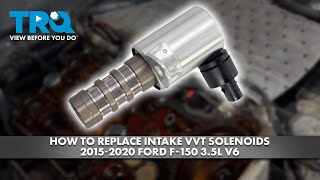
Typical fix: Replace the Bank 2 (driver's side) intake VCT solenoid. It is often recommended to replace all four VCT solenoids (intake and exhaust for both banks) 🎬 See this step-by-step guide to replacing your intake solenoids. at the same time. The intake and exhaust solenoids may have different colored connectors for identification.
Est. part cost: $30-$70 per solenoid
Rare But Worth Checking
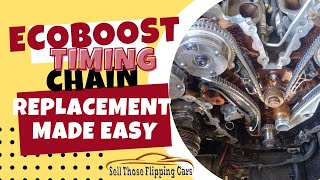
- Stretched Timing Chain: → Shop Engine Timing Chain This is a known issue on higher-mileage 3.5L EcoBoost engines. A key symptom is a distinct 'cold start rattle' that lasts for a few seconds. This is a major mechanical repair that requires professional service and can cost over $3,000. 🎬 Watch: A professional walkthrough of the EcoBoost timing chain replacement.
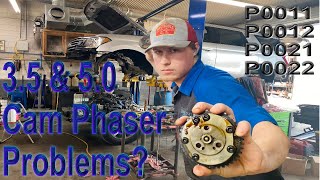
- Failed Camshaft Phaser: → Shop Engine Camshaft The phaser (the gear on the end of the camshaft) can get stuck in the advanced position due to internal failure or oil sludge. This is a more involved and expensive repair than a solenoid replacement, often performed at the same time as a timing chain.
Diagnosis Steps
- Check Engine Oil: Verify the oil level is correct and the oil is clean. If low or dirty, perform an oil and filter change with 5W-30 synthetic blend or full synthetic oil. This is the most important and cheapest first step.
- Inspect VCT Solenoid Wiring: Check the wiring harness and connector for the Bank 2 (driver's side) intake VCT solenoid for any damage, corrosion, or loose connections.
- Scan Tool Diagnosis: Use a scan tool like FORScan to monitor live data. Graph the PIDs for desired vs. actual camshaft angle (RCAM_DSD vs RCAM) and the cam error (VCT_INT_DIF2). A large, persistent error indicates a problem. Use the scan tool's bidirectional controls to cycle the solenoid 10 times to see if it clears debris, as suggested by Ford's TSBs.
- Test the VCT Solenoid: The most common DIY test is to swap the Bank 2 intake solenoid with the Bank 1 intake solenoid. Clear the codes and drive. If the trouble code moves to Bank 1 (P0011), the solenoid is bad and needs replacement.
- Check for TSBs: Check for any applicable Technical Service Bulletins (TSBs) for your vehicle's VIN. TSB 16-0093 applies to some 2016 models with this code at low mileage. Additionally, Bulletin #SSM 54366 notes that vehicles may exhibit an illuminated MIL with DTC P0021 and directs technicians to Pinpoint test HK in the PC/ED manual.
- Mechanical Inspection: If the steps above do not resolve the issue, a more in-depth mechanical inspection is needed. Listen for a cold-start rattle. This level of diagnosis involves checking for a stretched timing chain, failed timing chain tensioners, or a faulty camshaft phaser and is best left to a professional.
Parts You'll Likely Need
- Variable Camshaft Timing (VCT) Solenoid
(OEM #AT4Z-6M280-B)— This solenoid is the most common part to fail, often getting stuck due to oil debris, as documented in Ford TSBs and numerous owner forums.
Trusted brands: Motorcraft, Dorman
OEM price range: $50-$85
Aftermarket price range: $30-$60 - Engine Oil and Filter
(OEM #Motorcraft FL-500S)— Incorrect, low, or dirty oil is a primary cause of all VCT system faults and can trigger code P0021 by itself.
Trusted brands: Motorcraft, Mobil 1, Pennzoil
OEM price range: $40-$60
Aftermarket price range: $30-$50
Related Codes That Often Appear With This One
- P0011 — This is the equivalent code for Bank 1. If you swap a faulty Bank 2 solenoid to Bank 1 for diagnosis, P0021 will be replaced by P0011.
- P0018 — This code indicates a Crankshaft/Camshaft correlation error on Bank 2. Seeing it with P0021 strongly points towards a timing issue on Bank 2 and can be caused by a stuck solenoid, a bad phaser, or a stretched timing chain.
- P0022 — This is for an 'over-retarded' condition on Bank 2. Seeing P0021 and P0022 together can indicate a very erratic VCT solenoid that is sticking in both directions or a severe mechanical timing problem.
Technical Service Bulletins (TSBs) & Recalls
- TSB 16-0093: For some 2016 models (Transit, F-150, Explorer, etc.) with the 3.5L engine and less than 2,000 miles, recommends replacing the affected VCT solenoid for codes P0011, P0021, P0018, etc.
- Bulletin #16-0038: Specifically addresses 2016 Transit vehicles equipped with a 3.5L GTDI engine under 3200 km (2000 miles) that exhibit an illuminated MIL with DTC P0021.
- SSM 47170 / SSM 50067: Note that small debris can cause the VCT solenoid to stick, leading to this code. Recommends attempting to clear debris by cycling the solenoid with a scan tool before replacement.
- Bulletin #SSM 54366: Confirms that Ford and Lincoln vehicles may exhibit an illuminated MIL with DTC P0021 and suggests following Pinpoint test HK in the Powertrain Control and Emissions Diagnosis (PC/ED).
Platform-Specific Known Issues
- TSB 16-0093 was issued for some 2016 Transit models with the 3.5L GTDI engine that may exhibit P0021 (and other related codes) at very low mileage (under 2,000 miles), recommending solenoid replacement.
- Ford Service Bulletins SSM 47170 and SSM 50067 acknowledge that P0021 can be caused by small debris causing the VCT solenoid to stick, and advise against replacing major components before diagnosing the solenoid and oil condition. SSM 50067 suggests using a scan tool to cycle the solenoid 10 times to attempt to clear the debris.
- Bulletin #SSM 47170 specifically notes that before attempting any component diagnosis or replacement for P0021, technicians should consider that small debris may be causing the VCT solenoid to stick.
Mechanic-Grade Diagnostic Values
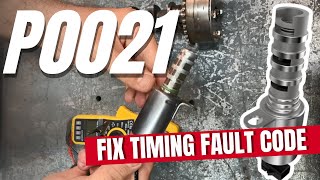
- VCT Solenoid Resistance — expected: 6.9 - 7.9 Ohms at 68°F (20°C). Some sources state a broader but acceptable range of 5-15 Ohms.. Failure: A reading of 0 Ohms (short circuit), infinite/O.L. (open circuit), or a value significantly outside the expected range indicates a faulty solenoid coil.
- FORScan/IDS Live Data PID: VCT_INT_DIF2 — expected: Should be close to 0 degrees at warm idle. A variance of +/- 5 degrees for a short time is considered acceptable.. Failure: A large, persistent positive value (e.g., greater than +6 degrees at idle) indicates the cam is over-advanced and can point to a stuck solenoid, phaser, or stretched chain.
- VCT Solenoid Connector Voltage — expected: Should show battery voltage (approx. 12V) on one pin with the key on, engine off. The other pin is the ground control from the PCM.. Failure: No voltage indicates a wiring or fuse issue upstream of the solenoid. A constant ground on the control wire could indicate a short or a failed PCM driver.
Hidden / Shadow Codes Worth Checking
- Mode 6, Test ID $81: This is not a shadow code, but a diagnostic test monitor for the Variable Camshaft Timing (VCT) system. It tracks statistical data on cam position errors. Technicians can use this data in dealer-level tools like IDS to see if the error rate is approaching the threshold that sets a DTC, even before the light comes on. (see via Ford IDS (Integrated Diagnostic System) or advanced scan tools capable of displaying Mode 6 data.)
Scan Tool Commands That Help
- Ford IDS or FORScan: VCT Solenoid On/Off State or Duty Cycle Command — This is a critical bidirectional control to test the mechanical function of the solenoid and phaser. With the engine idling, commanding the intake solenoid ON should cause the engine to run rough or stall. If there is no change in idle quality, it confirms a problem with the solenoid (stuck), oil passages (clogged), or the phaser itself.
- Ford IDS or FORScan: Monitor PIDs: VCT_INT_DIF2, RCAM, RCAM_DSD — These PIDs are essential for live diagnosis. VCT_INT_DIF2 (Intake Cam Error Bank 2) is the most direct measurement of the problem, showing the difference between the desired (RCAM_DSD) and actual (RCAM) cam angle. Graphing these PIDs during a drive cycle can reveal if the error occurs under specific load or temperature conditions.
Wiring & Ground Locations
- VCT Solenoid Connector — On the front of the Bank 2 (driver's side) valve cover, plugging into the top of the VCT solenoid.. This is the primary electrical connection for the component that most often causes P0021. The connector and its wiring are exposed to significant heat and vibration and should be inspected for brittleness, corrosion, or loose pins.
- Engine Block/Cylinder Head Grounds — There are multiple ground points on the engine itself. While specific Transit ground point maps are not readily available, key grounds are typically located on the cylinder heads and engine block, secured by bolts. For example, on related Ford vehicles, a common ground point is G108, located on the right front of the engine compartment.. A poor engine ground can cause erratic behavior in various sensors and actuators, including the VCT solenoids. While not a primary cause, verifying clean and tight engine grounds is a valid step in advanced diagnosis if direct component testing is inconclusive.
Real Owner Repair Stories
- YouTube channel 'Truck Lab' (2019 Ford F-150 3.5L EcoBoost (same engine family)) — Check Engine Light with codes P0018 and P0021, occasional loss of power, and a cold start rattle.
❌ Tried (didn't work) The owner had been using long oil change intervals (10,000 miles), which likely contributed to the failure. An oil change alone was not sufficient to fix the already damaged component.
✅ What actually fixed it Replacement of the faulty Bank 2 VCT solenoid resolved all symptoms, including the trouble codes and the cold start rattle, proving the rattle is not always a failed phaser.
OEM Part Supersession History
AT4Z-6M280-A→AT4Z-6M280-B— Ford often updates parts to improve reliability and address known failure modes. This part number is widely listed for the 3.5L engine family for this period.
Heads up: While AT4Z-6M280-B is common, Ford uses different color connectors (e.g., black, grey, blue) for intake and exhaust solenoids on various models. It is critical to verify the correct part for the specific position (Bank 2 Intake) by VIN or by matching the connector color of the old part.
Model Year Variations Within This Range
- 2015-2016: These model years use the 1st Generation 3.5L EcoBoost. This engine's timing system uses a single long primary timing chain, which is more susceptible to stretching over time, a known cause of timing correlation codes.
- 2017-2019: These model years received the 2nd Generation 3.5L EcoBoost. This updated engine features a significantly redesigned timing system with two shorter primary chains and improved cam phasers to enhance durability and reduce the likelihood of chain stretch. While P0021 can still occur, a stretched chain is a less frequent cause on these later models compared to the Gen 1 engine.
Diagnostic Flowchart
Real Owner Stories
Aggregated from forums and TSBs cited above. Mileages and costs reflect what owners reported in those sources.
2018 Ford F-150 3.5L EcoBoost
Symptoms: Experienced a sudden loss of power while towing.
What fixed it: Required a deeper diagnosis and repair of the VCT system.
Source hint: f150forum.com: Thread '2018 3.5 EB issues, codes P0018 and P0021'
2016 Ford Transit 3.5L EcoBoost — ~1500 miles
Symptoms: Check engine light illuminated with P0021 and related codes at very low mileage.
What fixed it: Replaced the affected VCT solenoid as per Ford's technical service bulletin.
Source hint: TSB 16-0093
2019 Ford F-150 3.5L EcoBoost
Symptoms: Check engine light came on with codes P0018 and P0021.
What fixed it: Diagnosed and repaired a VCT solenoid failure.
Source hint: YouTube - Truck Lab: A video titled '3.5L Ford Ecoboost VCT Solenoid failure'
Ford F-150 3.5L EcoBoost
Symptoms: Threw codes P0021 and P0018 just 6 days into ownership.
What fixed it: Consulted Ford's diagnostic manual to trace the list of possible VCT causes.
Source hint: f150forum.com: Thread '6 Days of Ownership.. P0021 and P0018'
Related OBD-II Codes
Frequently Asked Questions
Does TSB 16-0093 apply to my 2016 Ford Transit 3.5L EcoBoost?
What do Ford service messages SSM 47170 and SSM 50067 recommend for code P0021?
How can I test if the Bank 2 intake VCT solenoid is bad on my Transit?
What scan tool parameters should I monitor for P0021 on my 3.5L EcoBoost?
Why is my Transit making a rattling noise on cold startup with this code?
What oil filter and oil viscosity should I use to prevent P0021 on the 3.5L EcoBoost?
Helpful Videos
We Have This Part in Stock


The information in this article is provided for general reference and educational purposes only. Vehicle specifications, procedures, and part compatibility can vary by production date, trim level, and region. Always consult your vehicle's factory service manual and verify part numbers before purchasing or performing repairs. Safety-critical components such as airbags, seat belts, and braking systems should be installed by a qualified professional.
- Ford Transit:
- 🧭 Diagnostic Flowchart
- 🎬 Helpful Videos
- 🛍️ Shop This Part
- What's Unique About the 2015-2019 Ford Transit
- Symptoms You May Notice
- Most Likely Causes
- Rare But Worth Checking
- Diagnosis Steps
- Parts You'll Likely Need
- Related Codes That Often Appear With This One
- Technical Service Bulletins (TSBs) & Recalls
- Platform-Specific Known Issues
- Mechanic-Grade Diagnostic Values
- Hidden / Shadow Codes Worth Checking
- Scan Tool Commands That Help
- Wiring & Ground Locations
- Real Owner Repair Stories
- OEM Part Supersession History
- Model Year Variations Within This Range
- Real Owner Stories
- 2018 Ford F-150 3.5L EcoBoost
- 2016 Ford Transit 3.5L EcoBoost — ~1500 miles
- 2019 Ford F-150 3.5L EcoBoost
- Ford F-150 3.5L EcoBoost
- Related OBD-II Codes
- Frequently Asked Questions
- 🎟️ Get 5% Off