

P0021 on 2019-2025 Genesis G70 3.3T: Causes, Fixes for Over-Advanced Camshaft Timing
On the Genesis G70 3.3T, code P0021 is almost always caused by low or dirty engine oil, or a faulty driver's side (Bank 2) intake Oil Control Valve (OCV). First, check your oil. If it's full and clean, replacing the OCV (part #24355-3L100) is the most likely fix. Expect to pay ~$50-$80 for an OEM part, with a DIY difficulty of 2/5.
- Before buying any parts, check your engine oil. A simple oil and filter change with 5W-30 synthetic oil and an OEM filter fixes P0021 in many cases.
- The most likely failed part is the driver's side (Bank 2) intake Oil Control Valve (OCV), part number 24355-3L100.
- A no-cost diagnostic test is to swap the driver's side and passenger's side intake OCVs. If the code moves to the other side (P0011), you have confirmed the OCV is bad.
- Check if your vehicle is affected by Recall 019G for a leaking turbo oil feed pipe, as this can be the root cause of oil loss leading to this code.
What's Unique About the 2019-2025 Genesis G70
The Genesis G70's 3.3T Lambda II V6 engine, shared with the Kia Stinger GT and Genesis G80, is known for being sensitive to oil quality and level. Consequently, timing codes like P0021 are very frequently traced back to simple oil maintenance issues or a failing Oil Control Valve (OCV), rather than more severe mechanical problems like a stretched timing chain. A key issue for this platform is a recall for a leaking driver-side turbocharger oil feed pipe, which can lead to the low oil levels that trigger this exact code.
Symptoms You May Notice
- Check Engine Light is on
- Rough or unstable idle
- Engine hesitation or stumbling during acceleration
- Noticeable loss of power
- Reduced fuel economy
- Engine stalling when coming to a stop
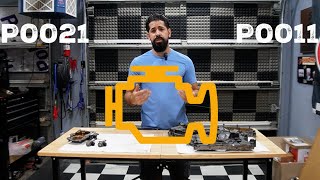
- Replacing the Camshaft Position Sensor. The sensor is almost always just accurately reporting the timing problem caused by oil issues or the OCV. Replacing it will not fix the code. 🎬 Watch: A complete guide to fixing P0021 and P0011 codes.
Most Likely Causes
- Low, Dirty, or Incorrect Viscosity Engine Oil 🔴 High Probability The CVVT system is hydraulic and extremely sensitive to oil level, cleanliness, and viscosity. The twin-turbo GDI engine runs hot, which can degrade oil more quickly. A recall (019G) exists for a leaking driver-side turbo oil feed pipe that can cause a low oil condition.
How to confirm: Check the engine oil dipstick. The level should be at the 'F' mark, and the oil should be a translucent amber color, not black, gritty, or sludgy. A low oil level warrants an immediate inspection for the turbo oil feed line leak.
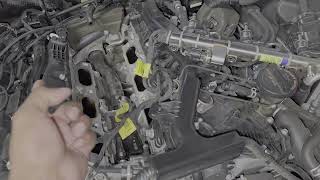
Typical fix: Perform a complete oil and filter change using a high-quality full synthetic 5W-30 oil that meets Genesis specifications. Always use a genuine OEM oil filter to ensure correct oil pressure. In some cases of stubborn codes, a chemical engine flush may be required to clear sludge from OCV passages. 🎬 See how to clean your VVT solenoids to clear codes.
Est. part cost: $70-$120 - Faulty Bank 2 (Driver's Side) Intake Oil Control Valve (OCV) 🔴 High Probability → Shop Engine Variable Valve Timing (VVT) Solenoid This electromechanical solenoid is a common failure point across the platform (G70, Stinger, G80). It can become clogged with oil sludge or fail electrically, causing it to stick open and over-advance the timing.
How to confirm: Swap the Bank 2 (driver's side) intake OCV with the identical Bank 1 (passenger's side) intake OCV. Clear the codes and drive. If the fault code changes to P0011 (the Bank 1 equivalent), the OCV is confirmed to be faulty. A mechanic can also test the OCV's internal resistance, which should be between 6.9 and 7.9 Ohms.
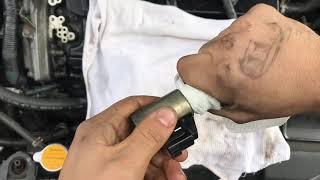
Typical fix: Replace the faulty Oil Control Valve. It is located on the front of the driver's-side valve cover and held by a single 10mm bolt. 🎬 Watch this quick 4-minute DIY fix for the P0021 code.
Est. part cost: $50-$80
Rare But Worth Checking
- Stretched Timing Chain or Failed Tensioner: → Shop Engine Timing Chain While much less common than oil issues or a bad OCV, this is a possibility on higher-mileage engines or those with a history of poor maintenance. This is a much more involved and expensive repair.
- Failed Cam Phaser: → Shop Engine Timing Gear The cam phaser is the mechanical gear that the OCV directs oil to. It can fail mechanically, but this is rare and should only be considered after ruling out the OCV and oil issues.
Diagnosis Steps
- Read the trouble codes with an OBD-II scanner to confirm P0021 is the primary code.
- Check the engine oil level and condition. If low, dirty, or past its service interval, perform an oil and filter change with 5W-30 full synthetic oil and an OEM filter. Clear the code and see if it returns. If oil was low, inspect the driver's side turbo oil feed pipe for leaks per recall 019G.
- If the oil is fine and the code returns, locate the intake Oil Control Valves (OCVs) on the front of each valve cover.
- Swap the driver's side (Bank 2) intake OCV with the passenger's side (Bank 1) intake OCV. They are identical and held by a single 10mm bolt.
- Clear the codes and drive the vehicle until the Check Engine Light comes back on.
- Re-scan the codes. If the code is now P0011, the OCV you moved is faulty and needs to be replaced.
- If the code remains P0021, the problem lies elsewhere, such as wiring to the OCV, a clogged oil passage that swapping didn't clear, or a more serious mechanical issue like the cam phaser or timing chain.
Parts You'll Likely Need
- Engine Oil Control Valve (VVT Solenoid)
(OEM #24355-3L100)— This is the most common part to fail that causes code P0021 after ruling out oil issues. It gets clogged with sludge or fails electrically.
Trusted brands: Hyundai/Kia (OEM)
OEM price range: $50-$80
Aftermarket price range: $30-$60 - Engine Oil and Filter Kit — Low, dirty, or incorrect viscosity oil is the number one cause of all CVVT system problems on this engine.
Trusted brands: Pennzoil, Mobil 1, Castrol, Hyundai/Kia (OEM Filter)
OEM price range: $70-$120
Aftermarket price range: $50-$90
Related Codes That Often Appear With This One
- P0011 — This is the equivalent code for Bank 1 (passenger's side). If you see both P0011 and P0021, it strongly suggests a systemic issue like low/dirty oil affecting the entire engine. It will also appear if you swap a bad Bank 2 OCV to Bank 1 for diagnosis.
- P0018 / P0019 — These are camshaft/crankshaft correlation codes for Bank 2. They can appear alongside P0021 and often point to the same root causes: a stuck OCV or oil flow problems affecting the entire bank.
Technical Service Bulletins (TSBs) & Recalls
- Recall 019G / NHTSA 24V-191 - Replaces recall 19V-538. Addresses a potential oil leak from the left turbocharger oil feed pipe, a direct potential cause for low oil levels that trigger P0021. The remedy is to replace the pipe with an improved stainless steel part.
Platform-Specific Known Issues
- Recall 019G (NHTSA #24V209000): Affects 2019-2022 G70s with the 3.3T engine. The left (driver's side) turbocharger oil feed pipe may deteriorate and crack due to heat, causing an oil leak. A significant leak can cause a low oil level, which is a primary trigger for P0021. The fix involves replacing the original pipe with a more durable full stainless steel version.
Mechanic-Grade Diagnostic Values
- Oil Control Valve (OCV) Internal Resistance — expected: 6.9 - 7.9 Ohms at 68°F (20°C). Failure: A reading of 0 (shorted), infinity/OL (open), or significantly outside the expected range indicates a faulty solenoid coil.
- OCV Harness Voltage (Key On, Engine Off) — expected: Battery voltage (approx. 12V) on the power supply pin of the OCV connector.. Failure: Low or no voltage points to a problem with the wiring, fuse, or engine main relay, not the OCV itself.
- Scan Tool Live Data: CVVT Actual vs. Desired Angle — expected: The actual and desired camshaft angle PIDs should track each other very closely (within a few degrees) as engine RPM changes.. Failure: A large, persistent deviation between the actual and desired angle (e.g., >10-15 degrees) while the engine is running indicates the cam phaser is not responding correctly to commands.
- ECM Code Trigger Condition (Cam Angle Deviation) — expected: The difference between the actual and desired cam position should be minimal.. Failure: The P0021 code will set if the ECM detects a deviation greater than a specified threshold, for example, a difference of more than 20 degrees for a set period.
Scan Tool Commands That Help
- Hyundai GDS (Global Diagnostic System) or equivalent advanced bidirectional scanner: Active Test: CVVT Oil Control Valve — This command allows a technician to manually cycle the Bank 2 intake OCV while the engine is idling. A noticeable change in engine idle (stumbling or roughness) confirms the OCV is mechanically moving and oil passages are at least partially clear. If there is no change, it points to a stuck OCV, a complete blockage, or a wiring/ECM driver issue.
- Hyundai GDS (Global Diagnostic System) or equivalent advanced bidirectional scanner: Service Function: Reset VVT Adaptations — After replacing a major timing component like a cam phaser, OCV, or timing chain, this function should be used to clear the old learned values from the ECM. This allows the system to re-learn the new component's baseline position and response characteristics.
Wiring & Ground Locations
- Bank 2 Intake OCV Connector — On the front of the driver's side (Bank 2) valve cover, plugged into the top of the Oil Control Valve solenoid.. This 2-pin connector provides the power and control signal from the ECM. Damage, corrosion, or oil contamination in this connector can interrupt the signal, preventing the OCV from operating and directly causing a P0021 code even if the OCV itself is good.
- OCV Oil Filter — Located in the cylinder head, directly in the oil passage leading to the Oil Control Valve. It is a small, cylindrical mesh screen.. This small filter can become clogged with sludge or debris from infrequent oil changes. A clogged filter will restrict oil flow to the OCV and cam phaser, preventing the camshaft from advancing or retarding correctly and triggering timing codes like P0021. It should be inspected and cleaned or replaced whenever the OCV is serviced.
Real Owner Repair Stories
- Aggregated forum story for platform-mate Kia Stinger 3.3T (Kia Stinger GT (Lambda II 3.3T engine)) — Persistent P0011/P0021 codes, especially after spirited driving.
❌ Tried (didn't work) Standard oil and filter change.
✅ What actually fixed it The issue was only resolved after removing the OCVs, cleaning them directly with carburetor cleaner, performing a chemical engine flush to remove hidden sludge, and then refilling with fresh OEM-spec oil and a new filter. This indicates that simple oil changes were not enough to clear severe, built-up deposits in the oil passages. - YouTube Repair Channel (Generic Hyundai) (Hyundai V6 with CVVT system) — Check Engine Light with P0021.
❌ Tried (didn't work) Assuming it was a major mechanical issue.
✅ What actually fixed it The vehicle was simply low on engine oil. Topping the oil up to the correct level on the dipstick resolved the low oil pressure condition, which made the Check Engine Light and the P0021 code go away without any parts being replaced.
OEM Part Supersession History
24355-3L100→24355-3L100— No supersession found. The part number appears to be consistent for the specified vehicle and engine across its model years.
Model Year Variations Within This Range
- 2019-2025: While the G70 had a significant facelift for the 2022 model year and a new base engine in 2024, the 3.3T Lambda II V6 powertrain and its CVVT system (including the OCVs, phasers, and sensors) did not undergo changes that would affect the diagnosis or repair of a P0021 code.
Diagnostic Flowchart
Other Known Issues on This Vehicle
Issues unrelated to this code that are worth knowing about as an owner of this generation:
- Electronic Wastegate Actuator Failure 🟠 Medium — Common, especially on earlier models. Often preceded by a distinct squeaking or rattling noise when shutting the engine off. Can lead to P0299 (Turbo Underboost) code.
- High-Pressure Fuel Pump (HPFP) Failure 🔴 High — A known issue, particularly on the 2.0T engine but also reported on the 3.3T. Can cause stalling at low speeds. Covered by recalls for some models/years. (Ref: Recall 023G (NHTSA 23V-771) for 2.0T models.)
- Harsh Downshifting (Transmission) 🟡 Low — Frequently reported by owners, especially a jerky or lurching feeling when slowing to a stop (e.g., 3-2 and 2-1 downshifts). Often considered a characteristic, but some owners have sought software updates.
- Oxidation of Dark Chrome Trim 🟡 Low — Common on Sport/Prestige models. The dark chrome window trim and grille surround can develop a hazy or oxidized appearance. There is a TSB for this cosmetic issue. (Ref: TSB exists (number varies by region))
- Sunroof Rattle/Creak 🟡 Low — A common complaint where the panoramic sunroof develops a creaking or rattling noise when closed.
- Limited-Slip Differential (LSD) Noise/Failure 🟠 Medium — Some owners of LSD-equipped models report a whining noise during sharp, low-speed turns, which can sometimes be a precursor to failure. The issue is also seen on the Kia Stinger.
Used vs. New Parts: Buying Guide for This Vehicle
When a used part is the smart pick: For this repair, using a used part is generally not recommended for the Oil Control Valve (OCV). The part is relatively inexpensive when purchased new (OEM), and its failure is often due to internal sludge or electrical wear that is impossible to assess visually on a used part.
Donor-vehicle mileage cap: roughly under 40000 miles for the part to have meaningful remaining life.
What to inspect on the donor part:
- If considering a used OCV, only pull from a documented low-mileage vehicle.
- Ensure the donor vehicle has no signs of engine sludge (check the oil fill cap for milky or thick residue).
- The electrical connector pins on the used OCV should be clean, straight, and free of corrosion.
OEM-only on this vehicle (don't cheap out):
- Oil Control Valve (OCV): Given the sensitivity of the CVVT system and the high failure rate of this part, using a genuine Hyundai/Kia OEM part (24355-3L100) is strongly advised to ensure correct operation and longevity.
- Engine Oil Filter: Always use a genuine OEM oil filter. Aftermarket filters may not have the correct internal bypass valve pressure, which can negatively affect oil pressure and the CVVT system's performance.
Brands owners have reported issues with on this vehicle:
- Unbranded or 'white-box' OCVs from online marketplaces should be avoided. Forum discussions frequently show these parts failing quickly or being dead-on-arrival.
Real Owner Stories
Aggregated from forums and TSBs cited above. Mileages and costs reflect what owners reported in those sources.
2019 Genesis G70 3.3T V6
Symptoms: Check engine light appeared after spirited driving; the car also had a jerky or lurching feeling when slowing to a stop.
What fixed it: The owner performed an oil change and swapped the OCVs to diagnose; the dealer eventually replaced the OCV under warranty.
Source hint: genesisg70forum.com thread 'Check Engine Light P0011' and forum_citations regarding 'spirited driving'
2018-2023 Kia Stinger GT 3.3L T-GDi V6
Symptoms: Check Engine Light with codes P0018, P0019, or other timing-related faults.
What fixed it: Correcting the engine oil level/condition and replacing faulty Oil Control Valves (OCVs).
Source hint: stingerforum.org aggregated reports in owner_reports
2021 Genesis G70 3.3T
Symptoms: Potential oil loss issues and concern over engine health.
What fixed it: Ensuring the turbo oil feed pipe recall (019G) was performed to prevent low oil conditions.
Source hint: Reddit r/GenesisG70 thread 'Potential G70 3.3T Buyer – Honest Thoughts from Owners?'
Related OBD-II Codes
Frequently Asked Questions
How does Recall 019G affect the P0021 code on my 2019-2022 Genesis G70 3.3T?
Can I use any 5W-30 oil to fix the P0021 code on my G70?
Is there a way to test if the Bank 2 Intake OCV is actually bad before buying a new one?
Does the Kia Stinger GT suffer from the same P0021 issues as the G70?
My G70 is stalling when I come to a stop; is this related to P0021?
What is the specific fix for the turbo oil feed pipe leak mentioned in the TSB?
Helpful Videos
![How to Fix KIA P0021 Engine Code in 4 Minutes [1 DIY Method / Only $19.45]](https://img.youtube.com/vi/H8rdCDH1sdE/mqdefault.jpg)
We Have This Part in Stock


The information in this article is provided for general reference and educational purposes only. Vehicle specifications, procedures, and part compatibility can vary by production date, trim level, and region. Always consult your vehicle's factory service manual and verify part numbers before purchasing or performing repairs. Safety-critical components such as airbags, seat belts, and braking systems should be installed by a qualified professional.
- Genesis G70:
- 🧭 Diagnostic Flowchart
- 🎬 Helpful Videos
- 🛍️ Shop This Part
- What's Unique About the 2019-2025 Genesis G70
- Symptoms You May Notice
- Most Likely Causes
- Rare But Worth Checking
- Diagnosis Steps
- Parts You'll Likely Need
- Related Codes That Often Appear With This One
- Technical Service Bulletins (TSBs) & Recalls
- Platform-Specific Known Issues
- Mechanic-Grade Diagnostic Values
- Scan Tool Commands That Help
- Wiring & Ground Locations
- Real Owner Repair Stories
- OEM Part Supersession History
- Model Year Variations Within This Range
- Other Known Issues on This Vehicle
- Used vs. New Parts: Buying Guide for This Vehicle
- Real Owner Stories
- 2019 Genesis G70 3.3T V6
- 2018-2023 Kia Stinger GT 3.3L T-GDi V6
- 2021 Genesis G70 3.3T
- Related OBD-II Codes
- Frequently Asked Questions
- 🎟️ Get 5% Off