

P0021 on 2008-2009 Mercury Sable 3.5L V6: Causes and Fixes for Over-Advanced Cam Timing
On a 2008-2009 Mercury Sable, P0021 is almost always caused by low/dirty engine oil or a faulty Variable Camshaft Timing (VCT) solenoid on Bank 2 (the front/radiator side of the engine). Always check the oil first and perform an oil change with the correct 5W-20 oil. If that doesn't fix it, the VCT solenoid is the next likely part, costing around $40-$90 and is a common DIY fix.
- P0021 on this vehicle points to an over-advanced intake camshaft on the front (radiator side) of the engine.
- Before buying any parts, check your engine oil. A simple oil and filter change with 5W-20 oil is the most common and cheapest fix.
- The most likely failed part is the Bank 2 intake VCT solenoid (Part No. AT4Z-6M280-B). You can confirm this by swapping it with the Bank 1 solenoid to see if the code follows the part, but this requires removing the valve cover.
- Ignoring this code can lead to stalling, poor performance, and eventually more expensive repairs to the timing system or engine damage if the root cause is oil contamination from a failing water pump.
What's Unique About the 2008-2009 Mercury Sable
The 3.5L 'Cyclone' V6 engine, shared with the Ford Taurus, Edge, and Flex, is well-known for having a VCT system that is extremely sensitive to oil quality and maintenance schedules. Ford has issued multiple service bulletins for this engine family acknowledging that even small amounts of debris in the oil can cause the VCT solenoids to stick and trigger this code. Therefore, regular oil changes with the correct 5W-20 oil and a quality filter (like the Motorcraft FL-500S) are more critical on this platform than on many others to prevent this common fault.
Symptoms You May Notice
- Check Engine Light is on
- Rough or unstable idle, especially when warm
- Engine stalling when coming to a stop
- Hesitation or stumbling during acceleration
- Noticeable decrease in fuel economy
- Rattling or ticking noise from the engine, particularly on startup
- Engine feels sluggish or down on power
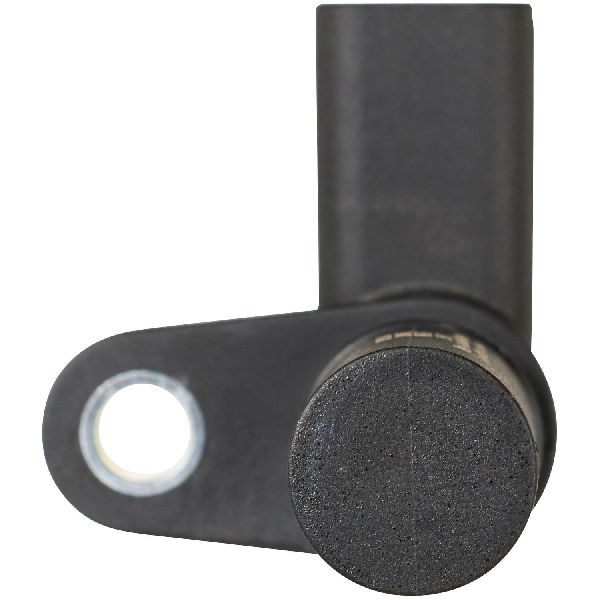
- Replacing the camshaft position sensor. While a sensor can fail, it is not a common cause for this specific code. A faulty sensor would typically generate its own specific sensor circuit code, and it is usually just reporting the mechanical timing error accurately.
Most Likely Causes
- Low, Dirty, or Incorrect Viscosity Engine Oil 🔴 High Probability The VCT system in the 3.5L Cyclone V6 is hydraulic and highly sensitive to oil pressure and cleanliness, as documented in Ford TSBs. Using oil other than the specified 5W-20 can cause the solenoids to respond incorrectly.
How to confirm: Check the oil level on the dipstick and inspect its color and consistency. If the level is low or the oil is dark, gritty, or past its service interval, this is the likely cause. 🎬 Watch: A guide on how to fix P0021 and P0011 codes. Confirm the last oil change used 5W-20 oil.
Typical fix: Perform an engine oil and filter change using the manufacturer-specified 5W-20 synthetic blend or full synthetic oil and a new filter (OEM part is Motorcraft FL-500S).
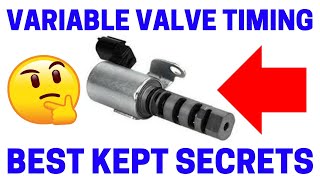
Est. part cost: $50-$80 - Sticking or Failed VCT Solenoid (Bank 2 Intake) 🔴 High Probability → Shop Engine Variable Valve Timing (VVT) Solenoid Oil debris is known to clog the fine mesh screens on these solenoids, causing them to stick open or closed. It's the most common component failure for this code on this engine.
How to confirm: Swap the Bank 2 (front/radiator side) intake VCT solenoid with the Bank 1 (rear/firewall side) intake VCT solenoid. Clear the codes and drive. If the code returns as P0011 (the Bank 1 equivalent), the solenoid is confirmed to be faulty. The solenoids are located under the valve covers, so this requires some labor.
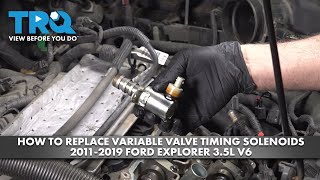
Typical fix: Replace the Bank 2 intake VCT solenoid. It is located on the front valve cover. 🎬 See this walkthrough for replacing the VCT solenoids. It is highly recommended to replace the valve cover gasket at the same time.
Est. part cost: $40-$90 - Failed Camshaft Phaser (Bank 2 Intake) 🟡 Medium Probability → Shop Engine Camshaft The phasers can wear out over time or be damaged by prolonged operation with poor oil quality or low oil pressure, causing them to get stuck in the advanced position.
How to confirm: This is typically diagnosed after an oil change and VCT solenoid replacement have failed to resolve the code. A prominent rattling noise on cold starts is a strong indicator. Professional diagnosis with a scan tool monitoring cam deviation (VCT error PIDs) is required.
Typical fix: Replace the Bank 2 intake camshaft phaser. This is a complex and expensive job that also requires replacing the timing cover gaskets and other related components.
Est. part cost: $150-$300
Rare But Worth Checking
- Stretched Timing Chain or Failed Tensioner: → Shop Engine Timing Chain While less common than a solenoid or phaser failure, a stretched timing chain can cause the cam timing to be physically off, triggering this code. This is more likely at higher mileage (>150,000 miles) or if the engine has suffered from oil contamination.
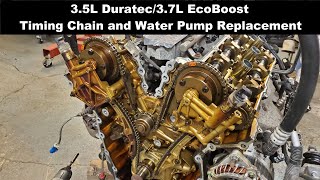
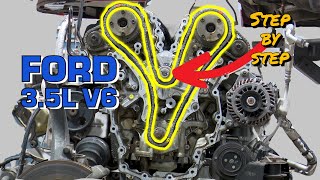
- Failing Internal Water Pump: A known catastrophic failure on the transverse 3.5L Cyclone V6 is a failing internal water pump that leaks coolant into the oil. This creates a milky, contaminated sludge that will quickly cause VCT system failure and trigger multiple timing codes. Check the oil for a milky appearance and the coolant reservoir for oil contamination. A weep hole for the pump may drip coolant near the A/C compressor as an early warning. This requires immediate and extensive repair to avoid catastrophic engine failure. 🎬 Watch: How to replace the timing chain and water pump.
Diagnosis Steps
- Check the engine oil level and condition. If it is low, dirty, or appears milky (coolant contamination), address this first. An oil and filter change with 5W-20 oil is the number one recommended first step.
- Scan for any other OBD-II codes that may provide more context. Codes like P0011, P0018, or P0022 are significant.
- Listen for any engine noises. A diesel-like rattle at idle or a brief rattle on cold starts could point towards a failing cam phaser or timing chain tensioner.
- Using a capable scan tool, monitor the VCT PIDs (Parameter IDs) for Bank 2. Observe the commanded vs. actual camshaft angle and the VCT error percentage. A large, persistent error points away from a simple oil issue.
- To confirm a faulty VCT solenoid, swap the Bank 2 (front) intake solenoid with the Bank 1 (rear) intake solenoid. This requires removing the valve covers.
- Clear the codes and drive the vehicle. If the code changes to P0011, the solenoid you moved is bad and needs to be replaced.
- If the P0021 code returns after the swap, the problem is not the solenoid. The issue is likely a faulty camshaft phaser, a clogged oil passage in the cylinder head, or a timing chain issue.
- At this stage, further professional diagnosis is recommended to inspect the timing components, which is a labor-intensive job.
Parts You'll Likely Need
- Variable Camshaft Timing (VCT) Solenoid
(OEM #AT4Z-6M280-B (Supersedes 7T4Z-6M280-C))— This is the most common part to fail for code P0021, typically by getting stuck due to oil debris. Note that this part is physically located under the valve cover.
Trusted brands: Motorcraft, Dorman
OEM price range: $60-$90
Aftermarket price range: $30-$60 - Engine Oil and Filter
(OEM #FL-500S)— Low, dirty, or incorrect viscosity oil is the leading cause of VCT system problems and may be the only fix required. The specified oil is 5W-20.
Trusted brands: Motorcraft, Mobil 1, Castrol
OEM price range: $50-$80
Aftermarket price range: $40-$70 - Valve Cover Gasket Set
(OEM #7T4Z-6584-A (Bank 2))— The VCT solenoids are located under the valve covers. The gaskets are a required replacement item when accessing the solenoids to prevent oil leaks.
Trusted brands: Motorcraft, Fel-Pro
OEM price range: $30-$50
Aftermarket price range: $20-$40
Related Codes That Often Appear With This One
- P0011 — This is the equivalent code for Bank 1. If you see P0011 and P0021 together, it strongly points to a systemic issue like low oil level/pressure or a stretched timing chain affecting both banks.
- P0022 — This is the 'over-retarded' code for the same bank. Seeing both P0021 and P0022 could indicate an erratic VCT solenoid or oil pressure issue causing the cam to fluctuate wildly.
- P0018 — This is a crankshaft/camshaft correlation code for Bank 2. Seeing it with P0021 strongly suggests a mechanical timing issue, such as a stretched timing chain or a failing phaser that has jumped time.
Technical Service Bulletins (TSBs) & Recalls
- SSM 50067 / 47170: Notes that P0021 is frequently caused by small debris causing the VCT solenoid to stick and advises using a scan tool to cycle the solenoid to clear it before replacement.
- TSB 10-3-7: This TSB supersedes a previous one and provides a detailed diagnostic procedure for DTCs P0011, P0012, P0021, and P0022 on the 3.5L engine, guiding technicians to check oil pressure first, then use a scan tool to monitor VCT PIDs before replacing either the solenoid or the phaser.
Platform-Specific Known Issues
- Owner Experience: P0021 Fixed with Solenoid Swap: A user on the Ford Edge Forum with the same 3.5L engine experienced rough idle and codes P0018 and P0021. The community consensus pointed towards oil issues or a bad VCT solenoid as the first steps in diagnosis, highlighting the commonality of the issue across platforms.
- Owner Experience: Persistent P0021 after Phaser Replacement: A Reddit user with a 3.5L engine described a frustrating experience where code P0021 kept returning even after multiple cam phaser replacements and timing adjustments, costing thousands. This highlights that if the root cause (like oil pressure/contamination or a separate issue) isn't addressed, even major parts replacement may not solve the problem.
- DIY: VCT Solenoid Replacement: → Shop Engine Variable Valve Timing (VVT) Solenoid Replacing the VCT solenoids on the 3.5L Cyclone engine requires removing the upper intake manifold to access the valve covers. While not overly complex, it is a time-consuming job for a DIYer. Numerous YouTube videos demonstrate the process on the Ford Taurus, which is mechanically identical.
Mechanic-Grade Diagnostic Values
- VCT Solenoid Internal Resistance — expected: 5 to 15 Ohms (a more precise Ford spec is 6.9 to 7.9 Ohms at 68°F/20°C).. Failure: A reading of 0 Ohms (short circuit) or OL/infinity (open circuit) indicates a failed solenoid.
- VCT Solenoid Connector Voltage (Key On, Engine Off) — expected: ~12V (Battery Voltage) on the power supply pin.. Failure: No voltage or significantly low voltage points to a wiring, fuse, or PCM power supply problem.
- Live Data PID: VCT_ADV_ERR (or VCT2ERR for Bank 2) — expected: Should hover around 0° at hot idle. A deviation of more than +/- 5° for a sustained period indicates a problem.. Failure: A large, persistent positive value (e.g., >5°) on VCT2ERR indicates the Bank 2 camshaft is over-advanced as the code suggests.
- Live Data PID: VCT_INT_DIF2 (Ford-specific error PID for Bank 2 Intake) — expected: Should be near 0° at stable idle.. Failure: A consistent non-zero value indicates the PCM is detecting a difference between the commanded and actual cam angle.
- Live Data PID: VCTDC2 / CAMDCR (Duty Cycle for VCT Solenoid) — expected: The PCM will vary the duty cycle to command cam angle changes. At idle, it should be low. When one bank has an issue, the PCM may command a much higher duty cycle on that bank to compensate.. Failure: A significantly higher duty cycle commanded for Bank 2 compared to Bank 1 with little to no change in cam angle suggests a stuck solenoid or phaser.
Hidden / Shadow Codes Worth Checking
- Mode 6, Test ID $83: Ford uses Mode 6 to store test results for non-continuous monitors. Test ID $83 relates to Camshaft Position Timing. A technician can view the raw test value and compare it to the manufacturer's maximum allowable limit to see if the system is borderline failing, even before a code is set. (see via An advanced scan tool capable of displaying Mode 6 data.)
Scan Tool Commands That Help
- Ford IDS (or FORScan): VCT Solenoid Actuator Test / On-Off Command / Cycle Solenoid — This bidirectional command allows a technician to manually cycle the VCT solenoid at idle. A functional solenoid and phaser will cause the engine to stumble or run rough. If there is no change in engine operation, it points to a stuck solenoid, clogged oil passage, or a seized phaser. Ford TSBs suggest cycling the solenoid 10 times to try and dislodge debris before replacement.
Wiring & Ground Locations
- S123 / S125 / S127 — Splices located in the engine control & fuel charge harness, near the breakout to the fuel injectors and coil-on-plugs.. These splices are part of the sensor and actuator power and ground distribution. Corrosion or damage to these harness sections could cause erratic voltage to the VCT solenoid or camshaft position sensor, leading to intermittent codes.
- Battery Junction Box (BJB) — Located on the left side of the engine compartment.. The VCT solenoid receives its power via a fuse (e.g., F16 on some similar models) located in the BJB, which is supplied by the PCM power relay. A fault in the BJB could interrupt power to the solenoid.
Real Owner Repair Stories
- YouTube channel 'Truck Lab' (2019 Ford F-150 3.5L EcoBoost (mechanically similar VCT system)) — Check Engine Light with codes P0018 and P0021, occasional power loss, and a cold start rattle.
❌ Tried (didn't work) Initial diagnosis pointed towards failing cam phasers due to the rattle, which is a common and expensive repair on this engine family.
✅ What actually fixed it The true cause was a failed Bank 2 intake VCT solenoid. A small piece of the solenoid's internal plastic control ring had broken off, jamming the internal spool valve. Replacing all four VCT solenoids as a preventative measure resolved all symptoms, including the P0021 code and the cold start rattle.
OEM Part Supersession History
7T4Z-6M280-C→AT4Z-6M280-B— Likely internal design improvements for durability and resistance to sticking from oil debris.
Heads up: The parts are interchangeable, but the newest revision (AT4Z-6M280-B or a later letter revision) is always recommended for replacement.
Diagnostic Flowchart
Other Known Issues on This Vehicle
Issues unrelated to this code that are worth knowing about as an owner of this generation:
- Internal Timing-Chain-Driven Water Pump Failure 🔴 High → Shop Engine Timing Chain — Common at mileages over 80,000-120,000 miles. Failure can be catastrophic if coolant contaminates the engine oil.
- Electronic Throttle Body (ETB) Failure 🟠 Medium — A very common issue for the 3.5L V6, causing the vehicle to enter 'limp mode' with a wrench light on the dash. (Ref: Customer Satisfaction Program 13N03 (expired))
- HVAC Blend Door Actuator Failure 🟡 Low — Common failure causing a repetitive clicking sound from behind the dashboard after starting the vehicle.
- Transmission/PTU Fluid Leaks at Axle Seal 🟠 Medium — Leaks can develop from the axle seals on both the transmission and, on AWD models, the Power Transfer Unit (PTU).
- Driver Frontal Airbag Improper Inflation 🔴 High — Subject to a specific recall for improper second-stage deployment in a high-speed crash. (Ref: NHTSA Recall 17V222000)
Used vs. New Parts: Buying Guide for This Vehicle
When a used part is the smart pick: For this specific repair, buying a used VCT solenoid is generally not recommended. The failure mode is often internal wear or clogging from an unknown maintenance history, making a used part a high-risk gamble. The cost of labor to replace it again if the used part fails outweighs the savings. Used parts are not a smart choice for this component.
Donor-vehicle mileage cap: roughly under 30000 miles for the part to have meaningful remaining life.
What to inspect on the donor part:
- If forced to buy used, demand proof of mileage from the donor vehicle.
- Inspect the mesh screens on the solenoid; they must be perfectly clean and intact with no tears or debris.
- Avoid any solenoid that shows signs of sludge or dark, baked-on oil varnish.
OEM-only on this vehicle (don't cheap out):
- Camshaft Phasers
- Timing Chain and Tensioners
Aftermarket brands forum-validated for this vehicle:
- Motorcraft (OEM)
- Dorman (often has design improvements over the original OEM part)
Brands owners have reported issues with on this vehicle:
- No-name, unbranded parts from online marketplaces should be avoided due to inconsistent quality control.
Real Owner Stories
Aggregated from forums and TSBs cited above. Mileages and costs reflect what owners reported in those sources.
2007-2010 Ford Edge 3.5L V6
Symptoms: Rough idle and trouble codes P0018 and P0021.
What fixed it: The community consensus recommended starting with oil issues or VCT solenoid replacement, highlighting the solenoid swap as a diagnostic step.
Source hint: Ford Edge Forum: 'Rough Idle and trouble codes P0018 and P0021'
2008-2012 Ford Taurus 3.5L V6 — ~100000 miles
Symptoms: Code P0021 kept returning even after multiple cam phaser replacements and timing adjustments.
What fixed it: The issue remained unresolved because the root cause (such as oil pressure/contamination) was not addressed, despite spending thousands on parts.
Source hint: Reddit r/f150: '3.5l Cam Phaser Replacement Costs'
Related OBD-II Codes
Frequently Asked Questions
Is there a specific TSB for the P0021 code on my 2008 Mercury Sable 3.5L?
What type of oil should I use in my 2008-2009 Sable to prevent VCT issues?
Which VCT solenoid is responsible for the P0021 code on this engine?
Can I swap parts to test if the solenoid is bad before buying a new one?
Is there a specific oil filter recommended for the 3.5L Cyclone V6?
Could a rattling noise on startup be related to my P0021 code?
Helpful Videos
We Have This Part in Stock


The information in this article is provided for general reference and educational purposes only. Vehicle specifications, procedures, and part compatibility can vary by production date, trim level, and region. Always consult your vehicle's factory service manual and verify part numbers before purchasing or performing repairs. Safety-critical components such as airbags, seat belts, and braking systems should be installed by a qualified professional.
- Mercury Sable:
- 🧭 Diagnostic Flowchart
- 🎬 Helpful Videos
- 🛍️ Shop This Part
- What's Unique About the 2008-2009 Mercury Sable
- Symptoms You May Notice
- Most Likely Causes
- Rare But Worth Checking
- Diagnosis Steps
- Parts You'll Likely Need
- Related Codes That Often Appear With This One
- Technical Service Bulletins (TSBs) & Recalls
- Platform-Specific Known Issues
- Mechanic-Grade Diagnostic Values
- Hidden / Shadow Codes Worth Checking
- Scan Tool Commands That Help
- Wiring & Ground Locations
- Real Owner Repair Stories
- OEM Part Supersession History
- Other Known Issues on This Vehicle
- Used vs. New Parts: Buying Guide for This Vehicle
- Real Owner Stories
- 2007-2010 Ford Edge 3.5L V6
- 2008-2012 Ford Taurus 3.5L V6 — ~100000 miles
- Related OBD-II Codes
- Frequently Asked Questions
- 🎟️ Get 5% Off