

P0022 on 2015-2021 Ford Escape? What It Really Means (Likely P0012)
A 2015-2021 Ford Escape cannot have a P0022 code because its inline engines lack a 'Bank 2'. You likely have code P0012, which points to an over-retarded intake camshaft on Bank 1. The most common fix is replacing a sticking Variable Camshaft Timing (VCT) solenoid, often due to dirty or low engine oil. An oil and filter change followed by VCT solenoid replacement resolves the vast majority of cases.
- P0022 is the wrong code for a 2015-2021 Ford Escape. The correct code for the same problem is P0012.
- The most likely cause of P0012 is either low/dirty engine oil or a faulty intake VCT solenoid.
- Always start by checking your oil. An oil and filter change is the cheapest and easiest first step.
- If an oil change doesn't work, replacing the intake VCT solenoid is the next most probable fix and is a manageable DIY job.
- Ignoring this code can lead to poor performance, bad fuel economy, and potentially more expensive engine damage down the road.
What's Unique About the 2015-2021 Ford ESCAPE
The key issue for this platform is confusion between diagnostic codes. While the generic definition for P0022 exists, it's inapplicable to the Escape's I3 and I4 engines. The actual issue owners face is code P0012. Ford has issued multiple Technical Service Bulletins (TSBs) acknowledging that VCT solenoids on these engines can stick due to small debris, leading to these timing codes. This makes a faulty VCT solenoid a very high-probability cause, often linked to oil condition and maintenance history. Ford's own diagnostic advice per TSB SSM 50067 is to first attempt to clear the debris by electronically cycling the affected VCT solenoid 10 times before replacing any parts.
Diagnostic Flowchart
Tap your situation to follow the diagnostic path that matches what you're seeing on this vehicle.
Generation note: The 2015-2021 year range covers the end of the third generation (2013-2019) and the beginning of the fourth generation (2020-present). Engines like the 1.5L EcoBoost (I4), 2.0L EcoBoost (I4), and 2.5L (I4) were available across these generations. The VCT system design and related issues with P0012 are common to all of these inline engines.
Symptoms You May Notice
- Check Engine Light (MIL) illuminated
- Rough or unstable idle
- Engine stalling, especially when coming to a stop
- Reduced engine power and sluggish acceleration
- Noticeable decrease in fuel economy
- Hard starting
- Rattling noise from the engine, especially on cold starts
- Replacing the camshaft position sensor first. The sensor is usually just reporting the problem, not causing it.
- Replacing the camshaft phaser before the VCT solenoid. The solenoid is cheaper, easier to access, and fails much more frequently.
- Assuming a major timing chain issue before performing an oil change and inspecting/replacing the VCT solenoids, which are far more common and cheaper fixes.
Most Likely Causes
- Low or Dirty Engine Oil 🔴 High Probability The VCT system is hydraulic and uses engine oil pressure to adjust cam timing. The oil passages in the VCT solenoids are very small and can easily become clogged with sludge or debris from old or incorrect viscosity oil. This is the most common reason for VCT system-related codes.
How to confirm: Check the oil level on the dipstick. Inspect the oil's color and consistency. If it is low, below the minimum mark, or appears very dark, thick, or sludgy, this is your likely starting point. 🎬 Watch this breakdown of common P0012 causes and fixes.
Typical fix: Perform an engine oil and filter change using the manufacturer-recommended full synthetic oil viscosity (e.g., 5W-20 or 5W-30 for EcoBoost models). Often, this simple maintenance step can resolve the code.
Est. part cost: $40-$80 - Sticking/Failing VCT Solenoid (Oil Control Valve) 🔴 High Probability → Shop Engine Variable Valve Timing (VVT) Solenoid Ford TSBs #SSM 50067 and #SSM 47170 directly state that small debris can cause the VCT solenoid to stick, triggering codes like P0012. This is the most common mechanical failure for this code on this platform, often happening after 60,000 miles. The solenoids' internal screens get clogged, restricting oil flow.
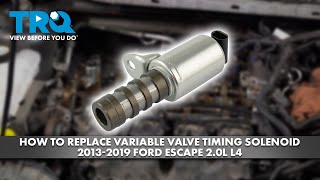
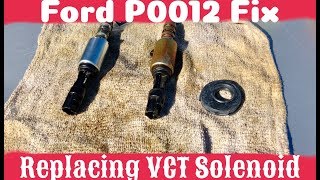
How to confirm: After confirming oil is clean and full, this is the next step. A scan tool can command the solenoid to check for response. A DIY approach is to remove the solenoid (located on the top of the valve cover) 🎬 See how to replace the VCT solenoid on 2.0L engines. and inspect its screens for sludge. You can also test its resistance with a multimeter, which should be between 5 and 15 ohms.
Typical fix: Replacement of the intake VCT solenoid (Bank 1). They are often replaced in pairs (intake and exhaust) as a preventative measure. Cleaning is sometimes attempted, but replacement is recommended for reliability.
Est. part cost: $25-$96 - Worn Timing Chain, Tensioners, or Guides ⚪ Low Probability → Shop Engine Timing Chain While less common than oil or solenoid issues, timing chains can stretch over high mileage (typically over 100,000 miles), especially with a history of poor oil maintenance. This creates slack, causing a mechanical delay (retard) in cam timing that the VCT system cannot compensate for.
How to confirm: This is a more involved diagnosis. A key symptom is a distinct rattling sound from the engine for 2-3 seconds on a cold startup. An advanced scan tool can measure camshaft deviation. Visual inspection requires removing the valve cover or timing cover.
Typical fix: Replacement of the timing chain, tensioners, and guides. This is a labor-intensive and expensive job.
Est. part cost: $200-$500
Rare But Worth Checking
- Failed Camshaft Phaser (VCT Actuator): → Shop Engine Camshaft The phaser is the gear-like mechanism on the end of the camshaft. It can fail internally or get stuck, but it's much less common than the solenoid that controls it. This is usually suspected only after an oil change and VCT solenoid replacement fail to fix the issue. A user on a Reddit forum mentioned their issue persisted after a VCT solenoid change and suspected the phaser/sprocket.
- Faulty Camshaft Position Sensor: → Shop Engine Camshaft Position Sensor While possible, the sensor failing in a way that causes a timing deviation code (instead of a sensor circuit code like P0340) is uncommon. It's often misdiagnosed as the primary problem when it is accurately reporting the timing error.
- Incorrect Camshaft Bridge Installation: → Shop Engine Camshaft In a documented case on a 2017 Escape 1.5L, a P0012 code was caused by a camshaft bridge being installed backward during previous engine work by a machine shop. Correcting the installation fixed the P0012 code.
Diagnosis Steps
- Confirm the code with an OBD-II scanner. If it shows P0022, double-check the scanner or have it read by another device, as the correct code should be P0012 for an inline engine.
- Check the engine oil level and condition. If low, top it off. If dirty or past its service interval, perform a full oil and filter change with the correct OEM-specified viscosity oil. Clear codes and test drive.
- Listen for engine noise. A distinct rattling sound on cold startup lasting a few seconds strongly suggests a timing chain/tensioner issue.
- If the oil change does not resolve the code, the next step is to inspect and likely replace the intake VCT solenoid for Bank 1. Per TSB SSM 50067, a technician can first try cycling the solenoid with a scan tool to dislodge debris.
- Test the VCT solenoid circuit with a multimeter to rule out wiring problems (shorts, open circuits).
- If a new solenoid and clean oil do not fix the issue, the problem may be a more significant mechanical problem like a stretched timing chain or a faulty VCT phaser, which typically requires professional diagnosis and is a much more involved repair.
Parts You'll Likely Need
- Variable Camshaft Timing (VCT) Solenoid
(OEM #CM5Z-6M280-D (superseded by CM5Z-6M280-G) for some 1.5L/1.6L engines; CJ5Z-6M280-A 🎬 Watch: Step-by-step VVT solenoid replacement for 1.6L EcoBoost engines. for 2.0L/2.5L engines. Always verify with VIN.)— This is the most frequent point of failure for this code on this vehicle, as confirmed by Ford TSBs and numerous owner experiences.
Trusted brands: Motorcraft, Dorman, Delphi
OEM price range: $50-$100
Aftermarket price range: $25-$70 - Engine Oil and Filter — Clean oil of the correct viscosity is essential for VCT system operation. This is the first and most crucial step in troubleshooting and often resolves the issue on its own.
Trusted brands: Motorcraft (Synthetic Blend), Mobil 1, Castrol, Pennzoil
OEM price range: $50-$90
Aftermarket price range: $40-$70
Related Codes That Often Appear With This One
- P0011 — This is the opposite code, 'Timing Over-Advanced'. It can appear with P0012 if the VCT system is behaving erratically or if the exhaust solenoid is also failing.
- P0014 / P0015 — These are the codes for the exhaust camshaft on Bank 1 ('B' camshaft). Since the intake and exhaust VCT solenoids are similar parts living in the same oil environment, it's not uncommon for both to have issues.
- P0300, P0301, etc. — Misfire codes can occur because the incorrect cam timing leads to poor combustion efficiency in one or more cylinders.
- P1450 — This code for 'Unable to Bleed Up Fuel Tank Vacuum' can sometimes appear alongside VCT codes, potentially due to related electrical or system voltage issues, as seen in one diagnostic video on a Ford Edge.
Technical Service Bulletins (TSBs) & Recalls
- SSM 54366: Mentions a group of VCT-related DTCs, including P0012 and P0022, for various Ford/Lincoln vehicles and points to diagnostic procedures.
- SSM 50067: States that codes like P0012/P0022 may be due to small debris causing the VCT solenoid to stick and advises cycling the solenoid with a scan tool (Pinpoint Test HK12) to clear debris before replacement.
- SSM 47170: An earlier version of SSM 50067 with the same guidance about sticking VCT solenoids due to debris.
- TSB 19-2346: Addresses a separate, but critical, issue of potential coolant intrusion into the cylinders on some 2.0L EcoBoost engines found in the Escape and other models.
Platform-Specific Known Issues
- The primary issue for this platform is the VCT solenoids becoming clogged with small debris from oil, leading to sticking. This is explicitly mentioned in Ford TSBs #SSM 50067 and #SSM 47170.
- Some 1.5L and 2.0L EcoBoost engines in this year range were subject to concerns about coolant intrusion into cylinders due to block design flaws (TSB 19-2346). While unrelated to P0012, it's a serious known issue for these engines that owners should be aware of.
- A YouTube video demonstrates replacing the VCT solenoids on a 2.0L Duratec engine, which requires removing the valve cover to access them.
Mechanic-Grade Diagnostic Values
- VCT Solenoid Internal Resistance — expected: 7 to 15 Ohms. Failure: A reading outside this range (open or shorted) indicates a faulty solenoid.
- VCT Solenoid Power Supply Voltage — expected: Battery voltage (approx. 12V) with key on, engine off.. Failure: No voltage indicates a wiring or fuse issue upstream of the solenoid.
- Ford IDS Scan Tool VCT_ADV_ERR PID — expected: Should hover around 0 degrees (+/- 5 degrees) during closed-loop operation.. Failure: Excessive variation or a large, consistent deviation while the drivability concern is present points to a VCT system fault.
Scan Tool Commands That Help
- Ford IDS (Integrated Diagnostic System): VCT Solenoid Duty Cycle Command / Output State Control — As mentioned in TSBs, this bidirectional command allows a technician to cycle the solenoid (e.g., 10 times) to attempt to dislodge small debris causing it to stick. It's also used to verify solenoid and circuit function without removal.
- Ford IDS (Integrated Diagnostic System): Data Logger with VCT_ADV_ERR PID — To diagnose intermittent issues. A technician can record live data during a test drive to capture the exact moment the timing error occurs, correlating it with engine load and RPM.
Wiring & Ground Locations
- Engine Block Ground (G104 equivalent) — On some 2.5L engines, a primary ground contact for the wiring harness is located on the engine block near the oil filter.. A poor engine ground can cause erratic behavior in all engine sensors and actuators, including the VCT solenoids and camshaft position sensors. Cleaning this connection can resolve unexplained electrical glitches.
- Bell Housing Ground — A ground wire with a large eyelet often attaches to a bell housing bolt where the engine and transmission meet.. This is a critical grounding point for the powertrain. If disturbed during other repairs (like a transmission swap) and not reconnected properly, it can lead to numerous engine codes and drivability problems.
- VCT Solenoid Connector — Located on top of the valve cover, connected to the VCT solenoids. One wire is power (often blue-green) and the other is the control wire from the PCM (provides ground).. This is the primary point for electrical testing (voltage, resistance). A corroded or loose connector here can mimic a failed solenoid.
Real Owner Repair Stories
- YouTube user 'Fix it Felix' (2005 Ford Expedition 5.4L (Note: Different engine, but same VCT principle and P0012 code)) — Flashing check engine light, no power, struggling to accelerate past 40 MPH, misfire felt, engine stalls after a complete stop.
❌ Tried (didn't work) The owner noted that many others online had replaced phasers and other expensive parts without success.
✅ What actually fixed it The owner replaced the Bank 1 VCT solenoid. After replacement, the check engine light went off and power was restored. The repair cost under $100.
OEM Part Supersession History
CM5Z-6M280-D→CM5Z-6M280-F, CM5Z-6M280-G— Standard part revision and improvement by the manufacturer.
Heads up: The newer part numbers (F, G) are direct replacements for the older (-D) version for applicable 1.0L/1.5L/1.6L engines. Always verify with VIN.CJ5Z-6M280-A→No common supersession found, this part number appears stable.
Heads up: This part is listed for 2.0L and 2.5L engines in the Escape and other Ford models. It is not interchangeable with the CM5Z series solenoids.
Model Year Variations Within This Range
- 2015-2019: Primarily used I4 engines, including the 1.5L EcoBoost I4, 2.0L EcoBoost I4, and 2.5L I4. VCT issues on these are well-documented and typically relate to the solenoids.
- 2020-2021: Introduced the 1.5L EcoBoost 'Dragon' I3 engine. This engine uses a timing chain (not a wet belt like some other Ford engines) and has both direct and port injection. While the VCT system principles are the same, the specific parts and engine characteristics are unique to this newer 'Dragon' engine family.
Helpful Videos
We Have This Part in Stock


The information in this article is provided for general reference and educational purposes only. Vehicle specifications, procedures, and part compatibility can vary by production date, trim level, and region. Always consult your vehicle's factory service manual and verify part numbers before purchasing or performing repairs. Safety-critical components such as airbags, seat belts, and braking systems should be installed by a qualified professional.
- Ford ESCAPE:
- 🧭 Diagnostic Flowchart
- 🎬 Helpful Videos
- 🛍️ Shop This Part
- What's Unique About the 2015-2021 Ford ESCAPE
- Symptoms You May Notice
- Most Likely Causes
- Rare But Worth Checking
- Diagnosis Steps
- Parts You'll Likely Need
- Related Codes That Often Appear With This One
- Technical Service Bulletins (TSBs) & Recalls
- Platform-Specific Known Issues
- Mechanic-Grade Diagnostic Values
- Scan Tool Commands That Help
- Wiring & Ground Locations
- Real Owner Repair Stories
- OEM Part Supersession History
- Model Year Variations Within This Range
- 🎟️ Get 5% Off