

P0022 on 2015-2019 Ford FLEX: 'A' Camshaft Over-Retarded (Bank 2) Causes & Fixes
On a 2015-2019 Ford Flex, code P0022 almost always points to a problem with the Bank 2 intake camshaft timing. The most common fixes are an oil change with the correct grade oil or replacing a sticking Bank 2 VCT solenoid, which costs about $30-$70 for the part. Accessing the Bank 2 solenoid requires removing the upper intake manifold.
- The first and most important step is to check your engine oil. Low or dirty oil is a primary cause of P0022.
- The most common faulty part is the Bank 2 intake VCT solenoid, often due to clogging from oil debris, an issue acknowledged by Ford.
- Bank 2 is the cylinder bank near the firewall, and replacing its VCT solenoids requires removing the upper intake manifold, making the job more labor-intensive.
- If you are replacing a Bank 2 solenoid, it is cost-effective to replace all four VCT solenoids at the same time to save on future labor.
- Do not immediately replace the camshaft position sensor; it is almost always just reporting the problem correctly.
What's Unique About the 2015-2019 Ford FLEX
The 3.5L engine family (Cyclone and EcoBoost) used in the Ford Flex is known to be sensitive to oil quality and maintenance schedules. The Variable Camshaft Timing (VCT) system uses solenoids with very fine internal passages and screens that can become clogged with small debris or sludge if oil changes are neglected. This specific failure mode is so common that Ford has issued multiple Technical Service Bulletins acknowledging that debris can cause the VCT solenoids to stick, leading to codes like P0022.
Diagnostic Flowchart
Tap your situation to follow the diagnostic path that matches what you're seeing on this vehicle.
Symptoms You May Notice
- Check Engine Light is on
- Rough or unstable idle, sometimes with shaking
- Poor acceleration and loss of power
- Decreased fuel economy
- Engine stalling at low speeds or when stopping
- Rattling noise from the engine, especially on startup, which could indicate a timing chain or phaser issue
- Replacing the camshaft position sensor. The sensor is correctly reporting the timing fault; it is very rarely the cause of the problem itself. The code indicates an actual mechanical timing issue or oil flow problem, not a sensor reading error.
Most Likely Causes
- Low, Old, or Incorrect Engine Oil 🔴 High Probability The VCT system is entirely dependent on clean oil at the correct pressure and viscosity to function. Sludge or debris from old oil can easily clog the small passages in the VCT solenoids. In some cases, an oil change can stir up debris and temporarily cause the code, which may clear after a few days of driving.
How to confirm: Check the oil level on the dipstick and examine its condition. If the level is low or the oil is dark, gritty, or past its recommended change interval, this is the most likely cause.
Typical fix: Change the engine oil and filter using the Ford-specified grade (typically 5W-20 or 5W-30, check your owner's manual). Use a quality filter like Motorcraft. Consider using an engine flush product during the oil change if sludge is suspected.
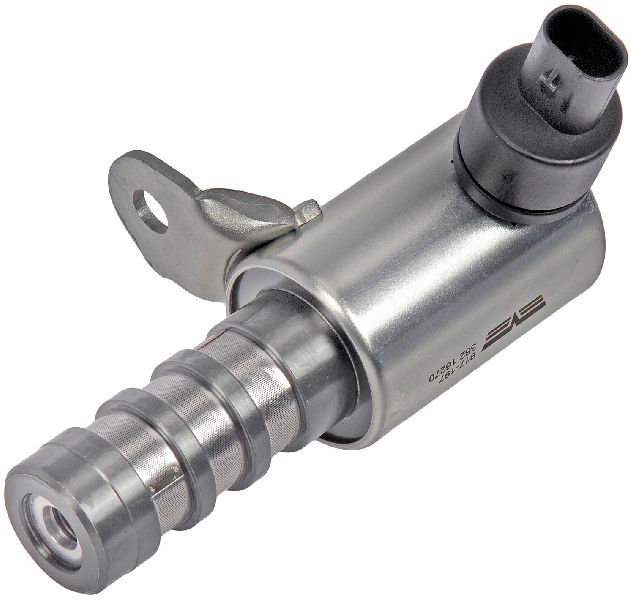
Est. part cost: $40-$80 - Failing VCT Solenoid (Bank 2 Intake) 🔴 High Probability → Shop Engine Variable Valve Timing (VVT) Solenoid This is a well-documented issue. Ford TSBs #SSM 50067 and #SSM 47170 directly state that P0022 can be caused by 'small debris causing the VCT solenoid to stick.' The solenoids are the primary actuators for the timing system and a common failure point.
How to confirm: After an oil change, if the code persists, the solenoid is the next suspect. A mechanic can command the solenoid with a scan tool. A common DIY method is to swap the Bank 2 intake and exhaust solenoids (if they are identical) and see if the code changes to P0024 (exhaust over-retarded). If it does, the solenoid is faulty. Resistance can also be tested with a multimeter; a good solenoid should read between 6.9 and 7.9 ohms at room temperature.
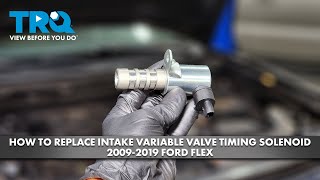
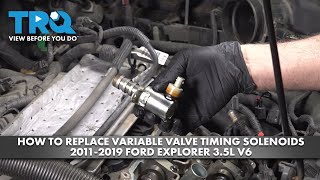
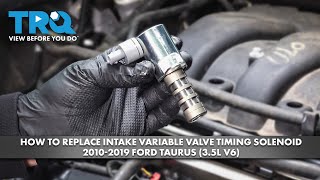
Typical fix: Replace the Bank 2 intake VCT solenoid. Since accessing the Bank 2 (rear) solenoids requires removing the upper intake manifold, it is highly recommended to replace all four solenoids (Bank 1 & 2, intake & exhaust) at the same time to avoid future repeat labor. 🎬 See this walkthrough for replacing all four VVT solenoids.
Est. part cost: $30-$70 per solenoid - Failed Camshaft Phaser (Bank 2 Intake) 🟡 Medium Probability → Shop Engine Camshaft The phaser is the mechanical gear that the VCT solenoid directs oil to. It can become clogged internally or fail mechanically, getting stuck in the retarded position. This is a known issue on the 3.5L engine family, especially at higher mileage.
How to confirm: This is a more advanced diagnosis. If new solenoids and clean oil do not fix the issue, the phaser is the next likely culprit. This usually requires professional diagnosis and teardown of the front engine cover.
Typical fix: Replace the camshaft phaser. This is a labor-intensive job that involves removing the valve cover and timing components. It is often recommended to replace the timing chain, guides, and tensioners at the same time.
Est. part cost: $100-$250 per phaser
Rare But Worth Checking
- Stretched Timing Chain or Worn Guides: → Shop Engine Timing Chain While less common than a solenoid failure, the 3.5L engines can suffer from timing chain stretch over time, especially past 100,000 miles. This is a major repair but can be the root cause if other diagnostics fail. A startup rattle is a key symptom. This repair can cost over $1,700 at a shop.
- PCM Calibration Issue: For some 2016 models, Ford issued TSB 15-0151 for the 3.5L GTDI engine, which states that DTCs P0012 and/or P0022 can be caused by a software issue. The fix is to reprogram the PCM to the latest calibration.
Diagnosis Steps
- Check Engine Oil: Verify the oil level is full and the oil is clean. If it's low, dirty, or the wrong viscosity, perform an oil and filter change with the manufacturer-recommended oil (e.g., Motorcraft 5W-20 or 5W-30). Clear the code and drive to see if it returns. Some owners report the code clearing on its own after a few days of driving post-oil change.
- Scan Tool Analysis: Use an OBD-II scanner with live data capability. Monitor the PIDs for commanded vs. actual camshaft position for the Bank 2 intake cam (e.g., VCT_INT_CMD2 vs. VCT_INT_ACT2). A significant, persistent lag between the two confirms the over-retarded state. The VCT error PID (e.g., VCT_INT_DIF2) should be close to zero; a large deviation indicates a problem.
- Test the VCT Solenoid: The Bank 2 solenoids are on the rear of the engine, near the firewall, and require removing the upper intake manifold for access. Once accessed, you can test the solenoid's resistance with a multimeter (should be 6.9-7.9 ohms). A more definitive test is to swap the intake and exhaust solenoids to see if the trouble code follows the part (e.g., P0022 changes to P0024).
- Inspect Wiring: Check the wiring harness and connector to the Bank 2 intake VCT solenoid for any damage, corrosion, or loose connections. A circuit fault can mimic a failed solenoid.
- Advanced Mechanical Diagnosis: If the oil and solenoid are good, the problem is likely mechanical inside the engine. This points to a faulty camshaft phaser or, in more serious cases, a stretched timing chain or broken guides. This level of diagnosis and repair should be performed by a professional.
- Consult TSBs: Be aware of Ford TSBs #SSM 50067, #SSM 47170, and #SSM 54366, which all point to debris causing the VCT solenoid to stick. For 2016 models, check for TSB 15-0151 regarding a PCM reflash.
Parts You'll Likely Need
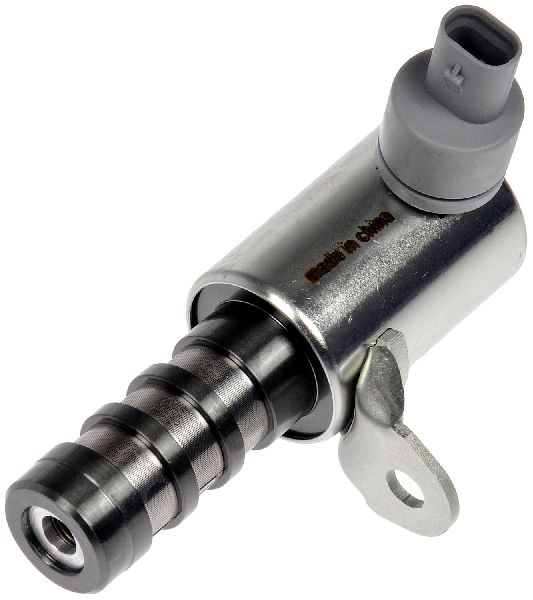
- Engine Variable Valve Timing (VVT) Solenoid
(OEM #AT4Z-6M280-B)— This part is the most frequent cause of P0022, often failing due to internal blockage from oil debris, as acknowledged in Ford TSBs. The part number AT4Z-6M280-A was also used, but AT4Z-6M280-B is a common replacement. Note that on some 3.5L engines, intake and exhaust solenoids for different banks may have unique part numbers.
Trusted brands: Motorcraft, Standard Motor Products (SMP), Dorman, TRQ
OEM price range: $40-$70
Aftermarket price range: $25-$50 - Upper Intake Manifold Gaskets
(OEM #BR3Z-9E936-A (example, verify for specific engine))— These must be replaced when accessing the Bank 2 (rear) VCT solenoids, as the intake manifold has to be removed. Reusing old gaskets can cause vacuum leaks.
Trusted brands: Motorcraft, Fel-Pro
OEM price range: $30-$50
Aftermarket price range: $15-$30
Related Codes That Often Appear With This One
- P0012 — This is the same 'over-retarded' code but for Bank 1. Seeing both P0012 and P0022 together strongly suggests a systemic oil pressure or quality issue affecting the entire engine, or a potential PCM software issue on some 2016 models.
- P0016, P0017, P0018, P0019 — These are correlation codes between the crankshaft and camshafts. They often appear alongside VCT codes and can point towards a more serious base timing issue, like a stretched or jumped timing chain.
Technical Service Bulletins (TSBs) & Recalls
- SSM 50067: Notes that various VCT codes, including P0022, may be due to small debris causing the VCT solenoid to stick.
- SSM 47170: An earlier bulletin with the same guidance as SSM 50067, indicating a known issue with debris affecting VCT solenoids.
- SSM 54366: Refers to diagnostic procedures for a range of VCT codes, including P0022.
- TSB 15-0151: Specific to some 2016 3.5L GTDI engines, advises a PCM reprogram for P0012 and/or P0022.
Platform-Specific Known Issues
- Ford has issued multiple Technical Service Bulletins (TSBs) that are relevant to this code. Bulletins #SSM 50067 and #SSM 47170 for 2015-2019 models state that DTCs including P0022 may be caused by 'small debris causing the VCT solenoid to stick.' They advise performing diagnosis before replacing components. Bulletin #SSM 54366 also references this group of codes and points technicians to specific diagnostic tests in the workshop manual.
- TSB 15-0151 was issued for some 2016 Ford Explorer models with the 3.5L GTDI engine, which states that DTCs P0012 and/or P0022 can be caused by a software issue. The fix is to reprogram the PCM to the latest calibration.
Mechanic-Grade Diagnostic Values
- VCT Solenoid Internal Resistance — expected: 6.9 to 7.9 Ohms at 68°F (20°C). Failure: No reading (open circuit) or a reading significantly outside this range.
- VCT Solenoid Power Supply Voltage — expected: Battery voltage (approx. 12.0-12.6V) with ignition on, engine off.. Failure: Low or no voltage indicates a problem with the VPWR circuit or fuse.
- Live Data VCT Error PID (VCT_INT_DIF2) — expected: Should hover around 0° (±5° is acceptable for brief periods).. Failure: A significant and persistent deviation from 0° indicates the cam is not reaching its commanded position.
- Live Data VCT Solenoid Duty Cycle PID — expected: The PCM will increase the duty cycle percentage to try and correct a lagging camshaft.. Failure: If the duty cycle for Bank 2 is significantly higher than Bank 1 with little change in cam angle, it suggests a mechanical or hydraulic restriction (clogged solenoid/phaser).
Scan Tool Commands That Help
- Ford IDS (Integrated Diagnostic System): VCT Solenoid Pinpoint Test / Output State Control — As per Ford TSBs, a technician can use this function to command the VCT solenoid on and off multiple times (e.g., 10 cycles) to try and dislodge small debris that may be causing it to stick, potentially clearing the fault without part replacement.
- Ford IDS (Integrated Diagnostic System): Power Balance Test — While not specific to P0022, if the timing issue is causing a rough idle or misfire, this bidirectional test can help identify which cylinder(s) are affected by individually disabling them, helping to correlate the timing fault with a specific performance issue.
Wiring & Ground Locations
- G104 — On the transmission assembly.. This is a major ground point for the engine and transmission assembly. While not directly for the VCT solenoid, a poor ground at this location can introduce electrical noise and voltage issues to various engine sensors, potentially affecting PCM calculations and sensor readings related to the timing system.
- VCT Solenoid Connector (Bank 2) — On the rear valve cover, near the firewall. The intake solenoid connector is often black, while the exhaust may be a different color (e.g., white).. This is the direct connection point for testing. Pin 1 is typically the power supply (VPWR) and Pin 2 is the control line from the PCM (ground-switched). Checking for voltage, ground signal, and corrosion here is a primary electrical diagnostic step.
Real Owner Repair Stories
- Ford F150 Forum (Ford F-150 with 3.5L EcoBoost (similar engine architecture)) — P0022 code appeared, accompanied by a cam phaser rattle that started happening while driving, not just on startup.
❌ Tried (didn't work) Replacing the VVT solenoids, Replacing the camshaft position sensor
✅ What actually fixed it The owner performed a full timing job, replacing the cam phasers and all related timing components. This resolved the code and the noise. - Reddit r/MechanicAdvice (2016 Ford F-150 5.0L (shares VCT design principles)) — Engine would bog down, RPMs would slide and bounce, and it would sometimes stall at red lights.
❌ Tried (didn't work) Initial diagnosis was unclear.
✅ What actually fixed it A mechanic replaced the VCT solenoids, which completely fixed the stalling and RPM fluctuation problem.
OEM Part Supersession History
AT4Z-6M280-A→AT4Z-6M280-B— Part revision and update by Ford. The -B version is the common service replacement part.
Heads up: For some earlier model years or different 3.5L/3.7L engines, different VCT solenoid part numbers exist. It is critical to verify the correct part number for the specific vehicle's intake/exhaust and bank, as they are not always interchangeable across all Cyclone engine variants.
Model Year Variations Within This Range
- 2017+: The second-generation 3.5L EcoBoost (used in F-150 and other platforms, but not the Flex) received significant updates, including a redesigned VCT phaser system to improve reliability and reduce startup rattle. While the Flex retained the first-generation EcoBoost through 2019, this highlights Ford's acknowledgement of and improvements to the VCT system in the broader engine family.
Helpful Videos
We Have This Part in Stock


The information in this article is provided for general reference and educational purposes only. Vehicle specifications, procedures, and part compatibility can vary by production date, trim level, and region. Always consult your vehicle's factory service manual and verify part numbers before purchasing or performing repairs. Safety-critical components such as airbags, seat belts, and braking systems should be installed by a qualified professional.
- Ford FLEX:
- 🧭 Diagnostic Flowchart
- 🎬 Helpful Videos
- 🛍️ Shop This Part
- What's Unique About the 2015-2019 Ford FLEX
- Symptoms You May Notice
- Most Likely Causes
- Rare But Worth Checking
- Diagnosis Steps
- Parts You'll Likely Need
- Related Codes That Often Appear With This One
- Technical Service Bulletins (TSBs) & Recalls
- Platform-Specific Known Issues
- Mechanic-Grade Diagnostic Values
- Scan Tool Commands That Help
- Wiring & Ground Locations
- Real Owner Repair Stories
- OEM Part Supersession History
- Model Year Variations Within This Range
- 🎟️ Get 5% Off