

P0022 on 2006-2011 Hyundai Azera: Causes and Fixes for Over-Retarded Camshaft Timing
For a 2006-2011 Hyundai Azera with a P0022 code, the most common cause is low or dirty engine oil, followed by a faulty Bank 2 (firewall side) Oil Control Valve (OCV). First, check your oil. If the oil level and quality are good, the OCV is the likely culprit. Before replacing the OCV, also check the small filter screen in the head underneath it for clogs. The updated OEM part number for the OCV is 24355-3C200.
- Always check your engine oil level and condition first; an oil change may fix the problem.
- The most likely failed part is the Bank 2 (rear/firewall side) Oil Control Valve (OCV), part number 24355-3C100.
- A simple diagnostic is to swap the rear OCV with the front one (Bank 1). If the code changes to P0012, you've confirmed the OCV is bad.
- Do not replace the camshaft position sensor for this code; it is almost always an oil pressure or mechanical issue.
- If you hear a rattle on startup, the problem could be a more serious timing chain tensioner issue.
What's Unique About the 2006-2011 Hyundai Azera
The Lambda V6 engines in this generation of Hyundai vehicles are highly dependent on clean oil and proper oil pressure for the CVVT system to function correctly. Oil sludge from extended oil change intervals or using non-OEM spec oil filters can quickly clog the narrow passages in the Oil Control Valves (OCV) and the small filter screens beneath them. While the OCV is a common failure point, these engines are also known for hydraulic timing chain tensioners that can bleed down oil pressure when parked, causing a distinct rattling noise on startup and potentially triggering timing codes. It is important to note that while Bank 2 is the rear/firewall bank on the Azera, it is the front/radiator bank on other popular Lambda platforms like the Santa Fe and Veracruz, which can cause confusion during diagnosis.
Symptoms You May Notice
- Check Engine Light is on
- Rough or unstable idle
- Engine hesitates or stumbles during acceleration
- Reduced engine power
- Decreased fuel economy
- Engine may be hard to start or stall
- Rattling noise from the engine for a few seconds on a cold startup
- Replacing the Camshaft Position Sensor (CMP). A P0022 code indicates a mechanical timing problem (the camshaft is not where it's supposed to be), not an electrical failure of the sensor that reads its position. A bad sensor would typically set a different code, like P0346.
Most Likely Causes
- Low or Dirty Engine Oil 🔴 High Probability The CVVT system is entirely dependent on oil pressure and cleanliness. Sludge or low levels directly impact its ability to adjust cam timing, causing over 30% of P0022 codes.
How to confirm: Check the engine oil level on the dipstick and inspect its color and consistency. If the level is low or the oil is dark, gritty, or sludgy, this is the likely cause.
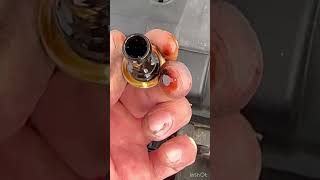
Typical fix: Perform an oil and filter change using a quality 5W-20 or 5W-30 synthetic oil and an OEM-spec oil filter. Clear the code and drive to see if it returns. Many owners report this alone solves the issue. 🎬 Watch: Two simple DIY methods to clear the P0022 code.
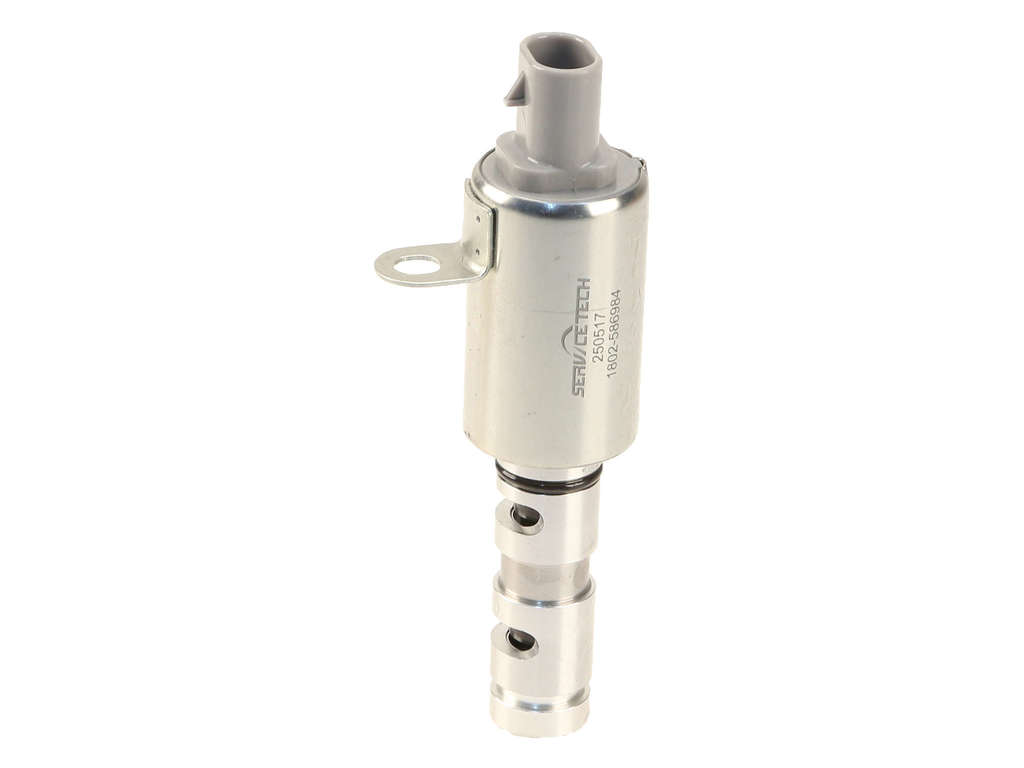
Est. part cost: $40-$80 - Faulty Bank 2 Oil Control Valve (OCV) / VVT Solenoid 🔴 High Probability → Shop Engine Variable Valve Timing (VVT) Solenoid The OCV can become clogged with sludge or fail electrically, preventing it from properly directing oil pressure to the camshaft phaser. It is the most common hardware failure for this code, accounting for around 40% of cases.
How to confirm: The most effective method is to swap the Bank 2 (rear/firewall side) OCV with the Bank 1 (front/radiator side) OCV. Clear the codes and drive. If the trouble code changes from P0022 to P0012 (the Bank 1 equivalent), the OCV is confirmed to be faulty. You can also test the coil resistance, which should be between 6.9 and 7.9 Ohms at 68°F (20°C).
Typical fix: Replace the faulty Oil Control Valve. Bank 2 is the left-hand (LH) valve, located on the rear cylinder head.
Est. part cost: $50-$120 - Clogged OCV Filter Screen 🟡 Medium Probability A small, cylindrical mesh filter is located in the cylinder head oil passage directly beneath the OCV. This screen can become clogged with sludge, starving the OCV of oil pressure even if the valve itself is functional. This is an often-overlooked cause.
How to confirm: When the OCV is removed for inspection or swapping, use a small pick or screw to carefully extract the filter screen from its bore in the cylinder head. Visually inspect it for blockage from dark, sludgy debris.
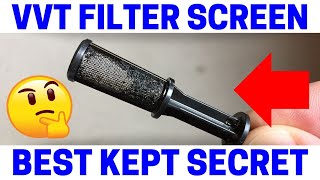
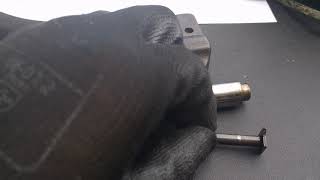
Typical fix: Thoroughly clean the screen with brake cleaner and compressed air, or replace it if it is damaged or cannot be cleaned. The part is inexpensive. 🎬 See how to locate and replace the VVT oil filter screen.
Est. part cost: $5-$15 - Failing Timing Chain Tensioner 🟡 Medium Probability → Shop Engine Timing Chain The hydraulic timing chain tensioners on Lambda engines are known to lose oil pressure when the engine is off, causing chain slack on startup. This slack can cause the timing to be off enough to trigger a code, especially on a cold start.
How to confirm: A distinct rattling or grinding noise from the engine for 2-5 seconds immediately after a cold start is a strong indicator. This diagnosis is often confirmed after OCV and oil issues have been ruled out.
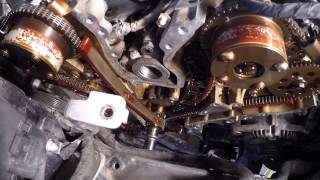
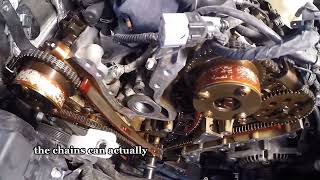
Typical fix: Replace the timing chain, guides, and tensioners. Hyundai released an improved tensioner part to address this. TSB 10-EM-006 provides a revised procedure for replacing the tensioners without removing the engine. 🎬 Watch this explanation of the V6 timing chain tensioner rattle.
Est. part cost: $200-$500
Rare But Worth Checking
- Sticking or Failed Camshaft Phaser (CVVT Actuator): → Shop Engine Camshaft If a new OCV, clean filter screen, and fresh oil do not resolve the issue, the mechanical phaser on the end of the camshaft may be stuck or damaged, preventing it from rotating as commanded. This is a more involved and expensive repair.
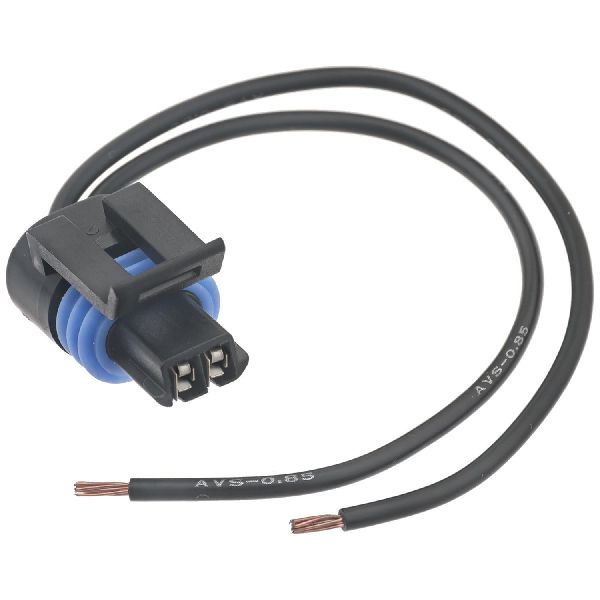
- Wiring or Connector Issue to the OCV: Check the wiring harness and connector for the Bank 2 OCV for any damage, corrosion, or oil contamination, especially from a leaking valve cover gasket. A poor connection can prevent the ECM from controlling the valve properly.
Diagnosis Steps
- Check Engine Oil Level and Condition: Verify the oil is at the full mark and is clean. If low or dirty, perform an oil and filter change, clear the code, and re-test. This simple step resolves many cases.
- Scan for Other Codes: Check for any other related codes that could provide more clues (e.g., misfire codes, other timing codes like P0021, or sensor circuit codes like P0346).
- Inspect OCV Connector: Check the electrical connector and wiring for the Bank 2 (rear/firewall side) OCV for damage or oil saturation.
- Perform OCV Swap Test: Swap the Bank 2 (rear) and Bank 1 (front) intake OCVs. They are identical parts. Clear the codes and drive the vehicle. If the code changes to P0012, the OCV you moved to Bank 1 is faulty and needs replacement. This is a definitive, no-cost diagnostic test.
- Inspect and Clean OCV Filter Screen: While the OCV is removed, extract and inspect the small filter screen in the cylinder head bore beneath it. If it's clogged with sludge, clean it with brake cleaner or replace it.
- Listen for Startup Rattle: On a cold start (after sitting for several hours), listen carefully for any rattling from the engine bay that lasts for a few seconds. This points towards a timing chain tensioner issue.
- Advanced Mechanical Checks: If all else fails, the issue may be a stuck camshaft phaser or a stretched timing chain, which requires more in-depth mechanical diagnosis, likely by a professional.
Parts You'll Likely Need
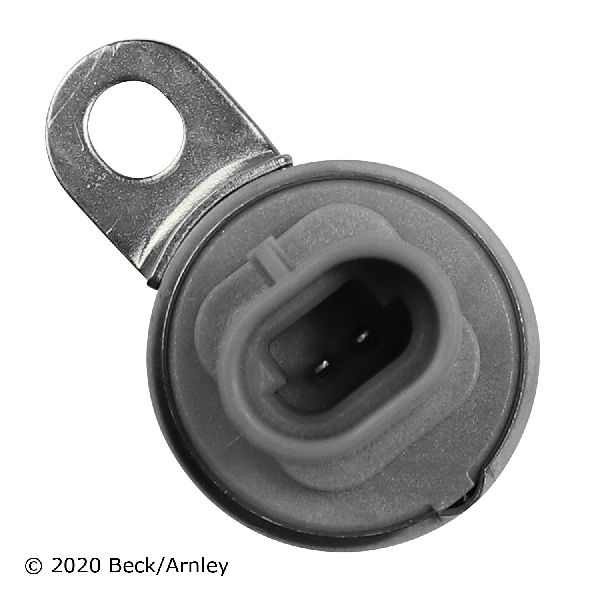
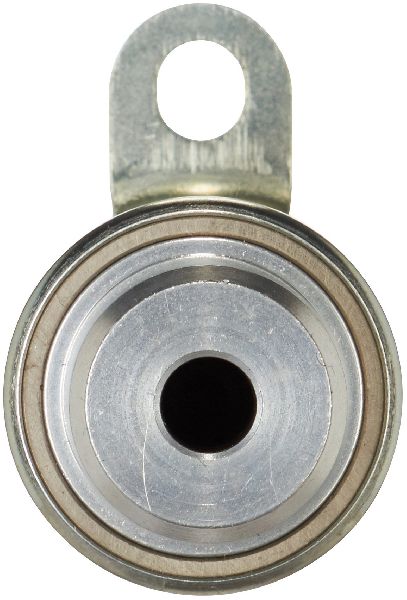
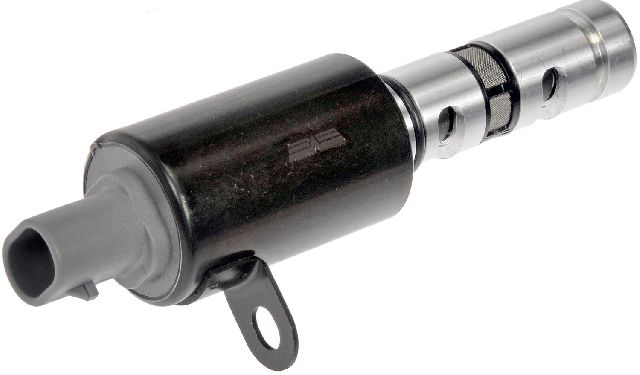
- Oil Control Valve (VVT Solenoid), Left Hand / Bank 2
(OEM #24355-3C100 (superseded by 24355-3C200))— This is the most common component to fail or become clogged, directly causing the P0022 code. Bank 2 is the LH (firewall) side. Using the updated OEM part is recommended.
Trusted brands: Hyundai Genuine, Dorman, Standard Motor Products (SMP)
OEM price range: $90-$130
Aftermarket price range: $40-$80 - Engine Oil and Filter — Low or contaminated oil is a primary cause of all VVT system faults. Always start with an oil change using the correct viscosity (5W-20 or 5W-30) and a quality filter.
Trusted brands: Pennzoil, Mobil 1, Castrol, Hyundai Genuine Filter
OEM price range: $60-$90
Aftermarket price range: $40-$70
Related Codes That Often Appear With This One
- P0012 — This is the equivalent over-retarded code for Bank 1. It will appear if you swap a faulty Bank 2 OCV to Bank 1 as a diagnostic test, confirming the OCV is the problem.
- P0021 — This is the 'over-advanced' code for the same Bank 2 intake camshaft. It shares the same root causes, such as a failing OCV or oil pressure problems, and can appear intermittently if the OCV is sticking.
- P0300, P0301-P0306 — Incorrect camshaft timing can cause unstable engine operation, leading to random or specific cylinder misfires as combustion is disrupted.
Technical Service Bulletins (TSBs) & Recalls
- TSB 09-EM-002: Provides the inspection procedure and coil resistance specifications (6.9-7.9 Ohms) for the Oil Control Valve (OCV) on Lambda V6 engines.
- TSB 10-EM-006: Supersedes an earlier TSB and provides a revised service procedure for replacing the timing chain tensioners without removing the engine.
Platform-Specific Known Issues
- A recall on the related Hyundai Veracruz (NHTSA 14V432000) for a leaking valve cover gasket highlights the platform's sensitivity to oil levels, which directly cause CVVT codes like P0022. While not a direct Azera recall for this part, the shared engine makes the issue relevant.
- The 2006 model year, in particular, has the highest number of owner complaints for a variety of issues, including engine and electrical problems.
Mechanic-Grade Diagnostic Values
- Oil Control Valve (OCV) Coil Resistance — expected: 6.9 - 7.9 Ω at 68°F (20°C). Failure: A reading outside this range indicates a faulty solenoid coil.
- OCV Power Supply Voltage (at harness connector) — expected: Battery voltage (~12V) with Ignition ON, Engine OFF. Failure: No voltage suggests a blown fuse or a break in the power supply wire from the main relay.
- Scan Tool Live Data: Desired vs. Actual Cam Angle (Bank 2) — expected: The 'Actual' value should closely track the 'Desired' value as engine RPM changes.. Failure: A significant and persistent lag between the actual and desired angle (greater than 20 degrees) confirms the over-retarded condition.
Scan Tool Commands That Help
- Hyundai GDS (Global Diagnostic System): CVVT Actuator Test — This bidirectional test directly commands the OCV to operate. The technician should hear a clicking sound from the solenoid, confirming it is mechanically responding to the ECM's command. This helps differentiate a stuck valve from an electrical or oil pressure issue.
- Hyundai GDS (Global Diagnostic System): Flight Record / Data Analysis — For intermittent faults, this function records live data during a drive. When the symptom occurs, the driver can press a trigger to save the data from the moments leading up to the event. This allows a technician to analyze the commanded vs. actual cam angle at the exact moment the fault happened.
Wiring & Ground Locations
- G115 — Left rear of the engine compartment.. This is a primary engine ground. A loose or corroded connection at this point can cause erratic behavior and incorrect readings from various engine sensors, including the Camshaft and Crankshaft Position Sensors, which are critical for timing calculations.
- Bank 2 OCV Connector — On top of the rear cylinder head (firewall side), connected to the OCV.. This connector is the direct electrical interface to the faulty component. Pin 1 is the power supply (should have battery voltage with key on), and Pin 2 is the control signal from the ECM. Testing voltage and continuity here is a key diagnostic step.
Real Owner Repair Stories
- Hyundai-Forums user thread (2007 Hyundai Azera 3.8L) — Check engine light with P0022, rough idle, and hesitation.
❌ Tried (didn't work) Changed engine oil and filter., Replaced the Bank 2 Oil Control Valve (OCV)., Swapped OCVs between banks with no change in the code.
✅ What actually fixed it The final resolution was replacing the Bank 2 CVVT phaser assembly itself. The internal locking pin of the original phaser was likely stuck, preventing it from advancing even with a functional OCV and good oil pressure.
OEM Part Supersession History
24355-3C100→24355-3C200— The updated part is believed to have improved internal components to better resist sticking from oil sludge and debris.
Heads up: The parts are interchangeable, but it is highly recommended to use the newer 24355-3C200 part for any replacement to ensure longevity.
Model Year Variations Within This Range
- 2011: For the 2011 model year, both the 3.3L and 3.8L engines received a power increase (to 260 hp and 283 hp, respectively) and were paired with a new 6-speed automatic transmission, replacing the previous 5-speed. While the fundamental CVVT system causing P0022 remains the same, the engine and transmission control software will differ from earlier years.
Diagnostic Flowchart
Other Known Issues on This Vehicle
Issues unrelated to this code that are worth knowing about as an owner of this generation:
- Timing Chain Tensioner Rattle on Startup 🔴 High → Shop Engine Timing Chain — Common, especially on vehicles with over 75,000 miles or inconsistent oil change history. The noise lasts 2-5 seconds after a cold start. (Ref: TSB 10-EM-006 describes a revised, in-vehicle replacement procedure. RepairPal also notes that improved tensioners are available.)
- Malfunctioning Stop Lamp Switch 🟠 Medium — Widespread enough to trigger a major recall (NHTSA 13V113000). (Ref: Hyundai Recall 110 / NHTSA 13V113000. The faulty switch could prevent brake lights from illuminating or prevent cruise control from deactivating.)
- ABS Module Electrical Short 🔴 High — A recall was issued due to the risk of water ingress causing an electrical short, which could lead to an engine compartment fire. (Ref: Hyundai Recall 151 / NHTSA 16V869000. Affects 2006-2011 Azera models.)
- No Sound from Speakers 🟡 Low — A commonly reported electrical issue where the factory amplifier fails, causing a total loss of audio. It is one of the top complaints on RepairPal for the Azera.
- Rear Suspension Corrosion 🔴 High — A recall was issued for vehicles in salt-belt states due to corrosion of the rear crossmember, which could affect rear wheel alignment. (Ref: Hyundai Recall 120 / NHTSA 13V354000.)
Used vs. New Parts: Buying Guide for This Vehicle
When a used part is the smart pick: A used Oil Control Valve (OCV) from a low-mileage, reputable junkyard can be a cost-effective diagnostic tool. If swapping a used OCV fixes the problem, it confirms the diagnosis without the cost of a new part. However, for a permanent repair, a new part is recommended due to the high failure rate of this component.
Donor-vehicle mileage cap: roughly under 60000 miles for the part to have meaningful remaining life.
What to inspect on the donor part:
- Verify the donor vehicle's mileage is under 60,000 miles.
- Inspect the OCV's electrical connector for corrosion or damage.
- Check the small mesh screens on the valve for any signs of metallic debris or heavy sludge, which would indicate poor engine health of the donor vehicle.
OEM-only on this vehicle (don't cheap out):
- CVVT Cam Phaser Assembly: This is a precision-machined mechanical part. Aftermarket versions have a high risk of premature failure or incorrect operation. Given the high labor cost to replace it, using a genuine OEM part is critical.
- Timing Chain and Tensioners: Similar to the phaser, the timing components are critical to engine health. OEM parts are designed for the specific harmonics and tension requirements of the Lambda engine.
Aftermarket brands forum-validated for this vehicle:
- Aisin (for OCV/VVT Solenoid): Aisin is a well-regarded OEM supplier for many Japanese and Korean automakers and is often considered a reliable alternative to genuine dealer parts.
Brands owners have reported issues with on this vehicle:
- No-name/unbranded OCVs from online marketplaces: These often have lower quality control, using solenoid coils that fail quickly or internal spools that do not meet the precise tolerances required, leading to a quick return of the P0022 code.
Real Owner Stories
Aggregated from forums and TSBs cited above. Mileages and costs reflect what owners reported in those sources.
2013 Hyundai Azera 3.3L
Symptoms: Classic cold start rattle.
What fixed it: Replacing the timing chain tensioner, along with the chain and guides at the same time.
Source hint: hyundai-forums.com - 'timing chain rattle' (2021)
Hyundai Lambda V6
Symptoms: Startup rattle.
What fixed it: Replacement of the oil pump which was taking too long to build pressure.
Source hint: bobistheoilguy.com - 'Start up rattle' (2021)
2008 Hyundai Veracruz 3.8L
Symptoms: A cluster of timing codes including P0022, P0021, and P0018.
What fixed it: Issues persisted even after having the timing chain, guides, and tensioner replaced, illustrating multiple layers of failure.
Source hint: reddit.com - r/MechanicAdvice - 'Need help with a 2008 Hyundai Veracruz' (2024)
Related OBD-II Codes
Frequently Asked Questions
Is there a TSB for the rattling noise I hear on cold starts in my Azera?
How can I test if the Bank 2 Oil Control Valve is actually bad without buying a new part?
Does the Hyundai Veracruz recall for leaking valve covers affect my Azera's P0022 code?
What type of oil should I use to prevent CVVT issues in my 3.3L/3.8L engine?
I've heard about a small filter screen; where is it located on the Azera V6?
Helpful Videos
![How to Fix P0022 Engine Code in 4 Minutes [2 DIY Methods / Only $6.53]](https://img.youtube.com/vi/BO7HzbeFxqo/mqdefault.jpg)
We Have This Part in Stock


The information in this article is provided for general reference and educational purposes only. Vehicle specifications, procedures, and part compatibility can vary by production date, trim level, and region. Always consult your vehicle's factory service manual and verify part numbers before purchasing or performing repairs. Safety-critical components such as airbags, seat belts, and braking systems should be installed by a qualified professional.
- Hyundai Azera:
- 🧭 Diagnostic Flowchart
- 🎬 Helpful Videos
- 🛍️ Shop This Part
- What's Unique About the 2006-2011 Hyundai Azera
- Symptoms You May Notice
- Most Likely Causes
- Rare But Worth Checking
- Diagnosis Steps
- Parts You'll Likely Need
- Related Codes That Often Appear With This One
- Technical Service Bulletins (TSBs) & Recalls
- Platform-Specific Known Issues
- Mechanic-Grade Diagnostic Values
- Scan Tool Commands That Help
- Wiring & Ground Locations
- Real Owner Repair Stories
- OEM Part Supersession History
- Model Year Variations Within This Range
- Other Known Issues on This Vehicle
- Used vs. New Parts: Buying Guide for This Vehicle
- Real Owner Stories
- 2013 Hyundai Azera 3.3L
- Hyundai Lambda V6
- 2008 Hyundai Veracruz 3.8L
- Related OBD-II Codes
- Frequently Asked Questions
- 🎟️ Get 5% Off