

P0022 on 2013-2018 Hyundai Santa Fe 3.3L V6: Causes and Fixes for Over-Retarded Cam Timing
For the 2013-2018 Santa Fe 3.3L, P0022 is almost always caused by low/dirty engine oil or a failing Bank 2 (front) Oil Control Valve (OCV). An oil change is the first step. If the OCV needs replacement, be aware it's a labor-intensive job as the part is located under the upper and lower intake manifolds, requiring several hours of work.
- Always check your engine oil first. A simple oil change with the correct full synthetic oil and an OEM filter is the cheapest and easiest first step and often fixes the issue.
- The most likely failed part is the Bank 2 (front/radiator side) Oil Control Valve (OCV), but it is difficult to access.
- Due to the OCV's location under the intake manifold, this repair has a high DIY difficulty (4/5) and involves significant labor time.
- Do NOT replace the camshaft position sensor; it is almost never the cause of a P0022 code.
What's Unique About the 2013-2018 Hyundai Santa Fe
The key challenge on the 3.3L Lambda II GDi V6 is the location of the Bank 2 Oil Control Valve (OCV). Unlike many engines where OCVs are easily accessible, the Bank 2 (front) OCV is buried under the upper and lower intake manifolds. This turns a simple part swap into a significant repair job requiring removal of the throttle body, surge tank, and both intake manifolds, which can take a professional 3-4 hours. Because of this, the common diagnostic trick of swapping the Bank 1 and Bank 2 solenoids is not practical for a DIY mechanic on this specific vehicle.
Symptoms You May Notice
- Check Engine Light is on
- Rough or unstable idle
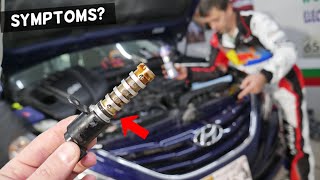
- Engine hesitation or stumbling during acceleration 🎬 See: Common symptoms of a failing VVT solenoid in action.
- Reduced engine power
- Decreased fuel economy
- Engine may be hard to start or stall at low speeds
- A rattling noise from the engine on cold startup for 2-4 seconds (if related to timing chain tensioner)
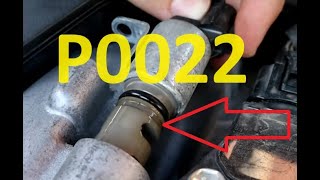
- Replacing the Camshaft Position Sensor (CMP). P0022 indicates a mechanical timing problem (the camshaft is not in the right place), not an electrical failure of the sensor 🎬 Watch: A breakdown of P0022 causes and common fixes. that reads its position. If the sensor were bad, you would typically see codes like P0345 or P0346.
Most Likely Causes
- Low, Dirty, or Incorrect Viscosity Engine Oil 🔴 High Probability The Continuously Variable Valve Timing (CVVT) system is highly dependent on clean oil and correct oil pressure to function. The 3.3L GDi engine is known to have potential oil consumption issues, making it critical to check the oil level frequently. Using non-OEM oil filters has also been anecdotally linked to CVVT problems due to pressure differences.
How to confirm: Check the engine oil level on the dipstick and inspect its condition. If the level is low, or the oil is dark, sludgy, or past its service interval, this is the most likely cause. A Reddit user with a 2017 Santa Fe reported their engine died suddenly on a highway on-ramp; the cause was a complete lack of oil on the dipstick due to excessive consumption, which was ultimately covered under an extended warranty for rod bearing failure.
Typical fix: Perform a complete oil and filter change using a high-quality OEM filter and the correct full synthetic oil viscosity (typically 5W-30) as specified in your owner's manual. Clear the code and drive to see if it returns.
Est. part cost: $40-$80 - Failing Bank 2 (Front) Intake Oil Control Valve (OCV/VVT Solenoid) 🔴 High Probability → Shop Engine Variable Valve Timing (VVT) Solenoid The OCV is a solenoid that frequently gets clogged with oil sludge or fails electrically, preventing it from properly directing oil pressure to the camshaft phaser. It is a very common failure point on Hyundai's Lambda V6 engines.
How to confirm: Because the Bank 2 OCV is under the intake manifold, a physical swap with Bank 1 is not feasible for easy diagnosis. The part can be tested with a multimeter for resistance (should be around 6.9-7.9 Ohms at 68°F) or by applying 12V power to see if the internal plunger actuates with a click. If an oil change doesn't fix the code, this is the next logical suspect.
Typical fix: Replace the Bank 2 intake Oil Control Valve. This requires removing the upper and lower intake manifolds to access the part. The upper and lower intake manifold gaskets should also be replaced at the same time.
Est. part cost: $50-$120
Rare But Worth Checking
- Stretched Timing Chain or Failed Tensioner: → Shop Engine Timing Chain This is a more serious mechanical issue. A key symptom is a distinct rattling noise from the engine for a few seconds on a cold startup, which indicates slack in the chain before oil pressure builds. If you hear this noise along with the P0022 code, a timing issue is more likely.
- Clogged OCV Filter Screen: Some Hyundai engines have small, secondary filter screens in the oil passages leading to the OCVs. If these become clogged with sludge, they can restrict oil flow and cause timing codes even if the OCV itself is functional. These are typically cleaned or replaced during an OCV replacement.
- Failing Camshaft Phaser (CVVT Actuator): → Shop Engine Camshaft The phaser is the mechanical gear on the end of the camshaft that actually adjusts the timing. It can get stuck or fail internally, but this is much less common than an OCV failure. This is a more complex and expensive repair.
- Wiring or Connector Issue: Damage to the wiring harness or a poor connection at the OCV connector can prevent the solenoid from receiving the correct signal from the ECM. This can be caused by corrosion, heat damage, or physical abrasion. A visual inspection of the harness leading to the OCV is recommended during replacement.
Diagnosis Steps
- Check the engine oil level and condition. If low or dirty, perform an oil and filter change with the correct viscosity full synthetic oil and an OEM filter, clear the code, and re-test.
- Scan for any other accompanying trouble codes. Codes like P0018 or misfire codes can provide additional diagnostic clues.
- Listen for engine noises. A distinct rattle on cold startup strongly suggests a timing chain/tensioner issue.
- If the oil change does not resolve the code, the next step is to inspect and test the Bank 2 intake Oil Control Valve (OCV).
- To access the Bank 2 OCV, the upper and lower intake manifolds must be removed. 🎬 Watch: How to remove the manifolds and inspect the valves.
- Once removed, inspect the OCV screen for sludge or debris. Test its resistance with a multimeter (should be approx. 6.9-7.9 ohms). You can also carefully apply 12V power to see if the solenoid clicks.
- Inspect the wiring and connector for the OCV for any signs of damage, corrosion, or loose pins.
- If the OCV is faulty or testing is inconclusive, replace it. It is highly recommended to also replace the upper and lower intake manifold gaskets at this time to prevent vacuum leaks.
- If the OCV is confirmed good but the code persists, the issue is likely a more serious mechanical problem like a stretched timing chain or faulty cam phaser, which requires professional diagnosis.
Parts You'll Likely Need
- Intake Oil Control Valve (VVT Solenoid) - Bank 2
(OEM #24355-3C200)— This solenoid is the most common part to fail for this code. It gets clogged with sludge or fails electrically, causing the timing to retard. Note: The original part may be 24355-3C100; 24355-3C200 is an updated version. Verify by VIN.
Trusted brands: Hyundai/Kia Genuine, Dorman, Standard Motor Products (SMP)
OEM price range: $70-$120
Aftermarket price range: $40-$80 - Upper and Lower Intake Manifold Gaskets
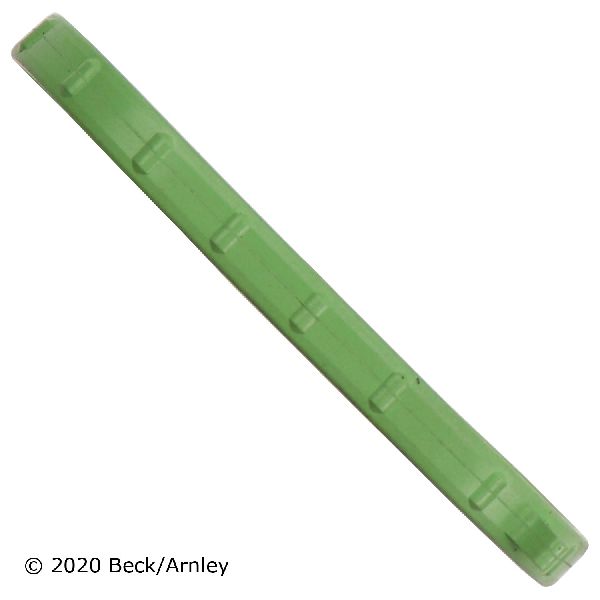
(OEM #Upper: 29215-3C301, Lower: 28411-3C622)— These must be replaced when removing the intake manifold to access the Bank 2 OCV to prevent future vacuum leaks.
Trusted brands: Hyundai/Kia Genuine, Fel-Pro, Mahle
OEM price range: $40-$60
Aftermarket price range: $20-$40
Related Codes That Often Appear With This One
- P0018 — This code indicates a correlation error between the Bank 2 camshaft and the crankshaft. It can appear with P0022 if the timing deviation is significant, pointing towards a more serious issue like a stretched timing chain.
- P0300, P0301-P0306 — Misfire codes can be triggered because the incorrect valve timing from the P0022 condition leads to poor combustion, which the ECM interprets as a misfire. Fixing the timing issue will usually resolve the misfires.
Technical Service Bulletins (TSBs) & Recalls
- TSB 09-EM-002: While not for this specific model, this TSB for other Hyundai V6s provides the OCV resistance specification of 6.9-7.9 Ohms, which is a useful diagnostic parameter.
- TSB 10-EM-006: Referenced for older 3.3L engines regarding timing chain tensioner issues, which can be a rare cause of this code.
- TSB 24-EM-003H: This is a critical TSB that extends the warranty for the engine short block assembly due to connecting rod bearing wear. While not directly for P0022, it addresses the root cause of potential oil consumption and low oil pressure that can trigger this code.
Platform-Specific Known Issues
- The location of the Bank 2 Oil Control Valve under the intake manifold is the most significant platform-specific issue, making a common repair much more difficult and costly in terms of labor.
- This engine is subject to a class-action lawsuit and an extended warranty (15yr/150k miles) for premature bearing failure, which can be preceded by excessive oil consumption. A P0022 code caused by low oil could be an early symptom of this larger problem.
Mechanic-Grade Diagnostic Values
- Bank 2 Intake Oil Control Valve (OCV) Resistance — expected: 6.9 - 7.9 Ohms at 68°F (20°C).. Failure: A reading of infinite resistance (OL) indicates an open coil, while a reading near zero indicates a shorted coil. Readings that change drastically when the part is hot can indicate a thermal failure.
- Scan Tool Live Data: CVVT Angle vs. Desired Angle — expected: While driving at a steady RPM (e.g., 2500 RPM), the 'CVVT Actual Position (B2)' should closely track the 'CVVT Desired Position (B2)' with a variance of less than 5 degrees.. Failure: If the 'Actual' angle is stuck at or near 0 degrees, or consistently lags the 'Desired' angle by more than 15 degrees while the OCV duty cycle is commanded high, it indicates a fault.
- Scan Tool Live Data: OCV Duty Cycle — expected: The 'CVVT Duty Cycle (B2)' PID will vary based on engine load and RPM as the ECM commands changes.. Failure: If the duty cycle is commanded to a high value (e.g., >80%) but the camshaft angle does not change, it points to a stuck OCV, a clogged oil passage, or a faulty phaser.
Scan Tool Commands That Help
- Hyundai GDS (or equivalent high-end scanner): CVVT Actuation Test / Operation Test — This bidirectional test is used after confirming oil level and pressure are good. It allows the technician to manually command the Bank 2 OCV to a specific duty cycle (e.g., 0%, 50%, 100%) while the engine is running. By observing the live camshaft angle data during this test, a technician can confirm if the OCV solenoid is physically responding and if the oil passages and phaser are functioning. If the angle changes as commanded, the issue may be intermittent or related to the ECM's control logic; if it doesn't change, it confirms a mechanical/hydraulic fault in the CVVT assembly.
- Hyundai GDS (or equivalent high-end scanner): Reset Adaptive Values — After replacing a major timing component like an OCV, cam phaser, or timing chain, this function should be used. It clears the long-term learned adjustments the ECM has stored for valve timing control, allowing it to re-learn the behavior of the new parts more quickly and prevent the code from returning due to old, incorrect adaptations.
Wiring & Ground Locations
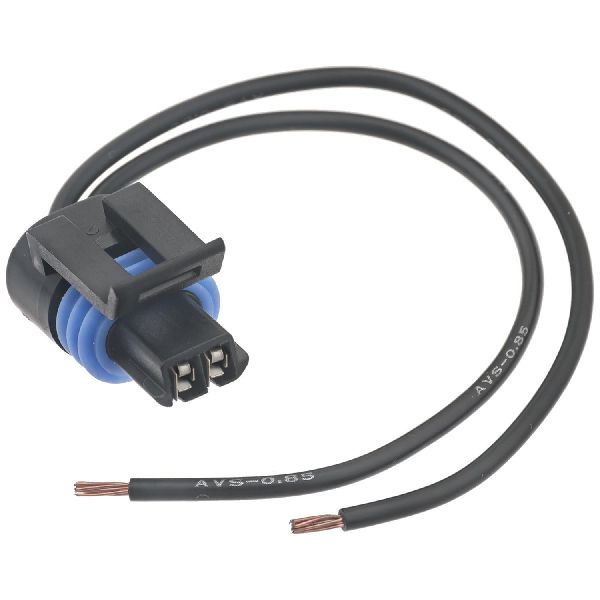
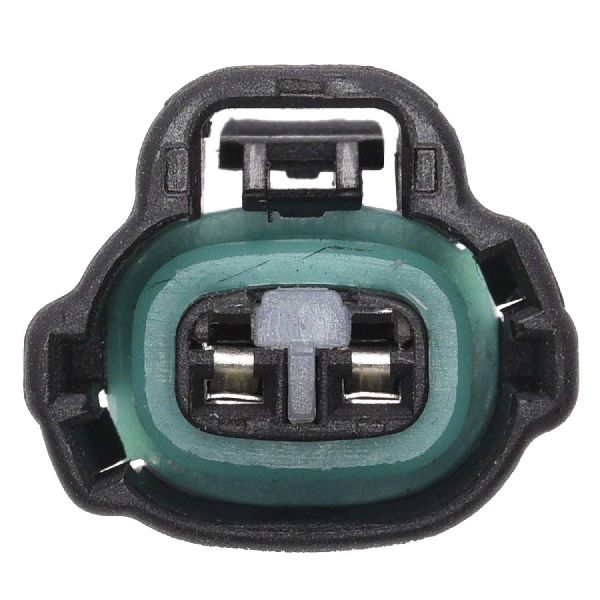
- Bank 2 Intake OCV Connector — On the Bank 2 (front/radiator side) cylinder head, connected to the intake OCV. Access requires removing the upper and lower intake manifolds.. This is the direct electrical connection for the faulty component. Testing should be done at this connector. Pin 1 is the control wire (ground-side switched) from the ECM. Pin 2 is the 12V+ power supply, which should be hot with the key on.
- Main Engine Ground (GE01/GE03) — Typically a heavy gauge strap bolted from the engine block or cylinder head to the chassis frame rail in the left side of the engine compartment.. A poor engine ground can cause erratic behavior in all engine sensors and actuators, including the OCVs. While not a primary cause, it should be checked for corrosion and tightness if multiple, seemingly unrelated electrical faults are present.
Real Owner Repair Stories
- hyundai-forums.com user (2014 Hyundai Santa Fe LWB 3.3L) — Check Engine Light with code P0022.
❌ Tried (didn't work) Performing an engine oil and filter change.
✅ What actually fixed it The user paid a mechanic to replace the Bank 2 (front) Oil Control Valve (OCV). The repair took 3.5 hours of labor due to the need to remove the intake manifold, which resolved the P0022 code.
OEM Part Supersession History
24355-3C100→24355-3C200— Internal design improvements for reliability and performance.
Heads up: The parts are physically interchangeable, but it is always recommended to use the latest available part number (24355-3C200) for the repair.
Diagnostic Flowchart
Other Known Issues on This Vehicle
Issues unrelated to this code that are worth knowing about as an owner of this generation:
- Premature Engine Bearing Failure / Seizure 🔴 High — Occurs frequently enough to have prompted class-action lawsuits and a warranty extension. Failures can occur under 100,000 miles. (Ref: Hyundai extended the engine warranty to 15 years/150,000 miles for some 2013-2019 Santa Fe vehicles with the 3.3L engine, detailed in TSB 24-EM-003H.)
- Excessive Oil Consumption 🟠 Medium — Many owners report a sudden increase in oil consumption as the engine ages, sometimes leading to low oil levels between changes and contributing to other failures. This is often attributed to issues with piston rings or the PCV system. (Ref: Hyundai has issued general TSBs like 19-EM-003H regarding oil consumption inspection guidelines for its gasoline engines.)
- Intake Valve Carbon Buildup 🟡 Low — As with most GDi (Gasoline Direct Injection) engines, carbon can accumulate on the intake valves over time since fuel is not sprayed over them. This typically occurs at higher mileage (60k+ miles) and can lead to reduced performance.
Used vs. New Parts: Buying Guide for This Vehicle
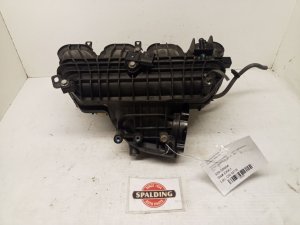
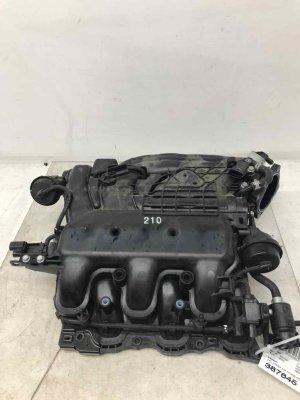
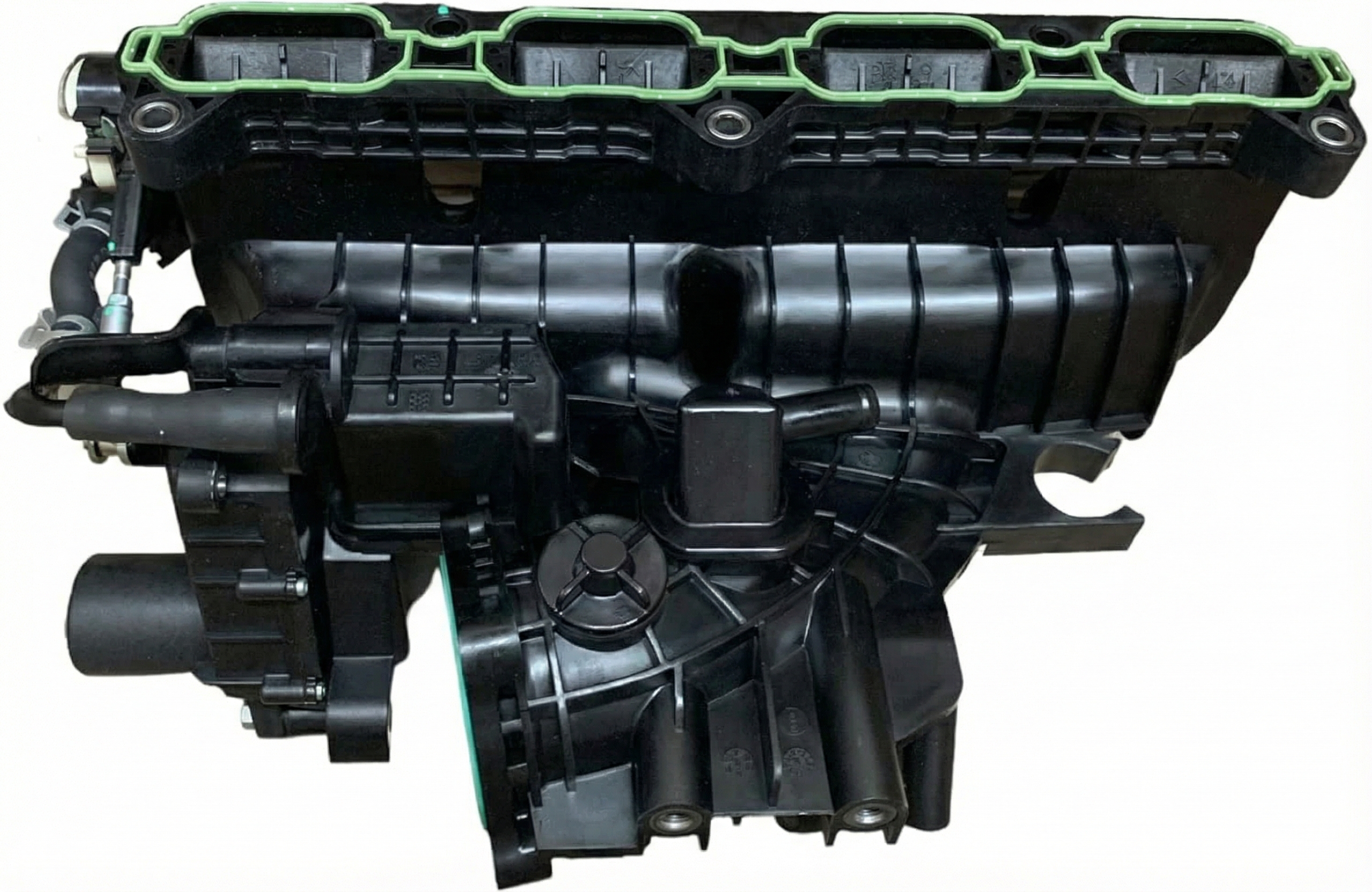
When a used part is the smart pick: For a P0022 repair, buying a used part is generally not recommended for the core components. The only exception might be for a major plastic component like the upper intake manifold if it were damaged during the repair, as it has no moving parts.
What to inspect on the donor part:
- For an intake manifold, inspect for any cracks, warping near the mating surfaces, and ensure all threaded inserts are intact and not stripped.
OEM-only on this vehicle (don't cheap out):
- Oil Control Valve (OCV): Aftermarket OCVs have a high reported failure rate. Given the extreme labor involved in replacing this part on this specific engine, the risk of a premature failure outweighs the cost savings. Use a genuine Hyundai/Kia part.
- Intake Manifold Gaskets: To avoid a vacuum leak after a 3-4 hour job, using OEM gaskets is a low-cost insurance policy against having to do the work again.
- Engine Oil Filter: Many Hyundai technicians and owners strongly advise against aftermarket oil filters, citing potential issues with internal bypass valve pressure ratings that can affect the CVVT system's operation.
Aftermarket brands forum-validated for this vehicle:
- For gaskets, Fel-Pro and Mahle are widely considered reliable OEM-equivalent brands.
- For the OCV itself, if OEM is not an option, Standard Motor Products (SMP) is often cited as a higher-quality aftermarket alternative.
Brands owners have reported issues with on this vehicle:
- Avoid unbranded, low-cost OCVs from online marketplaces. The failure rate is high, and the labor cost for this specific job makes it a poor risk.
Real Owner Stories
Aggregated from forums and TSBs cited above. Mileages and costs reflect what owners reported in those sources.
2017 Hyundai Santa Fe 3.3L V6
Symptoms: The engine died suddenly on a highway on-ramp; upon inspection, there was a complete lack of oil on the dipstick due to excessive consumption.
What fixed it: The engine failure was covered under an extended warranty for rod bearing failure.
Source hint: reddit.com/r/Hyundai - Thread 'Is this the beginning of the 3.3L's?'
2013 Hyundai Santa Fe 3.3L V6 — 109000 miles
Symptoms: Engine self-destructed under normal driving conditions despite meticulous maintenance.
What fixed it: The thread discusses catastrophic failure related to the 3.3L V6's susceptibility to oil consumption.
Source hint: BobIsTheOilGuy.com - Thread '2013 Hyundai Santa Fe 3.3 V6 Blown up engine 109k'
Related OBD-II Codes
Frequently Asked Questions
Is there an extended warranty that covers engine issues related to P0022 on my 2013-2018 Santa Fe?
What is the correct oil viscosity and filter I should use for my 3.3L Lambda II GDi V6 to avoid CVVT codes?
How can I test if my Bank 2 Oil Control Valve is failing without removing it?
Why is the repair for P0022 more expensive on the Santa Fe compared to some other vehicles?
My Santa Fe has a rattling noise for a few seconds on cold startup; is this related to P0022?
Can I just swap the Bank 1 and Bank 2 OCVs to diagnose the problem?
Helpful Videos
Used OEM Parts in Stock
New Aftermarket Parts Available


The information in this article is provided for general reference and educational purposes only. Vehicle specifications, procedures, and part compatibility can vary by production date, trim level, and region. Always consult your vehicle's factory service manual and verify part numbers before purchasing or performing repairs. Safety-critical components such as airbags, seat belts, and braking systems should be installed by a qualified professional.
- Hyundai Santa Fe:
- 🧭 Diagnostic Flowchart
- 🎬 Helpful Videos
- 🛍️ Shop This Part
- What's Unique About the 2013-2018 Hyundai Santa Fe
- Symptoms You May Notice
- Most Likely Causes
- Rare But Worth Checking
- Diagnosis Steps
- Parts You'll Likely Need
- Related Codes That Often Appear With This One
- Technical Service Bulletins (TSBs) & Recalls
- Platform-Specific Known Issues
- Mechanic-Grade Diagnostic Values
- Scan Tool Commands That Help
- Wiring & Ground Locations
- Real Owner Repair Stories
- OEM Part Supersession History
- Other Known Issues on This Vehicle
- Used vs. New Parts: Buying Guide for This Vehicle
- Real Owner Stories
- 2017 Hyundai Santa Fe 3.3L V6
- 2013 Hyundai Santa Fe 3.3L V6 — 109000 miles
- Related OBD-II Codes
- Frequently Asked Questions
- 🎟️ Get 5% Off