

P0022 on 2015-2019 Lincoln MKT: Intake Cam Timing Over-Retarded (Bank 2) Causes and Fixes
This code usually means the Bank 2 intake Variable Camshaft Timing (VCT) solenoid is sticking, often due to dirty or low engine oil. Replacing the solenoid is the most common fix. Expect to pay around $50-$100 for an aftermarket part and $150-$250 for labor. An oil and filter change is highly recommended at the same time.
- P0022 on a 2015-2019 Lincoln MKT almost always points to an issue with the Bank 2 intake VCT solenoid or the engine oil.
- Before buying any parts, check your engine oil level and condition. An oil change is the cheapest and easiest first step.
- The most effective diagnostic step is to swap the intake VCT solenoids between Bank 1 and Bank 2 to see if the code follows the solenoid.
- Multiple Ford TSBs confirm that sticking VCT solenoids are a common problem on this engine platform.
- While more serious issues like timing chains or phasers can cause this code, they are much less likely than a faulty solenoid.
What's Unique About the 2015-2019 Lincoln MKT
On this generation of Lincoln and Ford vehicles with the 3.5L and 3.7L engines, the Variable Camshaft Timing (VCT) system is a known weak point. Multiple Technical Service Bulletins (TSBs) from Ford confirm that the VCT solenoids are prone to sticking due to small debris in the engine oil. This is not a rare occurrence but a well-documented pattern for this powertrain family, which also includes the Ford Flex, Edge, F-150, and Lincoln MKS.
Diagnostic Flowchart
Tap your situation to follow the diagnostic path that matches what you're seeing on this vehicle.
Symptoms You May Notice
- Check Engine Light is on
- Rough or unstable idle
- Poor acceleration and loss of power, sometimes described as hesitation.
- Engine stalling, especially when putting the vehicle in gear.
- Decreased fuel mileage.
- Rattling noise from the engine, particularly a 2-5 second rattle from the front of the engine on a cold start.
- Replacing the camshaft position sensor when the actual fault is a sticking VCT solenoid.
- Replacing the cam phaser before thoroughly diagnosing the VCT solenoid and checking oil quality, which are far more common and cheaper fixes. A user on Reddit detailed a costly experience where a dealer replaced the timing chain for P0022, but the issue returned and was ultimately traced back to the VCT units.
Most Likely Causes
- Sticking or Failed VCT Solenoid 🔴 High Probability → Shop Engine Variable Valve Timing (VVT) Solenoid As documented in Ford TSBs #SSM 50067 and #SSM 47170, these solenoids are highly susceptible to sticking from small debris or sludge in the oil, a common issue on the 3.5L/3.7L engine family. A torn or missing screen on the solenoid is a common failure mode.
How to confirm: Use a scan tool to monitor commanded vs. actual cam timing for Bank 2. A common diagnostic step is to swap the Bank 2 intake solenoid with the Bank 1 intake solenoid. If the code changes to P0012 (Bank 1 over-retarded), the solenoid is confirmed faulty. TSB SSM 50067 also suggests using a scan tool to cycle the solenoid 10 times to try and clear debris before replacement.
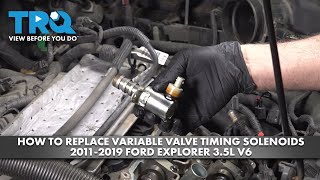
Typical fix: Replace the Bank 2 intake VCT solenoid. 🎬 Watch: Step-by-step guide to replacing the VCT solenoid. It's also wise to perform an engine oil and filter change at the same time to remove the contaminants that caused the failure.
Est. part cost: $50-$100 - Low or Dirty Engine Oil 🔴 High Probability The VCT system is entirely dependent on clean oil and correct pressure to function. Contaminated or low-viscosity oil can clog the fine mesh screens and passages in the VCT solenoids, causing them to stick. Some owners report the code appearing immediately after an oil change, possibly from dislodged sludge.
How to confirm: Check the engine oil dipstick for level and inspect the oil's condition. If it's low, dark, or sludgy, it needs to be changed. Verify the correct oil viscosity is being used (check owner's manual).
Typical fix: Perform an engine oil and filter change using the manufacturer-specified grade (typically 5W-20 or 5W-30, check your owner's manual). Consider an engine flush if significant sludge is found.
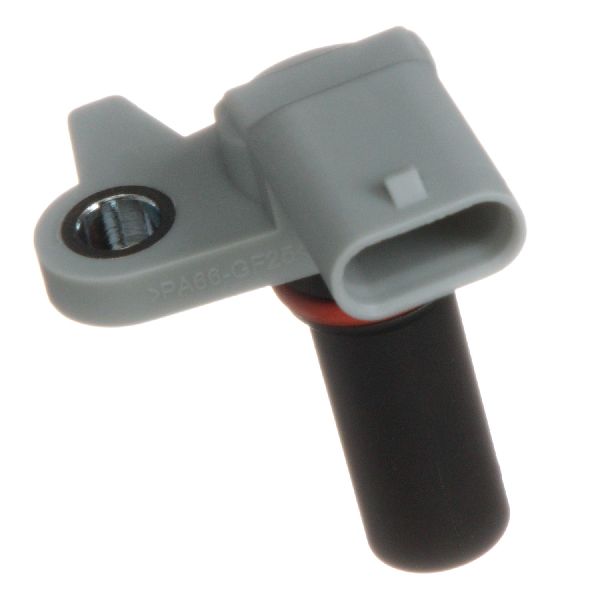
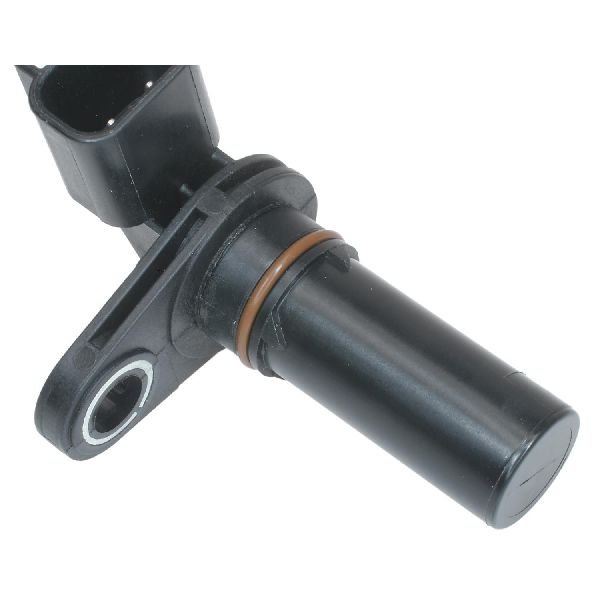
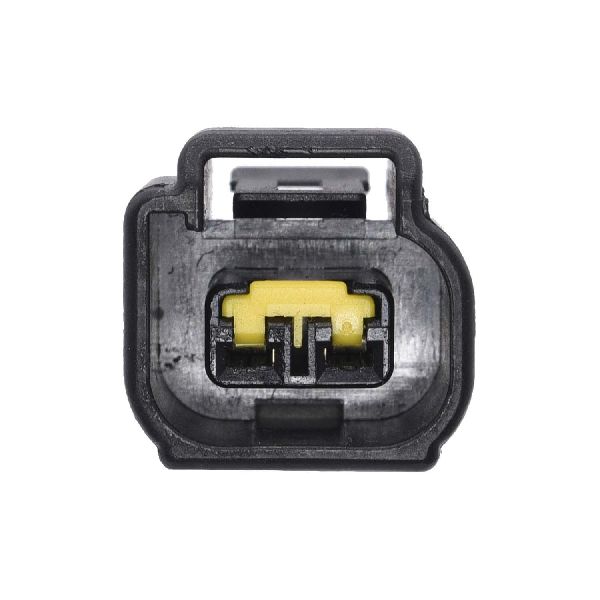
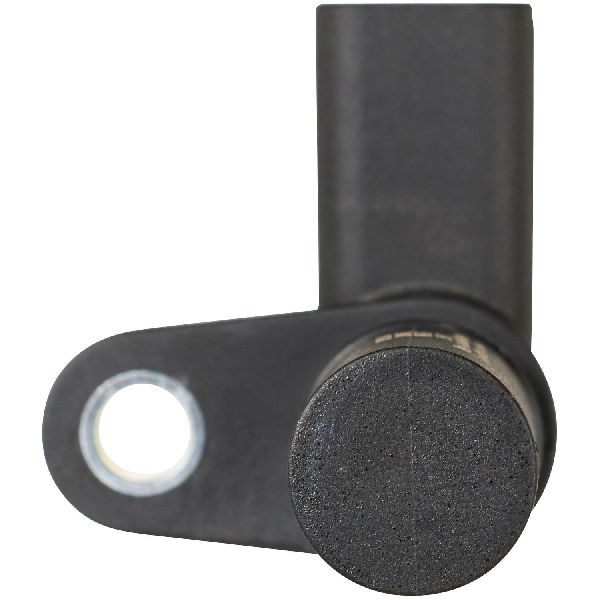
Est. part cost: $40-$80 - Faulty Camshaft Position Sensor ⚪ Low Probability → Shop Engine Camshaft Position Sensor
How to confirm: The sensor provides the timing data to the PCM. If the VCT solenoid swap doesn't move the code, and oil is clean, the sensor could be sending bad data. It can be tested with a multimeter or by swapping it with the sensor from Bank 1.
Typical fix: Replace the Bank 2 intake camshaft position sensor.
Est. part cost: $30-$70
Rare But Worth Checking
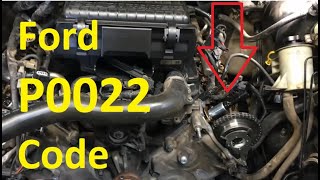
- Worn Timing Chain or Failed Cam Phaser: → Shop Engine Timing Chain This is a more serious mechanical issue. A stretched timing chain or a phaser that is stuck can cause the timing to be physically off, which the VCT system cannot correct. This is often accompanied by rattling noises, especially on startup. 🎬 See and hear what a failing cam phaser sounds like. TSB 23-2124 addresses this issue on related 3.5L EcoBoost engines, recommending VCT unit replacement for cold start rattles.
- Wiring Harness Damage: An open or short in the wiring to the VCT solenoid or camshaft position sensor can mimic a failed component. This should be checked before replacing more expensive parts like a phaser.
Diagnosis Steps
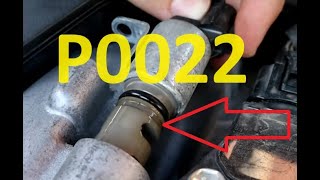
- Verify the code with a reliable OBD-II scanner. 🎬 Watch: A quick breakdown of P0022 causes and fixes.
- Check the engine oil level and condition. If low or dirty, correct this first, clear the codes, and see if the problem returns.
- Using a scan tool with live data, monitor the commanded versus actual camshaft position for the Bank 2 intake cam (CMP21). A significant lag indicates a problem.
- Per TSB SSM 50067, use the scan tool's bidirectional controls to command the Bank 2 intake VCT solenoid on and off 10 times to attempt to dislodge any debris.
- Swap the Bank 2 intake VCT solenoid with the Bank 1 intake VCT solenoid. Clear the codes and drive the vehicle. If the code returns as P0012, the solenoid you moved is faulty.
- If the code remains P0022 after the swap, inspect the wiring and connector for the Bank 2 VCT solenoid for damage or corrosion.
- If the solenoid and wiring are good, the issue may be a faulty cam phaser or a stretched timing chain, which requires more intensive mechanical diagnosis, often involving checking for startup rattles and potentially removing the valve cover for inspection.
Parts You'll Likely Need
- Variable Camshaft Timing (VCT) Solenoid
(OEM #8L3Z-6M280-B (Motorcraft))— This is the most frequent point of failure for this code on this platform, as confirmed by multiple TSBs. Note that the part number stamped on the solenoid itself may differ from the part number on the packaging.
Trusted brands: Motorcraft, Dorman, Standard Motor Products
OEM price range: $80-$120
Aftermarket price range: $50-$90 - Engine Oil and Filter — Clean oil is critical for VCT system operation and is often the root cause of solenoid failure. It should be replaced along with the solenoid.
Trusted brands: Motorcraft, Mobil 1, Castrol
OEM price range: $50-$90
Aftermarket price range: $40-$70
Related Codes That Often Appear With This One
- P0012 — If a technician swaps the suspected bad Bank 2 solenoid with the Bank 1 solenoid for diagnosis, the over-retarded code will move to Bank 1 and set P0012. It can also appear if both banks have issues simultaneously due to widespread oil contamination.
- P0021 — This code for 'Bank 2 Camshaft Timing Over-Advanced' can sometimes appear with P0022 if the VCT solenoid is acting erratically, not just sticking in one position.
- P0011, P0014, P0015, etc. — The provided TSBs indicate that P0022 is part of a family of VCT-related codes. If the underlying oil contamination issue is severe, codes for other camshafts may appear simultaneously.
- P0420 — A persistent timing issue can lead to inefficient combustion, which may eventually damage the catalytic converter and trigger a P0420 code (Catalyst System Efficiency Below Threshold Bank 1) or P0430 for Bank 2.
Technical Service Bulletins (TSBs) & Recalls
- SSM 50067: Notes that various VCT codes including P0022 may be due to debris causing the VCT solenoid to stick. Recommends cycling the solenoid with a scan tool before replacement.
- SSM 47170: An earlier bulletin with the same guidance as SSM 50067, indicating a persistent issue.
- SSM 54366: Directs technicians to a specific diagnostic test (Pinpoint Test HK) for these codes.
- TSB 23-2124: Addresses cold-start rattle on 3.5L EcoBoost engines by replacing VCT phasers, a more severe cause of timing codes.
Platform-Specific Known Issues
- Ford Technical Service Bulletin SSM 50067 notes that vehicles may exhibit P0022 due to small debris causing the VCT solenoid to stick, and advises diagnosis before component replacement, including a specific scan tool test to cycle the solenoid.
- Similarly, TSB SSM 47170 points to the same issue of sticking VCT solenoids caused by debris.
- TSB SSM 54366 references a specific pinpoint test (HK) in the workshop manual for diagnosing this family of VCT codes, reinforcing that a proper diagnostic procedure is required.
- On the related 3.5L EcoBoost, TSB 23-2124 was issued for a cold-start rattle that can be associated with VCT issues, recommending replacement of the VCT units (phasers).
Mechanic-Grade Diagnostic Values
- VCT Solenoid Internal Resistance — expected: 6.9 to 7.9 Ohms at 68°F (20°C). Some sources state a wider range of 5-15 Ohms is acceptable.. Failure: A reading of 0 Ohms indicates a short, while an infinite reading (OL) indicates an open circuit. A reading outside the specified range suggests a failing coil.
- Camshaft Position Sensor (3-wire Hall-effect) Signal Voltage — expected: Approximately 4.8-5.0 Volts on the signal wire with the ignition on, engine off.. Failure: When a metallic object (like a socket) is passed over the sensor tip, the voltage should drop to 0V. If the voltage does not change, the sensor is likely faulty.
- Camshaft Position Sensor (3-wire Hall-effect) Power and Ground Test — expected: With the sensor unplugged and ignition on, one wire should have battery voltage (VBPWR), one should have ~5V (Signal), and one should be ground. Probing between the power and ground terminals should show battery voltage (~12.6V).. Failure: If the expected voltages are not present at the connector, the fault lies in the wiring harness or PCM, not the sensor itself.
Scan Tool Commands That Help
- Ford IDS, FORScan, high-end scan tools: VCT Solenoid Test / Output Control — As suggested by TSB SSM 50067, this bidirectional command cycles the VCT solenoid on and off. It is used to dislodge small debris that may be causing the solenoid to stick. If cycling the solenoid temporarily resolves the rough idle or timing issue, it strongly points to a contaminated or failing solenoid.
Wiring & Ground Locations
- Main Engine Ground — On many Ford V6/V8 engines, a primary engine-to-chassis ground is located on the passenger side, attached to one of the motor mount bolts.. A poor engine ground can cause electrical noise and erratic voltage for all engine sensors, including the Camshaft Position Sensor, potentially leading to incorrect readings and false codes.
- Cylinder Head Ground — An additional ground strap is often found at the back of the driver's side cylinder head.. This ground is critical for the sensors located on that bank of the engine. A loose or corroded connection here can directly impact the performance of the Bank 2 Camshaft Position Sensor.
- VCT Solenoid Connector — On the top of the valve cover for Bank 2 (driver's side on FWD-based platforms like the MKT).. The two pins are for power (VPWR) and control (ground signal from PCM). Testing here can verify if the solenoid is receiving power and if the PCM is attempting to command it.
Real Owner Repair Stories
- F150online Forums user (Ford F-150 (engine not specified but VCT system is similar)) — P0022 code, rough running.
❌ Tried (didn't work) Initial diagnosis was difficult.
✅ What actually fixed it The user inspected the VCT oil control solenoid and found it had a broken screen. Replacing the solenoid resolved the code and the truck ran great afterward. Another user in the same thread confirmed a new set of VCT solenoids fixed their similar issue, noting one of theirs also had a broken screen.
OEM Part Supersession History
3L3Z-6M280-EA→8L3Z-6M280-A, then 8L3Z-6M280-B— Part revision and improvement by the manufacturer. The later 'B' revision is the most current and recommended replacement for this VCT solenoid design.
Heads up: While older versions may fit, the newest revision (8L3Z-6M280-B) should be used to ensure the latest design updates are incorporated. Note that for the 3.5L/3.7L engines, there can be different solenoids for intake vs. exhaust, so verifying the specific application part number (like AT4Z-6M280-A/B/C) is critical.
Helpful Videos


We Have This Part in Stock


The information in this article is provided for general reference and educational purposes only. Vehicle specifications, procedures, and part compatibility can vary by production date, trim level, and region. Always consult your vehicle's factory service manual and verify part numbers before purchasing or performing repairs. Safety-critical components such as airbags, seat belts, and braking systems should be installed by a qualified professional.
- Lincoln MKT:
- 🧭 Diagnostic Flowchart
- 🎬 Helpful Videos
- 🛍️ Shop This Part
- What's Unique About the 2015-2019 Lincoln MKT
- Symptoms You May Notice
- Most Likely Causes
- Rare But Worth Checking
- Diagnosis Steps
- Parts You'll Likely Need
- Related Codes That Often Appear With This One
- Technical Service Bulletins (TSBs) & Recalls
- Platform-Specific Known Issues
- Mechanic-Grade Diagnostic Values
- Scan Tool Commands That Help
- Wiring & Ground Locations
- Real Owner Repair Stories
- OEM Part Supersession History
- 🎟️ Get 5% Off