

P0022 on 2007-2009 Saturn Aura 3.6L: 'A' Camshaft Position Timing Over-Retarded (Bank 2) Causes and Fixes
On the 2007-2009 Saturn Aura with the 3.6L V6, code P0022 is a serious warning. While it can be caused by a simple faulty camshaft actuator solenoid (~$150-$250 repair), it is very often an early symptom of stretched timing chains, a widespread and critical issue for this engine. A timing chain replacement can cost over $2,000. Due to the engine's known history, this code should be investigated immediately.
- Code P0022 on a 3.6L Aura is a serious issue that should be diagnosed immediately.
- The first and easiest step is to check your engine oil. Low or dirty oil is a primary cause of all VVT system faults.
- The most likely cause is either a simple-to-fix VVT solenoid or a complex and expensive-to-fix stretched timing chain.
- A rattling noise from the engine on cold starts is a tell-tale sign of the more serious timing chain problem.
- If you also have codes P0008 or P0009, it is almost certain that the timing chains need to be replaced.
What's Unique About the 2007-2009 Saturn Aura
The 3.6L LY7 V6 engine used in this generation of Saturn Aura is notorious for premature timing chain stretching. The original timing chains were not durable enough, and this issue was often accelerated by the factory's optimistic oil change intervals, leading to oil breakdown and sludge. This specific code, P0022, while sometimes just a solenoid issue, must be treated as a potential early warning for this very common and expensive timing chain failure. GM acknowledged the problem by issuing Special Coverage Adjustment #11340C, which extended the warranty on these parts for many sibling vehicles and included an ECM reprogram to shorten oil change intervals.
Symptoms You May Notice
- Check Engine Light is on
- Reduced engine power and poor acceleration
- Rough or unstable idle
- Decreased fuel economy
- Rattling or ticking noise from the engine, especially on a cold start for 2-3 seconds. 🎬 Watch: Hear the specific clattering noise caused by VVT issues.
- Engine may stall unexpectedly.
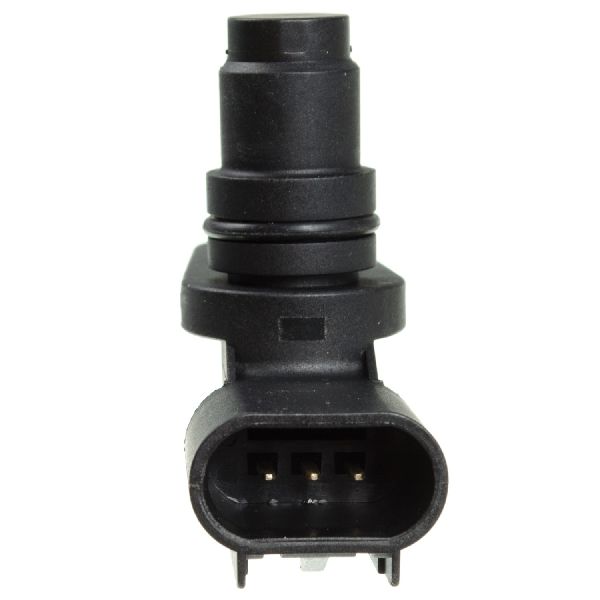
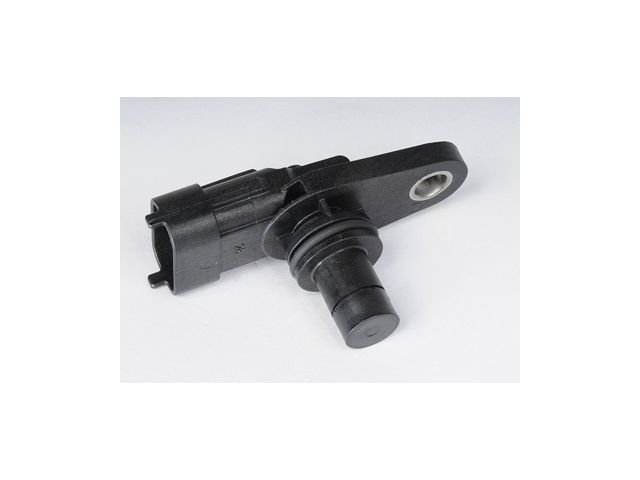
- Replacing the camshaft position sensor. This code indicates a mechanical timing problem (cam is in the wrong place), not an electrical sensor failure. The sensor is usually working correctly and accurately reporting the timing error.
Most Likely Causes
- Stretched Timing Chains 🔴 High Probability → Shop Engine Timing Chain The original timing chains on the 3.6L LY7 V6 were made of a softer metal that was prone to premature wear and stretching, a well-documented factory issue across many GM models. This was exacerbated by long oil change intervals recommended by the original Oil Life Monitor calibration.
How to confirm: A persistent rattling noise on cold starts is a strong indicator. The definitive diagnosis is done by a professional, who will measure the deviation in timing angles with a scan tool (looking for camshaft/crankshaft correlation codes like P0008/P0009) or physically inspect the chains for slack, which requires significant disassembly. A consistent variance greater than 4-6 degrees between desired and actual cam angle at idle points to a stretched chain.
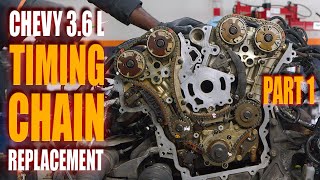
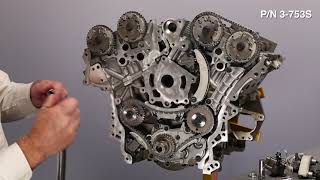
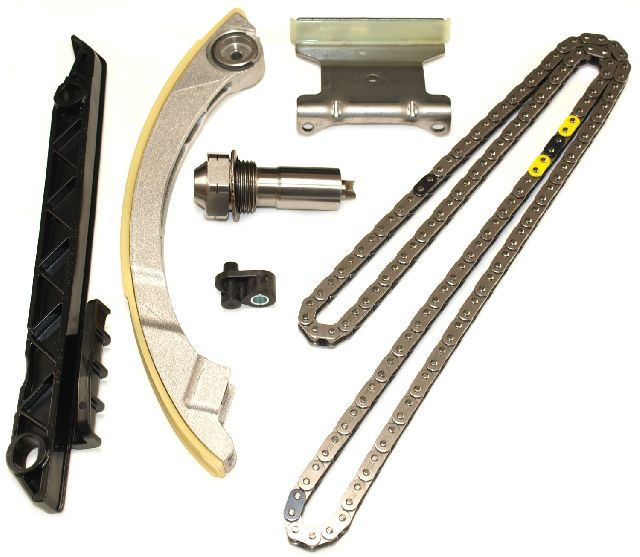
Typical fix: Replace all three timing chains, all tensioners, and all guides with an updated kit. This is a very labor-intensive job, often requiring 10-12 hours. 🎬 Watch: Full length timing chain removal and installation guide. Aftermarket kits like the Cloyes 9-0753S are a popular choice.
Est. part cost: $250-$700 - Low or Dirty Engine Oil 🔴 High Probability The VVT system is entirely dependent on oil pressure and cleanliness to function. The original oil life monitor calibration on these vehicles was too long, leading to oil degradation that clogged the fine mesh screens on the VVT solenoids and contributed to timing chain wear.
How to confirm: Check the oil level on the dipstick and inspect its condition. If the oil is very dark, gritty, or below the 'add' line, this is a likely contributor. A professional can test oil pressure; it should be at least 24 psi at 1,000 RPM when warm.
Typical fix: Perform an oil and filter change using a quality full synthetic 5W-30 oil that meets GM dexos1 specifications. This is the first and cheapest step before any parts are replaced.
Est. part cost: $40-$80 - Faulty Bank 2 Intake Camshaft Actuator Solenoid (VVT Solenoid) 🟡 Medium Probability → Shop Engine Camshaft These solenoids have fine mesh screens that can become clogged by debris and sludge from dirty oil, causing them to stick or respond slowly. They are a common failure point and a logical part to test early.
How to confirm: Swap the Bank 2 intake solenoid (front bank, top position) with the Bank 1 intake solenoid (rear bank, top position). Clear the codes and drive the vehicle. If the code changes to P0011 (Bank 1 Intake), the solenoid is confirmed to be faulty. The solenoid's resistance can also be tested and should be between 6.9 and 7.9 Ohms.
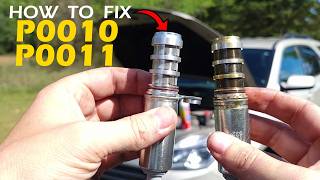
Typical fix: Replace the faulty solenoid. It is held in by a single 10mm bolt and is easily accessible on top of the engine's valve cover. 🎬 See this walkthrough on how to replace the VVT solenoid.
Est. part cost: $30-$80 - Failed Camshaft Phaser ⚪ Low Probability → Shop Engine Camshaft
How to confirm: This is typically diagnosed after confirming the oil is clean and the VVT solenoid is working correctly. A scan tool showing a commanded versus actual camshaft angle that is consistently off, even with a new solenoid, points to a mechanical phaser or chain issue.
Typical fix: Replace the camshaft phaser assembly on the Bank 2 intake camshaft. This is usually done during a timing chain replacement job as it requires similar labor.
Est. part cost: $100-$200
Rare But Worth Checking
- Wiring to VVT Solenoid: The wiring harness or connector for the Bank 2 intake solenoid could be damaged or have a poor connection, mimicking a failed solenoid. Check for chafing or corrosion.
- ECM Fault: In very rare cases, the Engine Control Module itself can fail, but all other possibilities, especially mechanical ones, should be exhausted before considering this.
Diagnosis Steps
- Check the engine oil level and condition. If low or dirty, change the oil and filter with 5W-30 synthetic oil, clear the code, and see if it returns.
- Using an OBD-II scanner, check for other related codes, especially P0008, P0009, or P0017, which strongly indicate a timing chain problem.
- Listen for a loud rattling noise from the engine for 2-3 seconds on a cold start. This is a classic symptom of bad timing chain tensioners and stretched chains.
- Locate the Bank 2 (front/radiator side) intake and exhaust VVT solenoids. Swap the intake solenoid with the intake solenoid from Bank 1 (rear/firewall side). They are identical parts.
- Clear the codes and drive the vehicle. If the code changes to P0011, the solenoid is bad and needs to be replaced.
- If the P0022 code returns after the swap, the problem is not the solenoid. The issue is likely mechanical, pointing to stretched timing chains or a bad phaser.
- At this point, professional diagnosis is recommended to confirm stretched timing chains with a scan tool (comparing commanded vs. actual cam angles) before beginning the extensive repair.
Parts You'll Likely Need
- Engine Timing Chain Kit
(OEM #12650230 (2007), 12650231 (2008-2009 LY7))— This is the most probable root cause of code P0022 on this specific engine due to a known factory defect with the original chains.
Trusted brands: ACDelco (OEM), Cloyes (e.g., Kit 9-0753S)
OEM price range: $450-$600
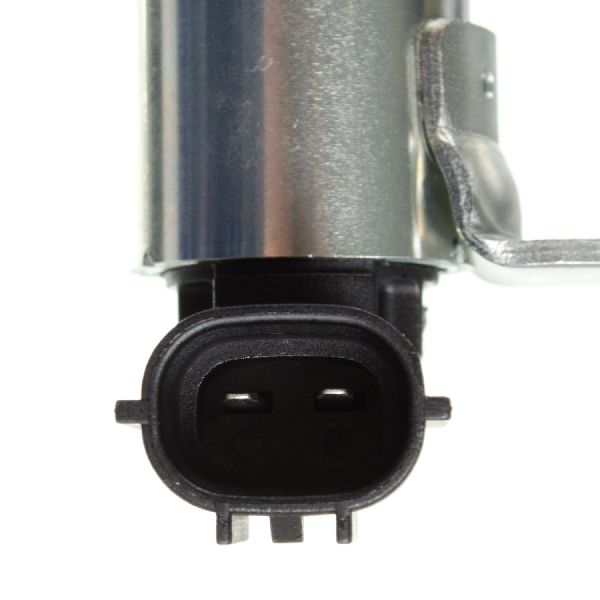
Aftermarket price range: $250-$450 - Camshaft Position Actuator Solenoid (VVT Solenoid)
(OEM #12636175 (Supersedes earlier numbers))— This solenoid controls oil flow to the cam phaser and is a common failure point due to clogging from dirty oil. It's a much cheaper and easier fix than timing chains, so it should be tested first.
Trusted brands: ACDelco, Delphi, Dorman
OEM price range: $45-$80
Aftermarket price range: $30-$60
Related Codes That Often Appear With This One
- P0008 — This code indicates a general engine position system performance error for Bank 1. Its presence with P0022 is a very strong sign that the timing chains have stretched, as it means the ECM sees a timing discrepancy on both banks.
- P0009 — This is the same as P0008 but for Bank 2. If seen with P0022, it almost certainly confirms a stretched timing chain issue affecting the entire Bank 2 system.
- P0011 — This code for Bank 1 intake timing ('A' Camshaft Position - Timing Over-Advanced) will appear if you swap a faulty Bank 2 intake solenoid over to Bank 1 as a diagnostic test, confirming the solenoid is the problem.
- P0016, P0017, P0018, P0019 — These are all crankshaft-camshaft correlation codes. Any of them appearing alongside P0022 reinforces the diagnosis of a systemic mechanical timing issue, i.e., stretched chains.
Technical Service Bulletins (TSBs) & Recalls
- 11340C: Special Coverage Adjustment - Timing Chain Wear. This is the key document from GM acknowledging the timing chain problem. It extended the warranty and mandated an ECM reprogram to adjust the oil life monitor if the chains were not yet worn.
- 12-06-01-009D: Information on High Feature V6 Timing Chain Kits. This bulletin provides details on the updated timing chain kits and diagnostic information for technicians, advising which parts to replace (chains, guides, tensioners) and which to reuse if not worn (sprockets, phasers).
Real Owner Repair Stories
NHTSA records for related Saturn models highlight how P0022 can manifest in severe drivability issues. For instance, NHTSA ODI #11173915 describes a situation where the transmission would downshift hard enough to pull the driver's body forward violently, with P0022 and P0011 identified as the principal fault codes pointing to the actuator solenoid control.
Platform-Specific Known Issues
- GM Special Coverage Adjustment #11340C was issued for premature timing chain wear on many vehicles with the 3.6L engine, including the Saturn Outlook and Cadillac models. This program extended the warranty to 10 years or 120,000 miles for this specific repair, though this coverage is now expired for all affected vehicles due to age. The program also included an ECM reprogram to shorten oil change intervals to combat oil degradation that accelerated chain wear.
Mechanic-Grade Diagnostic Values
- Scan Tool: Camshaft Position Deviation/Variance — expected: Less than +/- 2-3 degrees at idle.. Failure: A consistent deviation exceeding +/- 4-6 degrees at idle is a strong indicator of a stretched timing chain. The code may set when deviation exceeds 7-10 degrees.
- Camshaft Position Actuator Solenoid Resistance — expected: 6.9 to 7.9 Ohms for LY7 engine. Some sources state a wider range of 4.6-7.5 Ohms or 8-13 Ohms for the broader High Feature V6 family, but 6.9-7.9 is specific to a service manual test.. Failure: A reading of 0 Ohms (short), OL/infinite (open), or a value significantly outside the specified range indicates a failed solenoid coil.
- VVT Solenoid Connector Voltage (Key On, Engine Off) — expected: Battery voltage (approx. 12V) on the power supply pin.. Failure: Low or no voltage points to a wiring issue, a bad fuse, or a problem with the ECM's driver circuit, not the solenoid itself.
- Camshaft End Play — expected: 0.045-0.215 mm (0.0016-0.0085 in).. Failure: End play measuring equal to or over 0.40 mm (0.016 in) is considered excessive and can be a contributing factor to timing codes.
Scan Tool Commands That Help
- GM Tech 2 / GDS2 (or equivalent professional scanner): Camshaft Position Actuator Solenoid Test / VVT Control — This is a bidirectional control that allows a technician to command the VVT solenoid to a specific duty cycle (e.g., 0%, 25%, 50%) while observing the 'Camshaft Position Variance' PID. If the variance angle does not change when the solenoid is commanded, it confirms a fault with the solenoid, a clogged oil passage, or a mechanically stuck phaser. It is the definitive way to isolate an electrical/hydraulic issue from a base mechanical timing problem like a stretched chain.
- GM Tech 2 / GDS2 (SPS - Service Programming System): ECM Reprogramming — As part of Special Coverage 11340C, if the timing chains were inspected and found not to be worn, GM required dealers to reprogram the ECM. This update changed the Oil Life Monitor (OLM) algorithm to be more conservative, shortening oil change intervals to prevent future oil degradation and chain wear.
Wiring & Ground Locations
- G105 — Center rear of the engine block for the 3.6L LY7.. This is a primary engine ground. A poor connection can cause erratic behavior in various engine sensors and actuators, including the VVT solenoids and the ECM itself.
- G111 — Top rear right side of the engine on the 3.6L LY7.. Another critical engine ground. A loose or corroded G111 can lead to intermittent and hard-to-diagnose electrical issues affecting sensor readings.
- G113 — On the center of the left side cylinder head (Bank 2 side) for the 3.6L LY7.. This ground is specific to the Bank 2 cylinder head. A poor connection here could directly impact the stability of signals from the Bank 2 camshaft position sensor or the operation of the Bank 2 VVT solenoids.
- ECM (Engine Control Module) — On the left (front) side of the engine compartment, in front of the battery.. The ECM is the source of the command signal to the VVT solenoid. Knowing its location is essential for any circuit testing (continuity, shorts to ground) that traces back from the solenoid connector.
OEM Part Supersession History
Various individual timing components→12650230 (for 2007 MY), 12650231 (for 2008-2009 MY w/LY7)— GM consolidated the required parts into comprehensive kits with updated, more durable timing chain designs to address the widespread stretching issue.
Heads up: It is critical to use the correct kit for the specific model year. The 2007 kit (12650230) and the 2008-2009 kit (12650231) are different and not interchangeable. Using the wrong kit can lead to improper fitment or continued issues.Multiple older VVT Solenoid part numbers→12636175— Part number consolidation and potential minor design revisions over time.
Model Year Variations Within This Range
- 2007 vs. 2008-2009: The OEM timing chain service kits are different for the 2007 model year versus the 2008-2009 model years. The kit for 2007 is part number 12650230, while the kit for 2008-2009 is 12650231. This highlights a change in one or more of the timing components between those years, making it critical to order the year-specific kit for the repair.
Diagnostic Flowchart
Other Known Issues on This Vehicle
Issues unrelated to this code that are worth knowing about as an owner of this generation:
- 6T70 Transmission 3-5-R Wave Plate Failure 🔴 High — A very common failure, often occurring between 70,000 and 120,000 miles. It can lead to sudden loss of reverse, 3rd, and 5th gears. (Ref: GM Special Coverage #14404A extended the warranty for this specific failure to 10 years/120,000 miles. TSB 09-07-30-012F also details the condition.)
- Sudden Loss of Electric Power Steering (EPS) 🔴 High — Widespread enough to trigger a major safety recall. Can happen at any time while driving, resulting in a sudden increase in steering effort. (Ref: NHTSA Campaign ID: 14V153000 (GM Recall N140115). Dealers were instructed to replace the torque sensor assembly and/or the power steering motor controller.)
- Fractured Transmission Shift Cable 🟠 Medium — Common on vehicles with the 4-speed automatic transmission. The cable end tabs can break, causing a mismatch between the gear shifter position and the actual transmission gear. (Ref: A recall was issued for 2007-2008 models to install a retainer or replace the cable.)
- Catalytic Converter Failure (Secondary) 🟠 Medium — The catalytic converters on these vehicles often fail, but it is frequently a secondary issue caused by the primary timing chain problem. Stretched chains lead to poor combustion, dumping raw fuel into the exhaust and destroying the converter.
Used vs. New Parts: Buying Guide for This Vehicle
When a used part is the smart pick: For this specific repair, using used parts is generally not recommended. However, a used VVT solenoid from a low-mileage donor vehicle could be used for diagnostic purposes (to confirm a bad solenoid) or as a temporary, low-cost fix. Given the low price of new aftermarket solenoids, this is often not worth the effort.
Donor-vehicle mileage cap: roughly under 60000 miles for the part to have meaningful remaining life.
What to inspect on the donor part:
- Check the donor vehicle's oil fill cap and dipstick for signs of sludge or 'milky' oil, which indicates poor maintenance or a head gasket leak.
- If possible, verify the donor vehicle did not have any timing-related trouble codes.
- Physically inspect the mesh screens on a used VVT solenoid for any tears, debris, or heavy sludge before installation.
OEM-only on this vehicle (don't cheap out):
- While high-quality aftermarket is acceptable, parts to absolutely avoid from unknown or budget brands are the Timing Chains, Tensioners, and Guides. The failure of these components is catastrophic and the original issue was due to a weak design. Do not use used timing components under any circumstances.
Aftermarket brands forum-validated for this vehicle:
- Cloyes (for Timing Chain Kits, e.g., 9-0753S)
- Delphi (for VVT Solenoids)
- ACDelco (OEM supplier, often sold as aftermarket)
Brands owners have reported issues with on this vehicle:
- Unnamed, 'white-box' timing chain kits from online marketplaces. The risk of premature failure is too high given the labor-intensive nature of the repair.
Related OBD-II Codes
Frequently Asked Questions
Is there a GM warranty extension for the timing chain issues on my 2007-2009 Saturn Aura 3.6L?
What specific oil should I use in my 3.6L LY7 V6 to prevent P0022?
My Saturn Aura has a rattling noise for 2-3 seconds on cold starts; is this related to P0022?
Can I just reprogram the ECM to fix the timing chain wear mentioned in TSB 11340C?
Is there a specific aftermarket part recommended for the timing chain replacement?
How can I tell if the P0022 code is just a bad solenoid or a mechanical timing chain failure?
Helpful Videos
We Have This Part in Stock



The information in this article is provided for general reference and educational purposes only. Vehicle specifications, procedures, and part compatibility can vary by production date, trim level, and region. Always consult your vehicle's factory service manual and verify part numbers before purchasing or performing repairs. Safety-critical components such as airbags, seat belts, and braking systems should be installed by a qualified professional.
- Saturn Aura:
- 🧭 Diagnostic Flowchart
- 🎬 Helpful Videos
- 🛍️ Shop This Part
- What's Unique About the 2007-2009 Saturn Aura
- Symptoms You May Notice
- Most Likely Causes
- Rare But Worth Checking
- Diagnosis Steps
- Parts You'll Likely Need
- Related Codes That Often Appear With This One
- Technical Service Bulletins (TSBs) & Recalls
- Real Owner Repair Stories
- Platform-Specific Known Issues
- Mechanic-Grade Diagnostic Values
- Scan Tool Commands That Help
- Wiring & Ground Locations
- OEM Part Supersession History
- Model Year Variations Within This Range
- Other Known Issues on This Vehicle
- Used vs. New Parts: Buying Guide for This Vehicle
- Related OBD-II Codes
- Frequently Asked Questions
- 🎟️ Get 5% Off