

P0024 on 2005-2011 Audi A6: Exhaust Cam Timing Over-Advanced Causes and Fixes
On the 2005-2011 Audi A6, code P0024 is most often caused by a faulty camshaft adjuster solenoid (N319) or low/dirty engine oil. A solenoid replacement is a common DIY fix costing around $40-$100. However, this code, especially when accompanied by a startup rattle, can also signal a much more serious timing chain issue, which is a very expensive, engine-out repair on these models.
- Always check your engine oil level and condition first; it's the easiest and a common fix.
- The most likely faulty part is the Bank 2 (driver's side) exhaust camshaft adjuster solenoid. Swapping it with another one is the best way to confirm.
- Do not immediately assume the camshaft position sensor is bad; it's often misdiagnosed.
- If you hear a rattling noise from the back of the engine, especially on the 4.2L V8, stop driving and have the timing chain system inspected professionally to avoid catastrophic engine failure.
What's Unique About the 2005-2011 Audi A6
On the C6 platform A6 with the 3.2L V6 and 4.2L V8 engines, the VVT system is highly dependent on clean oil of the correct viscosity. While a faulty camshaft adjuster solenoid is a frequent and relatively simple fix, these engines, particularly the 4.2L V8, are also known for significant timing chain system wear. Issues like stretched chains, failing hydraulic tensioners, or broken plastic guides can also trigger P0024. Distinguishing between a simple electrical fault and a major mechanical one is crucial, as the timing components are located at the rear of the engine, requiring engine removal for service.
Symptoms You May Notice
- Check Engine Light is on
- Rough or unstable idle
- Engine stalling, especially when cold
- Noticeable loss of power and sluggish acceleration
- Hard starting
- Increased fuel consumption
- Rattling noise from the rear of the engine, especially on startup (a strong indicator of a timing chain/tensioner issue)
- Burnt oil smell in the cabin (can be caused by leaking solenoid O-rings)
- Replacing the camshaft position sensor when the actual fault is the much more common adjuster solenoid. One forum user swapped sensors only to find the code did not change, leading them back to the solenoid.
- Assuming the issue is a major timing chain failure without first diagnosing the cheaper and more common solenoid failure or checking oil quality.
- Replacing the solenoid but not the hardened, leaking O-ring, leading to persistent oil leaks.
Most Likely Causes
- Low, Dirty, or Incorrect Engine Oil 🔴 High Probability The VVT system uses hydraulic pressure from engine oil to actuate the camshaft adjusters. Thick, sludgy, or low oil cannot operate the system correctly, causing components to stick or respond slowly. These engines are sensitive to oil quality and level.
How to confirm: Check the oil level via the dipstick or MMI system and inspect the oil's condition and service history. Ensure the oil meets Audi's specific viscosity requirements (e.g., VW 502 00). A fresh oil change is a common first step and sometimes resolves the issue.
Typical fix: Perform an oil and filter change using high-quality, manufacturer-specified synthetic oil and a new OEM filter.
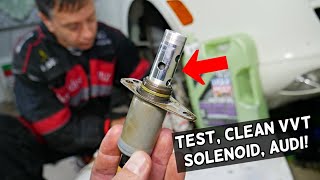
Est. part cost: $80-$150 - Faulty Camshaft Adjuster Solenoid (N205/N319) 🔴 High Probability → Shop Engine Camshaft This solenoid (also called an Oil Control Valve or Camshaft Adjustment Valve) gets clogged with oil sludge or can fail electrically, causing it to stick open or closed. The O-rings for these solenoids also commonly harden and leak oil.
How to confirm: Swap the Bank 2 exhaust solenoid with the Bank 1 exhaust solenoid. They are identical and located on the front of the valve covers. If the code changes to P0014 (Bank 1 Exhaust), the solenoid is bad. You can also test its resistance with a multimeter; it should be between 6.9 and 7.9 ohms.
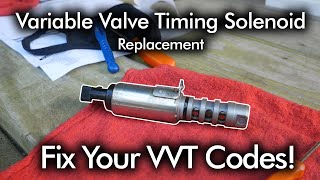
Typical fix: Replace the Bank 2 exhaust camshaft adjuster solenoid and its O-ring. 🎬 Watch: How to replace the VVT cam adjuster solenoid Many owners replace them in pairs (both exhaust or all four) as a preventative measure.
Est. part cost: $40-$150 - Failing Timing Chain System 🟡 Medium Probability → Shop Engine Timing Chain The 4.2L V8 (BVJ) is particularly notorious for its plastic timing chain guides becoming brittle and breaking. The 3.2L V6 can also suffer from stretched chains and failing hydraulic tensioners over time. This wear creates slack, leading to incorrect cam timing that the ECM flags as a fault.
How to confirm: Listen for a distinct "death rattle" from the rear of the engine on cold startups 🎬 Hear the timing chain noise on a cold start that lasts more than 1-2 seconds. A mechanic can use a scan tool (like VCDS) to check camshaft deviation values in Measuring Block 93. Values approaching or exceeding -8.0 degrees indicate significant chain stretch. Visual inspection requires engine removal.
Typical fix: Replace timing chains, tensioners, and guides. This is a major, engine-out service on both the 3.2L and 4.2L engines.
Est. part cost: $800-$2500 - Faulty Camshaft Position Sensor (G301) ⚪ Low Probability → Shop Engine Camshaft Position Sensor While less common than a solenoid failure, the Hall effect sensor that reads the camshaft's position can fail and send incorrect data to the ECM.
How to confirm: Swap the Bank 2 exhaust sensor with the Bank 1 exhaust sensor. If the code changes to P0014, the sensor is faulty. Note that accessing the Bank 2 (driver's side) sensor is tight and may require a stubby T30 Torx driver.
Typical fix: Replace the Bank 2 exhaust camshaft position sensor.
Est. part cost: $50-$120
Rare But Worth Checking
- Stuck Camshaft Phaser/Adjuster: → Shop Engine Camshaft The mechanical adjuster unit on the camshaft itself can get stuck due to oil debris or internal failure. This is less common than a solenoid issue but more serious, often requiring replacement of the timing components.
- Blocked Oil Passages: Severe oil sludging can block the small oil passages in the cylinder head leading to the VVT solenoids and cam phasers, starving them of oil pressure. This usually indicates a history of poor maintenance and may require extensive engine cleaning or disassembly.
- Failing Engine Control Module (ECM): → Shop Engine Control Module (ECM) In very rare cases, the ECM itself can malfunction and send incorrect commands or fail to read sensor data properly, triggering the code even with good components.
Diagnosis Steps
- Check Engine Oil: Verify the oil level is full and the oil is clean and of the correct VW 502 00 specification. If in doubt, perform an oil and filter change. Clear the code and see if it returns.
- Scan for Other Codes: Use an OBD-II scanner to check for other codes that could provide more clues (e.g., misfire codes on Bank 2, correlation codes like P0018).
- Listen for Noise: On a cold start, listen carefully for any rattling from the rear of the engine. A brief 1-2 second rattle can be normal, but a persistent or loud rattle strongly indicates a timing chain tensioner or guide problem.
- Inspect Solenoid Wiring: Check the electrical connector and wiring to the Bank 2 exhaust camshaft adjuster solenoid for any damage, corrosion, or oil contamination.
- Swap the Adjuster Solenoid: This is the most effective diagnostic step. Locate the exhaust adjuster solenoid on Bank 2 (driver's side, front of valve cover) and swap it with the identical solenoid on Bank 1 (passenger's side). Clear the codes and drive. If the code returns as P0014, you have confirmed the solenoid is the problem.
- Check Camshaft Deviation (Advanced): If you have access to a tool like VCDS, check the values in Engine Measuring Block 93 at idle. If the value is approaching or exceeds -8.0 degrees, it's a strong sign of a stretched timing chain.
- Mechanical Timing Inspection: If all other steps fail to identify the issue, the problem is likely mechanical within the timing system. The car should be taken to a qualified Audi specialist for confirmation, as this requires significant labor to inspect.
Parts You'll Likely Need
- Camshaft Adjuster Solenoid / Oil Control Valve
(OEM #06E109257P (supersedes 06E109257J, 06E109257F))— This is the most common point of failure for P0024, as it gets clogged or fails electrically, preventing correct camshaft adjustment. Also known as the N205 valve.
Trusted brands: Genuine Audi/VW, Pierburg (OEM Supplier), Bosch, URO Parts
OEM price range: $150-$220
Aftermarket price range: $40-$120 - Camshaft Position Sensor
(OEM #07L905163C (or similar))— Though less common, this sensor can fail and send incorrect position data, triggering the code. Failure often occurs after the solenoid swap test proves inconclusive.
Trusted brands: Bosch, Delphi, NTK
OEM price range: $90-$150
Aftermarket price range: $50-$120 - Timing Chain Kit — If the cause is mechanical wear, a full kit including chains, tensioners, and guides is required. This is a more probable cause on the 4.2L V8 engine but also affects the 3.2L V6.
Related Codes That Often Appear With This One
- P0014 — This is the same fault ('B' Camshaft Position - Timing Over-Advanced) but for Bank 1 (passenger side). It will appear if you swap a faulty Bank 2 component to Bank 1 for diagnosis. Seeing both P0014 and P0024 together could indicate a systemic issue like low oil pressure.
- P0300, P0305, P0306, P0307, P0308 — These are random and specific cylinder misfire codes for Bank 2. Incorrect cam timing disrupts the combustion process, leading to misfires on the affected bank.
- P0018 — Crankshaft Position - Camshaft Position Correlation (Bank 2 Sensor A). This code points to a more serious mechanical timing mismatch and is a strong indicator of a stretched or jumped timing chain.
Technical Service Bulletins (TSBs) & Recalls
- While no specific TSB for P0024 was found, Audi has issued TSBs (e.g., TSB 2012464/1) acknowledging that a brief 1-2 second rattle on cold start is considered 'normal' as oil pressure builds. However, persistent rattling is a clear sign of failure and is not covered by this TSB.
Platform-Specific Known Issues
- The 4.2L V8 (BPK, BVJ) engine is notorious for the plastic timing chain guides becoming brittle and breaking. The repair is a very labor-intensive, engine-out job estimated at over 20 labor hours.
- Access to the Bank 2 (driver's side) camshaft position sensor can be difficult due to tight space, often requiring a stubby T30 Torx bit.
- The timing chains and tensioners are located on the rear of the engine against the firewall, meaning the engine must be removed for any timing service.
Mechanic-Grade Diagnostic Values
- Camshaft Adjuster Solenoid (N205/N319) Resistance — expected: 6.9 - 7.9 Ohms at 68°F (20°C). Failure: No reading (open circuit) or a reading outside of the specified range.
- VCDS Engine Measuring Block 093 - Camshaft Phase Position — expected: 0 to -4 degrees at warm idle.. Failure: A value of -8 degrees or more negative indicates significant timing chain stretch, requiring mechanical inspection. The total deviation for a bank is the sum of the intake and exhaust values.
- Camshaft Position Sensor (G301) Connector Voltage - Pin 1 to Ground — expected: Approx. 5V with ignition on.. Failure: No voltage or significantly different voltage indicates a wiring or ECM issue.
- Camshaft Position Sensor (G301) Connector Voltage - Pin 2 to Ground — expected: Battery Voltage with ignition on.. Failure: Significantly lower than battery voltage suggests a problem in the power supply wire.
- Camshaft Position Sensor (G301) Connector Resistance - Pin 3 to Ground — expected: Near 0 Ohms.. Failure: High resistance indicates a poor ground connection.
Scan Tool Commands That Help
- VCDS (VAG-COM): Engine -> Basic Settings -> Group 096 (for exhaust) — This performs an output test on the exhaust camshaft adjuster solenoid (N319). The system will actuate the solenoid and report 'Syst. OK' if it responds correctly. This can help differentiate between a failed solenoid and a wiring issue.
- VCDS (VAG-COM): Engine -> Measuring Blocks -> Group 093 — This is used to monitor the phase adaptation values for both camshafts on both banks at idle. It is the most critical data point for diagnosing timing chain stretch. Values consistently at or beyond -8 degrees on a given bank strongly suggest mechanical timing wear.
Wiring & Ground Locations
- Engine Ground Strap — A small, single brown ground wire is often attached to one of the bolts for the oil filter housing.. This ground is for the oil pressure switch. If it's left disconnected after service (like an engine swap or oil filter housing work), it can cause erratic oil pressure readings or warnings, which can indirectly affect VVT system diagnosis. A forum user noted this wire often snaps or is forgotten during reassembly.
- Camshaft Position Sensor (G301) Connector — On the rear of the driver's side (Bank 2) cylinder head. Access is tight.. The 3-pin connector provides power, ground, and signal. Pin 1 is 5V reference, Pin 2 is battery voltage, and Pin 3 is ground. Testing these pins can rule out wiring issues before replacing the sensor.
Real Owner Repair Stories
- YouTube user 'Re-check!' (Audi with 3.2L FSI engine) — P0024 code returned after replacing valve cover gaskets and fixing oil leaks. Misfiring was also present.
❌ Tried (didn't work) Replacing valve cover gaskets., Fixing oil leaks into spark plug wells.
✅ What actually fixed it The user pulled the Bank 2 exhaust camshaft adjuster solenoid and discovered a tiny, removable filter screen inside it was clogged. After removing the screen from the solenoid, cleaning it, and reinstalling, the P0024 code did not return and the engine ran much quieter. - AudiWorld Forums user 'dzywicki' (2008 Audi A6 4.2L) — P0024 code appearing only on cold starts. If cleared after warm-up, it would not return until the next cold start.
❌ Tried (didn't work) Swapping the VVT solenoids between Bank 1 and Bank 2 (no change in code)., Swapping the camshaft position sensors between Bank 1 and Bank 2 (no change in code).
✅ What actually fixed it The user realized they had swapped the *intake* VVT solenoids, not the *exhaust* ones. The P0024 code specifically refers to the exhaust camshaft. The final resolution was not posted, but the realization that there are four distinct solenoids (Intake/Exhaust for each bank) and that the correct one must be diagnosed is the key takeaway.
OEM Part Supersession History
06E109257F→06E109257J, then 06E109257P, and currently 06E109257L— Likely internal design improvements to combat sticking and electrical failure.
Heads up: The latest part number (06E109257L) is generally backward compatible with vehicles that used the older versions. Always confirm fitment with a VIN.
Model Year Variations Within This Range
- 2005-2008: Pre-facelift 3.2L V6 models often used engine codes AUK or BKH.
- 2009-2011: Facelift 3.2L V6 models used the CALA engine code. While the fundamental design is similar, some parts like the specific camshaft adjuster solenoid may have different part numbers or revisions from the factory.
Diagnostic Flowchart
Other Known Issues on This Vehicle
Issues unrelated to this code that are worth knowing about as an owner of this generation:
- Intake Valve Carbon Buildup 🔴 High — A universal problem for these FSI (direct injection) engines. Significant performance loss can occur by 40,000-60,000 miles, causing misfires, rough idle, and hesitation.
- Timing Chain Guide/Tensioner Failure 🔴 High → Shop Engine Timing Chain — Extremely common on the 4.2L V8 and frequent on the 3.2L V6, typically after 80,000 miles. Characterized by a startup rattle. Failure requires an engine-out service. (Ref: Audi has issued TSBs about startup noise but no recall.)
- MMI System Failure 🟠 Medium — The MMI infotainment screen can go black or get stuck in a boot loop. It is often caused by a failure in one of the modules on the fiber optic (MOST) ring, frequently the amplifier or satellite radio module in the trunk.
- Thermostat Failure 🟠 Medium — The electronically controlled thermostat can fail, commonly sticking open, which prevents the engine from reaching full operating temperature (90°C). This leads to poor fuel economy and reduced heater performance.
Used vs. New Parts: Buying Guide for This Vehicle
When a used part is the smart pick: A used camshaft adjuster solenoid from a reputable auto recycler can be a cost-effective way to diagnose the problem. If swapping a used solenoid from the same position on a donor car (or from Bank 1 to Bank 2 on your own car) resolves the code, it confirms the diagnosis without the cost of a new part. However, for the final repair, a new part is recommended due to the high failure rate.
Donor-vehicle mileage cap: roughly under 80000 miles for the part to have meaningful remaining life.
What to inspect on the donor part:
- Ask for the VIN of the donor car to verify its service history if possible.
- Inspect the solenoid's electrical connector for corrosion or damage.
- Check the small oil screen (if visible) for sludge or debris before installation.
- Ensure the O-rings are pliable and not flattened or cracked.
OEM-only on this vehicle (don't cheap out):
- Timing Chain Kit (Chains, Guides, Tensioners): The labor cost for this job is immense. Using non-OEM parts risks premature failure and having to do the entire engine-out service again. Always use OEM or OEM-supplier (e.g., IWIS for chains) parts.
- Camshaft Position Sensors: While some aftermarket brands are reliable, these sensors are critical for engine timing. Sticking with OEM or a top-tier brand like Bosch or NTK is a safer bet to avoid chasing phantom issues.
Aftermarket brands forum-validated for this vehicle:
- Pierburg (for Camshaft Adjuster Solenoid - often the OEM supplier)
- Bosch (for sensors and solenoids)
- NTK (for Camshaft Position Sensors)
Brands owners have reported issues with on this vehicle:
- Unbranded, no-name solenoids and sensors from online marketplaces. While cheap, they have a high rate of being dead-on-arrival or failing shortly after installation, leading to repeated repairs.
Real Owner Stories
Aggregated from forums and TSBs cited above. Mileages and costs reflect what owners reported in those sources.
2008 Audi A6 4.2L V8
Symptoms: The owner documented getting the P0024 code specifically on cold starts. They noted extreme difficulty accessing the Bank 2 cam position sensor due to tight space.
What fixed it: The owner attempted to swap VVT solenoids to diagnose the issue, though the source notes the tight space required a special stubby T30 bit for sensor access.
Source hint: AudiWorld Forums - Thread '2008 A6 4.2 P0024'
2006 Audi A6 3.2L V6
Symptoms: The vehicle was repeatedly throwing codes P0391 and P0024.
What fixed it: The owner was advised to swap the Bank 2 camshaft adjuster valves with Bank 1 to determine if the fault followed the part.
Source hint: AudiWorld Forums - Thread '2006 A6 3.2 repeatedly gives codes P0391 & P0024'
2005-2011 Audi A6 C6
Symptoms: Severe oil leaks often misdiagnosed as valve cover gaskets and a noticeable cold start rattle.
What fixed it: Replacing the hardened O-rings on the four camshaft adjuster solenoids (a '$3 solution').
Source hint: YouTube - 'Audi A6 C6 Quattro OIL LEAK - $3 solution and 10 min fix!'
Related OBD-II Codes
Frequently Asked Questions
I hear a brief rattle on cold start in my A6; does this mean I need to replace the timing chains?
Can I use any synthetic oil for my 3.2L FSI engine to clear P0024?
How can I tell if the P0024 code is caused by a bad solenoid or a mechanical timing issue without pulling the engine?
Is there a way to check for timing chain stretch on my Audi A6 using a scan tool?
Why is the Bank 2 camshaft position sensor (G301) so difficult to replace on the A6?
Could an oil leak be related to my P0024 code and startup rattle?
Helpful Videos
We Have This Part in Stock


The information in this article is provided for general reference and educational purposes only. Vehicle specifications, procedures, and part compatibility can vary by production date, trim level, and region. Always consult your vehicle's factory service manual and verify part numbers before purchasing or performing repairs. Safety-critical components such as airbags, seat belts, and braking systems should be installed by a qualified professional.
- Audi A6:
- 🧭 Diagnostic Flowchart
- 🎬 Helpful Videos
- 🛍️ Shop This Part
- What's Unique About the 2005-2011 Audi A6
- Symptoms You May Notice
- Most Likely Causes
- Rare But Worth Checking
- Diagnosis Steps
- Parts You'll Likely Need
- Related Codes That Often Appear With This One
- Technical Service Bulletins (TSBs) & Recalls
- Platform-Specific Known Issues
- Mechanic-Grade Diagnostic Values
- Scan Tool Commands That Help
- Wiring & Ground Locations
- Real Owner Repair Stories
- OEM Part Supersession History
- Model Year Variations Within This Range
- Other Known Issues on This Vehicle
- Used vs. New Parts: Buying Guide for This Vehicle
- Real Owner Stories
- 2008 Audi A6 4.2L V8
- 2006 Audi A6 3.2L V6
- 2005-2011 Audi A6 C6
- Related OBD-II Codes
- Frequently Asked Questions
- 🎟️ Get 5% Off