

P0024 on 2012-2019 Buick LaCrosse 3.6L V6: Exhaust Cam Timing Causes and Fixes
On the 3.6L V6 LaCrosse, code P0024 is most often caused by a sticking exhaust camshaft actuator solenoid on Bank 2 or outdated engine computer software. A replacement solenoid costs about $40-$80, while a dealer software update may cost $120-$200. Low or dirty oil is also a frequent culprit.
- P0024 on a 2012-2019 LaCrosse V6 means the Bank 2 (front) exhaust camshaft timing is too far advanced.
- The two most likely causes are a faulty exhaust camshaft actuator solenoid or outdated ECM software that needs a dealer-installed update.
- Always check your engine oil level and condition first, as low or dirty oil is a common cause of VVT system problems.
- A simple way to diagnose a bad solenoid is to swap it with the one from the other bank and see if the code follows the part (changes to P0014).
- Do not confuse the camshaft position *sensor* with the camshaft position *actuator solenoid*; the solenoid is the part that most often fails for this code.
What's Unique About the 2012-2019 Buick LACROSSE

What's unique about the P0024 code on this specific Buick platform is that General Motors has issued Technical Service Bulletins (TSBs) pointing to two distinct primary causes. The problem can be a straightforward mechanical failure, like a sticking camshaft actuator solenoid, or it can be a software glitch within the Engine Control Module (ECM). [Bulletin #GCUS-9-3286, #N192266190] This means that unlike many other vehicles where this code points almost exclusively to a hardware fault, a trip to the dealer for a simple ECM reprogram could be the required fix. TSB #GCUS-9-3286 even established a "Special Coverage" program for the sticking actuator, extending the warranty for this specific component due to its high failure rate.
Diagnostic Flowchart

Tap your situation to follow the diagnostic path that matches what you're seeing on this vehicle.
Generation note: This year range covers two LaCrosse generations. The 2012-2016 models (second generation) use the 3.6L LFX V6, while the 2017-2019 models (third generation) use the updated 3.6L LGX V6. The P0024 code and its common causes (faulty solenoids, ECM software) are relevant to both V6 engines, as confirmed by TSBs covering these model years.
Symptoms You May Notice
- Check Engine Light is on
- Engine runs rough, especially at idle
- Engine may stall when the vehicle is stopped. [Bulletin #N192266190 02]
- Reduced engine power or hesitation during acceleration. [Bulletin #N192266190]
- Increased fuel consumption.
- Rattling or ticking noise from the engine.
- Replacing the camshaft position *sensor* instead of the camshaft position *actuator solenoid*. The sensor's job is to read the camshaft's position, while the actuator solenoid is the part that uses oil pressure to change the position. P0024 points to a performance issue (timing is incorrect), which is most often a fault of the control system (solenoid) or a mechanical issue, not the sensor itself. A Reddit user with a 2013 LaCrosse reported changing all four sensors with no change before learning the actuator was the likely culprit.
Most Likely Causes

- Sticking/Failed Exhaust Camshaft Position Actuator Solenoid (Bank 2) 🔴 High Probability → Shop Engine Camshaft A manufacturer TSB specifically identifies a "sticking exhaust camshaft position actuator" as a known cause for this code on these vehicles, leading to a Special Coverage program (#16115) to address the frequent failures. [Bulletin #GCUS-9-3286] These solenoids operate using engine oil pressure and can become clogged with sludge from infrequent oil changes or fail electrically over time.
How to confirm: Swap the Bank 2 exhaust solenoid with the Bank 1 exhaust solenoid (located on the other cylinder bank). Clear the codes and drive the vehicle. If the trouble code changes to P0014 (the equivalent code for Bank 1), the solenoid is faulty. A professional can also use a scan tool to command the solenoid on and off to listen for a clicking sound, indicating mechanical operation.
Typical fix: Replace the Bank 2 exhaust camshaft position actuator solenoid.
Est. part cost: $40-$80 - Outdated Engine Control Module (ECM) Software 🔴 High Probability → Shop Engine Control Module (ECM) GM released a TSB stating that this code, along with related drivability concerns like rough running or stalling, can be resolved by reprogramming the ECM with updated software. [Bulletin #N192266190, #N192266190 02] This indicates the original software logic was too sensitive or had parameters that could lead to false or intermittent timing codes.
How to confirm: This must be confirmed by a GM dealership or a qualified repair shop with access to GM's Service Programming System (SPS). They can check the current software calibration number against the latest available version mentioned in the TSB.
Typical fix: Reprogram the ECM to the latest software version. This is a dealer or professional-level repair.
Est. part cost: $0 - Low or Dirty Engine Oil 🟡 Medium Probability The VVT system is entirely dependent on clean engine oil at the correct pressure to function. The GM 3.6L engine family has been noted to have issues with oil consumption or timing chain stretch when oil change intervals are extended too far. Dirty or low oil can clog the fine mesh screens on the actuator solenoids, causing them to stick or respond slowly and trigger a timing performance code.
How to confirm: Check the engine oil level on the dipstick and inspect its condition. If the oil is dark, gritty, or past its recommended change interval, it should be replaced.
Typical fix: Perform an oil and filter change using the manufacturer-specified oil viscosity (e.g., SAE 5W-30 synthetic).
Est. part cost: $50-$100
Rare But Worth Checking
- Stretched Timing Chain: → Shop Engine Timing Chain While a known issue on some GM 3.6L engines, a stretched timing chain typically sets other specific codes first (like P0008 or P0017). However, if left unaddressed, it can eventually cause general timing performance codes like P0024. This issue was more prevalent on earlier (pre-2012) 3.6L engines but can still occur with poor maintenance.
- Failed Camshaft Phaser: → Shop Engine Camshaft The phaser is the mechanical gear at the end of the camshaft that the solenoid controls. It can fail mechanically by getting stuck in the advanced position, but this is much less common than a solenoid failure. Diagnosis often requires ruling out the solenoid and oil issues first.
Diagnosis Steps

- Check the engine oil level and condition. If it's low or dirty, perform an oil and filter change using full synthetic 5W-30 oil before proceeding. This alone can sometimes resolve the code. 🎬 Watch: Two simple DIY methods to fix the P0024 code.
- Using an OBD-II scanner, check for any other stored trouble codes to see if P0024 is appearing alone or with other timing codes.
- Use a scan tool with bidirectional controls to command the Bank 2 exhaust solenoid on and off. Listen for an audible click. No click suggests a failed solenoid or wiring issue.
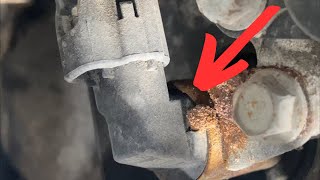
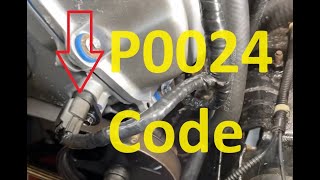
- If you don't have an advanced scanner, locate the exhaust camshaft position actuator solenoids on both banks. Bank 2 is toward the front of the vehicle. 🎬 Watch: How to locate and replace solenoids on the 3.6L engine.
- Swap the Bank 2 (front) exhaust solenoid with the Bank 1 (rear) exhaust solenoid. This is a common and effective DIY diagnostic step.
- Clear the trouble codes and test drive the vehicle. If the code returns as P0014 (for Bank 1), the solenoid you moved is faulty and must be replaced.
- If the P0024 code returns, the solenoid is likely not the issue. At this point, the cause is more likely software-related or a deeper mechanical problem.
- Contact a GM dealer or qualified shop to inquire about TSB #N192266190. They can verify if your ECM's software is outdated and requires reprogramming.
- If the software is current and the solenoid is good, the problem may be more complex, requiring professional diagnosis of the camshaft phaser, timing chain, or internal oil pressure.
Parts You'll Likely Need
- Exhaust Camshaft Position Actuator Solenoid
(OEM #12636175)— This solenoid is the most common mechanical failure point for code P0024, as identified by a manufacturer TSB and Special Coverage program. [Bulletin #GCUS-9-3286]
Trusted brands: ACDelco (OEM), Dorman, NGK/NTK
OEM price range: $60-$90
Aftermarket price range: $35-$70
Related Codes That Often Appear With This One
- P0014 — This is the identical 'over-advanced' code but for the exhaust camshaft on Bank 1. Seeing both codes together could indicate a systemic issue like old oil or an ECM software problem affecting both banks. [Bulletin #PIP5096C]
- P0011 — This is the 'over-advanced' code for the *intake* camshaft on Bank 1. TSBs mention that these codes can set in pairs or as a group, often pointing towards a systemic issue like oil quality or ECM software. [Bulletin #PIP5568E]
- P0021 — This is the 'over-advanced' code for the *intake* camshaft on Bank 2. Seeing it with P0024 points to a potential issue affecting the entire VVT system on Bank 2, such as a localized oil pressure problem or a faulty phaser on that bank. [Bulletin #PIP5096C]
Technical Service Bulletins (TSBs) & Recalls

- N192266190 / N192266190 02: States that dealers will reprogram the ECM to correct rough running, reduced power, or stalling when P0024 (and other VVT codes) are present.
- GCUS-9-3286: Identifies a sticking exhaust camshaft position actuator as a cause for P0024 and references Special Coverage #16115.
- PIP5096C: Mentions P0024 and advises technicians to check for an 'A' prefix on the engine EUN sticker on certain 2012 models, which may indicate a known solenoid issue.
Platform-Specific Known Issues
- A Service Bulletin (#N192266190) indicates that an ECM reprogram is the correct fix for drivability concerns like rough running or stalling associated with code P0024.
- Another bulletin (#GCUS-9-3286) points to a sticking exhaust camshaft position actuator as a specific cause for this code and was part of a Special Coverage program (#16115).
- Early in the 2012 model year, a specific batch of actuator solenoids may have had clearance issues, requiring replacement with an updated service part. TSB #PIP5096C advises technicians to check the engine's EUN sticker for an 'A' prefix, which indicates the potential for this issue.
Mechanic-Grade Diagnostic Values
- Camshaft Oil Control Valve (VVT Solenoid) Resistance — expected: 6.9 to 7.9 Ohms at 68°F (20°C). Failure: A reading outside this range, or an open/short (OL/0), indicates a faulty solenoid.
- VVT Solenoid Connector Voltage — expected: Battery voltage on the power supply pin with ignition on, engine off.. Failure: No voltage indicates a problem with the wiring or the relay supplying power to the solenoid.
- Scan Tool Camshaft Position Variance — expected: Near 0 degrees at idle and should change predictably as the VVT system is commanded on.. Failure: A large, persistent variance between the desired and actual cam position that doesn't respond to commands suggests a mechanical problem like a stuck phaser or stretched chain.
Scan Tool Commands That Help
- GDS2 (GM Techline): Camshaft Position Actuator Solenoid Test — Use this bidirectional control to manually command the solenoid on and off. This verifies if the solenoid is mechanically clicking and if the wiring from the ECM is functional, helping to isolate a bad solenoid from a wiring or mechanical phaser issue.
- GDS2 (GM Techline): Camshaft Position Variation Learn — This procedure should be performed after replacing a camshaft, phaser, or timing chain to allow the ECM to learn the new baseline positions of the valvetrain components.
Wiring & Ground Locations
- Bank 2 VVT Solenoids — On the front of the engine (closer to the radiator). The intake solenoid is on top, and the exhaust solenoid (related to P0024) is directly below it.. Correctly identifying the Bank 2 exhaust solenoid is critical for diagnosis and replacement. Swapping the wrong solenoid will lead to incorrect diagnosis.
Real Owner Repair Stories
- Reddit user in r/MechanicAdvice (2018 Chevrolet Colorado 3.6L V6 (LGX engine family)) — Check Engine Light with code P0024.
❌ Tried (didn't work) Initially suspected the camshaft position actuator solenoid.
✅ What actually fixed it The actual issue was a corroded negative battery terminal causing low system voltage (reading 11.8V). After cleaning the terminal and post, voltage returned to normal (12.6V key-off, 14.5V running) and the Check Engine Light turned off. The code remained in 'permanent' status, pending a drive cycle to fully clear. - YouTube creator 'Carl's Garage' (2015 Buick LaCrosse 3.6L V6 (LFX engine)) — Check Engine Light with code P0014 (Bank 1 equivalent of P0024).
✅ What actually fixed it Replacing the Bank 1 exhaust VVT solenoid fixed the issue. The failure occurred at only 46,000 miles, suggesting premature failure of the original part.
"I Checked Everything" — The Actual Cause
- In a case involving a similar GM 3.6L engine, a P0024 code was not caused by the common solenoid or oil issues. The root cause was found to be a corroded negative battery terminal, which created low system voltage and likely caused erratic behavior in the engine control system. Cleaning the terminal resolved the fault.
OEM Part Supersession History
12588943, 12615613, 12626012→12636175— GM periodically updates parts to improve durability and performance. These solenoids are a known high-failure item.
Heads up: While multiple part numbers exist (including 12679100 and 12681018), they are generally interchangeable for the specified application. However, always confirm the latest part number with a dealer using the vehicle's VIN to ensure compatibility.
Model Year Variations Within This Range
- 2012-2016 (LFX) vs. 2017-2019 (LGX): The 2017+ LGX engine is a significant redesign. It features a more durable rear-mounted timing chain, a variable displacement oil pump (vs. the LFX's fixed pump), and redesigned cylinder heads with a more advanced VVT system. While the P0024 code's meaning is the same, the underlying hardware (phasers, chains, oil pump) is different and not interchangeable between generations.
Helpful Videos
![How to Fix P0024 Engine Code in 4 Minutes [2 DIY Methods / Only $6.74]](https://img.youtube.com/vi/0tbOM7HEJsQ/mqdefault.jpg)
We Have This Part in Stock

The information in this article is provided for general reference and educational purposes only. Vehicle specifications, procedures, and part compatibility can vary by production date, trim level, and region. Always consult your vehicle's factory service manual and verify part numbers before purchasing or performing repairs. Safety-critical components such as airbags, seat belts, and braking systems should be installed by a qualified professional.
- Buick LACROSSE:
- 🧭 Diagnostic Flowchart
- 🎬 Helpful Videos
- 🛍️ Shop This Part
- What's Unique About the 2012-2019 Buick LACROSSE
- Symptoms You May Notice
- Most Likely Causes
- Rare But Worth Checking
- Diagnosis Steps
- Parts You'll Likely Need
- Related Codes That Often Appear With This One
- Technical Service Bulletins (TSBs) & Recalls
- Platform-Specific Known Issues
- Mechanic-Grade Diagnostic Values
- Scan Tool Commands That Help
- Wiring & Ground Locations
- Real Owner Repair Stories
- "I Checked Everything" — The Actual Cause
- OEM Part Supersession History
- Model Year Variations Within This Range
- 🎟️ Get 5% Off