

P0024 on 2007-2014 Ford Edge 3.5L: Causes and Fixes for Cam Timing
On a 2007-2014 Ford Edge with the 3.5L V6, code P0024 is most often caused by low/dirty engine oil or a failing Bank 2 exhaust VVT solenoid. Always check the oil level and condition first. Replacing the solenoid is a common, affordable fix, often costing under $100 for the part.
- Always check the engine oil level and condition first. Low, dirty, or incorrect viscosity oil is the most common cause of P0024.
- The most likely failed part is the Bank 2 (front) exhaust VVT solenoid. This is an affordable part and a common DIY fix.
- Be aware of the 3.5L Duratec's internal water pump. If you find milky, contaminated oil, the water pump has failed and is the root cause of the timing issue.
- Do not replace the more expensive camshaft phaser or timing chain without first ruling out oil problems and a faulty VVT solenoid.
- If you hear a rattling noise from the engine on startup, it's a strong sign of a stretched timing chain, which is a much more serious and expensive repair.
What's Unique About the 2007-2014 Ford Edge
The 3.5L Duratec V6 in this Ford Edge has a critical design feature specific to its transverse mounting: an internal, timing-chain-driven water pump. A well-documented and common failure point for this engine is the water pump leaking coolant directly into the engine oil. This contaminated oil loses its lubricating properties and can quickly cause sludge, leading to the failure of VVT components like solenoids and phasers, and can even destroy the timing chain guides, causing this code and potentially catastrophic engine failure. One owner on a forum reported this exact failure on their 100k-mile 2012 Edge, resulting in a $5,500 engine replacement.
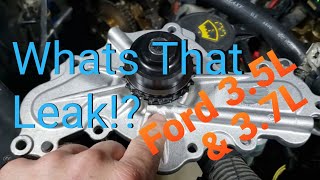
🎬 Watch: How to spot a leaking internal water pump.Generation note: The 2007-2014 model years cover the first generation Ford Edge and its mid-cycle facelift (2011-2014). The 3.5L Duratec V6 engine and its VVT system are fundamentally the same across this period, so the causes and fixes for P0024 are consistent.
Symptoms You May Notice
- Check Engine Light is on
- Rough or shaky idle
- Poor acceleration and loss of power
- Engine hesitation or stalling
- Decreased fuel economy
- Hard starting condition
- Rattling noise from the engine, especially on startup, can indicate a timing chain issue
- Replacing the camshaft position sensor when the actual fault is with the VVT solenoid or an oil quality/pressure issue. The sensor is usually working correctly by reporting the timing error.
- Replacing the camshaft phaser without first diagnosing the much cheaper and more common VVT solenoid failure.
Most Likely Causes
- Low, Dirty, or Incorrect Viscosity Engine Oil 🔴 High Probability The VVT system is hydraulic and extremely sensitive to oil pressure and cleanliness. Sludge or debris can easily clog the small passages in the VVT solenoids, causing them to stick.
How to confirm: Check the engine oil dipstick for level and examine the oil's condition. If it is below the minimum level, dark black, gritty, or has a milky/creamy appearance (indicating coolant contamination), it needs to be addressed.
Typical fix: Perform an engine oil and filter change using the OEM-specified 5W-20 or 5W-30 synthetic blend oil. If oil is contaminated with coolant, the root cause (likely the internal water pump) must be repaired immediately. - Failing VVT Solenoid (Oil Control Valve) 🔴 High Probability These solenoids are a common failure item, a fact acknowledged by Ford in multiple TSBs. They can get clogged with debris from the oil or fail electrically, causing them to stick in the advanced position.
How to confirm: A good diagnostic step is to swap the Bank 2 exhaust solenoid with the Bank 1 exhaust solenoid. Clear the codes and drive. If the code changes to P0014 (the equivalent code for Bank 1), the solenoid is confirmed to be faulty. Before swapping, a technician may use a scan tool to cycle the solenoid to try and dislodge debris, per TSB SSM 50067.
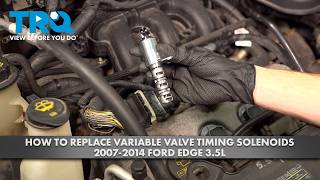
Typical fix: Replace the Bank 2 exhaust VVT solenoid. The valve cover must be removed for access. 🎬 See this step-by-step VVT solenoid replacement walkthrough. It is recommended to replace the valve cover gasket at the same time. - Worn Timing Chain / Guides / Tensioner 🟡 Medium Probability → Shop Engine Timing Chain Accelerated wear can be caused by oil contamination from a failing internal water pump. The plastic timing chain guides can become brittle and break, causing slack in the chain and incorrect timing.
How to confirm: Listen for a rattling or slapping noise from the front of the engine (timing cover area), especially on cold starts. A mechanic can confirm with a scan tool by checking cam/crank deviation.
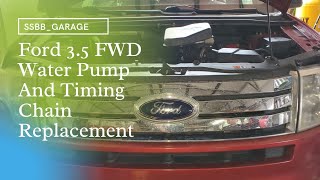
Typical fix: This is a major repair that involves replacing the timing chain, tensioners, and guides. The internal water pump should always be replaced at the same time due to significant labor overlap. 🎬 Watch: Full timing chain and water pump service guide.
Rare But Worth Checking
- Failed Camshaft Phaser: → Shop Engine Camshaft The phaser is the mechanical gear on the camshaft that actually adjusts the timing. It can become stuck or fail internally, but this is less common than a solenoid failure. It's usually diagnosed after ruling out oil issues and the solenoid.
- Failed Camshaft Position Sensor: → Shop Engine Camshaft Position Sensor The sensor reports the camshaft's position to the PCM. While it can fail, it's more common for the code to be triggered by a mechanical timing issue (solenoid, phaser, chain) that the sensor is accurately reporting.
- Internal Water Pump Failure: While the pump itself doesn't directly cause the code, its failure leads to oil contamination, which is a primary cause of VVT and timing component failure. If oil is milky, the water pump is the root cause.
Diagnosis Steps
- Verify the code with an OBD-II scanner.
- Check the engine oil level and condition. Top off or change the oil if it's low, old, or appears contaminated. If the oil is milky, stop and diagnose the internal water pump.
- Use a scan tool with live data to monitor the commanded vs. actual camshaft position for the Bank 2 exhaust cam.
- Listen for any rattling or unusual noises from the engine, particularly the timing chain area at the front of the engine.
- Per Ford TSBs (like SSM 50067), use a scan tool's bidirectional controls to command the VVT solenoid on and off multiple times. This may dislodge small debris and fix the issue without parts replacement.
- To definitively test the VVT solenoid, swap the Bank 2 exhaust solenoid with the Bank 1 exhaust solenoid. They are located under the valve covers.
- Clear the codes and test drive the vehicle. If the code returns as P0014, the solenoid is faulty and should be replaced.
- If the P0024 code returns after the swap, the issue is not the solenoid. The next steps involve checking the solenoid's wiring and connector, and then diagnosing for a more serious mechanical issue like a failed phaser or stretched timing chain, which may require a professional mechanic.
Parts You'll Likely Need
- Engine Variable Valve Timing (VVT) Solenoid
(OEM #AT4Z-6M280-C (or superseded 7T4Z-6M280-C))— This is the most common component to fail for this code, usually by sticking due to oil debris or electrical failure, an issue acknowledged by Ford TSBs.
Trusted brands: Motorcraft, Dorman, Walker
OEM price range: $60-$90
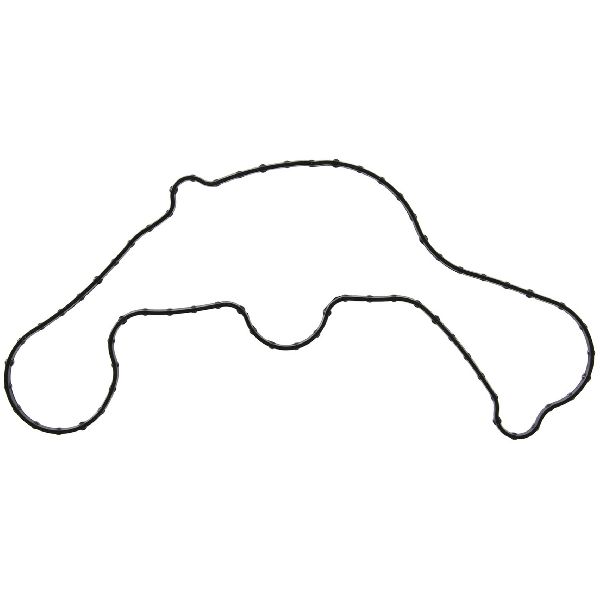
Aftermarket price range: $30-$60 - Valve Cover Gasket Kit
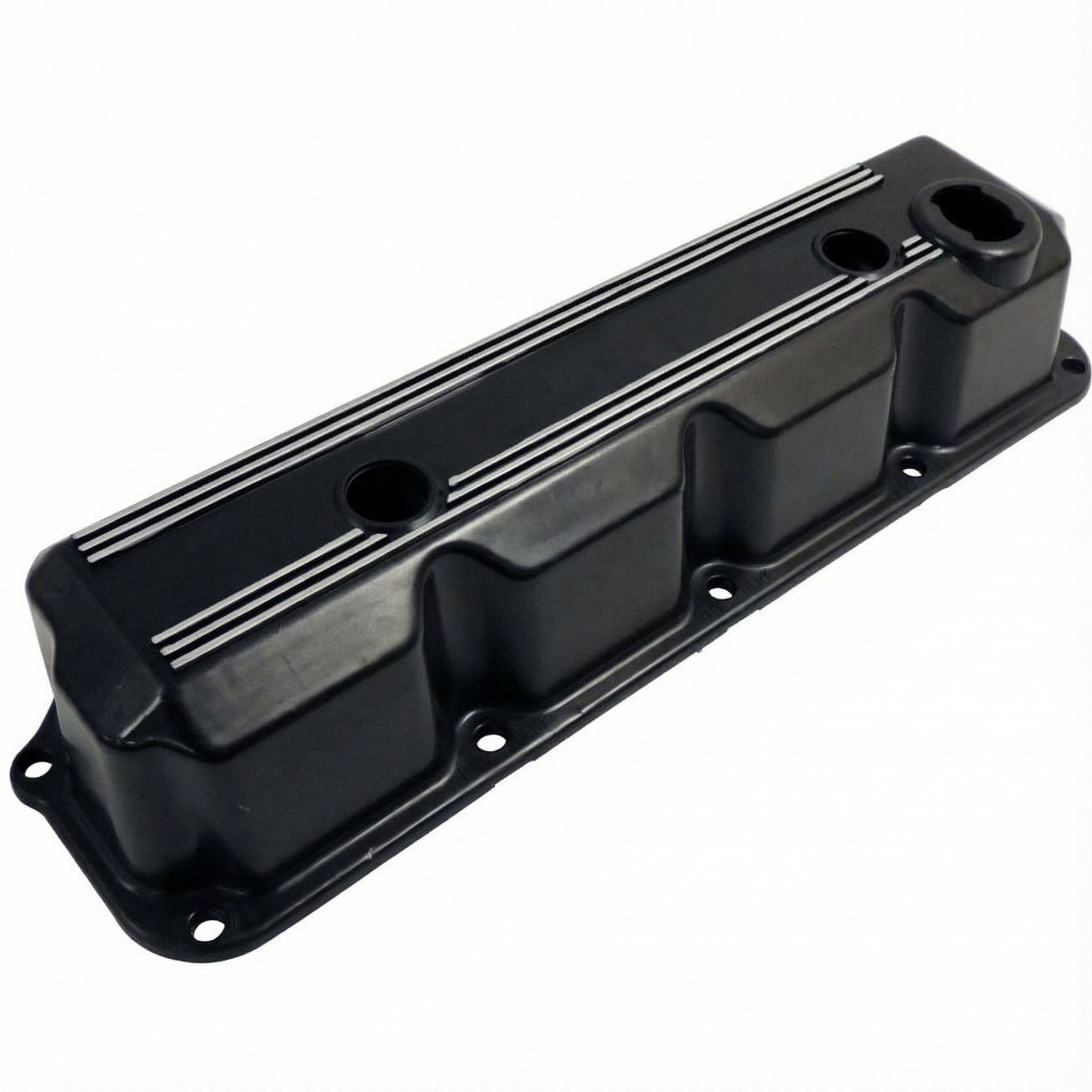
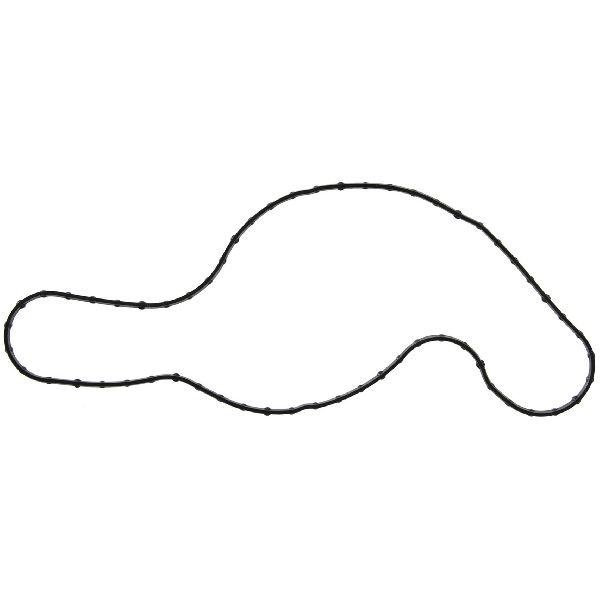
(OEM #7T4Z-6584-B)— The valve cover must be removed to access the VVT solenoids, and the gasket is a one-time-use item that should be replaced to prevent oil leaks.
Trusted brands: Fel-Pro, Mahle, Motorcraft
OEM price range: $50-$80
Aftermarket price range: $30-$50 - Timing Chain and Water Pump Kit — If diagnosis points to a stretched timing chain, this comprehensive kit is required. On the 3.5L Duratec, the water pump is internal and should always be replaced during a timing chain service due to its high failure rate and labor overlap.
Trusted brands: Motorcraft, Cloyes
OEM price range: $500-$700
Aftermarket price range: $300-$500
Related Codes That Often Appear With This One
- P0014 — This is the same over-advanced timing code but for Bank 1. Seeing P0014 and P0024 together strongly suggests a systemic issue affecting both banks, such as low oil pressure or severe oil contamination.
- P0021 — This code is for an over-advanced *intake* camshaft on Bank 2. Seeing them together can point to a timing chain issue or a severe oil pressure problem affecting the entire bank.
- P0016 / P0018 — These are cam/crank correlation codes. If the timing chain has stretched or jumped a tooth, you may see these codes along with P0024, indicating a base timing problem.
Technical Service Bulletins (TSBs) & Recalls
- SSM 50067: Covers various 2015-2021 Ford/Lincoln vehicles. Notes that VCT codes (including P0024) may be caused by small debris causing the VCT solenoid to stick. Advises using scan tool pinpoint test HK12 to cycle the solenoid 10 times to attempt to clear debris before replacement.
- SSM 47170: An earlier bulletin with similar advice to SSM 50067, noting that debris can cause the solenoid to stick and to perform diagnostic tests before replacing parts.
Platform-Specific Known Issues
- The internal water pump on the 3.5L Duratec V6 is a significant and well-documented failure point. When it fails, it leaks coolant into the engine oil pan, contaminating the oil and leading to widespread lubrication failure.
- This oil contamination is a primary driver for VVT-related codes like P0024, as the sludge and coolant mixture quickly clogs the small passages in the VVT solenoids and can damage phasers and timing components.
Mechanic-Grade Diagnostic Values
- VCT Solenoid Internal Resistance — expected: 5.0 to 15.0 Ohms. A more precise OEM target is 6.9 to 7.9 Ohms at 68°F (20°C).. Failure: A reading of 0 Ohms (short), OL/infinite resistance (open circuit), or a value significantly outside the expected range indicates a failed solenoid.
- Scan Tool PID: VCTADVERR2 (VCT Angle Error Bank 2) — expected: Should hover around 0° at a stable, warm idle.. Failure: A consistent positive value (e.g., > 5 degrees) for an excessive amount of time indicates the camshaft is over-advanced and not responding to PCM commands.
- Engine Oil Pressure (at idle) — expected: Minimum of 15 PSI at warm idle.. Failure: Pressure below 15 PSI at idle indicates an oiling problem that can starve VCT components and trigger timing codes.
- VCT Solenoid Connector Voltage (Key On, Engine Off) — expected: Approximately 12V (battery voltage) should be present on the power supply pin of the connector.. Failure: Low or no voltage points to a wiring issue, a blown fuse, or a problem with the PCM driver circuit.
Scan Tool Commands That Help
- Ford IDS or FORScan: VCT Solenoid Bidirectional Control (Pinpoint Test HK) — As recommended in Ford TSBs, this command actively cycles the VCT solenoid on and off. It is used to test the solenoid's mechanical response and can sometimes dislodge small debris causing it to stick, potentially resolving the code without part replacement.
- Ford IDS or FORScan: PCM - Reset All Adaptations / Camshaft Profile Correction Reset — This procedure is critical after replacing any VCT or timing components (solenoids, phasers, chain). The PCM learns the response rate of the old, failing parts; without a reset, it may continue using incorrect adaptive values and trigger a code even with new, functioning parts.
Wiring & Ground Locations
- Bank 2 VCT Solenoids (VCT21, VCT22) — On the 3.5L transverse engine, Bank 2 is the cylinder bank closer to the radiator (front of the vehicle). The two solenoids are located under the front valve cover.. P0024 specifically refers to the exhaust camshaft ('B' cam) on Bank 2. The exhaust solenoid is VCT22. Knowing its location is essential for testing and replacement.
- G109 — Located on the right front of the engine, near the chassis.. This is a primary engine-to-chassis ground. A poor or corroded connection at this point can cause erratic voltage and signal issues for all engine sensors and actuators, including the VVT solenoids and camshaft position sensors, leading to false or intermittent codes.
- G105 — Located on the left front cylinder head, per 2014 wiring diagrams.. This ground is directly on the engine block. A bad connection here can affect the reference ground for sensors and solenoids mounted on that cylinder bank, potentially causing incorrect readings and fault codes.
- PCM (Powertrain Control Module) — Located in the engine bay, at the right front (passenger side) near the firewall.. All VVT solenoid and camshaft sensor wiring terminates at the PCM. If components and wiring test good, the fault could lie with the PCM's internal driver circuits, though this is rare.
Real Owner Repair Stories
- Ford F150 Forum user (2013 F-150 with 3.5L EcoBoost engine (shares VVT system design), ~110,000 miles) — Check Engine Light with codes P0014 and P0024 appearing at the same time. Rough running at idle.
❌ Tried (didn't work) Initial diagnosis pointed towards common VVT solenoid or cam phaser issues.
✅ What actually fixed it The problem was diagnosed as oil sludging that clogged the VVT phaser oil screens. A technician performed an engine flush by replacing the engine oil with Automatic Transmission Fluid (ATF), running the engine to operating temperature, and then draining the ATF and performing a standard oil and filter change. This cleared the sludge and resolved the codes.
When the Usual Fixes Don't Work
- While Pass 2 correctly identifies the VVT solenoid as a high-probability cause, a real-world repair story shows that when both bank's exhaust cam codes (P0014 and P0024) appear simultaneously, the root cause may not be two failed solenoids but rather a systemic oil sludge issue clogging the phaser screens downstream. In this case, simply replacing the solenoids would not have fixed the problem; an engine flush was required to clear the blockage.
OEM Part Supersession History
7T4Z-6M280-B (and -A, -AA)→7T4Z-6M280-C— Part revision by Ford to improve reliability and performance.
Heads up: The newer -C revision is the correct service part and is backward compatible.7T4Z-6M280-C→AT4Z-6M280-C— Part number update. The parts are functionally identical for this application.
Diagnostic Flowchart
Other Known Issues on This Vehicle
Issues unrelated to this code that are worth knowing about as an owner of this generation:
- Power Transfer Unit (PTU) Failure (AWD Models) 🔴 High — Very common, can occur as early as 40,000-50,000 miles. Ford claims the fluid is 'lifetime,' but it overheats, degrades, and leads to seal leaks and catastrophic gear failure.
- Electronic Throttle Body (ETB) Failure 🔴 High — Common across multiple model years, especially 2011-2013. Causes sudden 'limp mode,' stalling, and erratic idle. Failure is often internal electronics, not just dirt. (Ref: TSB 10-21-6 (for 2010 models), Customer Satisfaction Program 13N03 (expired))
- Door Ajar Sensor Failure 🟠 Medium — Extremely common, particularly in 2011-2013 models. The switch within the door latch assembly fails, causing the interior lights to stay on and drain the battery.
- Brake Booster Diaphragm Tear 🔴 High — A known issue for 2007-2015 models. The internal diaphragm can tear, causing a hissing sound when the brake is applied and a hard pedal feel with reduced braking assistance. (Ref: Ford extended warranty coverage via program 13N02 and issued recall 23S12 for some models.)
Used vs. New Parts: Buying Guide for This Vehicle
When a used part is the smart pick: Used parts are generally not recommended for the core VVT components like solenoids, phasers, or timing chains due to their sensitivity to wear and oil quality. However, sourcing related external hardware like a valve cover, wiring harness connectors, or mounting brackets from a junkyard is a cost-effective and safe option.
Donor-vehicle mileage cap: roughly under 100000 miles for the part to have meaningful remaining life.
What to inspect on the donor part:
- For any part, check for obvious physical damage or corrosion.
- When pulling parts from a donor engine, remove the oil fill cap. Avoid engines with thick, milky, or sludgy residue visible, as this indicates poor maintenance or coolant contamination, and any related parts are likely compromised.
- Prefer donor vehicles from dry, salt-free climates to minimize corrosion on electrical connectors and grounds.
OEM-only on this vehicle (don't cheap out):
- Timing Chain Kit: Due to the catastrophic potential of a timing chain failure and the high labor cost, using an OEM (Motorcraft) or a highly reputable aftermarket brand is critical. Avoid unbranded, low-cost kits.
- Internal Water Pump: Given its location inside the timing cover and the severe damage its failure causes, only an OEM or top-tier aftermarket pump should be used during a timing service.
Aftermarket brands forum-validated for this vehicle:
- Cloyes (for timing chain kits)
- Dorman (for VVT solenoids and various OE FIX solutions)
- Fel-Pro (for gaskets)
Brands owners have reported issues with on this vehicle:
- While generally reputable, at least one owner has reported a premature failure (within one year) of a Cloyes timing chain, highlighting the importance of quality control and sourcing from authorized dealers even with good brands.
Real Owner Stories
Aggregated from forums and TSBs cited above. Mileages and costs reflect what owners reported in those sources.
2012 Ford Edge 3.5L Duratec — 100000 miles
Symptoms: Catastrophic internal water pump failure leading to coolant leaking into the engine oil pan and contaminating the oil.
What fixed it: Short block replacement.
Cost: $5,500-$5,500
Source hint: Glamisdunes.com - Warning if you have a Ford 3.5 Duratec engines.
2013 Ford Edge 3.5L Duratec
Symptoms: Vehicle felt sluggish and threw multiple VCT codes simultaneously.
What fixed it: Systemic check of oil pressure and contamination affecting the VVT system.
Source hint: Fordedgeforum.com - Sluggish New to me 2013 Edge - Code P0012, P0014, P0022 and P0024
Related OBD-II Codes
Frequently Asked Questions
My 2013 Ford Edge has P0024 and is sluggish; could this be related to other timing codes like P0012 or P0014?
Does Ford have a specific procedure to fix a sticking VVT solenoid on the Edge without replacing parts?
I see milky oil while diagnosing P0024 on my 3.5L Duratec; what does this mean?
Can I just swap the solenoids to see if the Bank 2 exhaust solenoid is bad?
Is there a specific oil I should use to prevent VVT issues on my Ford Edge?
Helpful Videos
Used OEM Parts in Stock
New Aftermarket Parts Available


The information in this article is provided for general reference and educational purposes only. Vehicle specifications, procedures, and part compatibility can vary by production date, trim level, and region. Always consult your vehicle's factory service manual and verify part numbers before purchasing or performing repairs. Safety-critical components such as airbags, seat belts, and braking systems should be installed by a qualified professional.
- Ford Edge:
- 🧭 Diagnostic Flowchart
- 🎬 Helpful Videos
- 🛍️ Shop This Part
- What's Unique About the 2007-2014 Ford Edge
- Symptoms You May Notice
- Most Likely Causes
- Rare But Worth Checking
- Diagnosis Steps
- Parts You'll Likely Need
- Related Codes That Often Appear With This One
- Technical Service Bulletins (TSBs) & Recalls
- Platform-Specific Known Issues
- Mechanic-Grade Diagnostic Values
- Scan Tool Commands That Help
- Wiring & Ground Locations
- Real Owner Repair Stories
- When the Usual Fixes Don't Work
- OEM Part Supersession History
- Other Known Issues on This Vehicle
- Used vs. New Parts: Buying Guide for This Vehicle
- Real Owner Stories
- 2012 Ford Edge 3.5L Duratec — 100000 miles
- 2013 Ford Edge 3.5L Duratec
- Related OBD-II Codes
- Frequently Asked Questions
- 🎟️ Get 5% Off