

P0024 on 2010-2012 Hyundai Santa Fe 3.5L: Exhaust Cam Timing Over-Advanced Causes & Fixes
On the 2010-2012 Santa Fe 3.5L, code P0024 is most often caused by low or dirty engine oil. If the oil is clean and full, the next likely culprit is a faulty Bank 2 Exhaust Oil Control Valve (OCV), which costs about $50-$120 for the part. Always check your oil first, and use an OEM oil filter to prevent pressure issues.
- Before buying any parts for a P0024 code, check your engine oil. Low, old, or sludgy oil is the most frequent cause.
- The faulty part is most likely the Bank 2 (radiator side) exhaust Oil Control Valve (OCV).
- A reliable DIY diagnostic is to swap the exhaust OCV with the intake OCV on the same bank. If the code changes to P0021, you have confirmed the OCV is bad.
- Be aware that replacing the exhaust OCV on this engine may require removing the valve cover, making it a more involved job than replacing the more accessible intake OCV.
- Always use a high-quality full synthetic oil and an OEM oil filter to prevent recurrence.
What's Unique About the 2010-2012 Hyundai Santa Fe
The 3.5L Lambda II V6 engine uses a Dual CVVT system, with four Oil Control Valves (OCVs) to manage timing on both intake and exhaust camshafts for both cylinder banks. This system is highly sensitive to oil pressure and cleanliness. Owners report that using non-OEM oil filters can sometimes lead to pressure deviations that trigger timing codes. Furthermore, on this specific engine, the Bank 2 (front/radiator side) OCVs are significantly harder to access than Bank 1's. Replacing the Bank 2 exhaust OCV often requires removing the upper engine mount and its large bracket to gain clearance, a much more involved job than for Bank 1.
Symptoms You May Notice
- Check Engine Light is on
- Rough or unstable idle, engine may shake
- Engine hesitation or stalling, especially under load or when coming to a stop
- Reduced engine power and poor acceleration, feels sluggish
- Decreased fuel economy
- Difficulty starting the engine
- Rattling or knocking noises from the engine, especially on startup
- Replacing the camshaft position sensor. A sensor failure typically sets a sensor-specific circuit code (e.g., P0365-P0369), not a timing performance code like P0024. The P0024 code indicates the sensor is working correctly and reporting a mechanical timing problem.
Most Likely Causes
- Low or Dirty Engine Oil 🔴 High Probability The CVVT system is entirely dependent on clean oil at the correct pressure to function. Sludge from infrequent oil changes or low levels are the most common triggers for timing codes on these engines, clogging the small passages in the OCVs and phasers.
How to confirm: Check the engine oil dipstick. The oil should be at the full mark and have a clear, amber-to-brown color. If it is black, thick, sludgy, or below the 'add' line, this is your likely cause.
Typical fix: Perform a complete engine oil and filter change using a full synthetic oil of the manufacturer-specified viscosity (typically 5W-20 or 5W-30) and a genuine Hyundai/Kia OEM oil filter.
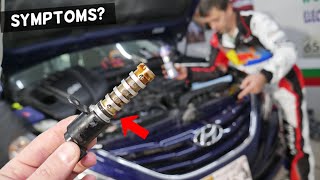
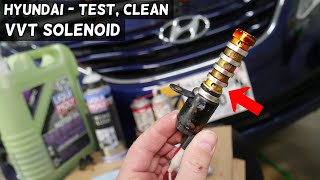
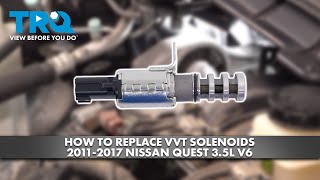
Est. part cost: $40-$80 - Faulty Bank 2 Exhaust Oil Control Valve (OCV) 🔴 High Probability → Shop Engine Variable Valve Timing (VVT) Solenoid These solenoids operate in hot engine oil and can become clogged with debris or fail electrically over time, causing them to stick open or closed and prevent proper timing adjustment.
How to confirm: After verifying the oil is good, locate the Bank 2 (radiator side) OCVs. Swap the exhaust OCV with the intake OCV on the same bank. Clear the codes and drive. If the code changes to P0021 ('A' Camshaft Over-Advanced), the OCV you moved is faulty. You can also test the OCV's resistance with a multimeter; it should be between 9.4 and 10.4 Ohms at 68°F (20°C). 🎬 See how to test and clean your VVT solenoid.
Typical fix: Replace the Bank 2 exhaust Oil Control Valve. This may require removing an engine mount bracket for access.
Est. part cost: $50-$120 - Failing Camshaft Phaser (CVVT Actuator) ⚪ Low Probability → Shop Engine Camshaft The phaser is a mechanical gear that can get stuck in the advanced position due to internal wear or clogged oil passages, especially on higher-mileage engines or those with a history of infrequent oil changes. This is a more serious mechanical failure.
How to confirm: This is a diagnosis of exclusion. If the oil is clean and a new OCV does not fix the code, the phaser itself is the next suspect. This requires professional diagnosis, often involving direct observation of cam angle deviation with an advanced scan tool and potentially compressed air testing of the phaser's movement.
Typical fix: Replace the Bank 2 exhaust camshaft phaser assembly. This is a labor-intensive job that also involves the timing chain.
Est. part cost: $150-$300
Rare But Worth Checking
- Stretched Timing Chain or Failed Tensioner: → Shop Engine Timing Chain While not the most common cause for a single-bank over-advanced code, a stretched chain can cause the base timing to be off, which the CVVT system cannot correct. This is more likely if you also hear a rattling noise on cold startups that persists.
- Clogged CVVT Oil Filter Screens: → Shop Engine Oil Filter Adapter Some Hyundai engines have small, thimble-sized filter screens in the cylinder head oil passages leading to the OCVs. If these become completely clogged with sludge, they can starve the system of oil pressure, even if the main oil and OCV are clean. Accessing them often requires removing the OCVs.
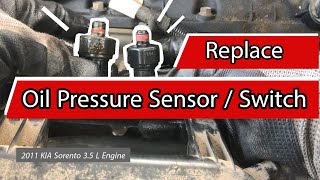
- Failing Oil Pressure Switch: The 3.5L Lambda II is known for a failing oil pressure switch located under the intake manifold. 🎬 Watch this guide to replacing the oil pressure sensor. While it typically causes an oil leak, a severe failure could impact overall engine oil pressure, indirectly contributing to CVVT system faults.
Diagnosis Steps
- Check the engine oil level and condition. If it is low, dirty, or sludgy, perform an oil and filter change using an OEM filter and the correct oil viscosity (5W-20 or 5W-30). Clear the code and see if it returns. This is the most common and cheapest fix.
- Scan for any other accompanying trouble codes. Codes for both banks (P0014 & P0024) point strongly to an oil issue.
- Locate the Oil Control Valves on Bank 2 (the engine bank closer to the radiator). There will be one for the intake cam and one for the exhaust cam.
- Inspect the electrical connector and wiring for the exhaust OCV for any signs of damage, corrosion, or oil contamination.
- Perform an OCV swap test. Disconnect and remove both the intake and exhaust OCVs on Bank 2. Swap their positions, reinstall them, clear the codes, and drive the vehicle. If the code changes to P0021, the OCV you moved to the intake position is confirmed to be faulty.
- If the P0024 code returns after the swap, test the resistance of the original exhaust OCV. It should be between 9.4-10.4 Ohms. If it's out of spec, it has failed electrically.
- If the OCV tests good but the code persists, the issue may lie in a clogged oil passage (check for CVVT filter screens), a faulty camshaft phaser, or a timing chain issue, which will likely require professional diagnosis.
Parts You'll Likely Need
- Bank 2 Exhaust Oil Control Valve (OCV) / VVT Solenoid
(OEM #24360-3CAB2)— This solenoid is the most common part to fail after an oil problem is ruled out. It gets clogged with debris or fails electrically, causing it to stick and send incorrect oil pressure to the cam phaser.
Trusted brands: Hyundai (Genuine), Dorman, Hitachi
OEM price range: $80-$140
Aftermarket price range: $50-$90 - Engine Oil and OEM Filter
(OEM #26320-3CAA0 (Filter))— Low, dirty, or incorrect viscosity oil is the number one cause of this code. Using a genuine Hyundai/Kia filter is recommended as some aftermarket filters can cause oil pressure issues.
Trusted brands: Hyundai (Filter), Mobil 1, Pennzoil, Valvoline
OEM price range: $10-$15 (Filter)
Aftermarket price range: $30-$60 (Oil)
Related Codes That Often Appear With This One
- P0014 — This is the same over-advanced exhaust cam code, but for Bank 1 (firewall side). Seeing P0014 and P0024 together strongly points to a systemic oil problem (low level, low pressure, severe contamination) affecting the entire engine.
- P0021 — This is an over-advanced code for the intake camshaft on the same bank (Bank 2). It will often appear after swapping the intake and exhaust OCVs for diagnosis, confirming the original exhaust OCV was faulty.
- P0019 — This code is for 'Crankshaft - Camshaft Position Correlation (Bank 2)'. If seen with P0024, it points towards a more severe timing issue, such as a jumped or stretched timing chain, rather than just a stuck OCV.
Technical Service Bulletins (TSBs) & Recalls
- TSB 15-01-022-1: While for a 2015 Sonata with a different code (P0010), this TSB addresses an improperly seated internal oil seal plug in the CVVT actuator. It demonstrates the sensitivity of the CVVT system to internal sealing and oil pressure integrity, which is relevant to the P0024 fault logic.
Platform-Specific Known Issues
- Access to the Bank 2 (front) exhaust OCV is obstructed by the upper engine mount bracket. To replace it, the engine must be supported from below, and the mount and its large bracket must be unbolted and removed, adding significant labor compared to the easily accessible Bank 1 OCVs.
Mechanic-Grade Diagnostic Values
- OCV Solenoid Power Connector Voltage — expected: Battery Voltage (approx. 12V) with key on, engine off.. Failure: Zero or very low voltage points to a wiring issue, blown fuse, or problem with the engine main relay.
- ECU Live Data: Desired vs. Actual Cam Angle — expected: At idle and steady RPM, the 'Actual' angle should closely mirror the 'Desired' angle.. Failure: The ECM flags P0024 if the 'Actual' position is more than 20 degrees advanced from the 'Desired' position while driving between 2000-3000 RPM.
- Bank 2 Exhaust OCV Control Wire — expected: This is a duty-cycled ground signal from the ECU. Testing requires an oscilloscope to see the waveform. A simple multimeter test is not effective.. Failure: No signal or a constant ground/open circuit when the ECU should be commanding the OCV indicates a wiring or ECU driver fault.
Hidden / Shadow Codes Worth Checking
- Mode 6, Test ID (TID) for CVVT: Mode 6 stores results from non-continuous system self-tests. For the CVVT system, it will monitor camshaft angle deviation. A test value approaching the maximum limit can indicate a problem before it's bad enough to set a P0024 code. (see via An advanced scan tool capable of displaying Mode 6 data. The specific Test ID (TID) and Component ID (CID) are manufacturer-specific and may need to be looked up for Hyundai.)
Scan Tool Commands That Help
- Hyundai GDS (or equivalent professional scanner): Actuator Test: Bank 2 Exhaust OCV — This command allows you to manually activate the solenoid while the engine is running. If the solenoid and its wiring are working, forcing it on should cause the engine to stumble, hesitate, or stall. If there is no change in engine operation, it confirms a fault in the OCV itself or its oil supply.
Wiring & Ground Locations
- ECU Pin 93 — At the main Engine Control Module (ECM/PCM), which is located in the engine bay at the left rear of the compartment.. This is the specific pin that the ECU uses to send the control signal to the Bank 2 Exhaust OCV. It is a Green wire. Testing for a signal here can isolate a wiring fault from a faulty ECU driver.
- ECU Pin 32 — At the main Engine Control Module (ECM/PCM).. This is the shared ground pin for the camshaft position sensors (both banks, intake and exhaust). A poor connection at this pin could cause erratic sensor readings, though it would likely trigger other codes as well. It is a Black wire.
- Ghg04 / Glg04 — Main engine grounds located at the rear of the engine block.. A poor main engine ground can cause a host of electrical issues, including incorrect sensor readings and improper actuator function. Ensuring these are clean and tight is a fundamental step in any electrical diagnosis.
Real Owner Repair Stories
- 2CarPros Forum User (2017 Hyundai Santa Fe (similar Lambda engine)) — Check engine light with codes P0014 and P0024 (both exhaust cams over-advanced), engine ticking noise.
❌ Tried (didn't work) Multiple oil changes at various shops, adding engine additives.
✅ What actually fixed it A certified mechanic advised that the likely cause was not the timing chain itself, but clogged OCV filter screens located in the cylinder heads beneath the OCVs. Cleaning these screens would restore proper oil flow to the cam phasers. - NHTSA ODI #11063653 — An owner reported a loud clunking noise and was told the vehicle was displaying codes P0014 and P0024. A mechanic diagnosed the issue as engine timing solenoids needing replacement due to advanced camshaft timing.
- NHTSA ODI #11597363 — One owner noted that after a clicking sound worsened, the check engine light came on with codes P0014 and P0024. Upon inspection, the engine oil was found to be low.
- NHTSA ODI #11438666 — A report describes a vehicle losing power due to codes P0014 and P0024, which the owner associated with crankshaft issues.
OEM Part Supersession History
24360-3CAB2→No supersession found.— This part number appears to be stable and is used across a wide range of Hyundai/Kia models and years with the Lambda V6 engine.
Diagnostic Flowchart
Other Known Issues on This Vehicle
Issues unrelated to this code that are worth knowing about as an owner of this generation:
- Engine Oil Pressure Switch Failure 🟠 Medium — A notorious and common failure item on the 3.5L Lambda II engine. The switch can leak oil, causing a mess and potentially low oil pressure if not addressed. It is difficult to access, requiring removal of the intake manifold.
- Harsh Shifting or Transmission Faults (2010 model year) 🟠 Medium — The 2010 model year was the first to use a new 6-speed automatic transmission, and some owners reported issues like harsh engagement or entering limp mode. TSBs were released to address some of these software-related glitches. (Ref: Yes, various TSBs for transmission software updates were released.)
- Premature Timing Chain Wear 🟡 Low → Shop Engine Timing Chain — While the timing chain is designed to last the life of the engine, neglect of oil changes (extended intervals or wrong oil type) can lead to premature stretch and guide wear, typically noticeable after 80,000 miles with a startup rattle.
Used vs. New Parts: Buying Guide for This Vehicle
When a used part is the smart pick: For this specific repair, using used parts is generally not recommended. The primary failure components (OCV, phaser) are sensitive to oil quality and wear, and a used part from a junkyard carries a high risk of having the same sludge or wear issues that cause the code.
Donor-vehicle mileage cap: roughly under 40000 miles for the part to have meaningful remaining life.
What to inspect on the donor part:
- If considering a used cam phaser (not recommended), look for a donor vehicle with documented, regular oil change history.
- Avoid any parts from an engine that shows signs of heavy oil sludge under the oil cap or valve cover.
- Never buy a used Oil Control Valve (OCV); the risk of it being clogged or failing electrically is too high to justify the small cost savings.
OEM-only on this vehicle (don't cheap out):
- Engine Oil Filter: It is strongly recommended to use a genuine Hyundai/Kia OEM filter (26320-3CAA0). Aftermarket filters have been anecdotally linked to oil pressure deviations that can trigger CVVT codes on this engine family.
Aftermarket brands forum-validated for this vehicle:
- Dorman: Widely available and often addresses known OE failure points.
- Hitachi: Often an OE supplier, known for high-quality electronics and solenoids.
Brands owners have reported issues with on this vehicle:
- No-name, unbranded solenoids from online marketplaces should be avoided, as their internal coil quality and mechanical tolerances are unverified and can fail quickly.
Real Owner Stories
Aggregated from forums and TSBs cited above. Mileages and costs reflect what owners reported in those sources.
2012 Santa Fe 3.5L — 213000 miles
Symptoms: Check engine light with codes P0011, P0014, P0021, and P0024.
What fixed it: A complete oil and filter change followed by driving the car for approximately 20 miles to allow the new oil to circulate and clear out gunk in the system.
Source hint: Hyundai Forum report from owner of 2012 Santa Fe 3.5L
2010 Hyundai Santa Fe 3.5L
Symptoms: Check engine light and acceleration issues; the light returned only one day after a part replacement.
What fixed it: The owner replaced the VVT solenoid, but it only provided a temporary fix, suggesting a persistent oiling or sludge issue remained.
Source hint: reddit.com/r/Hyundai - 'Had a P0024 code and replaced VVT solenoid, check engine still on'
NHTSA Reported Incident
Symptoms: Check engine light with codes P0014 and P0024; the light turned off upon restarting but returned after 3 minutes of driving.
What fixed it: NHTSA ODI #11589365 describes an owner attempting to schedule repairs after these codes appeared, noting the intermittent nature of the warning light during operation.
NHTSA Reported Incident
Symptoms: "P0014 b camshaft position timing over advanced, p0024 b camshaft position timing over advanced."
What fixed it: NHTSA ODI #11513071 notes that a dealer recommended getting a new vehicle if the repair was not covered under warranty, highlighting the potential severity of persistent timing faults.
Related OBD-II Codes
Frequently Asked Questions
I have a 2010 Santa Fe 3.5L; is the Bank 2 exhaust Oil Control Valve easy to replace myself?
Can I use any oil filter to fix the P0024 code on my 2012 Santa Fe?
My Santa Fe has P0024 and P0014; does this mean two different parts failed?
What is the correct resistance for the OCV on a 2011 Santa Fe 3.5L?
Does TSB 15-01-022-1 apply to my P0024 code?
I see oil leaking near the intake manifold; could this cause my P0024 code?
Helpful Videos
We Have This Part in Stock


The information in this article is provided for general reference and educational purposes only. Vehicle specifications, procedures, and part compatibility can vary by production date, trim level, and region. Always consult your vehicle's factory service manual and verify part numbers before purchasing or performing repairs. Safety-critical components such as airbags, seat belts, and braking systems should be installed by a qualified professional.
- Hyundai Santa Fe:
- 🧭 Diagnostic Flowchart
- 🎬 Helpful Videos
- 🛍️ Shop This Part
- What's Unique About the 2010-2012 Hyundai Santa Fe
- Symptoms You May Notice
- Most Likely Causes
- Rare But Worth Checking
- Diagnosis Steps
- Parts You'll Likely Need
- Related Codes That Often Appear With This One
- Technical Service Bulletins (TSBs) & Recalls
- Platform-Specific Known Issues
- Mechanic-Grade Diagnostic Values
- Hidden / Shadow Codes Worth Checking
- Scan Tool Commands That Help
- Wiring & Ground Locations
- Real Owner Repair Stories
- OEM Part Supersession History
- Other Known Issues on This Vehicle
- Used vs. New Parts: Buying Guide for This Vehicle
- Real Owner Stories
- 2012 Santa Fe 3.5L — 213000 miles
- 2010 Hyundai Santa Fe 3.5L
- NHTSA Reported Incident
- NHTSA Reported Incident
- Related OBD-II Codes
- Frequently Asked Questions
- 🎟️ Get 5% Off