

P0025 on 2008-2017 Buick Enclave 3.6L: Causes and Fixes for Over-Retarded Exhaust Cam Timing
On a Buick Enclave with the 3.6L V6, code P0025 is most often caused by a faulty Bank 2 exhaust camshaft actuator solenoid or low/dirty engine oil. Replacing the solenoid is a common DIY fix costing about $30-$60 for the part. However, this code can also be an early sign of a stretched timing chain, which is a known issue on this engine and a much more expensive repair, often costing over $2,500.
- Always check your engine oil level and condition first; it's the easiest and cheapest potential fix.
- The most likely failed part for P0025 is the Bank 2 (front/radiator side) exhaust (lower) camshaft actuator solenoid, part #12655421.
- A simple diagnostic is to swap the exhaust and intake solenoids on Bank 2. If the code changes to P0022, you've confirmed the solenoid is bad.
- Be aware that P0025 can be an early warning of a stretched timing chain, a known and very expensive problem on this engine. If other timing codes like P0008 or P0009 are present, the chain is the almost certain cause.
What's Unique About the 2008-2017 Buick Enclave
The GM High Feature V6 engine family (LY7 in 2008, LLT from 2009-2017) has a well-documented history of premature timing chain stretch. This was often attributed to an overly optimistic oil life monitoring system in early models, leading to oil breakdown and accelerated chain wear. While codes like P0008 or P0009 are the classic indicators of a major timing chain problem, P0025 can be an early symptom. GM issued a special coverage program (#11340C) for the 2009 model year to address this, covering timing chain replacement for 10 years or 120,000 miles. This TSB also included an ECM reprogram to adjust the oil life monitor for more conservative change intervals.
Generation note: The 2008-2017 range covers the entire first generation of the Buick Enclave. However, the engine changed slightly. The 2008 model used the port-injected LY7 3.6L V6, while the 2009-2017 models used the direct-injected LLT 3.6L V6. Both engines share the same basic architecture and are known to suffer from the same primary causes for this code, particularly timing chain wear and faulty VVT solenoids. The timing chain issues are considered most prevalent on the LY7 and early LLT engines (pre-2012).
Symptoms You May Notice
- Check Engine Light is on
- Rough or unstable idle
- Engine may be hard to start
- Reduced engine power and poor acceleration
- Engine stalling, especially when coming to a stop
- Increased fuel consumption
- Engine rattling noise, especially on cold startup
- Replacing the camshaft position sensor. The sensor is reporting the timing issue correctly; it is not the cause of it. The code indicates a mechanical timing problem or a control problem (solenoid), not a sensor data problem.
Most Likely Causes
- Low or Dirty Engine Oil 🔴 High Probability The VVT system is hydraulic and extremely sensitive to oil pressure and cleanliness. The original oil life monitor calibration on these engines was known to be too long, leading to sludge buildup that can clog the VVT system's small oil passages and solenoid screens. This is a primary cause of VVT-related fault codes.
How to confirm: Check the oil level on the dipstick and inspect its color and consistency. If the level is low or the oil is dark, gritty, or sludgy, this is the likely starting point. The VVT system cannot function correctly without 🎬 See: Common causes and quick solutions for the P0025 code the proper oil level and pressure.
Typical fix: Perform an oil and filter change using a quality full synthetic oil that meets GM's dexos1 specification (5W-30). Clear the code and drive to see if it returns. Some owners recommend performing an engine flush to help clear sludge from oil passages.
Est. part cost: $40-$80 - Failed Bank 2 Exhaust Camshaft Actuator Solenoid 🔴 High Probability → Shop Engine Camshaft
How to confirm: The easiest way is to swap the Bank 2 exhaust solenoid (the lower one on the front/radiator side of the engine) with the Bank 2 intake solenoid (the upper one). Clear the codes and run the engine. If the code changes to P0022 (Intake Camshaft Position Timing Over-Retarded Bank 2), you have confirmed the solenoid is faulty. The solenoids are held in by a single 10mm bolt.
Typical fix: Replace the faulty solenoid. It is held in by 🎬 Watch: Step-by-step 3.6L VVT solenoid replacement walkthrough a single 10mm bolt and can be accessed from the top of the engine. Ensure the new solenoid is for the exhaust position. It's often recommended to replace both the intake and exhaust solenoids on the affected bank at the same time.
Est. part cost: $30-$60 - Stretched Timing Chains 🟡 Medium Probability → Shop Engine Timing Chain This is a widely documented weakness of the 3.6L V6 engine family from this era, particularly models before 2012. The chains can elongate over time due to wear, often accelerated by oil breakdown, causing the camshafts to go out of sync with the crankshaft.
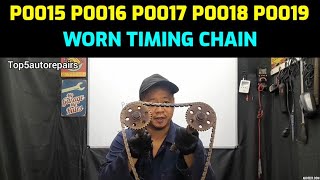
How to confirm: This is a more advanced diagnosis. A mechanic will use a scan tool to monitor camshaft position deviation data. Significant deviation that doesn't resolve with a solenoid replacement points to the chains. This code may also appear alongside P0008, P0009, P0017, or P0018, which are stronger indicators of a chain issue. A rattling noise from the engine on cold starts 🎬 Watch: How to identify a stretched timing chain is also a classic symptom.
Typical fix: This is a major, labor-intensive repair that involves replacing all three timing chains, the tensioners, and guides. It often requires dropping the engine subframe. Repair costs at a shop can range from $2,800 to over $4,500.
Est. part cost: $400-$700
Rare But Worth Checking
- Failed Camshaft Phaser: → Shop Engine Camshaft The phaser is the mechanical gear at the end of the camshaft that the solenoid controls. While less common than a solenoid failure, the phaser can become clogged with sludge or mechanically fail, getting stuck in the retarded position. This is a more complex repair than the solenoid.
- Wiring Harness Damage: The wiring or connector to the Bank 2 exhaust solenoid could be damaged, corroded, or have a loose connection, preventing the ECM from controlling it properly. A visual inspection and multimeter test can confirm this.
- Clogged Solenoid Screens: The VVT solenoids have small filter screens to protect them from debris in the oil. These screens can become clogged with sludge, restricting oil flow even if the solenoid itself is electrically sound. Sometimes, removing and cleaning the solenoid and its screens can resolve the issue without requiring replacement.
Diagnosis Steps
- Check the engine oil level and condition. Top off or change the oil and filter if it is low or dirty. Use full synthetic 5W-30 oil meeting the GM dexos1 specification.
- Use an OBD-II scanner to check for any other pending or stored trouble codes. Codes like P0008 or P0009 point strongly to a timing chain issue.
- Locate the camshaft actuator solenoids on Bank 2 (front of the engine, near the radiator). The exhaust solenoid is the lower of the two.
- Swap the Bank 2 exhaust solenoid with the Bank 2 intake solenoid (the top one). They are identical parts.
- Clear the trouble codes and start the engine. Let it run for a few minutes.
- Re-scan for codes. If the code has changed to P0022 (Bank 2 Intake Over-Retarded), the solenoid you moved is faulty and must be replaced.
- If code P0025 returns, the problem is not the solenoid. The next steps involve checking the solenoid's wiring and connector for continuity and voltage.
- If the wiring is good, the cause is likely a more serious mechanical issue, pointing to a stretched timing chain, a bad tensioner, or a faulty camshaft phaser. This requires professional diagnosis with a scan tool to observe cam deviation angles.
Parts You'll Likely Need
- Camshaft Position Actuator Solenoid (Bank 2, Exhaust)
(OEM #12655421 (supersedes 12628348, 12646784))— This solenoid controls oil flow to the cam phaser. It is a very common failure item, either by clogging with debris or electrical failure. The intake and exhaust solenoids are often the same part number.
Trusted brands: ACDelco (OEM), Delphi, Dorman
OEM price range: $45-$70
Aftermarket price range: $25-$50 - Timing Chain Kit
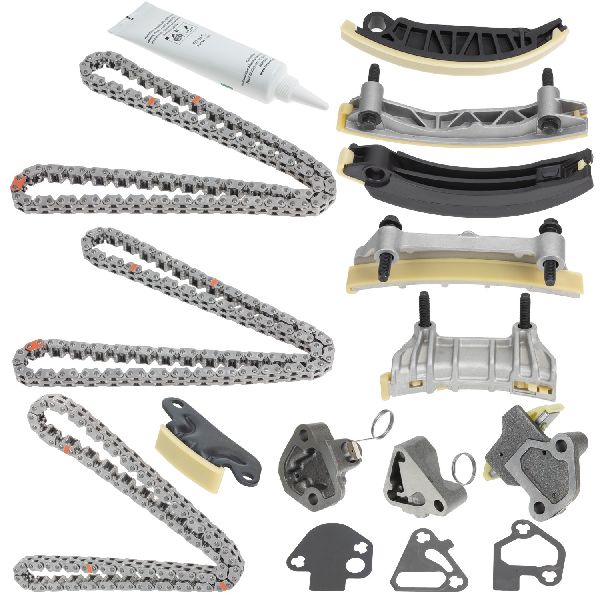
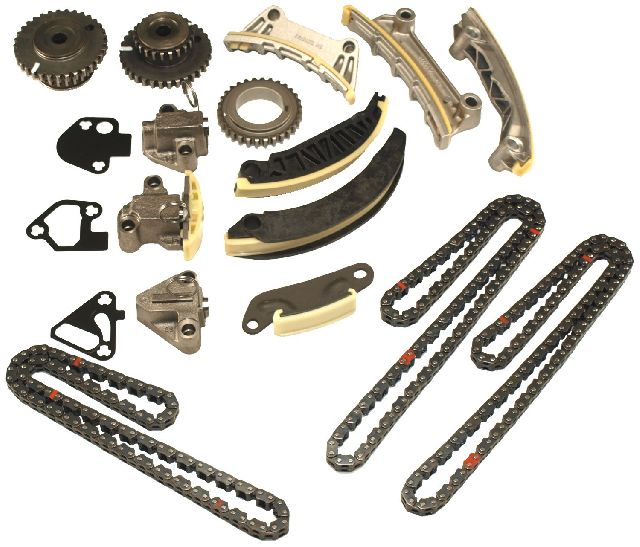
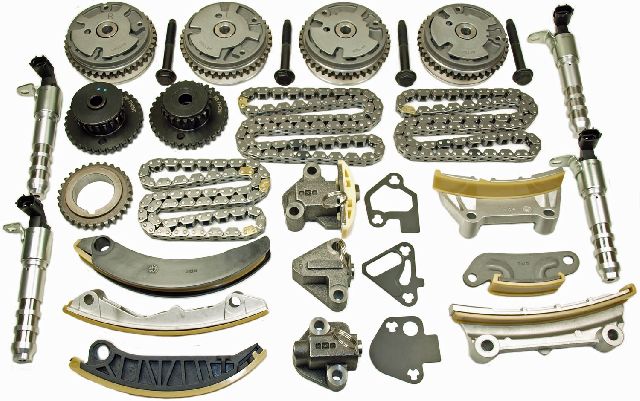
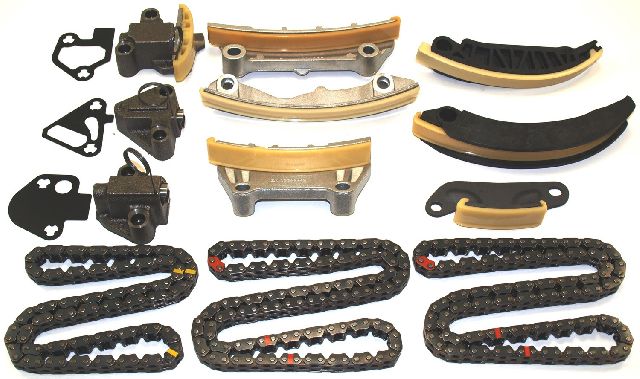
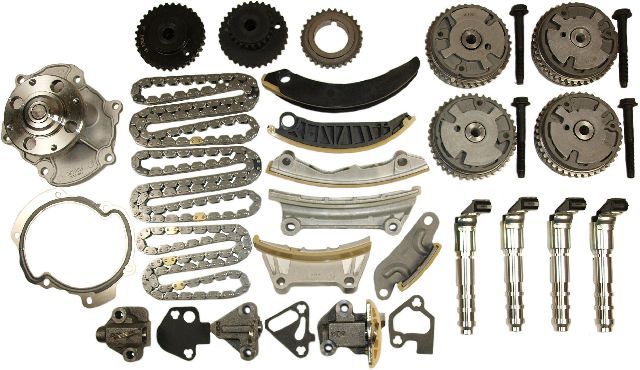
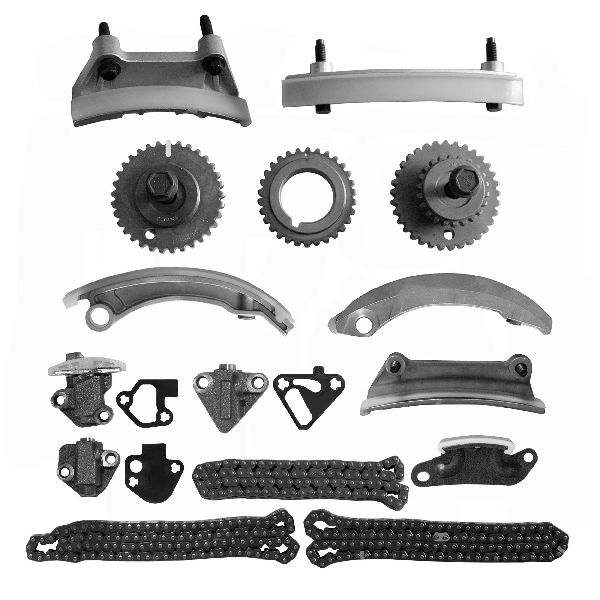
(OEM #12651450 (for LLT engine))— If diagnosis points to a stretched chain, a complete kit including all three chains, tensioners, and guides is required. This is a known weak point on the 3.6L V6. Using an OEM or high-quality aftermarket kit (like Cloyes) is critical for longevity.
Trusted brands: ACDelco (OEM), Cloyes
OEM price range: $400-$600
Aftermarket price range: $250-$400
Related Codes That Often Appear With This One
- P0017 — Crankshaft Position - Camshaft Position Correlation (Bank 1 Sensor B). If the timing chain has stretched, it can cause multiple correlation codes across both banks.
- P0008 — Engine Positions System Performance Bank 1. This is a general code indicating a timing discrepancy between the crankshaft and the Bank 1 camshafts, often pointing towards a stretched primary timing chain.
- P0009 — Engine Positions System Performance Bank 2. Similar to P0008 but for Bank 2. The presence of P0008 or P0009 with P0025 strongly suggests a timing chain issue.
Technical Service Bulletins (TSBs) & Recalls
- 11340C: Special Coverage Adjustment for premature timing chain wear on certain 2009 Buick Enclave models (among others) with the 3.6L V6. This extended the warranty to 10 years/120,000 miles and included an ECM reprogram to shorten oil change intervals.
- 14404B: Special Coverage for fractured 3-5-R clutch wave plate in the 6T70/6T75 transmission, affecting 2007-2009 models.
- 14329B: Special Warranty Coverage for power steering pump wear causing loss of assist, covering vehicles for 10 years/150,000 miles.
Platform-Specific Known Issues
- Premature Timing Chain Wear: The most significant issue for this platform. GM issued Special Coverage Adjustment #11340C for 2009 models, extending the warranty for this specific failure to 10 years/120,000 miles. Owners of other years may not be covered and face a very expensive repair, with some owners reporting costs of $3,200-$4,500.
- Sludge Buildup: Due to long oil change intervals recommended by the early Oil Life Monitor system, these engines are prone to sludge that clogs VVT solenoids and oil passages, leading to various timing codes. Regular changes with full synthetic oil are crucial.
- Solenoid Swapping as a Diagnostic Tool: A widely-shared tip in
Mechanic-Grade Diagnostic Values
- Camshaft Position Actuator Solenoid Resistance (LLT Engine, 2009-2017) — expected: 7 to 12 Ohms. Failure: A reading of 0 Ohms (short), infinite/OL (open), or significantly outside the expected range indicates a failed solenoid coil.
- Camshaft Position Actuator Solenoid Resistance (LY7 Engine, 2008) — expected: 4.6 to 7.5 Ohms. Failure: A reading outside this range indicates a failed solenoid coil. Note the different specification for the earlier engine.
- VVT Solenoid Connector Voltage — expected: Battery Voltage (~12V) on the power supply pin with ignition on, engine off.. Failure: No voltage or low voltage points to a problem in the wiring harness or fuse, not the solenoid itself.
- Scan Tool: Desired vs. Actual Camshaft Position Angle Variance — expected: Less than 5 degrees at idle.. Failure: A consistent variance greater than 5-6 degrees for more than a few seconds will trigger the fault code and points to a control or mechanical issue.
- Engine Oil Pressure (Warm Idle) — expected: Approximately 20-30 PSI.. Failure: Pressure consistently below 20 PSI at warm idle may be insufficient for proper VVT phaser operation and can indicate oil pump wear or severe oil breakdown.
Scan Tool Commands That Help
- GDS2 / Tech2: Camshaft Position Actuator Solenoid Test — This bidirectional control allows a technician to command the solenoid on and off (or to a specific angle) to verify its mechanical operation and see if the camshaft phaser responds. It is the definitive test to isolate a faulty solenoid from a wiring problem or a stuck mechanical phaser, and should be used if a simple solenoid swap is inconclusive.
- GDS2 / Tech2: Crankshaft Position (CKP) Variation Learn — This reset procedure is mandatory after replacing the timing chains, crankshaft sensor, or ECM. It allows the ECM to learn the profile of the new components to ensure accurate timing and misfire detection.
Wiring & Ground Locations
- G104 — Typically located on the rear of the driver's side cylinder head (Bank 2).. This is a primary engine ground for Bank 2. A loose or corroded ground at this location can cause erratic voltage, incorrect readings, and communication issues for all sensors and actuators on Bank 2, including the exhaust VVT solenoid, potentially causing a false P0025 code.
- G103 — Often located on the front of the passenger side cylinder head (Bank 1) or on the left frame rail.. While not directly for Bank 2, this is another major engine/chassis ground. Verifying all major grounds are clean and tight is a critical step in diagnosing any electrical fault.
- VVT Solenoid Connector — Plugged into the Bank 2 exhaust VVT solenoid, which is the lower of the two solenoids on the front of the engine near the radiator.. This 2-pin connector provides power and the control signal from the ECM. Pin 1 is typically the 12V supply, and Pin 2 is the control circuit that the ECM pulses to ground. Testing for voltage and continuity here is essential to rule out a wiring issue before replacing the solenoid.
Real Owner Repair Stories
- YouTube channel 'Pine Hollow Auto Diagnostics' (on a similar GM 3.6L engine) (GM 3.6L V6 with camshaft position sensor faults.) — Check engine light with camshaft position sensor performance codes.
❌ Tried (didn't work) Replacing the camshaft position sensor with a new aftermarket part., Replacing the sensor again with a new OEM part from a GM dealer., Replacing the sensor a third time with another new OEM part.
✅ What actually fixed it The technician used an oscilloscope and found that multiple new sensors (both aftermarket and OEM) were producing an incorrect waveform pattern, suggesting a bad batch of parts. The issue was only resolved after trying nearly ten different new sensors until one produced the correct 'two wide, two narrow' tooth pattern on the scope. This highlights that 'new' does not always mean 'good' and demonstrates the value of verifying the signal with a scope instead of just swapping parts.
OEM Part Supersession History
12628348, 12646784→12655421— Part revision and consolidation by GM.
Heads up: The intake and exhaust solenoids are generally the same part number for a given engine, which allows for diagnostic swapping. However, always verify the part number for your specific VIN before purchasing.
Model Year Variations Within This Range
- 2008-2011: These earlier models (LY7 and early LLT engines) are significantly more prone to premature timing chain stretch. GM implemented an improved timing chain design starting around the 2012 model year, making the issue less common on later vehicles.
- 2008 (LY7) vs 2009-2017 (LLT): The VVT solenoids have different electrical resistance specifications. The 2008 LY7 engine solenoid should measure between 4.6-7.5 Ohms, while the 2009-2017 LLT engine solenoid should measure between 7-12 Ohms. Using the wrong part or test spec will lead to misdiagnosis.
Diagnostic Flowchart
Other Known Issues on This Vehicle
Issues unrelated to this code that are worth knowing about as an owner of this generation:
- Cracked 3-5-R Transmission Wave Plate 🔴 High — Common on 2007-2009 models, typically occurring after 20,000 miles. Leads to sudden loss of 3rd, 5th, and Reverse gears. (Ref: TSB 14404B (Special Coverage))
- Power Steering Pump Failure / Leaks 🟠 Medium — Common across all years. Symptoms include whining noise, fluid leaks, and intermittent loss of power steering assist, especially at low speeds. (Ref: TSB 14329B (Special Coverage))
- Main Engine Water Pump Failure 🔴 High — A frequent failure item. Leaks coolant from the weep hole, leading to overheating if not addressed. Failure can damage other components.
- Stretched Timing Chains 🔴 High → Shop Engine Timing Chain — Very common, especially on 2008-2012 models. Caused by chain wear, exacerbated by long oil change intervals. Leads to codes P0008, P0009, and eventually engine failure. (Ref: TSB 11340C (Special Coverage for 2009 MY))
- Airbag Service Light / Faulty Connector 🟠 Medium — Many owners report the 'Service Airbag' light illuminating. Often caused by a poor connection in the wiring harness under the driver or passenger seat. (Ref: Recall 17V437000 (for driver's airbag inflator rupture))
Used vs. New Parts: Buying Guide for This Vehicle
When a used part is the smart pick: For this repair, sourcing used parts is generally not recommended for the core components. However, a used wiring harness connector (pigtail) or a motor mount (if it must be removed for access) from a reputable salvage yard could be a cost-effective choice if the original is damaged.
Donor-vehicle mileage cap: roughly under 80000 miles for the part to have meaningful remaining life.
What to inspect on the donor part:
- For a wiring connector, ensure the plastic is not brittle and the locking tab is intact.
- If considering a used solenoid (risky), inspect its screens for any signs of metallic debris or heavy sludge, which would indicate poor health of the donor engine.
OEM-only on this vehicle (don't cheap out):
- Timing Chain Kit: This is a labor-intensive, critical repair. Using cheap, unproven aftermarket timing kits is a major risk that can lead to catastrophic failure. Stick with OEM (ACDelco) or a top-tier, forum-validated aftermarket brand.
Aftermarket brands forum-validated for this vehicle:
- Cloyes (for Timing Chain Kits)
- Delphi (for VVT Solenoids, often an OEM supplier)
- Dorman (for VVT Solenoids)
Brands owners have reported issues with on this vehicle:
- Unbranded, 'white-box' solenoids and timing kits from online marketplaces should be avoided due to inconsistent quality and high failure rates.
Real Owner Stories
Aggregated from forums and TSBs cited above. Mileages and costs reflect what owners reported in those sources.
2009 Buick Enclave LLT 3.6L V6 — ~98000 miles
Symptoms: Check Engine Light on with a rattling noise from the engine on cold starts.
What fixed it: Replacement of all three timing chains, tensioners, and guides, which was covered under warranty.
Source hint: TSB 11340C: Special Coverage Adjustment for premature timing chain wear
2008 Buick Enclave LLT 3.6L V6 — 87000 miles
Symptoms: Multiple maintenance issues including power steering and sensor failures.
What fixed it: Repairs to the power steering system and replacement of failed sensors.
Cost: $3000-$3000
Source hint: Edmunds.com/buick/enclave/2008/consumer-reviews/
2010 Buick Enclave LLT 3.6L V6 — ~115000 miles
Symptoms: Check Engine Light on, rough and unstable idle, and reduced engine power.
What fixed it: After swapping the Bank 2 intake and exhaust solenoids, the code changed to P0022. The original exhaust solenoid was confirmed faulty and replaced.
Cost: $30-$60
Source hint: enclaveforum.net - Buick Enclave Forum
Related OBD-II Codes
Frequently Asked Questions
My 2009 Buick Enclave has a rattling noise and a P0025 code. Is there a special warranty for this?
What is the very first thing I should check on my Enclave when I get a P0025 code?
How can I test the camshaft actuator solenoid on my Enclave without special tools?
I have P0025 along with P0008 and P0017. What does this combination of codes mean for my Enclave?
What specific engine oil should I use to help prevent VVT issues and code P0025 in my 3.6L Enclave?
Is the timing chain problem that causes P0025 also found in the GMC Acadia or Chevy Traverse?
Helpful Videos
![How to Fix P0025 Engine Code in 4 Minutes [2 DIY Methods / Only $6.99]](https://img.youtube.com/vi/7E-oYdoFAfM/mqdefault.jpg)
We Have This Part in Stock

The information in this article is provided for general reference and educational purposes only. Vehicle specifications, procedures, and part compatibility can vary by production date, trim level, and region. Always consult your vehicle's factory service manual and verify part numbers before purchasing or performing repairs. Safety-critical components such as airbags, seat belts, and braking systems should be installed by a qualified professional.
- Buick Enclave:
- 🧭 Diagnostic Flowchart
- 🎬 Helpful Videos
- 🛍️ Shop This Part
- What's Unique About the 2008-2017 Buick Enclave
- Symptoms You May Notice
- Most Likely Causes
- Rare But Worth Checking
- Diagnosis Steps
- Parts You'll Likely Need
- Related Codes That Often Appear With This One
- Technical Service Bulletins (TSBs) & Recalls
- Platform-Specific Known Issues
- Mechanic-Grade Diagnostic Values
- Scan Tool Commands That Help
- Wiring & Ground Locations
- Real Owner Repair Stories
- OEM Part Supersession History
- Model Year Variations Within This Range
- Other Known Issues on This Vehicle
- Used vs. New Parts: Buying Guide for This Vehicle
- Real Owner Stories
- 2009 Buick Enclave LLT 3.6L V6 — ~98000 miles
- 2008 Buick Enclave LLT 3.6L V6 — 87000 miles
- 2010 Buick Enclave LLT 3.6L V6 — ~115000 miles
- Related OBD-II Codes
- Frequently Asked Questions
- 🎟️ Get 5% Off