

P0036 on 2005-2010 Hyundai Sonata: O2 Sensor Heater Circuit Causes and Fixes
This code almost always means the downstream oxygen sensor (Bank 1, Sensor 2) has failed. Replacing the sensor is the typical fix. Expect to pay $40-$80 for an aftermarket sensor or $100-$150 for an OEM part. It's a straightforward DIY job for many owners.
- P0036 points specifically to the heater circuit in the downstream O2 sensor (Bank 1, Sensor 2).
- The most likely cause by far is a failed sensor that needs to be replaced.
- Before buying parts, take 5 minutes to check the 15A 'SNSR 1' fuse in the engine bay fuse box.
- You can safely drive your car with this code, but you will need to fix it to pass an emissions test.
- This is a very DIY-friendly repair with basic tools and a 22mm (7/8") O2 sensor socket.
What's Unique About the 2005-2010 Hyundai Sonata
For the 2005-2010 Sonata, this code is a very common and simple issue. Both the 4-cylinder and V6 engines are prone to this failure as the oxygen sensors age. There are no widespread design flaws causing this; it's typically a standard wear-and-tear item. The diagnostic and repair process is consistent and does not usually involve complex electrical troubleshooting beyond checking a fuse and the sensor itself. The issue is also common on platform-mates like the Kia Optima, indicating a shared component lifecycle 🎬 See how this code affects shared Hyundai and Kia engines. rather than a Sonata-specific defect.
Generation note: The 2005-2010 year range covers two Sonata generations: the fourth generation (EF, model year 2005) and the fifth generation (NF, 2006-2010). While the meaning of the code and the repair procedure are virtually identical, specific part numbers for the oxygen sensor may differ. For the NF generation (2006-2010), the 2.4L I4 has two O2 sensors, while the 3.3L V6 has four. P0036 always refers to the downstream sensor on Bank 1. A mid-generation refresh for 2009 updated styling and powertrains, but the diagnosis for P0036 remains consistent.
Symptoms You May Notice
- Check Engine Light is on.
- Failure to pass a state emissions test.
- Slight decrease in fuel economy over a long period (uncommon).
- Pungent exhaust fumes (rare).
- Replacing the upstream (Bank 1, Sensor 1) oxygen sensor. This code specifically points to the downstream sensor (Sensor 2), which is located after the catalytic converter.
Most Likely Causes
- Failed Bank 1, Sensor 2 Oxygen Sensor 🔴 High Probability → Shop Oxygen Sensor The internal heating element of the sensor has a finite lifespan and eventually burns out from thousands of thermal cycles. It's a common failure part on most vehicles of this era, including the Sonata.
How to confirm: Unplug the sensor and measure the resistance between the two heater circuit pins (typically the two wires of the same color 🎬 Watch: A quick 2-minute guide to fixing the P0036 code., often black or white). If the multimeter shows infinite resistance (OL), the circuit is open and the sensor is bad. A good heater circuit should have a specific resistance, often between 5 and 20 ohms when cold for a typical zirconia sensor.
Typical fix: Replace the Bank 1, Sensor 2 oxygen sensor. A specialized 22mm (or 7/8 inch) O2 sensor socket is highly recommended. Apply anti-seize compound to the threads of the new sensor before installation if it's not pre-applied.
Est. part cost: $40-$150 - Blown Fuse for O2 Sensor Heater ⚪ Low Probability → Shop Oxygen Sensor An electrical short in the sensor or its wiring can cause the fuse to blow as a protective measure.
How to confirm: Locate the fuse box in the engine compartment. Check the 15A fuse labeled 'SNSR 1' or 'SENSOR 1'. A visual inspection or a multimeter test can confirm if it's blown. If it blows again after replacement, a short circuit exists in the wiring or the sensor itself.
Typical fix: Replace the blown fuse. If the fuse blows repeatedly, inspect the O2 sensor wiring for shorts before replacing the sensor.
Est. part cost: $1-$5 - Damaged Wiring or Connector ⚪ Low Probability The wiring harness for the downstream O2 sensor runs under the car and can be susceptible to road debris, corrosion, or melting if it comes into contact with the hot exhaust pipe. Owners have reported finding melted wires as the cause.
How to confirm: Visually inspect the entire length of the wiring from the sensor to where it connects to the main harness. Look for melted plastic, frayed wires, or corrosion in the connector pins.
Typical fix: Repair the damaged section of wire or replace the connector pigtail. If damage is severe, the sensor itself may also need replacement.
Est. part cost: $10-$30
Rare But Worth Checking
- Faulty Powertrain Control Module (PCM): → Shop Engine Control Module (ECM) This is extremely rare. The PCM should only be considered after all other possibilities (sensor, wiring, fuses) have been definitively ruled out by a professional.
Diagnosis Steps
- Read the code with an OBD-II scanner to confirm P0036 is the primary code present.
- Locate the fuse box in the engine bay and inspect the 15A fuse for the oxygen sensors (labeled 'SNSR 1' or 'SENSOR 1' in the NF Sonata). Replace if blown.
- Safely raise the vehicle and locate the Bank 1, Sensor 2 oxygen sensor. It is installed in the exhaust pipe just after the catalytic converter.
- Inspect the sensor's wiring harness and connector for any signs of melting, chafing, or corrosion. Pay close attention to where the harness may contact the exhaust.
- Disconnect the sensor's electrical connector.
- Using a multimeter set to Ohms, measure the resistance across the two pins for the heater circuit on the sensor side of the connector (these are usually the two wires of the same color). A reading of infinite resistance (OL) confirms the heater element has failed. A good sensor should read between approximately 5-20 Ohms.
- If resistance is within spec, check for 12V power and ground at the vehicle-side connector with the ignition on. One pin should have battery voltage, and the other is a ground controlled by the PCM.
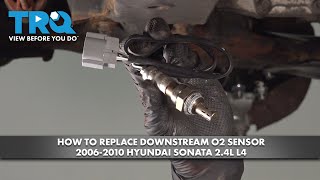
- If the sensor heater has failed (most common scenario), replace the Bank 1, Sensor 2 oxygen sensor using an O2 sensor socket. 🎬 Watch: Step-by-step downstream O2 sensor replacement for 2.4L models.
- Apply anti-seize to the new sensor threads if not pre-applied.
- Clear the trouble code with the scanner and perform a drive cycle to ensure the Check Engine Light does not return.
Parts You'll Likely Need
- Downstream Oxygen Sensor (Bank 1, Sensor 2)
(OEM #39210-2G550 (For 2009-2010 2.4L), 39210-37540 (For 2006-2008 2.4L/3.3L))— This is the component that contains the heater circuit reported as faulty by the P0036 code. Failure of this internal heater is the most common cause.
Trusted brands: Denso (e.g., 234-4238 for 2009-2010 models), NGK/NTK, Bosch (e.g., 15512), Delphi
OEM price range: $100-$180
Aftermarket price range: $40-$80
Related Codes That Often Appear With This One
- P0037 (HO2S Heater Control Circuit Low)
- P0038 (HO2S Heater Control Circuit High)
- P0420 (Catalyst System Efficiency Below Threshold) - If the sensor has been malfunctioning for a long time, it can sometimes accompany a P0420 code, though this is not a direct cause-and-effect.
Technical Service Bulletins (TSBs) & Recalls
- No specific TSBs were found directly addressing the P0036 code for this vehicle range. TSB #11-01-007 exists for the 2011 Sonata for an ECU update related to O2 sensor monitoring, but this is outside the specified vehicle range.
Platform-Specific Known Issues
- Part Number Varies by Year and Engine: The OEM part number 39210-2G550 primarily fits the 2009-2010 Sonata with the 2.4L engine. Earlier models (2006-2008) and the 3.3L V6 typically use part number 39210-37540. It is critical to verify fitment using the vehicle's VIN.
- Fuse Labeling: In the NF Sonata (2006-2010), the fuse for the O2 sensor heaters is located in the engine compartment fuse box and is typically a 15A fuse labeled 'SNSR 1'.
Mechanic-Grade Diagnostic Values
- O2 Sensor Heater Element Resistance — expected: 5 to 20 Ohms when cold for a typical zirconia sensor. Some sources cite a wider range of 3 to 25 Ohms.. Failure: A reading of infinite resistance (OL) indicates an open circuit (burned out heater). A reading near zero Ohms indicates a short circuit.
- Heater Circuit Voltage at Connector (Harness Side) — expected: Approximately 12V (battery voltage) on the power supply pin with the key on, engine off.. Failure: No voltage suggests a blown fuse or an open in the power wire from the fuse box.
- Heater Circuit Ground at Connector (Harness Side) — expected: Good continuity to chassis ground. The PCM controls the ground side of the circuit to activate the heater.. Failure: High or infinite resistance to ground indicates a break in the ground wire leading back to the PCM.
Scan Tool Commands That Help
- Hyundai GDS (Global Diagnostic System): Live Data Monitoring (O2 Sensor Heater Duty Cycle) — To observe if the PCM is attempting to command the heater on. In a video for a similar Hyundai, the known-good heater showed a duty cycle percentage, while the faulty circuit did not. This can help differentiate a bad sensor from a wiring or PCM issue.
- Hyundai GDS (Global Diagnostic System): Fault Code Diagnosis Guide — After retrieving the P0036 code, the GDS software provides a step-by-step diagnostic tree with component locations, wiring diagrams, and expected values for voltage and resistance tests, specific to the vehicle.
Wiring & Ground Locations
- Engine Ground Straps — For the NF Sonata, there are three main engine grounds. One is typically from the engine block to the chassis near the strut tower, another near the transmission, and one to the firewall.. While not directly for the O2 sensor, a corroded or loose main engine ground can cause a variety of electrical issues and codes. One potential, though less common, cause of P0036 is a bad ground strap for the exhaust system itself.
- O2 Sensor Heater Wires — Within the 4-wire O2 sensor connector, the two wires of the same color (often both white or both black) are for the heater circuit.. These are the specific wires/pins that must be probed on the sensor to test resistance and on the harness side to test for power and ground.
Real Owner Repair Stories
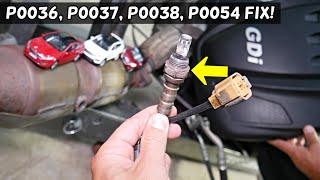
- YouTube channel 'Auto Repair Guys' (2013 Hyundai Sonata 2.4L GDI (Slightly newer, but same engine family and code)) — Check Engine Light with codes P0036, P0037, P0038, or P0054.
❌ Tried (didn't work) The video focuses on direct diagnosis rather than failed attempts.
✅ What actually fixed it The wiring harness for the downstream O2 sensor had come loose from its retaining clips, allowing it to touch the hot exhaust pipe and melt the wires together, causing a short. The fix was to repair the melted wires and properly secure the harness away from the exhaust.
OEM Part Supersession History
39210-37533→39210-37540— Part update or manufacturer change.
Heads up: 39210-37540 is the correct replacement for vehicles originally equipped with 39210-37533.39210-2G550→39210-2G560— Part update or manufacturer change.
Model Year Variations Within This Range
- 2009-2010: A significant refresh occurred for the 2009 model year. The 2.4L engine was updated (gaining 13 hp) and the 3.3L V6 was also revised (gaining 15 hp). The 4-cylinder models received a 5-speed automatic, replacing the previous 4-speed. The dashboard and interior were also redesigned. This is the primary reason for the different O2 sensor part numbers between the 2006-2008 and 2009-2010 models.
- 2006-2008 vs 2009-2010: Wiring harnesses for door electronics were found to be different between pre-refresh (2006-2008) and post-refresh (2009-2010) models. While this specific example is for a door harness, it indicates that wiring, in general, may not be interchangeable across the refresh boundary, which could affect O2 sensor connector pigtails if a repair is needed.
Diagnostic Flowchart
Real Owner Stories
Aggregated from forums and TSBs cited above. Mileages and costs reflect what owners reported in those sources.
2011 Hyundai Sonata SE 2.0T
Symptoms: Check Engine Light with code P0036.
What fixed it: Replaced the post-catalytic converter oxygen sensor.
Source hint: Reddit r/MechanicAdvice thread: '2011 Hyundai Sonata SE 2.0T P0036 Code : r/MechanicAdvice'
2014 Hyundai Sonata
Symptoms: Multiple sensor codes including P0036, P2096, P0140, P0138, P0455, C0300, P0500, and P0362 appeared all at once.
What fixed it: Reset the PCM and used a different OBDII reader, which left only the downstream O2 sensor codes. Replaced the downstream O2 sensor.
Source hint: 2CarPros forum thread: '2014 Hyundai Sonata Multiple Sensor Codes P0036, P2096, P0140...'
2015 Hyundai Sonata Sport
Symptoms: Check Engine Light with code P0036.
What fixed it: Confirmed the code refers specifically to Bank 1 Sensor 2 and replaced the downstream sensor.
Source hint: hyundai-forums.com thread: 'https://www.hyundai-forums.com/threads/sonata-sport.652130/'
Related OBD-II Codes
Frequently Asked Questions
What is the correct part number for the downstream O2 sensor on my 2005-2010 Sonata?
Where is the fuse for the O2 sensor heater located on the NF Sonata?
Are there any Technical Service Bulletins (TSBs) for the P0036 code on the 2005-2010 Sonata?
Can I use an aftermarket sensor like Denso for my Sonata?
Will a P0036 code affect my Sonata's drivability or fuel economy?
Helpful Videos
![How to Fix P0036 Engine Code in 2 Minutes [1 DIY Method / Only $19.64]](https://img.youtube.com/vi/qgkaZUN2re0/mqdefault.jpg)
We Have This Part in Stock



The information in this article is provided for general reference and educational purposes only. Vehicle specifications, procedures, and part compatibility can vary by production date, trim level, and region. Always consult your vehicle's factory service manual and verify part numbers before purchasing or performing repairs. Safety-critical components such as airbags, seat belts, and braking systems should be installed by a qualified professional.
- Hyundai Sonata:
- 🧭 Diagnostic Flowchart
- 🎬 Helpful Videos
- 🛍️ Shop This Part
- What's Unique About the 2005-2010 Hyundai Sonata
- Symptoms You May Notice
- Most Likely Causes
- Rare But Worth Checking
- Diagnosis Steps
- Parts You'll Likely Need
- Related Codes That Often Appear With This One
- Technical Service Bulletins (TSBs) & Recalls
- Platform-Specific Known Issues
- Mechanic-Grade Diagnostic Values
- Scan Tool Commands That Help
- Wiring & Ground Locations
- Real Owner Repair Stories
- OEM Part Supersession History
- Model Year Variations Within This Range
- Real Owner Stories
- 2011 Hyundai Sonata SE 2.0T
- 2014 Hyundai Sonata
- 2015 Hyundai Sonata Sport
- Related OBD-II Codes
- Frequently Asked Questions
- 🎟️ Get 5% Off