

P0036 on 2010-2013 Kia Soul: O2 Sensor Heater Circuit Causes and Fixes
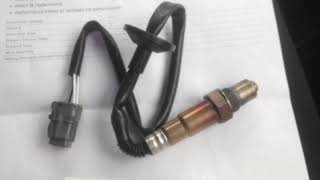
This code points to a problem with the heater circuit inside the downstream oxygen sensor (Bank 1, Sensor 2). The most common fix is replacing the sensor itself, which is located after the catalytic converter. Before replacing, it's wise to check the related fuse (likely marked 'SENSOR' in the engine bay fuse box) and inspect the wiring for any damage, especially melting against the exhaust.
- P0036 on a 2010-2013 Kia Soul almost always means the downstream (post-catalytic converter) oxygen sensor's heater has failed.
- The most likely fix is to replace the Bank 1 Sensor 2 oxygen sensor.
- Before buying parts, perform a quick visual check of the sensor's wiring for melting or damage, and check the related fuse (likely labeled 'SENSOR' in the engine bay).
- Driving with this code is generally safe, but you will not pass an emissions inspection until it is repaired.
- An oxygen sensor socket is highly recommended for DIY replacement to avoid damaging the new sensor.
What's Unique About the 2010-2013 Kia Soul
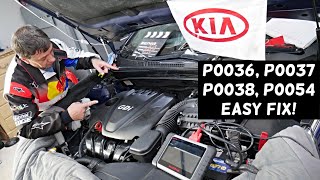
On the first-generation Kia Soul (2010-2013), the P0036 code is a straightforward and common issue, 🎬 Watch: Overview of Kia oxygen sensor codes and common fixes. consistent with other Hyundai/Kia vehicles of the era. There are no widespread design flaws that make this platform particularly prone to the code beyond normal wear and tear of the oxygen sensor. The most vehicle-specific issue to be aware of is the potential for the sensor's wiring harness to become detached from its clips and melt against the hot exhaust pipe, so a visual inspection is a critical first step before ordering parts.
Symptoms You May Notice
- Check Engine Light is on.
- Vehicle will fail an emissions test.
- Slight potential for decreased fuel economy.
- Replacing the upstream (Sensor 1) oxygen sensor instead of the downstream (Sensor 2) sensor.
- Replacing the catalytic converter. While a P0420 code can sometimes appear with P0036, the P0036 code itself points specifically to the sensor's heater circuit, not the converter's efficiency.
Most Likely Causes
- Failed Downstream Oxygen Sensor 🔴 High Probability → Shop Oxygen Sensor The internal heater element of the O2 sensor is a common failure point due to age and constant heat cycles. Corrosion from road salt can also contribute to failure. This is a very common wear-and-tear item on these vehicles.
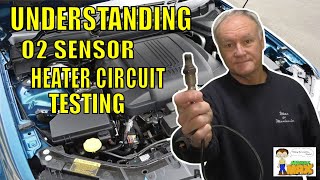
How to confirm: After checking the fuse and wiring, the most definitive test is to measure the resistance of the heater circuit within the sensor using a multimeter. Disconnect the sensor and measure across the two heater pins. 🎬 See this guide on how to test O2 heater circuits. A good sensor should have a resistance between 2 and 25 Ohms, with service information for similar Kia models suggesting a more specific value of approximately 9.0 Ohms. An open circuit (infinite resistance or 'OL' on the meter) confirms the heater has failed.
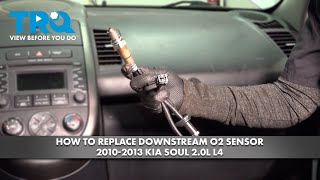
Typical fix: Replace the Bank 1, Sensor 2 (downstream) oxygen sensor. 🎬 Watch: Step-by-step downstream sensor replacement on a 2.0L Soul.
Est. part cost: $50-$180 - Damaged Wiring or Connectors 🟡 Medium Probability The sensor wiring is located under the vehicle and is exposed to road debris, water, and heat from the exhaust, which can cause wires to break, fray, or melt. The connector itself can also corrode or have pins back out.
How to confirm: Visually inspect the entire length of the wiring harness from the O2 sensor to its connection point. Look for any signs of melting, chafing, or broken wires. Check the connector for corrosion, moisture, or loose pins.
Typical fix: Repair the damaged section of the wiring harness or clean/replace the connector.
Est. part cost: $5-$30 - Blown Fuse ⚪ Low Probability A short in the heater circuit, either in the wiring or the sensor itself, can cause the corresponding fuse to blow.
How to confirm: Locate and inspect the fuse for the oxygen sensor heater circuit. On Kia models, this is often in the engine compartment fuse box and may be labeled 'SENSOR', 'SNSR 3', or 'A/F heater'. Consult your owner's manual for the exact fuse location and rating.
Typical fix: Replace the blown fuse. If the new fuse blows immediately, it indicates a short circuit in the wiring or the sensor itself that must be diagnosed and fixed first.
Est. part cost: $1-$5
Rare But Worth Checking
- Faulty Engine Control Module (ECM): → Shop Engine Control Module (ECM) This is extremely rare. The ECM should only be considered after all other possibilities (sensor, wiring, fuses) have been thoroughly ruled out by a professional.
Diagnosis Steps
- Read the code with an OBD-II scanner to confirm P0036 is present.
- Check the fuse related to the O2 sensor heater circuit. This is often in the engine compartment fuse box, labeled 'SENSOR' or similar.
- Visually inspect the downstream (post-catalytic converter) oxygen sensor wiring and connector for any signs of melting, chafing, or corrosion.
- If the fuse and wiring are good, disconnect the sensor and test the resistance of the heater circuit at the sensor's connector using a multimeter. The two wires for the heater are often the same color. A reading between 2-25 Ohms is a general pass, with Kia-specific data pointing to ~9.0 Ohms as a target value; an infinite resistance (OL) reading indicates a failed sensor.
- If resistance is within spec, check for 12V power at the sensor's harness connector (the side coming from the car) with the ignition on. Lack of voltage points to a wiring or fuse issue upstream.
- If power and ground are present and the sensor's resistance is good, but the code persists, there may be an intermittent wiring issue or, very rarely, a problem with the ECM.
Parts You'll Likely Need
- Downstream Oxygen Sensor (Bank 1, Sensor 2)
(OEM #39210-2B100 (for 1.6L) or 39210-2G200 (for 2.0L). Always verify with VIN.)— This is the most common failure. The internal heater element burns out, requiring the replacement of the entire sensor unit.
Trusted brands: Denso, Bosch, NGK/NTK, Delphi
OEM price range: $100-$180
Aftermarket price range: $50-$100
Related Codes That Often Appear With This One
- P0137 — This code indicates 'O2 Sensor Circuit Low Voltage (Bank 1 Sensor 2)'. It can appear alongside P0036 if the sensor has failed completely or has a wiring issue.
- P0420 — This code means 'Catalyst System Efficiency Below Threshold'. If the downstream O2 sensor isn't working correctly due to the heater fault, it can't accurately report on the catalytic converter's performance, sometimes triggering a false P0420 code.
- P0030 — This code indicates a fault in the heater circuit for the *upstream* sensor (Bank 1, Sensor 1). A Reddit user reported seeing both P0030 and P0036 together, which pointed to a common fuse or power supply issue for both sensors.
Platform-Specific Known Issues
- Real Owner Repair Stories: A YouTube video for a 2012 Kia Soul shows a DIY replacement of the downstream O2 sensor. The owner received the P0036 code after a free diagnostic test. The repair involved accessing the sensor from under the passenger side, applying penetrating oil, and unscrewing it. The wiring harness passes through a rubber grommet into the cabin under the passenger footwell carpet to its connection point.
Mechanic-Grade Diagnostic Values
- Downstream O2 Sensor Heater Element Resistance — expected: Approximately 9.0 Ω at 21°C (70°F). A general acceptable range is 2-25 Ω.. Failure: An open circuit (OL or infinite resistance) or a reading significantly outside the expected range.
- Voltage at Heater Circuit Supply Pin (Harness Side) — expected: Approximately 11-13.5 Volts (battery voltage) with Key On, Engine Off.. Failure: 0V or significantly low voltage, indicating a problem with the fuse, relay, or wiring.
Hidden / Shadow Codes Worth Checking
- Mode 06, Test ID $81, Component ID $11: On some generic OBD-II systems, these IDs can correspond to the O2 Sensor Heater Monitor for Bank 1, Sensor 2. This allows a technician to see the raw test values and limits set by the ECU, which can confirm a failure even before the P0036 code is permanently set. (see via An advanced OBD-II scan tool with Mode 06 functionality.)
Scan Tool Commands That Help
- Kia GDS (Global Diagnostic System) / KDS: DTC Analysis & Live Data (Sensors) — This dealer-level tool can be used to view live data for the heater circuit duty cycle (if applicable), follow guided diagnostic procedures for P0036, and confirm voltage signals as seen by the ECM. It is most useful when basic multimeter tests are inconclusive or an intermittent fault is suspected.
Wiring & Ground Locations
- Downstream O2 Sensor Connector — Located in the transmission tunnel, accessible from underneath the vehicle. The wiring harness passes through a large rubber grommet into the passenger cabin, with the final connection point under the passenger-side footwell carpet.. This connector is a primary point for inspection. Due to its location, it is susceptible to corrosion, moisture, and physical damage which can interrupt the heater circuit.
- Heater Circuit Ground — While not definitively mapped for the Soul, a common location on similar Kia platforms is a chassis ground bolt near the fuel tank mount. The ground wire is often black or has a green stripe.. A loose or corroded ground connection at this point can create high resistance in the heater circuit, triggering P0036 even if the sensor itself is good.
- Heater Circuit Wiring (4-wire sensor) — Within the 4-wire harness for the O2 sensor.. Identifying the correct pins is crucial for testing. While colors can vary, the two heater wires are often the same color (e.g., two black wires). Another common configuration on Hyundai/Kia is White (Heater Power +) and Black (Heater Control/Ground). Always verify with a multimeter; the heater pins will show a resistance reading between them, while signal wires will not.
Real Owner Repair Stories
- YouTube channel 'Our Grijalva Life' (2012 Kia Soul) — Check Engine Light was on. A free scan at an auto parts store revealed the P0036 code.
✅ What actually fixed it Replacing the downstream (post-catalytic converter) oxygen sensor. The video details accessing the sensor from the passenger side, the wire routing through a grommet into the cabin under the carpet, and making the connection. The repair resolved the check engine light. - Reddit user in r/KiaSoulClub (2009 Kia Soul 1.6L) — Check Engine Light with codes P0036, P0030, P0420, and P0172. Very low idle (400-500 RPM) and nearly double the normal fuel consumption.
❌ Tried (didn't work) The previous owner had already replaced the pre-cat O2 sensor and catalytic converter.
✅ What actually fixed it The user was in the process of diagnosing, but a key piece of advice given the presence of both upstream (P0030) and downstream (P0036) heater codes was to check the common fuse for the O2 sensor heaters first before replacing more parts. The user also measured the resistance of the old post-cat sensor at 14 ohms. - NHTSA ODI #11581569 (Kia Sorento) — While involving a different model, an owner reported P0036 (B1S2) alongside P0171, P0138, and P0087. The report notes that defects in the system were causing major damage and required frequent fuel pump and fuel injector services.
OEM Part Supersession History
39210-2G200→39210-2E550 (for 2012-2013 2.0L)— Engine change for the 2012 model year. The 2010-2011 models used the 2.0L 'Beta II' engine, while the 2012-2013 models received the new 2.0L 'Nu' engine.
Heads up: Part number 39210-2G200 is for the earlier 2010-2011 2.0L engine and may not be compatible with the 2012-2013 2.0L Nu engine. Always verify the part number with the vehicle's VIN.
Model Year Variations Within This Range
- 2012-2013: The 2012 model year marked a significant refresh. The 2.0L engine was changed from the 'Beta II' (142 hp) to the new 'Nu' engine (164 hp). The 1.6L engine also gained direct injection (GDI). This powertrain change means the oxygen sensors, particularly for the 2.0L engine, are different between the 2010-2011 and 2012-2013 model years. The OEM part number for the downstream sensor on a 2012-2013 2.0L Soul is 39210-2E550, not 39210-2G200.
Diagnostic Flowchart
Other Known Issues on This Vehicle
Issues unrelated to this code that are worth knowing about as an owner of this generation:
- Steering Coupler Failure 🟠 Medium — Very common, typically manifests as a clicking or clunking noise in the steering wheel when turning. Usually occurs after 60,000 miles. (Ref: Kia issued TSB CHA-045 for this issue, and while not a formal recall, dealers have been known to replace the flexible coupler part (#56315-2K000-FFF) often under warranty or as a goodwill repair if the vehicle is near 100k miles.)
- Catalytic Converter Damage & Potential Engine Failure (1.6L GDI) 🔴 High — Significant enough to warrant a recall (SC176). Affects 2012-2016 models with the 1.6L GDI engine. High exhaust temperatures can damage the converter, leading to debris entering the engine, causing piston damage and potential failure. (Ref: NHTSA Recall #19V120000 (Kia Recall SC176). The fix involves a software update to the ECU and, if necessary, replacement of the catalytic converter and/or engine.)
- Engine Compartment Fire Risk (HECU) 🔴 High — Affects a wide range of 2010-2013 Kia models, including the Soul. An electrical short in the Hydraulic Electronic Control Unit (HECU) can occur, posing a fire risk while parked or driving. (Ref: NHTSA Recall #23V652000 (Kia Recall SC284). Owners are advised to park outside and away from structures until the recall repair (fuse replacement) is performed.)
- Crankshaft or Camshaft Position Sensor Failure 🟡 Low — A known issue that can cause no-start or rough running conditions. Often triggers codes like P0335 (crankshaft) or P0014/P0017 (camshaft).
Used vs. New Parts: Buying Guide for This Vehicle
When a used part is the smart pick: Almost never for the oxygen sensor itself. The internal heater is a primary failure point and a wear-and-tear item. A used sensor has an unknown and limited remaining lifespan. A used part should only be considered if you need the wiring connector pigtail due to damage and cannot source a new one.
Donor-vehicle mileage cap: roughly under 30000 miles for the part to have meaningful remaining life.
What to inspect on the donor part:
- If sourcing a connector pigtail, ensure the plastic housing is not brittle and the locking tab is intact.
- Check for any green or white crusty corrosion on the electrical pins.
- Ensure there is at least 6-8 inches of wire attached to the connector to allow for easy splicing.
Aftermarket brands forum-validated for this vehicle:
- NGK/NTK
- Denso
- Bosch
- TRQ
Brands owners have reported issues with on this vehicle:
- Unnamed, 'white-box' generic parts from online marketplaces like Amazon or eBay. Owners frequently report these ultra-cheap sensors have incorrect heater resistance values, causing the P0036 code to return immediately after installation.
Real Owner Stories
Aggregated from forums and TSBs cited above. Mileages and costs reflect what owners reported in those sources.
2013 Kia Soul 1.6L — 203000 miles
Symptoms: Engine light on with codes P0036, P0420, and P0137. Unable to pass emissions test.
What fixed it: The user had not found a fix at the time of posting after replacing sensors and the catalytic converter, and was planning to go to the dealer.
Source hint: r/MechanicAdvice on Reddit
2011 Kia Soul
Symptoms: Vehicle triggered codes P0036 and P0136.
What fixed it: Replacing the downstream O2 sensor after verifying the fuse was intact.
Source hint: kiasoulforums.com thread titled 'P0036 and P0136'
2012 Kia Soul
Symptoms: Check engine light with P0036 code confirmed after a free diagnostic test.
What fixed it: DIY replacement of the downstream O2 sensor by accessing it from under the passenger side and using penetrating oil.
Source hint: YouTube video for a 2012 Kia Soul DIY replacement
Related OBD-II Codes
Frequently Asked Questions
Where is the fuse for the O2 sensor heater circuit located on my Kia Soul?
What is the correct resistance for a new downstream O2 sensor on a Kia Soul?
Does the 1.6L GDI engine recall (SC176) relate to my P0036 code?
Is there a specific part number for the steering clunk I hear while diagnosing this code?
Where does the downstream O2 sensor wiring enter the cabin on the 2010-2013 models?
Can I use a multimeter to confirm the sensor is bad before buying a new one?
Helpful Videos
We Have This Part in Stock



The information in this article is provided for general reference and educational purposes only. Vehicle specifications, procedures, and part compatibility can vary by production date, trim level, and region. Always consult your vehicle's factory service manual and verify part numbers before purchasing or performing repairs. Safety-critical components such as airbags, seat belts, and braking systems should be installed by a qualified professional.
- Kia Soul:
- 🧭 Diagnostic Flowchart
- 🎬 Helpful Videos
- 🛍️ Shop This Part
- What's Unique About the 2010-2013 Kia Soul
- Symptoms You May Notice
- Most Likely Causes
- Rare But Worth Checking
- Diagnosis Steps
- Parts You'll Likely Need
- Related Codes That Often Appear With This One
- Platform-Specific Known Issues
- Mechanic-Grade Diagnostic Values
- Hidden / Shadow Codes Worth Checking
- Scan Tool Commands That Help
- Wiring & Ground Locations
- Real Owner Repair Stories
- OEM Part Supersession History
- Model Year Variations Within This Range
- Other Known Issues on This Vehicle
- Used vs. New Parts: Buying Guide for This Vehicle
- Real Owner Stories
- 2013 Kia Soul 1.6L — 203000 miles
- 2011 Kia Soul
- 2012 Kia Soul
- Related OBD-II Codes
- Frequently Asked Questions
- 🎟️ Get 5% Off