

P0037 on 2012-2017 Hyundai Veloster: Causes and Fixes for O2 Sensor Heater Circuit Low
This code almost always points to a failed downstream oxygen sensor (Bank 1, Sensor 2). Replacing the sensor is the most common fix. Expect to pay between $60-$120 for an aftermarket sensor and around $160-$260 for an OEM part. It's a straightforward DIY job for many owners.
- P0037 on a Veloster almost always means you need a new downstream (post-catalytic converter) oxygen sensor.
- Before buying parts, always perform a visual inspection of the wiring under the car, as it can be damaged by heat or debris, and check the relevant fuse.
- If you have a 2013-2015 Turbo model, be aware of TSB 16-FL-002, which indicates a dealer software update may be needed along with the new sensor.
- This is a manageable DIY repair for many owners, typically requiring an O2 sensor socket and basic hand tools.
What's Unique About the 2012-2017 Hyundai Veloster
For the 2013-2015 Veloster Turbo models, Hyundai issued a Technical Service Bulletin (TSB 16-FL-002) specifically for a faulty oxygen sensor that required both sensor replacement and an engine software update. While the P0037 code can occur on any Veloster from this period, owners of the turbo models should be aware that a dealer visit for the software update might be necessary to fully resolve the issue, even after replacing the part. The underlying cause is most often the sensor itself failing due to age and heat cycles. Unlike some other vehicles, the wiring connector for the downstream sensor on some related Hyundai models is located inside the passenger compartment footwell, requiring removal of an interior trim piece to access.
Symptoms You May Notice
- Check Engine Light is on
- Failing a state emissions test
- Potentially reduced fuel economy
- Possible rough idle or slight hesitation, though often no noticeable driving issues
- Momentary loss of power or rough acceleration from a stop
- Replacing the upstream (Bank 1, Sensor 1) oxygen sensor instead of the downstream (Bank 1, Sensor 2) sensor.
- Replacing the catalytic converter. While other codes like P0420 may point to the converter, P0037 specifically relates to the sensor's heater circuit, not the converter's efficiency.
- Assuming the sensor is bad without checking the fuse or wiring first. A simple blown fuse or melted wire can mimic a failed sensor.
Most Likely Causes
- Failed Downstream Oxygen Sensor 🔴 High Probability → Shop Oxygen Sensor The internal heater element within the oxygen sensor is a common failure point due to constant, extreme heat cycles and age. This is the most frequent cause for P0037. The sensor has a finite service life, often needing replacement between 60,000 and 100,000 miles.
How to confirm: Disconnect the sensor and measure the resistance across the two heater circuit pins (usually the two wires of the same color). An open circuit (infinite resistance) or a resistance value far outside the manufacturer's specification (typically 8.1-11.1 ohms at room temperature) confirms a failed heater. 🎬 See this step-by-step guide for testing the heater circuit If the multimeter shows no continuity (no beep), the heater circuit is broken internally.
Typical fix: Replace the Bank 1, Sensor 2 (downstream) oxygen sensor. Applying anti-seize compound to the threads of the new sensor is recommended.
Est. part cost: $60-$260 - Damaged Wiring or Connector 🟡 Medium Probability The sensor and its wiring are located under the vehicle and are exposed to road debris and extreme heat from the exhaust pipe. This can cause wires to melt, fray, or break, especially if wiring clamps have failed and allowed the harness to touch the hot exhaust.
How to confirm: Visually inspect the entire wiring harness from the oxygen sensor to its connection point. Look for any signs of melting, chafing, corrosion on the connector pins, or breaks in the wires. Check for a solid ground connection.
Typical fix: Repair the damaged section of the wire or replace the connector pigtail.
Est. part cost: $10-$40 - Blown Fuse for the Heater Circuit ⚪ Low Probability A short circuit in the wiring or the sensor itself can cause the corresponding fuse to blow as a protective measure.
How to confirm: Consult the owner's manual or the diagram on the fuse box cover to locate the fuse for the O2 sensor heater circuit. On the 2012-2017 Veloster, this is the 10A 'SENSOR 2' fuse located in the engine compartment fuse box. Pull the fuse and visually inspect if the internal filament is broken or test for continuity with a multimeter.
Typical fix: Replace the blown fuse. If the new fuse blows immediately, it indicates a persistent short circuit that must be found and repaired before replacing the fuse again.
Est. part cost: $1-$5
Rare But Worth Checking
- Faulty Powertrain Control Module (PCM): → Shop Engine Control Module (ECM) This is extremely rare. Before condemning the PCM, all other possibilities, including the sensor, wiring, and fuses, must be exhaustively tested and ruled out. A failure of the internal driver transistor in the ECM can cause the low voltage condition.
Diagnosis Steps
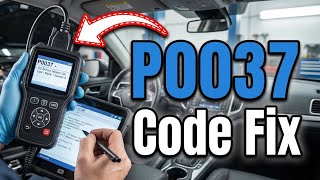
- Read the code with an OBD-II scanner to confirm P0037 is present and note any other codes.
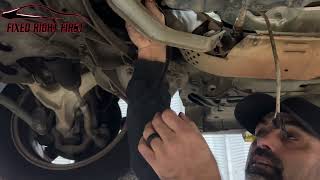
- Perform a thorough visual inspection of the downstream oxygen sensor's wiring harness and connector. Look for any signs of melting, fraying, corrosion, or contact with the exhaust pipe.
- Check the fuse for the O2 sensor heater circuit. For the Veloster, this is the 10A 'SENSOR 2' fuse in the engine compartment fuse box.
- If wiring and fuse look good, disconnect the sensor. With the ignition key in the 'On' position (engine off), use a multimeter to check for 12-volt power at the heater circuit power wire in the harness connector.
- Check the ground side of the heater circuit for continuity to a known good chassis ground.
- Using a multimeter set to Ohms, measure the resistance of the heater circuit on the sensor itself (between the two same-colored wires). A reading of infinite resistance (open) or a value outside the specified 8.1-11.1 ohm range indicates a faulty sensor that needs replacement.
- If the sensor, wiring, and fuse all test good, the issue may be with the PCM's driver circuit, but this is highly unlikely and should be diagnosed by a professional.
Parts You'll Likely Need
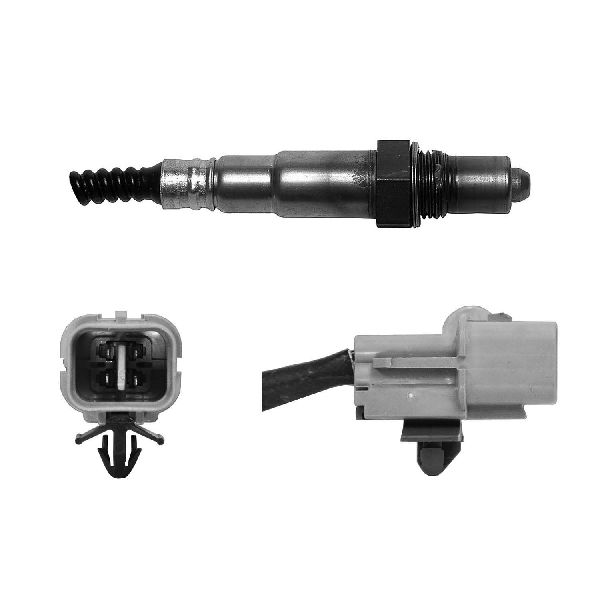
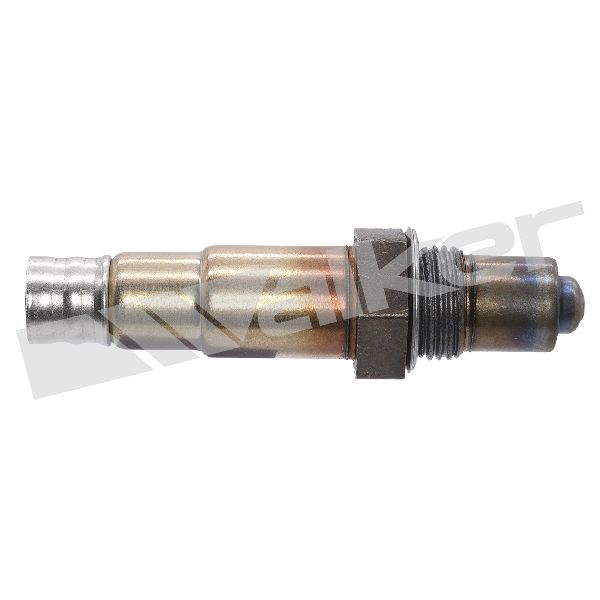
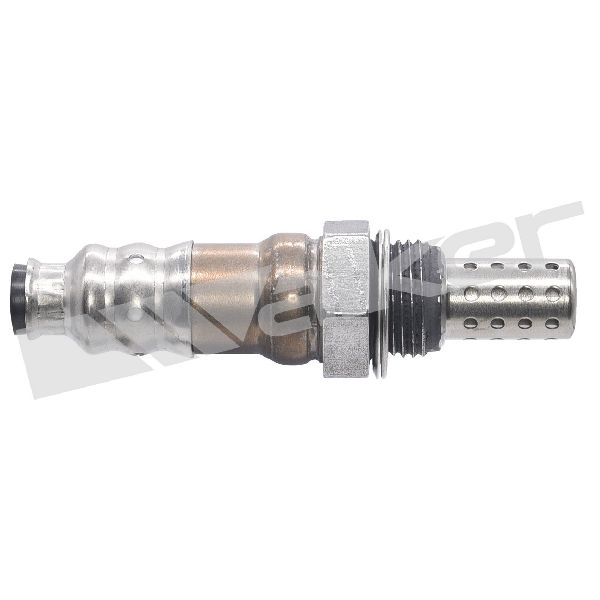
- Downstream Oxygen Sensor (Bank 1, Sensor 2)
(OEM #39210-2B250 (Turbo models, verify with VIN), 39210-2B320 (Non-Turbo models, verify with VIN))— This is the most common failure point for code P0037, as the internal heater element burns out over time.
Trusted brands: Hyundai (OEM), Bosch, Denso, NGK/NTK, Walker Products
OEM price range: $160-$260
Aftermarket price range: $60-$120
Technical Service Bulletins (TSBs) & Recalls
- 16-FL-002: Addresses a faulty oxygen sensor and requires an ECM software update for 2013-2015 Veloster Turbo models.
Platform-Specific Known Issues
- TSB 16-FL-002 was issued for 2013-2015 Veloster Turbo models for a faulty oxygen sensor that also requires an ECM software update to fully resolve.
- On some related Hyundai platforms, the downstream O2 sensor connector is located inside the car in the passenger footwell, behind a trim panel, rather than under the vehicle. Owners should verify the connector location before starting the repair.
Mechanic-Grade Diagnostic Values
- Downstream O2 Sensor (B1S2) Heater Element Resistance — expected: 8.1 - 11.1 Ω at 21°C (69.8°F). Failure: A reading of infinite resistance (Open Loop / OL) or a value significantly outside the specified range.
- Voltage at Heater Circuit Power Wire (Harness Side) — expected: Approximately 12V (Battery Voltage). Failure: 0V or significantly low voltage, indicating a blown fuse or an open in the power supply wire.
Scan Tool Commands That Help
- Hyundai GDS (Global Diagnostic System): Actuation Test / Output Test — After verifying the fuse and wiring are intact, a technician can use the GDS to command the O2 sensor heater circuit on and off. This directly tests the PCM's driver and the control side of the circuit, helping to isolate a faulty sensor from a rare PCM issue.
Wiring & Ground Locations
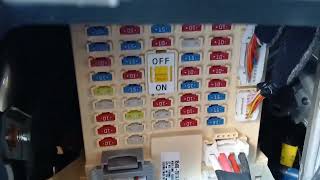
- Engine Compartment Fuse Box — Under the hood, on the driver's side, next to the battery.. 🎬 Watch: How to find and access the fuse box This box contains the fuse that provides power to the O2 sensor heater circuit.
- Fuse: SENSOR 2 (10A) — Inside the engine compartment fuse box.. This is the specific fuse that protects the circuit for both the upstream and downstream oxygen sensors. A short in the circuit will cause this fuse to blow, resulting in code P0037.
- Heater Circuit Wires (at sensor connector) — On the 4-wire connector for the oxygen sensor itself.. For testing resistance, you need to identify the two heater wires. On most 4-wire universal and OEM sensors, these are the two wires that are the same color (e.g., two white wires or two black wires).
OEM Part Supersession History
39210-2B320→N/A - but related to other parts— Part for Non-Turbo models.
Heads up: Interchanges with 39210-2B220 and 39210-2B120 according to aftermarket sources. Always verify with VIN.39210-2B250→— Part for Turbo models, specifically cited for years 2013-2015.
Heads up: This part is associated with TSB 16-FL-002, which may also require an ECU update. Not interchangeable with the non-turbo sensor.39210-2B410→— Listed for 2015-2017 Veloster models (likely non-turbo).
Heads up: Suggests a part change for later model years of the first generation. Verifying the correct part number with the vehicle's VIN is critical.
Model Year Variations Within This Range
- 2013-2015 (Turbo Only): These models are subject to TSB 16-FL-002, which indicates a specific oxygen sensor fault that requires both sensor replacement and an ECM software update by a dealer to be fully resolved.
- Circa 2015-2017: Part numbers for the oxygen sensors may have changed. For example, part number 39210-2B410 is listed for 2015-2017 models, differing from the earlier 39210-2B320 for non-turbo engines.
Diagnostic Flowchart
Other Known Issues on This Vehicle
Issues unrelated to this code that are worth knowing about as an owner of this generation:
- Connecting Rod Bearing Failure 🔴 High — Affects certain 2015-2016 models with the 1.6L GDI engine. Can occur between 40,000-80,000 miles, leading to knocking, power loss, and catastrophic engine failure. (Ref: Hyundai Recall 198 (NHTSA 20V-746) was issued to inspect engines and install a Knock Sensor Detection System (KSDS).)
- Dual-Clutch Transmission (DCT) Problems 🟠 Medium — Common on 2016-2017 Turbo models with the 7-speed DCT. Owners report hesitation from a stop, shuddering, jerking, and in some cases, complete loss of power. Issues can be intermittent. (Ref: Lawsuits have been filed regarding DCT issues, and various TSBs exist for software updates to the Transmission Control Module (TCM).)
- Engine Pinging and Knocking Noises 🟠 Medium — Frequently reported on 2012-2013 models. Can be a precursor to more severe engine issues like rod failure, but can also be related to carbon buildup or other less critical problems. (Ref: Related to the broader engine issues covered by recalls and warranty extensions for engine replacement.)
- Malfunctioning Speakers 🟡 Low — Widespread issue on 2012-2016 models where one or more speakers stop working intermittently or permanently. Not a mechanical or safety issue, but a common annoyance.
Used vs. New Parts: Buying Guide for This Vehicle
When a used part is the smart pick: It is strongly recommended to avoid used oxygen sensors. They are a wear-and-tear component with a finite lifespan determined by heat cycles and mileage. A used sensor may fail shortly after installation, offering poor value.
Donor-vehicle mileage cap: roughly under 60000 miles for the part to have meaningful remaining life.
What to inspect on the donor part:
- If buying used is unavoidable, source from the lowest-mileage vehicle possible.
- Inspect the wiring pigtail for any signs of melting, brittleness, or fraying.
- Ensure the connector is free of corrosion, dirt, or bent pins.
Aftermarket brands forum-validated for this vehicle:
- NTK (part of NGK)
- Denso
Brands owners have reported issues with on this vehicle:
- Avoid unbranded, 'no-name' sensors from online marketplaces, as their quality control, heater element longevity, and accuracy can be highly inconsistent.
Real Owner Stories
Aggregated from forums and TSBs cited above. Mileages and costs reflect what owners reported in those sources.
2013 Veloster Turbo
Symptoms: P0037 and P0031 codes present on a Turbo model.
What fixed it: Followed TSB 16-FL-002 which requires an ECM software update along with the sensor replacement.
Source hint: https://www.hyundai-forums.com/threads/p0037-and-p0031-on-a-2013-veloster-turbo.673898/
2012-2017 Hyundai Veloster
Symptoms: Check engine light with P0037 code.
What fixed it: Replacing the downstream O2 sensor; described as a straightforward DIY job.
Source hint: https://www.reddit.com/r/veloster/comments/x9w41c/p0037_code/
2012-2017 Hyundai Veloster
Symptoms: Replaced the downstream O2 sensor but the P0037 code remained.
What fixed it: Checking the 10A 'SENSOR 2' fuse and verifying wiring integrity, as a new sensor alone does not fix a blown fuse or broken harness.
Source hint: https://www.veloster.org/threads/new-o2-sensor-still-getting-p0037-code.70833/
Related OBD-II Codes
Frequently Asked Questions
I have a 2014 Veloster Turbo with P0037; is there a specific TSB I should know about?
Where is the 'SENSOR 2' fuse located on a 2012-2017 Veloster?
What is the correct resistance range for a new downstream O2 sensor on this vehicle?
I can't find the downstream O2 sensor connector under my car; where else could it be?
My 2016 Veloster is hesitating from a stop along with the P0037 code; could this be related to the transmission?
At what mileage does the downstream O2 sensor usually fail on the Veloster?
Helpful Videos

We Have This Part in Stock



The information in this article is provided for general reference and educational purposes only. Vehicle specifications, procedures, and part compatibility can vary by production date, trim level, and region. Always consult your vehicle's factory service manual and verify part numbers before purchasing or performing repairs. Safety-critical components such as airbags, seat belts, and braking systems should be installed by a qualified professional.
- Hyundai Veloster:
- 🧭 Diagnostic Flowchart
- 🎬 Helpful Videos
- 🛍️ Shop This Part
- What's Unique About the 2012-2017 Hyundai Veloster
- Symptoms You May Notice
- Most Likely Causes
- Rare But Worth Checking
- Diagnosis Steps
- Parts You'll Likely Need
- Technical Service Bulletins (TSBs) & Recalls
- Platform-Specific Known Issues
- Mechanic-Grade Diagnostic Values
- Scan Tool Commands That Help
- Wiring & Ground Locations
- OEM Part Supersession History
- Model Year Variations Within This Range
- Other Known Issues on This Vehicle
- Used vs. New Parts: Buying Guide for This Vehicle
- Real Owner Stories
- 2013 Veloster Turbo
- 2012-2017 Hyundai Veloster
- 2012-2017 Hyundai Veloster
- Related OBD-II Codes
- Frequently Asked Questions
- 🎟️ Get 5% Off