

P0045 on 2014 Ram 1500 EcoDiesel: Turbo Boost Control Circuit/Open Causes and Fixes
On a 2014 Ram 1500 with the 3.0L EcoDiesel, code P0045 most often indicates a failed electronic turbocharger actuator (boost control solenoid), a wiring harness issue, or outdated PCM software. Before replacing parts, check for software updates as per Ram TSBs. If software is current, inspect the actuator wiring for damage before replacing the actuator itself. A new actuator may require calibration with a capable scan tool like AlfaOBD. The part costs approximately $250-$550.
- For a 2014 Ram 1500 EcoDiesel, P0045 means there's an open in the turbo actuator's electrical circuit.
- **Check for software updates first.** Multiple TSBs indicate this code can be set by mistake, and a simple PCM reflash might be the fix.
- If software is current, carefully inspect the wiring harness and connector to the turbo actuator for damage before buying parts.
- The most likely failed part is the electronic turbo actuator itself, which contains the boost control solenoid.
- This code will cause the truck to enter a low-power "limp mode" and display a "Service Electronic Throttle Control" message.
What's Unique About the 2014-2014 Ram 1500
The 2014 Ram 1500 was the debut year for the 3.0L EcoDiesel engine, which uses a sophisticated Garrett Variable Geometry Turbocharger (VGT) controlled by a separate electronic actuator. Unlike simpler wastegate systems, this actuator allows for precise boost management but also introduces a common failure point. Significantly, as an early-production platform, Ram issued several Technical Service Bulletins (TSBs) like #18-028-14 REV. A, indicating that code P0045 could be set erroneously due to software calibration issues. This makes a PCM reflash a critical first diagnostic step before condemning expensive hardware.
Diagnostic Flowchart
Tap your situation to follow the diagnostic path that matches what you're seeing on this vehicle.
Symptoms You May Notice
- Check Engine Light is on
- "Service Electronic Throttle Control" message on the dash
- Significant loss of engine power and poor acceleration (limp mode)
- Little to no boost from the turbocharger, confirmed by watching gauge or OBDII data
- Engine shudder or vibration
- Audible change in turbo or engine sound
- Replacing the entire turbocharger assembly when only the electronic actuator is faulty. 🎬 Watch: Deciding between replacing the actuator or the whole turbo. The actuator can be purchased and replaced separately.
- Replacing the boost pressure sensor. This sensor is located on the intake manifold, gets clogged with soot, and typically sets different codes, though cleaning it is good maintenance.
- Failing to calibrate the new actuator after installation, causing the code to return immediately.
Most Likely Causes
- Faulty Turbocharger Boost Control Solenoid / Actuator 🔴 High Probability → Shop Turbocharger The electronic actuator is mounted directly to the turbocharger in a high-heat, high-vibration environment on the passenger side of the engine. This leads to eventual failure of the internal electronics or the small electric motor. The part has been superseded multiple times by Mopar, suggesting revisions to improve reliability.
How to confirm: Use a bidirectional scan tool (like the dealer's wiTECH or the enthusiast-favorite AlfaOBD) to command a "VGT System Test" or sweep. Observe the actuator arm for physical movement. You can also monitor "Commanded VGT Position" vs. "Actual VGT Position" PIDs; if the actual position is stuck at 0% or doesn't match the command, the actuator has failed. An open circuit (OL) reading with a multimeter across the solenoid pins also confirms failure.
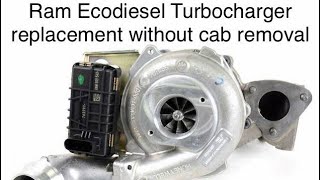
Typical fix: Replace the electronic turbo actuator. This is a difficult DIY job due to tight access. 🎬 See how to replace the turbo without removing the cab. After replacement, the new actuator must be calibrated using a scan tool to learn its travel limits.
Est. part cost: $250-$550 - Wiring or Connector Issue 🟡 Medium Probability The engine wiring harness is routed near several heat sources and potential chafe points. Owners report the harness connector near the front left wheel well can become loose or corroded, causing intermittent issues. The harness can also rub against the EGR tube clamp on the passenger side, eventually wearing through the insulation.
How to confirm: Visually inspect the harness from the PCM to the turbo actuator, paying close attention to the large frame rail connector (C104) and areas where it passes near hot exhaust components or sharp brackets. Check for continuity and for 12V power and ground at the actuator connector with the key on. Wiggle the harness while testing to expose intermittent breaks.
Typical fix: Repair the damaged section of wiring. If the main connector is the issue, it may need to be cleaned, secured with a zip tie, or replaced if pins are damaged. Some owners have had dealers replace entire harness sections for over $900.
Est. part cost: $20-$1200 - Outdated Powertrain Control Module (PCM) Software 🟡 Medium Probability As a first-year model, the 2014 EcoDiesel had several software updates to fix bugs. TSB #18-028-14 REV. A specifically states that P0045 can be set erroneously and that the fix is a PCM reflash. This is a known issue for early production trucks.
How to confirm: A Ram dealership or a well-equipped independent shop can use a wiTECH scan tool to check the vehicle's current software calibration ID and compare it against the latest available version listed in the TSBs.
Typical fix: Reprogram or "reflash" the PCM with the updated manufacturer software. This is a dealer-only or specialist repair.
Est. part cost: $100-$250
Rare But Worth Checking
- Faulty Powertrain Control Module (PCM): This is extremely rare. The PCM should only be replaced after all other possibilities—actuator, wiring, and software—have been exhaustively ruled out by a professional.
- Sticking Turbocharger Vanes: → Shop Turbocharger Soot buildup from the EGR system can cause the variable vanes inside the turbocharger housing to stick. The actuator will try to move them and may set a performance code (like P0299) or burn itself out trying, which could lead to P0045. This usually requires turbo replacement.
Diagnosis Steps
- Check for TSBs: The first and most important step. Contact a dealer with your VIN to see if TSBs #18-021-15 or #18-028-14 apply and if a PCM reflash is available. This can prevent unnecessary parts replacement.
- Scan Tool Analysis: Connect a bidirectional scan tool. Check for commanded vs. actual VGT position. If they don't match, proceed to testing the actuator.
- Actuator Test: Run the "VGT Actuator Calibration" or "VGT System Test" function. Listen for the actuator motor and watch the linkage for movement. No movement indicates a failed actuator or wiring problem.
- Wiring Inspection: Perform a thorough visual inspection of the wiring harness from the actuator to the PCM. Pay special attention to the C104 connector on the driver's side frame rail and any areas near the hot EGR tube on the passenger side.
- Electrical Tests: Disconnect the actuator and check for 12V power and good ground at the connector with the key on. Use a multimeter to check the resistance of the actuator's solenoid pins. An open loop (OL) reading confirms an internal break.
- Actuator Replacement & Calibration: If the actuator is confirmed bad, replace it. The job is known to be difficult due to access. After installation, you MUST run the calibration routine with a tool like AlfaOBD for the PCM to recognize and control the new part. 🎬 Watch: How to calibrate your new actuator using AlfaOBD.
Parts You'll Likely Need
- Turbocharger Electronic Actuator / Boost Control Solenoid
(OEM #68211213AD (Superseded by 68481712AB))— This is the most common failure point for P0045. The original part number has been superseded multiple times, indicating revisions for a high-failure part. It contains the motor and electronics that fail from heat and vibration.
Trusted brands: Mopar, Garrett (OEM supplier), Dorman
OEM price range: $400-$600
Aftermarket price range: $250-$450
Related Codes That Often Appear With This One
- P0299 — Turbocharger Underboost. If the actuator circuit is open (P0045), the PCM can't command the vanes to build boost, directly causing an underboost condition.
- P00AF — Turbocharger Boost Control 'A' Module Performance. This is a related code that points to a performance problem or internal fault within the actuator module itself, rather than just an open circuit.
- P0087 — Fuel Rail Pressure Too Low. This code is explicitly listed alongside P0045 in TSBs #18-021-15 and #18-028-14, indicating a common software glitch can trigger multiple unrelated codes simultaneously.
- P009A — Intake Air Temperature / Ambient Air Temperature Correlation. Also listed in the same TSBs as P0045, pointing to a common software issue.
Technical Service Bulletins (TSBs) & Recalls
- 18-021-15 REV. E: Lists P0045 among several DTCs that can be addressed with a PCM software update for 3.0L Powertrain Diagnostic And System Enhancements.
- 18-028-14 REV. D: Also lists P0045 with other codes related to a potential software issue that can be fixed with a reflash.
- 18-028-14 REV. A: Specifically notes that P0045-00 may be set erroneously on early 2014 models and can be fixed with a PCM reflash.
Platform-Specific Known Issues
- A primary issue for the 2014 model year is the potential for the PCM to erroneously set code P0045 due to software glitches. TSB #18-028-14 REV. A directly addresses this, making a software check a crucial first step.
- Access to the actuator is extremely tight, located on the passenger side of the engine, tucked under the exhaust manifold. Replacement often requires specialized tools like wobble sockets and extensions, and a lot of patience. Some shops even resort to lifting the cab for easier access.
- Post-repair calibration is not optional. The new actuator must be calibrated using a capable scan tool (AlfaOBD, wiTECH) to prevent the code from returning.
Mechanic-Grade Diagnostic Values
- VGT Actuator Connector Voltage (Key On) — expected: 11 to 14 V at Pin 1 (Power) and good continuity to ground at Pin 2.. Failure: No voltage or low voltage at Pin 1 suggests a wiring or fuse issue upstream. High resistance on Pin 2 indicates a bad ground.
- VGT Actuator CAN Bus Resistance — expected: Approximately 60-120 ohms between Pin 3 (CAN C +) and Pin 4 (CAN C -).. Failure: Readings significantly outside this range can indicate a problem with the CAN bus wiring or a terminating resistor.
Scan Tool Commands That Help
- AlfaOBD / wiTECH: VGT System Test — To command the actuator to sweep through its range of motion. This is a functional test to see if the actuator motor works and if the vanes are physically sticking.
- AlfaOBD / wiTECH: VGT Turbocharger Electronic Actuator Installation / Calibrate Actuator — This is a mandatory procedure after replacing the turbo actuator. It teaches the PCM the new actuator's electronic start and stop limits. Failure to perform this will cause the code to return.
Wiring & Ground Locations
- VGT Actuator Connector — On the electronic actuator itself, mounted to the passenger side of the turbocharger.. This is the primary connection point for all power, ground, and data signals to the actuator. Pinout: Pin 1 is 12V Power, Pin 2 is Ground, Pin 3 is CAN C (+), Pin 4 is CAN C (-).
- Connector C104 — A large, gray 16-pin connector located on the driver's side frame rail, often below or near the airbox.. This is a major pass-through connector for the engine harness. It is a known weak point for corrosion and moisture intrusion, which can cause an open in the circuit to the turbo actuator.
- Ground G105 — On the passenger side of the engine block, often near the starter motor.. This is a major engine ground point. A loose or corroded connection here can cause a variety of electrical faults, including an improper ground for the turbo actuator circuit, leading to P0045.
- Harness Chafe Point — The engine harness section on the passenger side of the engine where it can rub against the EGR tube mounting bracket.. Multiple owners have reported that vibration causes the harness to chafe against the sharp metal EGR bracket, eventually wearing through the insulation and causing a short or open circuit for the actuator wiring.
Real Owner Repair Stories
- ram1500diesel.com forum user (2014 Ram 1500 EcoDiesel) — P0045 and P0299 codes, truck in limp mode.
❌ Tried (didn't work) Initial diagnosis pointed to a bad actuator.
✅ What actually fixed it The wiring harness had chafed through on the EGR tube bracket on the passenger side of the engine. Repairing the damaged wires resolved both codes. - ram1500diesel.com forum user (2014 Ram 1500 EcoDiesel) — Intermittent P0045 code and limp mode.
❌ Tried (didn't work) Clearing the code would work temporarily.
✅ What actually fixed it The large C104 connector on the driver's side frame rail was found to be full of dirt and moisture. Cleaning the connector pins and securing it with dielectric grease and a zip tie provided a permanent fix. - YouTube/Forum user experiences (2014 Ram 1500 EcoDiesel) — P0045 code after replacing a faulty turbo actuator.
❌ Tried (didn't work) Replacing the actuator with a new part.
✅ What actually fixed it The code returned immediately after installation because the mandatory "VGT Turbocharger Electronic Actuator Installation" procedure was not performed. Running the calibration routine using AlfaOBD cleared the code and restored normal function.
OEM Part Supersession History
68211213AA, 68211213AB, 68211213AC→68211213AD— Progressive revisions by the manufacturer to improve reliability and address common failure modes.68211213AD→68481712AB (current as of late 2023/early 2024)— A more significant redesign or change in supplier for the actuator assembly, continuing efforts to improve longevity.
Heads up: The newest part number is a direct replacement for all previous versions on the 2014 model year.
Model Year Variations Within This Range
- Early 2014 models: Early production 2014 Ram 1500 EcoDiesels are more susceptible to erroneously setting a P0045 code due to PCM software calibration issues. TSB #18-028-14 REV. A specifically calls for a PCM reflash as the primary fix, which may not be necessary on later 2014 builds with updated software from the factory.
Helpful Videos
We Have This Part in Stock


The information in this article is provided for general reference and educational purposes only. Vehicle specifications, procedures, and part compatibility can vary by production date, trim level, and region. Always consult your vehicle's factory service manual and verify part numbers before purchasing or performing repairs. Safety-critical components such as airbags, seat belts, and braking systems should be installed by a qualified professional.
- Ram 1500:
- 🧭 Diagnostic Flowchart
- 🎬 Helpful Videos
- 🛍️ Shop This Part
- What's Unique About the 2014-2014 Ram 1500
- Symptoms You May Notice
- Most Likely Causes
- Rare But Worth Checking
- Diagnosis Steps
- Parts You'll Likely Need
- Related Codes That Often Appear With This One
- Technical Service Bulletins (TSBs) & Recalls
- Platform-Specific Known Issues
- Mechanic-Grade Diagnostic Values
- Scan Tool Commands That Help
- Wiring & Ground Locations
- Real Owner Repair Stories
- OEM Part Supersession History
- Model Year Variations Within This Range
- 🎟️ Get 5% Off