

P0068 on 2004-2011 Audi A6 3.2L FSI: MAP/Throttle Correlation Causes and Fixes
On the Audi A6 3.2L FSI, code P0068 is most often caused by a dirty throttle body needing a thorough cleaning and electronic reset (adaptation). This is a common issue due to carbon buildup and is a low-cost DIY fix, typically only requiring a can of throttle body cleaner and basic tools. Checking for vacuum leaks and cleaning the airbox 'snow screen' are also critical steps.
- Start by cleaning the throttle body. This is the most common and cheapest fix for P0068 on this engine.
- After cleaning the throttle body, you MUST perform a Throttle Body Adaptation with a proper scan tool.
- This engine does NOT have a MAF sensor, so don't waste time looking for one. The issue is between the MAP sensor and the throttle.
- Thoroughly inspect for vacuum leaks, including the oil filler cap, as this is the second most likely cause.
- Only consider replacing the MAP sensor or throttle body after cleaning and leak checks have been completed.
What's Unique About the 2004-2011 Audi A6
A key detail for the Audi 3.2L FSI engine is that it does not use a Mass Airflow (MAF) sensor; it relies on a speed-density system. This means the code is strictly a conflict between the MAP sensor and the throttle position, not a MAF sensor. This engine is also known for carbon buildup, which directly impacts the throttle body and intake system, making a dirty throttle body a very frequent cause of P0068. An ECU software update may also be available from dealers to change the valve overlap timing, which can help reduce the rate of future carbon buildup.
Symptoms You May Notice
- Check Engine Light is on
- Rough or unstable idle, sometimes described as 'bubbling' or 'sputtering'
- Poor acceleration and loss of power
- Engine sputtering or hesitating, especially under moderate load
- Increased fuel consumption
- Difficulty starting the engine
- RPMs fluctuating when decelerating or 'coasting'
- Replacing the MAP sensor before thoroughly cleaning the throttle body and checking for vacuum leaks.
- Searching for or attempting to clean a Mass Airflow (MAF) sensor, which this specific 3.2L FSI engine does not have.
Most Likely Causes
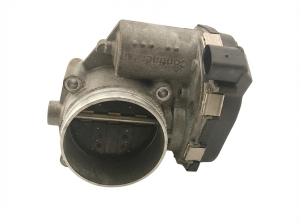
- Dirty Throttle Body 🔴 High Probability → Shop Fuel Injection Throttle Body Direct injection (FSI) engines are prone to carbon and oil vapor buildup in the intake system, which coats the throttle plate and housing, restricting its movement and causing airflow correlation errors. This is the most common cause reported by owners.
How to confirm: Remove the intake boot and visually inspect the throttle body for a thick layer of black carbon buildup around the throttle plate and bore. The plate should be shiny metal, not black. With a VCDS scan tool, a throttle valve sensor reading (Sensor 1) at idle of over 15% can indicate significant buildup; a clean and adapted throttle body should read closer to 12%.
Typical fix: Remove the throttle body, clean it thoroughly with throttle body cleaner and a soft brush, replace the gasket, and perform a throttle body adaptation with a compatible scan tool like VCDS.
Est. part cost: $10-$25 for cleaner and a new gasket. - Vacuum Leak 🟡 Medium Probability Hoses and gaskets in the intake and PCV (Positive Crankcase Ventilation) system can become brittle and crack over time, allowing unmetered air to enter the engine. The PCV valve itself is a known failure point that can cause air leaks.
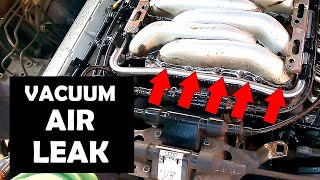
How to confirm: Visually inspect all vacuum lines and intake hoses for cracks or loose connections. A smoke test is the most effective way to find small leaks. 🎬 Watch: A simple method to find and fix vacuum leaks A loose or faulty oil filler cap can also cause this code. Check for leaks around the intake manifold runner flaps and PCV system components.
Typical fix: Replace the cracked hose or faulty gasket that is causing the leak.
Est. part cost: $20-$150 depending on the specific hose or gasket. - Faulty Manifold Absolute Pressure (MAP) Sensor ⚪ Low Probability → Shop Manifold Absolute Pressure Sensor The sensor itself can fail electronically or become contaminated with oil/carbon, sending incorrect pressure readings to the ECM. It is located on the intake manifold and is relatively easy to access.
How to confirm: After confirming no vacuum leaks and a clean throttle body, monitor the MAP sensor's live data with a scan tool to see if its readings are erratic or illogical for the given engine load. Test the sensor's voltage and ground. The sensor should receive a 5V reference and output approximately 4.0-4.7V with the key on, engine off, dropping to around 1.5V at idle.
Typical fix: Replace the MAP sensor. It is secured by two T20 Torx screws.
Est. part cost: $40-$100 - Clogged Air Filter or Snow Screen ⚪ Low Probability If severely neglected, the air filter or the pre-filter "snow screen" in the airbox can become so clogged that it restricts airflow, causing a discrepancy. This is a simple but often overlooked check.
How to confirm: Inspect the engine air filter and the snow screen located in the air intake snorkel/airbox. An AudiWorld user reported a 20% improvement in airflow after cleaning just the snow screen.
Typical fix: Replace the air filter and clean the snow screen.
Est. part cost: $20-$50
Rare But Worth Checking
- Faulty Intake Manifold Tuning (IMT) Valve Solenoid: → Shop Engine Intake Manifold A faulty intake manifold runner control solenoid can sometimes trigger a P0068 code along with IMT valve codes (like P2070). One owner reported that replacing this solenoid fixed both issues.
- Wiring Issue: Damage or corrosion on the wiring or connectors for the MAP sensor or throttle body can cause intermittent signal loss, triggering the code. This should be checked if new parts don't solve the issue.
- Faulty ECM: This is extremely rare. The Powertrain Control Module (ECM) should only be considered as a potential cause after all other possibilities have been exhaustively ruled out.
Diagnosis Steps
- Read all fault codes stored in the ECM. Note any other codes that are present, especially P307A or P2279. 🎬 Watch: Diagnosing P0068 and P307A codes on the 3.2L engine
- Visually inspect the entire air intake path from the airbox to the intake manifold. Check for cracked hoses, loose clamps, and disconnected vacuum lines.
- Check that the engine oil filler cap is tight and properly sealed, as a loose cap can cause an unmetered air leak.
- Remove the airbox cover and inspect the engine air filter and the 'snow screen' pre-filter. Clean or replace as needed.
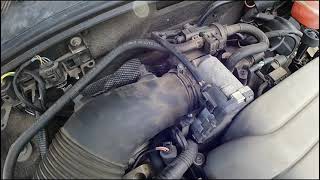
- Remove the intake boot from the throttle body and inspect for heavy carbon buildup.
- If the throttle body is dirty, remove it (typically four T30 Torx bolts), clean it meticulously using throttle body cleaner and a soft brush, and reinstall it with a new gasket.
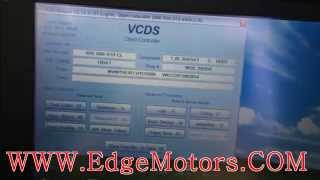
- CRITICAL: After cleaning or replacing the throttle body, perform a Throttle Body Adaptation (TBA) using a VCDS (VAG-COM) or another capable diagnostic tool. For VCDS, go to [Engine - 01] -> [Basic Settings - 04] -> Group 060 -> [Go 🎬 See how to perform a throttle body adaptation using VCDS!]. The status should change to 'ADP OK'. Before adapting, note the throttle valve sensor percentages in measuring blocks; after a successful cleaning and adaptation, the 'closed' position percentage should be lower.
- If the code returns, use a scan tool to monitor live data from the MAP sensor and Throttle Position Sensor. Ensure their values change smoothly and logically as you press and release the accelerator.
- If a vacuum leak is suspected but not visible, perform a smoke test to pinpoint the source of the leak. Pay close attention to the PCV system and intake manifold gaskets.
- If all other causes are ruled out and the MAP sensor's readings are suspect, replace the MAP sensor. It is located on the intake manifold and held by two T20 screws.
Parts You'll Likely Need
- Throttle Body Gasket
(OEM #06E133109G)— Must be replaced whenever the throttle body is removed for cleaning to prevent a vacuum leak.
Trusted brands: Victor Reinz, Elring
OEM price range: $15-$25
Aftermarket price range: $5-$15 - Manifold Absolute Pressure (MAP) Sensor
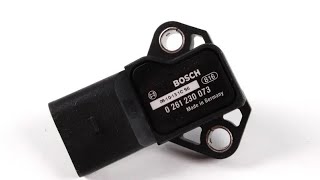
(OEM #07L907386A)— This sensor can fail or become contaminated, sending incorrect data. It's a potential cause if a throttle body cleaning and vacuum leak check don't resolve the code. Note: This part number may also be listed as an 'Intake Manifold Runner Position Sensor' by some vendors.
Trusted brands: Bosch, Hella
OEM price range: $60-$100
Aftermarket price range: $30-$60 - Throttle Body Assembly
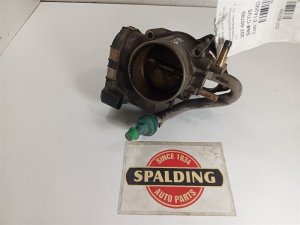
(OEM #06E133062C)— Replaced only if cleaning does not resolve the issue and the internal electronics or motor are confirmed to be faulty.
Trusted brands: Bosch, VDO
OEM price range: $350-$500
Aftermarket price range: $150-$300
Related Codes That Often Appear With This One
- P307A — This code means "Air Intake System: Flow too Low," which is often a direct result of the same issues causing P0068, like a dirty throttle body or clogged filter. They frequently appear together.
- P2279 — This code indicates a "Leak in Air Intake System," directly pointing to a vacuum leak as the root cause for the correlation fault seen in P0068.
Technical Service Bulletins (TSBs) & Recalls
- Audi TSB 01 23 62 2070915/1 - Mentions P0068 can be caused by a loose engine oil filler cap on some Audi
Platform-Specific Known Issues
- Carbon buildup on the FSI engine's intake valves and throttle body is a well-documented issue that directly contributes to this fault code over time. The design of the PCV system and valve overlap timing can exacerbate this issue.
- The use of a speed-density system (MAP sensor only, no MAF) means diagnosis must focus strictly on the correlation between manifold pressure and throttle angle, not MAF readings.
Mechanic-Grade Diagnostic Values
- Throttle Valve Sensor 1 Angle (VCDS Measuring Blocks) — expected: ~12-13% at idle after cleaning and adaptation.. Failure: A reading of 15% or higher at idle suggests significant carbon buildup preventing the throttle from closing properly.
- MAP Sensor (G71) Voltage — expected: Approx. 4.0V - 4.7V with Key On, Engine Off (KOEO). Drops to approx. 1.5V at idle.. Failure: Voltage that is stuck, does not change with engine load/vacuum, or is outside the expected range.
- MAP Sensor (G71) 5V Reference Voltage — expected: 4.8V - 5.2V at the sensor connector with Key On, Engine Off (KOEO).. Failure: No voltage or low voltage indicates a wiring or ECM problem.
Scan Tool Commands That Help
- VCDS (VAG-COM): Throttle Body Adaptation (TBA) — Required after cleaning or replacing the throttle body. Go to [01-Engine] -> [Basic Settings-04] -> Group 060. The status must change to 'ADP OK'.
- VCDS (VAG-COM): Kick-Down Adaptation — Can be performed in conjunction with the TBA. Go to [01-Engine] -> [Basic Settings-04] -> Group 063.
- Manual Procedure: Hard Reset / Clear Learned Values — As a last resort if adaptations fail or issues persist. Disconnect both battery terminals. Hold the positive and negative CABLES together for 5 minutes to discharge all capacitors in the modules, clearing volatile memory. Reconnect and re-attempt adaptations.
Wiring & Ground Locations
- Engine Ground Point — A small gauge ground wire is attached to one of the bolts on the oil filter housing. Some report two ground wires are secured there.. A poor ground connection at this critical point can cause a host of erratic electronic issues and sensor reading faults, including P0068. This is often missed or left disconnected after major engine work.
Real Owner Repair Stories
- AudiWorld Forums user 'exeattle' (2006 Audi A6 Avant 3.2L, 96,000 miles) — Check Engine Light with codes P0068 and P307A.
❌ Tried (didn't work) Cleaning the MAP/IAT sensor., Replacing the MAP/IAT sensor.
✅ What actually fixed it Replacing the engine air filter, removing and thoroughly cleaning the throttle body, and performing a Throttle Body Alignment with VCDS. The owner noted the throttle valve sensor reading at idle dropped from 15.3% to 12.2% after the fix. - Ross-Tech Forums user (VW Touareg 3.2L V6 (similar engine family)) — Persistent P0068 code after clearing.
❌ Tried (didn't work) Replacing MAF sensor (on a different model, but illustrates part-swapping)., Checking for vacuum leaks., Cleaning the throttle body.
✅ What actually fixed it Replacing the entire throttle body assembly and performing a re-alignment. This resolved the code and improved idle fuel consumption from 1.9 L/hr to 1.0 L/hr, indicating the original throttle body had an internal fault beyond just being dirty.
"I Checked Everything" — The Actual Cause
- In cases where a smoke test reveals no vacuum leaks and cleaning the throttle body does not resolve the P0068 code, the root cause can be an internal electronic or mechanical failure of the throttle body itself. The motor or position sensors within the sealed unit can fail, which requires replacing the entire assembly, not just cleaning it.
OEM Part Supersession History
06E133062C→06E133062G, then 06E133062H— Standard part revision and improvement by the manufacturer.07L907386A→07L907386B— Standard part revision by the manufacturer. This part serves as both the MAP sensor and the Intake Manifold Runner Position Sensor depending on its location.
Model Year Variations Within This Range
- 2004-2008 vs 2009-2011: The 3.2L FSI engine came in several codes, most commonly BKH (255 hp) in earlier models and CALA (265 hp) in later (facelift) models. While the fundamental cause of P0068 is the same, be aware of the engine code when ordering parts, although the throttle body and MAP sensor part numbers appear to be shared.
Diagnostic Flowchart
Used vs. New Parts: Buying Guide for This Vehicle
When a used part is the smart pick: A used throttle body assembly from a reputable salvage yard with a known low-mileage donor can be a cost-effective option, as the primary failure mode is often just carbon buildup that can be cleaned. However, there is a risk of the used part having the same internal electronic failure as the original.
Donor-vehicle mileage cap: roughly under 80000 miles for the part to have meaningful remaining life.
What to inspect on the donor part:
- Check for physical damage to the housing and connector.
- Ensure the throttle plate moves freely by hand (if applicable) without binding.
- Ask for the donor vehicle's mileage and check if it comes with a short warranty (e.g., 30-90 days).
OEM-only on this vehicle (don't cheap out):
- Manifold Absolute Pressure (MAP) Sensor: It is highly recommended to use an OEM (Bosch) or Genuine Audi sensor. Cheap aftermarket sensors are notorious for poor calibration and premature failure, which can lead to chasing the same P0068 code again.
Aftermarket brands forum-validated for this vehicle:
- Bosch (Often the original OEM supplier for throttle body and MAP sensor)
- VDO (A reliable OEM for throttle bodies)
Brands owners have reported issues with on this vehicle:
- Unbranded, 'white-box' electronic sensors from online marketplaces should be avoided as their quality and accuracy are highly questionable.
Real Owner Stories
Aggregated from forums and TSBs cited above. Mileages and costs reflect what owners reported in those sources.
2006 Audi A6 3.2L
Symptoms: Check Engine Light on with codes P0068 and P307A.
What fixed it: The owner removed and cleaned the throttle body, which had visible carbon buildup. After reinstalling it with a new gasket and performing a Throttle Body Alignment using VCDS, both codes were resolved. The throttle valve sensor reading at idle improved from 15.3% to 12.2%.
Source hint: AudiWorld Forums: THROTTLE BODY ISSUE, CODE P0068, FIXED
Audi A6 3.2L (C6 Platform)
Symptoms: A persistent P0068 code was present along with a P2070 code for the Intake Manifold Tuning (IMT) valve.
What fixed it: Replacing the front intake manifold runner control solenoid fixed the P2070 code and also unexpectedly cleared the P0068 code, suggesting a rare link between the two issues.
Source hint: AudiWorld Forums: P2070: Intake Manifold Tuning (IMT) Valve Stuck Open
Audi A6 3.2L (C6 Platform)
Symptoms: Investigating causes for an airflow-related code like P0068.
What fixed it: The owner reported a 20% improvement in measured airflow after cleaning the 'snow screen' pre-filter located in the engine's air intake snorkel/airbox.
Source hint: AudiWorld Forums: THROTTLE BODY ISSUE, CODE P0068, FIXED
Related OBD-II Codes
Frequently Asked Questions
I cleaned my A6's throttle body, but the P0068 code came back. What did I miss?
Is a dirty throttle body really the most common cause for P0068 on the 3.2L FSI engine?
My mechanic mentioned a loose oil cap could cause this. Is that true for my 2004-2011 A6?
What are the correct VCDS steps for the Throttle Body Adaptation (TBA) on this car?
My mechanic wants to do a smoke test. Is that a valid diagnostic step for P0068?
Why is checking the 'snow screen' mentioned for this code?
Helpful Videos
We Have This Part in Stock

The information in this article is provided for general reference and educational purposes only. Vehicle specifications, procedures, and part compatibility can vary by production date, trim level, and region. Always consult your vehicle's factory service manual and verify part numbers before purchasing or performing repairs. Safety-critical components such as airbags, seat belts, and braking systems should be installed by a qualified professional.
- Audi A6:
- 🧭 Diagnostic Flowchart
- 🎬 Helpful Videos
- 🛍️ Shop This Part
- What's Unique About the 2004-2011 Audi A6
- Symptoms You May Notice
- Most Likely Causes
- Rare But Worth Checking
- Diagnosis Steps
- Parts You'll Likely Need
- Related Codes That Often Appear With This One
- Technical Service Bulletins (TSBs) & Recalls
- Platform-Specific Known Issues
- Mechanic-Grade Diagnostic Values
- Scan Tool Commands That Help
- Wiring & Ground Locations
- Real Owner Repair Stories
- "I Checked Everything" — The Actual Cause
- OEM Part Supersession History
- Model Year Variations Within This Range
- Used vs. New Parts: Buying Guide for This Vehicle
- Real Owner Stories
- 2006 Audi A6 3.2L
- Audi A6 3.2L (C6 Platform)
- Audi A6 3.2L (C6 Platform)
- Related OBD-II Codes
- Frequently Asked Questions
- 🎟️ Get 5% Off