

P0068 on 2006-2013 Chevrolet Impala: MAP/MAF Throttle Position Correlation Fixes
Code P0068 on a 2006-2013 Impala usually means there's a dirty throttle body or a vacuum leak. Cleaning the throttle body is a common, low-cost first step that often resolves the issue, but an 'Idle Learn Reset' procedure must be performed afterward. If that doesn't work, suspect a vacuum leak or a faulty MAP sensor.
- Start with the cheapest and most likely fix: clean the throttle body.
- If cleaning doesn't work, your next step should be to check for vacuum leaks, which is another common and relatively inexpensive fix.
- Do not replace any sensors (MAP, MAF, or Throttle Body) until you have ruled out a dirty throttle body and vacuum leaks.
- This code will likely put the car in 'Reduced Engine Power' mode, so avoid driving it until the issue is resolved.
- Given the TSB for high-mileage vehicles, this code is a known issue and is very often not a major component failure.
What's Unique About the 2006-2013 Chevrolet IMPALA
On this generation of Impala, especially high-mileage examples, P0068 is frequently associated with a dirty electronic throttle body causing airflow discrepancies. GM issued a Technical Service Bulletin (TSB #PIP4578B) that directly connects P0068 with symptoms like idle surge and reduced engine power mode on high-mileage vehicles. The TSB explains that as carbon builds up, the ECM compensates by opening the throttle plate more at idle. If the throttle body is cleaned (or replaced) and this learned compensation isn't reset, the idle will be too high, which can re-trigger P0068 or set other codes. This makes cleaning the throttle body followed by an 'Idle Learn Reset' a crucial, platform-specific repair sequence.
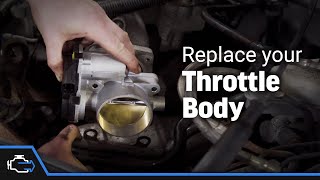
🎬 Watch: How to clean the throttle body and fix surging.Diagnostic Flowchart
Tap your situation to follow the diagnostic path that matches what you're seeing on this vehicle.
Generation note: The 2006-2013 year range covers the entire ninth generation of the Chevrolet Impala. This also includes the Impala Limited fleet vehicle which was produced until 2016. The causes and fixes are generally consistent across the various V6 engines (3.5L, 3.9L, and 3.6L) and the V8 (5.3L) offered in this generation, as the issue is primarily related to the electronic throttle control system and carbon buildup, a common problem across these engine families. However, the 3.6L LFX engine introduced in 2012 has a unique PCV system design that can cause hard-to-diagnose vacuum leaks when orifices clog.
Symptoms You May Notice
- Check Engine Light is on
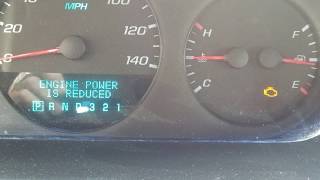
- "Reduced Engine Power" message on the driver information center
- Rough or unstable idle, sometimes described as 'shaky'
- Hesitation or sluggish acceleration, feeling like the engine is 'choking'
- Engine stalling, especially when coming to a stop
- Increased fuel consumption
- Inability to accelerate past a certain speed 🎬 See this video for a quick Reduced Engine Power fix. (e.g., 40 mph) when in limp mode
- Replacing the throttle body assembly when only a cleaning and idle relearn is needed.
- Replacing the MAP or MAF sensor before checking for vacuum leaks or cleaning the throttle body.
- Cleaning the throttle body but failing to perform the 'Idle Learn Reset' procedure, causing the symptoms to persist.
Most Likely Causes
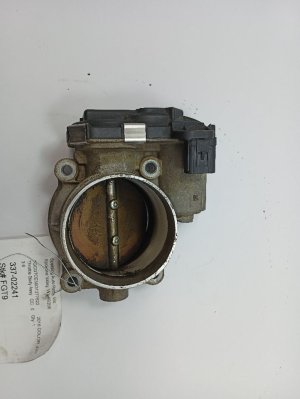
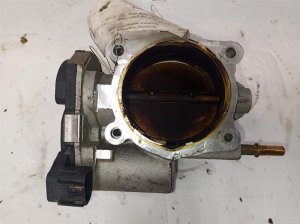
- Dirty Throttle Body 🔴 High Probability → Shop Fuel Injection Throttle Body Over time, oil vapor from the PCV system and other contaminants can bake onto the throttle plate and bore, creating a greasy sludge ('coke'). This buildup restricts airflow at small throttle openings, causing a mismatch between the expected and actual airflow that triggers P0068. The related TSB PIP4578B points to this being a common issue on high-mileage GM vehicles.
How to confirm: Remove the air intake tube from the throttle body and visually inspect the throttle plate and bore for a black, greasy coating.
Typical fix: Clean the throttle body thoroughly with a dedicated throttle body cleaner and a soft cloth or brush. After cleaning, an 'Idle Learn Reset' procedure must be performed using a capable scan tool (like a Tech 2/GDS) or a manual procedure to reset the ECM's learned throttle position values. Failure to perform the relearn can result in a continued high idle or other driveability issues.
Est. part cost: $5-$15 for cleaner - Vacuum Leak 🟡 Medium Probability With age, rubber and plastic components in the engine bay become brittle and crack. A common failure point is the intake manifold gaskets or any of the vacuum hoses connected to the intake, allowing unmetered air to enter the engine and disrupt sensor readings.
How to confirm: With the engine running, carefully spray short bursts of brake cleaner or carburetor cleaner around the intake manifold gaskets and vacuum hose connections. If the engine RPM changes or stumbles, a leak has been found. A smoke test is a more definitive and safer method to pinpoint the exact location of the leak.
Typical fix: Replace the leaking gasket or hose.
Est. part cost: $20-$150 depending on the specific gasket or hose - Faulty Manifold Absolute Pressure (MAP) Sensor ⚪ Low Probability → Shop Manifold Absolute Pressure Sensor Sensors can fail over time due to heat cycles and vibration, leading to incorrect pressure readings that conflict with MAF and TPS data.
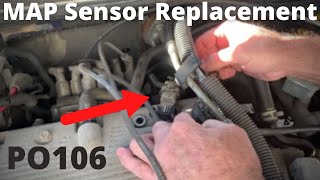
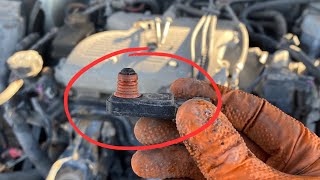
How to confirm: Use a scan tool to monitor the MAP sensor voltage. With the key on and engine off, it should read near 4.5-5 volts. At idle, it should drop to around 1-2 volts. If the readings are stuck or do not change smoothly with RPM, the sensor is likely faulty. For the 3.5L and 3.9L V6, the MAP sensor is typically located behind the throttle body. 🎬 Watch: How to find and remove the MAP sensor.
Typical fix: Replace the MAP sensor and clear the code.
Est. part cost: $30-$90 - Faulty Mass Airflow (MAF) Sensor ⚪ Low Probability → Shop Fuel Injection Air Flow Meter The sensor's delicate hot wire can become contaminated by dirt or oil, causing it to read airflow incorrectly.
How to confirm: First, try cleaning the sensor with a dedicated MAF sensor cleaner. Do not touch the sensor element. If the problem persists, monitor the sensor's output with a scan tool; the reading (in grams/sec) should increase smoothly as you increase engine RPM. A faulty sensor may provide erratic or no readings.
Typical fix: Clean the MAF sensor. If cleaning doesn't work, replace the sensor.
Est. part cost: $10 for cleaner, $70-$150 for a new sensor
Rare But Worth Checking
- Aftermarket Air Intake or Check Valve: An owner complaint (NHTSA ODI #10980487) specifically cited an aftermarket secondary air check valve as the cause for a P0068 code. Non-OEM parts, including performance cold air intakes or ported throttle bodies, can sometimes alter airflow characteristics enough to trigger this correlation fault because the actual airflow no longer matches the factory-programmed expected values.
- Damaged Wiring or Connectors: Frayed wires or corroded pins on the connectors for the MAP, MAF, or TPS can cause intermittent or incorrect signals, leading to the code. This should be checked if sensors have been replaced without success. Some TSBs for related models point to potential water intrusion into body harness connectors causing electrical issues.
Diagnosis Steps
- Scan for any other trouble codes. Codes related to specific sensors (like P0107 for MAP or P0102 for MAF) or throttle performance (P1516, P2135) can help pinpoint the problem.
- Perform a thorough visual inspection of the air intake system. Check for loose clamps, cracked hoses, or disconnected lines between the air filter box and the throttle body.
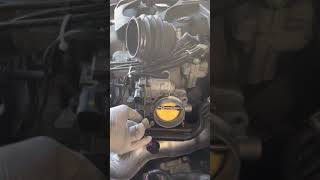
- Remove the intake duct and inspect the throttle body. If it is coated in black grime ('coke'), clean it thoroughly with throttle body cleaner and a rag.
- Crucial Step: After cleaning the throttle body, perform an 'Idle Learn Reset' or 'Reset Idle Learn' using a GM-compatible scan tool or a manual procedure.
- Check for vacuum leaks. With the engine idling, spray carb cleaner around the intake manifold gaskets and vacuum lines. Listen for any change in engine RPM. A smoke test is the most reliable method.
- Clean the MAF sensor using a dedicated MAF sensor cleaner spray. Do not touch the sensor wires.
- If the code persists, use a scan tool to monitor live data from the MAP, MAF, and TPS sensors. Watch for any readings that are erratic, stuck, or don't change logically with engine speed and load.
- Test sensor circuits. For the MAP sensor, check for ~5V reference, a good ground, and a signal wire that reads ~4.5-5V with key-on-engine-off and drops to 1-2V at idle. For the TPS, check for a smooth voltage increase from ~0.5V to ~4.5V as the throttle is opened.
- If a sensor is suspected after testing, test its wiring and connector for continuity and proper voltage before replacing the part.
Parts You'll Likely Need
- Throttle Body Cleaner — This is the most common and least expensive first step, as a dirty throttle body is a primary cause of P0068 on these vehicles.
Related Codes That Often Appear With This One
- P0121 — Throttle/Pedal Position Sensor/Switch 'A' Circuit Range/Performance. This code is often seen with P0068 as it also relates to an unexpected signal from the throttle body. TSB PIP4578B lists this code as a common companion to P0068.
- P1516 — Throttle Actuator Control (TAC) Module Throttle Actuator Position Performance. This is a GM-specific code that indicates a problem with the electronic throttle control system, which is directly related to the P0068 correlation fault. It is also listed in TSB PIP4578B.
- P2135 — Throttle/Pedal Position Sensor/Switch 'A'/'B' Voltage Correlation. This code points to a disagreement between the two position sensors within the throttle body assembly, which can also trigger P0068.
- P0507 — Idle Air Control System RPM Higher Than Expected. This can occur after cleaning a dirty throttle body if the idle learn reset is not performed, as the ECM is still commanding the throttle open based on the old, restricted airflow values.
Technical Service Bulletins (TSBs) & Recalls
- PIP4578B: SES Light, Idle Surge, and/or Reduced Engine Power Mode with DTCs P0068, P0121, P0506, P0507, P1516, P2101, P2119, and/or P2176 - Clean Throttle Body and Perform Idle Learn Reset.
Platform-Specific Known Issues
- GM Technical Service Bulletin PIP4578B directly addresses P0068 on high-mileage vehicles. It states that carbon buildup in the throttle body causes the ECM to learn incorrect idle airflow values. Cleaning the throttle body without performing an 'Idle Learn Reset' with a scan tool can lead to a return of the code or new codes like P0507 (Idle RPM too high).
- Owner forums for the 9th generation Impala are filled with reports of the 'Reduced Engine Power' message, which is almost always linked to this P0068 correlation fault and ultimately traced back to the throttle body needing cleaning or replacement.
Mechanic-Grade Diagnostic Values
- MAP Sensor Signal Voltage (Key On, Engine Off) — expected: ~4.5 - 4.7 V DC. Failure: Voltage significantly lower or higher indicates a sensor or wiring issue.
- MAP Sensor Signal Voltage (Engine Idling) — expected: ~1.0 - 2.0 V DC. Failure: Voltage that is stuck high or does not respond to changes in engine load/vacuum suggests a faulty sensor or vacuum leak.
- MAP Sensor 5V Reference Wire (Gray Wire) — expected: ~5.0 V DC. Failure: No voltage or low voltage points to a problem with the ECM or the wiring from the ECM.
- MAP Sensor Ground Wire (Orange/Black Wire) — expected: < 1k ohms to chassis ground. Failure: High resistance indicates a poor ground connection, which can cause incorrect sensor readings.
- Throttle Position Sensor (TPS) Signal Voltage — expected: Smoothly increases from ~0.5V (closed throttle) to ~4.5V (wide-open throttle).. Failure: Voltage that jumps, drops out, or has dead spots when the throttle is slowly opened indicates a worn or faulty TPS.
Scan Tool Commands That Help
- GDS2/Tech 2 or equivalent professional scan tool: Idle Learn Reset / Throttle Learn — This function must be used after cleaning or replacing the throttle body to reset the learned idle airflow values stored in the ECM. Failure to do so will likely result in a high idle, unstable idle, or the setting of other DTCs like P0507.
Wiring & Ground Locations
- G103 / G105 — On the engine block, typically on a stud on or near the starter motor or bell housing.. These are primary engine-to-chassis ground points. A loose or corroded connection at these locations can introduce electrical noise or incorrect reference voltages for critical sensors like the MAP, MAF, and TPS, directly causing correlation codes like P0068.
- MAP Sensor Connector (3.9L V6) — Located on the MAP sensor, which is typically behind the throttle body. Pin 1 is Light Green (Signal), Pin 2 is Orange/Black (Ground), Pin 3 is Gray (5V Reference).. Knowing the pinout is essential for accurately testing the sensor's power, ground, and signal circuits with a multimeter to rule out wiring issues before replacing the sensor.
Real Owner Repair Stories
- ImpalaForums user (2008 Chevrolet Impala SS (5.3L V8)) — P0068 code, Reduced Engine Power message, vehicle would not accelerate properly.
❌ Tried (didn't work) Cleaned the MAF sensor, Cleaned the throttle body, Checked for vacuum leaks
✅ What actually fixed it Replacing the Manifold Absolute Pressure (MAP) sensor. The user noted that even though the sensor seemed to be working, it was faulty and replacing it resolved all symptoms and the code did not return.
When the Usual Fixes Don't Work
- In one documented case on an Impala SS, the owner performed the most common fixes—cleaning the MAF sensor and throttle body, and checking for vacuum leaks—without success. The P0068 code and 'Reduced Engine Power' mode persisted. The ultimate solution was replacing the MAP sensor, even though it did not appear to be completely failed during initial checks. This highlights that an intermittently failing or out-of-calibration sensor can trigger this code without presenting as a hard failure during basic testing.
OEM Part Supersession History
12631186→12694871— Standard part revision by the manufacturer.
Heads up: While this part number is listed for many GM vehicles, it primarily fits 4-cylinder engines and is not correct for the V6/V8 Impala models. It serves as an example of supersession but highlights the need to verify fitment by VIN.
Model Year Variations Within This Range
- 2012-2013: Models equipped with the 3.6L LFX V6 engine have a different PCV system design compared to the earlier 3.5L and 3.9L engines. The LFX can suffer from a clogged PCV orifice in the valve cover, which can lead to a ruptured diaphragm in the clean-side tube, creating a significant and often misdiagnosed vacuum leak that can trigger P0068.
Helpful Videos

We Have This Part in Stock

The information in this article is provided for general reference and educational purposes only. Vehicle specifications, procedures, and part compatibility can vary by production date, trim level, and region. Always consult your vehicle's factory service manual and verify part numbers before purchasing or performing repairs. Safety-critical components such as airbags, seat belts, and braking systems should be installed by a qualified professional.
- Chevrolet IMPALA:
- 🧭 Diagnostic Flowchart
- 🎬 Helpful Videos
- 🛍️ Shop This Part
- What's Unique About the 2006-2013 Chevrolet IMPALA
- Symptoms You May Notice
- Most Likely Causes
- Rare But Worth Checking
- Diagnosis Steps
- Parts You'll Likely Need
- Related Codes That Often Appear With This One
- Technical Service Bulletins (TSBs) & Recalls
- Platform-Specific Known Issues
- Mechanic-Grade Diagnostic Values
- Scan Tool Commands That Help
- Wiring & Ground Locations
- Real Owner Repair Stories
- When the Usual Fixes Don't Work
- OEM Part Supersession History
- Model Year Variations Within This Range
- 🎟️ Get 5% Off