

P0073 on 2014-2016 Ford Transit Connect: Ambient Air Temp Sensor Causes and Fixes
On a 2014-2016 Ford Transit Connect, especially with the 2.5L engine, code P0073 is almost always caused by a faulty Ambient Air Temperature (AAT) sensor or its connector. This is a known issue documented in a Ford TSB. Replacing the sensor and pigtail connector is the common fix, with parts costing around $20-$50.
- P0073 on a 2014-2016 Transit Connect is a very specific and well-documented issue.
- The primary symptoms are a non-working A/C and a false, very low temperature reading on the dash.
- The cause is almost certainly a bad Ambient Air Temperature sensor, its connector, or the wiring right at the connector.
- Ford issued TSB 16-0054 which explicitly details the symptoms and the fix: replace both the sensor and the pigtail connector.
- Diagnosis is straightforward: check for the code, look for a -40 degree reading, and inspect the sensor/connector behind the driver's side of the front bumper.
What's Unique About the 2014-2016 Ford TRANSIT CONNECT
For the 2014-2016 Transit Connect with the 2.5L engine, this code is specifically addressed by Ford Technical Service Bulletin (TSB) 16-0054. The TSB notes that an inaccurate temperature display and/or inoperative A/C are common symptoms associated with this code, particularly when the sensor incorrectly reads below -1.1 °C (30 °F). Unlike a generic failure, Ford's bulletin points directly to a problem with the AAT sensor and/or its electrical connector and even provides a specific diagnostic flow: reset the Keep Alive Memory (KAM) and if function returns, then proceed with replacing both parts. This makes diagnosis more straightforward on this particular vehicle.
Diagnostic Flowchart
Tap your situation to follow the diagnostic path that matches what you're seeing on this vehicle.
Symptoms You May Notice
- Check Engine Light is on
- Air conditioning (A/C) is inoperative or does not cool properly.
- Inaccurate outside temperature reading on the instrument panel display, often showing a very low, fixed number like -40°F or -40°C, which is a classic sign of an open sensor circuit.
- Automatic climate control system not functioning correctly.
- Recharging the A/C system or replacing A/C components (like the compressor) without first checking for codes. The A/C system may be perfectly fine, but disabled by the PCM due to the faulty temperature reading from the AAT sensor.
Most Likely Causes
- Faulty Ambient Air Temperature (AAT) Sensor 🔴 High Probability → Shop Ambient Air Temperature Sensor The sensor is located in an exposed area behind the front bumper, making it susceptible to damage from road debris and moisture. Ford TSB 16-0054 specifically recommends replacing the sensor for this issue, confirming it as a high-failure item.
How to confirm: With a scan tool, observe the AAT sensor data. A reading of -40°F or another fixed, illogical value points to a failed sensor. You can also test the sensor's internal resistance with a multimeter; an open circuit (infinite resistance) confirms failure. A typical Ford AAT sensor should have a resistance of around 32.6 kOhms at 32°F (0°C) and 11.9 kOhms at 70°F (21°C).
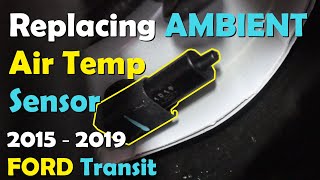
Typical fix: Replace the Ambient Air Temperature sensor. The sensor is located behind the front bumper cover, on the driver's side next to the lower air inlet. 🎬 Watch: Locate and replace the sensor on a Transit Connect.
Est. part cost: $15-$40 - Damaged AAT Sensor Wiring or Connector 🔴 High Probability Ford TSB 16-0054 explicitly advises replacing the AAT sensor connector pigtail as part of the official repair procedure, indicating it's a common failure point due to corrosion or wire fatigue. The wiring's location makes it vulnerable to corrosion and physical damage from road spray and debris.
How to confirm: Visually inspect the wiring harness and connector leading to the AAT sensor for any signs of green/white corrosion, breaks, or frayed wires. Check for 5V reference voltage at the connector with the key on and sensor unplugged.
Typical fix: Repair the damaged section of wiring or, as recommended by Ford, replace the entire connector pigtail. 🎬 Watch this guide to testing and fixing the P0073 circuit. Pigtail kits are readily available for this purpose and often include heat-shrink butt connectors for a durable repair.
Est. part cost: $10-$25
Rare But Worth Checking
- Faulty Powertrain Control Module (PCM): → Shop Engine Control Module (ECM) This is extremely rare. Before suspecting the PCM, all other possibilities, including the sensor and the entire length of its wiring, must be thoroughly ruled out. A PCM failure will usually be accompanied by other trouble codes.
Diagnosis Steps
- Read all fault codes using an OBD-II scanner. Note if P0074 or U0422 are also present, as this strongly points to the issue described in TSB 16-0054.
- View the live data stream for the Ambient Air Temperature (AAT) sensor. A reading that is stuck at a very low temperature (e.g., -40°F) strongly suggests an open circuit.
- Per TSB 16-0054, a dealer-level step is to reset the Keep Alive Memory (KAM). If the AAT display becomes accurate and A/C function returns, proceed with replacing the sensor and connector.
- Locate the AAT sensor. On the Transit Connect, it is found behind the front bumper cover on the driver's side, next to the lower grille opening. Access is gained from underneath by removing the plastic front splash guard.
- Visually inspect the sensor and its connector for physical damage, corrosion, or loose connections. Pay close attention to the pins inside the connector.
- Disconnect the sensor. With the ignition on, use a multimeter to check for a reference voltage (around 5 volts) at the connector.
- If reference voltage is present, test the old sensor's resistance. An open circuit (infinite resistance) confirms the sensor has failed. Compare readings to a temperature/resistance chart; for example, at 77°F (25°C), resistance should be approximately 10 kOhms.
- If the sensor tests good and voltage is present, inspect the full length of the wiring harness for breaks or shorts.
- Following TSB 16-0054, it is recommended to replace both the sensor and the connector pigtail simultaneously to prevent a comeback.
- After replacement, clear the codes. Some owners report needing to disconnect the battery for a period (e.g., overnight) to fully reset all modules and restore A/C function.
Parts You'll Likely Need
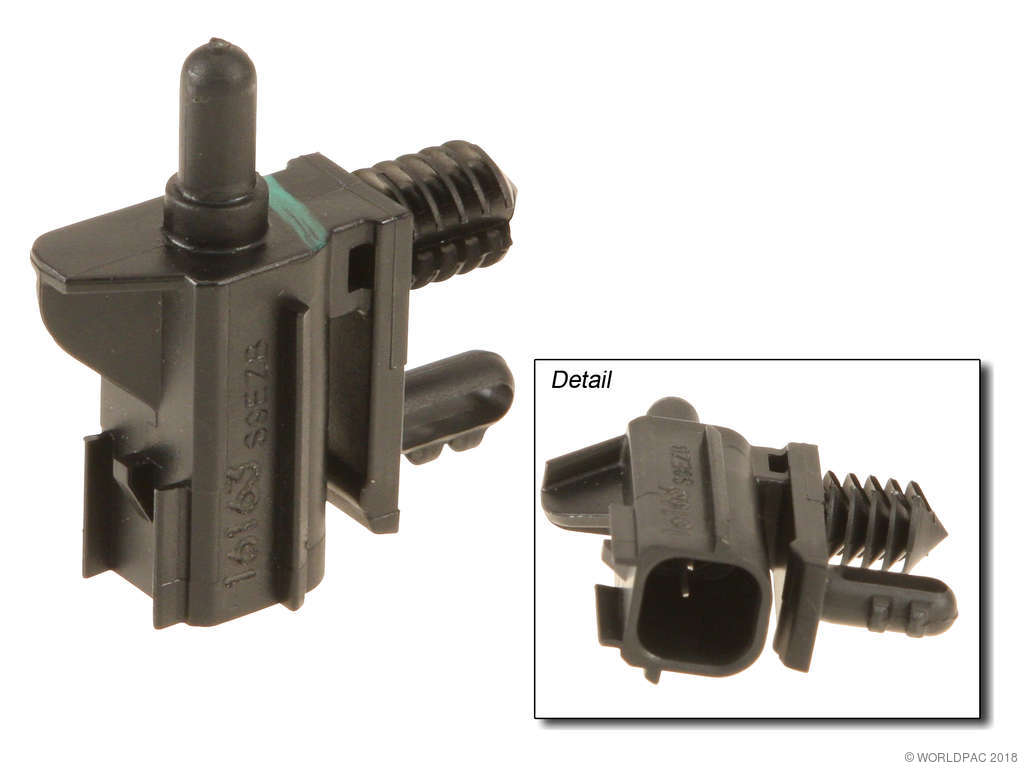
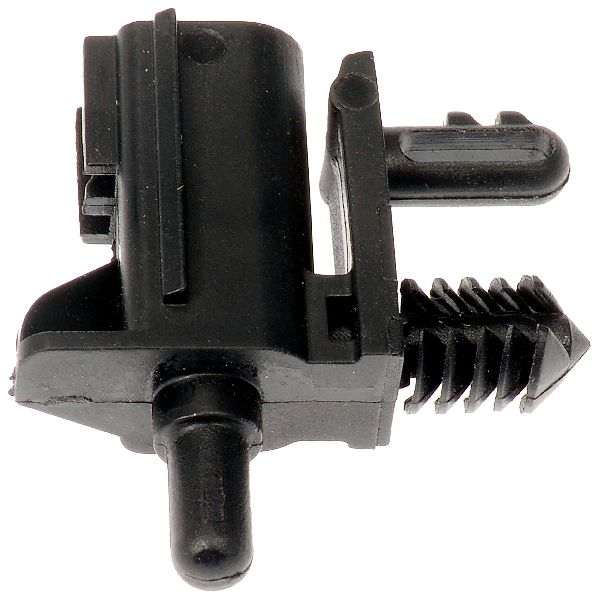
- Ambient Air Temperature Sensor
(OEM #AU5Z-12A647-B (Ford) or DY1160 (Motorcraft))— This is the most common failure point for code P0073, as identified by owner experiences and a manufacturer TSB.
Trusted brands: Motorcraft, Duralast, Standard Motor Products
OEM price range: $20-$40
Aftermarket price range: $15-$30 - Ambient Air Temperature Sensor Connector Pigtail
(OEM #WPT-1548 (Motorcraft))— Ford TSB 16-0054 specifically recommends replacing the connector along with the sensor, indicating it is a known point of failure due to corrosion or poor connection.
Trusted brands: Motorcraft (part number varies, consult dealer with VIN), Standard Motor Products (e.g., S2495), Dorman
OEM price range: $15-$30
Aftermarket price range: $10-$20
Related Codes That Often Appear With This One
- P0074 — This code for 'Ambient Air Temperature Sensor Circuit Intermittent' is often stored along with P0073, as noted in TSB 16-0054. It points to the same root cause of a failing sensor or loose connection.
- U0422 — This code for 'Invalid Data Received From Body Control Module' can also appear, as mentioned in TSB 16-0054. It indicates a communication problem between modules, which can be triggered by the faulty AAT sensor data.
Technical Service Bulletins (TSBs) & Recalls
- 16-0054: 2.5L - AIR CONDITIONING (A/C) INOPERATIVE AND/OR MESSAGE CENTER AMBIENT AIR TEMPERATURE DISPLAY INACCURATE - DTCS P0073, P0074 AND/OR U0422.
Platform-Specific Known Issues
- TSB 16-0054 was issued by Ford for 2014-2016 Transit Connects with the 2.5L engine for this exact issue, where an inaccurate AAT reading (specifically below -1.1 °C / 30 °F) causes the A/C to become inoperative. The official fix involves replacing both the AAT sensor and its connector.
Mechanic-Grade Diagnostic Values
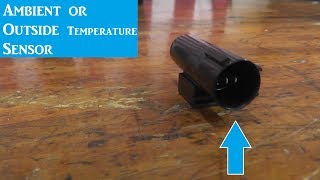
- AAT Sensor Resistance vs. Temperature — expected: Approx. 32.6 kΩ at 32°F (0°C), 17.2 kΩ at 55°F (13°C), 10.4 kΩ at 75°F (24°C), 6.5 kΩ at 95°F (35°C).. Failure: Infinite resistance (open circuit) or readings that are dramatically different from the expected values at a known temperature. 🎬 See how to test sensor resistance and restore your AC. A reading of -40° on a scan tool corresponds to an open circuit.
- AAT Sensor Connector Voltage (Key On, Sensor Unplugged) — expected: One pin should have a 5-volt reference from the PCM, the other is the signal return/ground.. Failure: No 5V reference suggests a wiring issue upstream or a PCM fault. If 5V is present, the issue is likely the sensor or the connection itself.
Scan Tool Commands That Help
- Ford Integrated Diagnostic System (IDS): Reset Keep Alive Memory (KAM) — This is a specific diagnostic step called out in TSB 16-0054. After observing the fault, a technician should perform a KAM reset. If the temperature reading becomes accurate and A/C function returns temporarily, it confirms the sensor/connector assembly is faulty and should be replaced.
- Ford Integrated Diagnostic System (IDS): Datalogger - PID: AAT — Used to monitor the live voltage or temperature reading from the Ambient Air Temperature sensor as seen by the PCM. A value stuck at -40°F/C or showing erratic jumps confirms a fault in the circuit.
Wiring & Ground Locations
- AAT Sensor Connector (C134) — Behind the front bumper cover, on the driver's side, near the lower grille opening.. This is the primary point of failure due to exposure to moisture and road debris, leading to corrosion or broken wires causing the P0073 code.
- AAT Sensor Wiring — Pin 1 (Signal): Gray/Yellow wire. Pin 2 (Signal Return/Ground): Violet/Orange wire. These wires run from the AAT sensor to the Powertrain Control Module (PCM).. A break or short in either of these wires will cause the P0073 code. The Gray/Yellow wire goes to Pin 5 and the Violet/Orange wire goes to Pin 18 of PCM connector C175B. Knowing the wire colors and pin locations is critical for testing continuity between the sensor and the PCM.
- PCM Connector C175B — The Powertrain Control Module (PCM) is located on the left side of the engine compartment. C175B is one of the main connectors to the PCM.. This is the termination point for the AAT sensor circuit. If the sensor and wiring test good at the connector, a technician would then check for voltage and continuity at pins 5 and 18 of this connector to isolate a fault to the wiring harness or the PCM itself.
Real Owner Repair Stories
- YouTube channel 'DIYDaly' (2013 Ford Transit Custom (European model, but uses similar sensor principles)) — Engine warning light on, fault code P0098 (Intake Air Temperature Sensor 2 Circuit High - equivalent to AAT on other models).
❌ Tried (didn't work) Initial diagnosis pointed to a bad sensor.
✅ What actually fixed it A visual inspection revealed a broken wire right at the connector for the temperature sensor located on the intercooler. The wire was repaired by de-pinning the connector, soldering a new section of wire on, and reassembling. This resolved the fault code without needing to replace the sensor itself.
OEM Part Supersession History
FC4Z-12A647-A→AU5Z-12A647-B— Standard part revision by the manufacturer.
Heads up: The new part number (AU5Z-12A647-B) is the correct and current replacement for the specified vehicles.DY-1345→AU5Z-12A647-B— Ford consolidated part numbers. DY-1345 was a previous service number.
Heads up: AU5Z-12A647-B is the direct replacement.
Helpful Videos

We Have This Part in Stock


The information in this article is provided for general reference and educational purposes only. Vehicle specifications, procedures, and part compatibility can vary by production date, trim level, and region. Always consult your vehicle's factory service manual and verify part numbers before purchasing or performing repairs. Safety-critical components such as airbags, seat belts, and braking systems should be installed by a qualified professional.
- Ford TRANSIT CONNECT:
- 🧭 Diagnostic Flowchart
- 🎬 Helpful Videos
- 🛍️ Shop This Part
- What's Unique About the 2014-2016 Ford TRANSIT CONNECT
- Symptoms You May Notice
- Most Likely Causes
- Rare But Worth Checking
- Diagnosis Steps
- Parts You'll Likely Need
- Related Codes That Often Appear With This One
- Technical Service Bulletins (TSBs) & Recalls
- Platform-Specific Known Issues
- Mechanic-Grade Diagnostic Values
- Scan Tool Commands That Help
- Wiring & Ground Locations
- Real Owner Repair Stories
- OEM Part Supersession History
- 🎟️ Get 5% Off