

P0087 on 2010-2017 Chevrolet Silverado 1500: Low Fuel Pressure Causes and Fixes
P0087 on a Silverado 1500 means the fuel pressure is too low. On 2014+ models with direct injection, this often points to a failing high-pressure fuel pump (HPFP) or the in-tank low-pressure pump. On 2010-2013 models, it's typically the in-tank fuel pump or the Fuel Pump Control Module (FPCM), which is prone to corrosion.
- P0087 indicates dangerously low fuel pressure that can cause stalling and no-start conditions.
- For 2014-2017 models, the high-pressure fuel pump (HPFP) is a primary suspect, in addition to the in-tank pump.
- For all years, the Fuel Pump Control Module (FPCM) located above the spare tire is a very common failure point due to corrosion.
- Diagnosis should begin by checking low-pressure fuel system pressure to determine which part of the system to focus on.
- Manufacturer TSBs confirm that cold weather and fuel contamination are known triggers for this code on these trucks.
What's Unique About the 2010-2017 Chevrolet Silverado 1500
The 2010-2017 Silverado 1500 spans two key generations with different fuel systems. The 2010-2013 (GMT900) trucks use a traditional port injection system with a single in-tank fuel pump regulated by a Fuel Pump Control Module (FPCM). The 2014-2017 (K2XX) trucks introduced EcoTec3 engines with direct injection, which uses both a low-pressure in-tank pump and an engine-driven high-pressure fuel pump (HPFP). This dual-pump setup on the 2014+ models adds complexity to diagnosing P0087, as the failure could be in either the low-pressure or high-pressure circuit.
Diagnostic Flowchart
Tap your situation to follow the diagnostic path that matches what you're seeing on this vehicle.
Generation note: This range covers the end of the 2nd generation (GMT900, 2010-2013) and the start of the 3rd generation (K2XX, 2014-2017). The primary difference is the fuel system: 2010-2013 models use port injection with an FPCM, while 2014-2017 models use direct injection with a high-pressure fuel pump (HPFP). Causes and diagnostic steps differ significantly between them, with FPCM failures common on earlier models and HPFP failures a key concern on later models.
Symptoms You May Notice
- Check Engine Light is on
- Engine hesitation or sputtering, especially under acceleration
- Loss of power and reduced engine performance
- Rough idle
- Hard starting or long crank times
- Engine stalling
- Whining or humming noise from the fuel tank area, especially in cold weather
- Increased fuel consumption 🎬 Watch: Understanding the causes and fixes for the P0087 code
- Replacing the in-tank fuel pump on a 2014+ model when the high-pressure fuel pump (HPFP) is the actual cause of the failure.
- Replacing fuel injectors when the issue is insufficient pressure from a failing pump, FPCM, or clogged filter/line.
- Replacing the HPFP without checking for fuel contamination in the tank, which can cause the new pump to fail shortly after installation.
Most Likely Causes
- Failing High-Pressure Fuel Pump (HPFP) (2014-2017 models) 🔴 High Probability → Shop Fuel Pump The mechanical HPFP is a known failure point on GM's direct-injection engines. It is driven by the camshaft, and wear on the pump's internal components, its follower, or the camshaft lobe can reduce its ability to generate the high pressure required. Fuel contamination can also cause premature failure.
How to confirm: Use a scan tool to monitor desired vs. actual fuel rail pressure. If actual pressure drops significantly below desired pressure under load, the HPFP is a likely culprit. A physical inspection may reveal a worn pump plunger or camshaft lobe. Checking the engine oil for the smell of gasoline is also a critical step, as a failed HPFP can leak fuel into the crankcase.
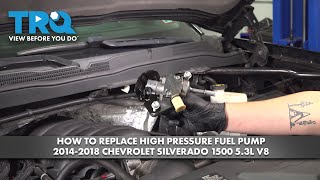
Typical fix: Replacement of the high-pressure fuel pump. On the 5.3L and 6.2L V8s, this requires removing the intake manifold for access. 🎬 See this walkthrough for replacing the high pressure fuel pump It is often recommended to change the engine oil at the same time to remove any fuel contamination.
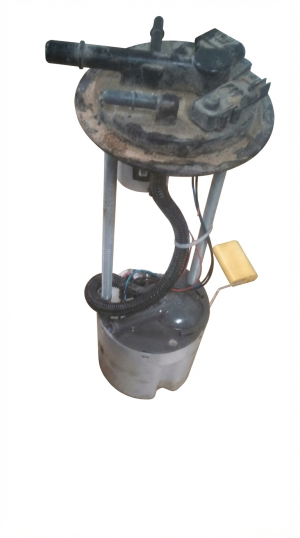
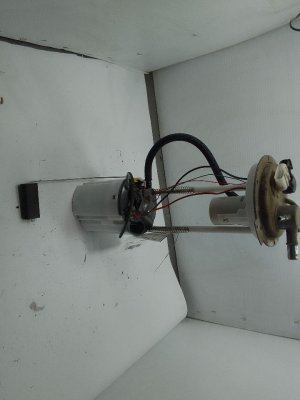
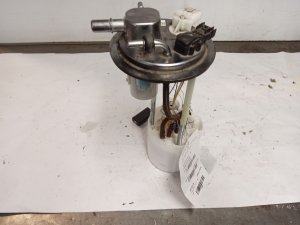
Est. part cost: $300-$700 - Failing In-Tank Fuel Pump (All Years) 🔴 High Probability → Shop Fuel Pump The in-tank pump can weaken over time or fail. TSB #18-NA-103 specifically notes issues with the in-tank pump whining or causing no-start/stalling conditions in cold temperatures (below 20°F/-6°C) due to fuel gelling. This pump supplies the entire system on 2010-2013 models and feeds the HPFP on 2014-2017 models.
How to confirm: Test the low-pressure fuel system with a mechanical gauge at the service port. Pressure should meet GM's specification (typically 50-75 PSI at idle). A distinct whining noise from the tank is a strong indicator of a failing pump.
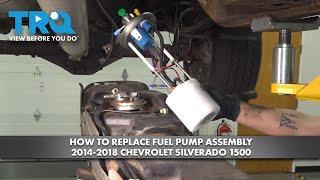
Typical fix: Replacement of the in-tank fuel pump module. This requires dropping the fuel tank or lifting the truck bed for access.
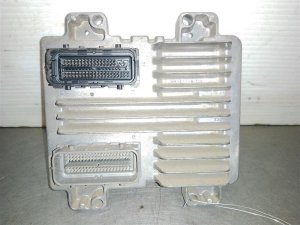
Est. part cost: $200-$500 - Failed Fuel Pump Control Module (FPCM) (Primarily 2010-2013) 🟡 Medium Probability → Shop Fuel Pump The FPCM (also called a Fuel Pump Driver Module) regulates voltage to the in-tank pump. It is mounted on a frame crossmember, often above the spare tire, making it highly vulnerable to corrosion from road salt and moisture, which leads to electrical failure and insufficient voltage to the pump.
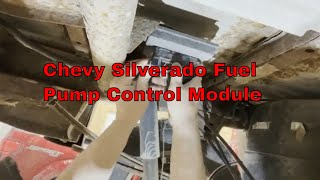
How to confirm: Symptoms are often identical to a bad in-tank pump. A visual inspection of the module and its connector for green or white corrosion is the first step. A diagnostic scan may show FPCM-specific codes (like P129F). Technicians can use a scan tool to command pump operation or use jumpers to bypass the module to see if the pump runs, confirming the module is the point of failure. 🎬 Watch: How to locate and inspect the fuel pump control module
Typical fix: Replacement of the Fuel Pump Control Module. Many replacement modules require programming by a dealer or with a capable scan tool, though some aftermarket units are sold as plug-and-play.
Est. part cost: $70-$200 - Clogged Fuel Filter / Restricted Fuel Line 🟡 Medium Probability → Shop Fuel Filter Fuel system contamination is a known issue, as cited in TSBs #16-NA-102 and #PIP5151F, where debris requires extensive cleaning. Additionally, some forum users and a GM TSB for Duramax models note that the flexible fuel supply lines can soften and collapse under vacuum from the pump, especially when hot, causing a restriction.
How to confirm: On many modern trucks, the primary filter is part of the in-tank pump assembly and is not separately serviceable. If a serviceable filter exists, it can be replaced as a low-cost first step. Inspect fuel lines for physical kinks or damage. A vacuum gauge on the low-pressure side can show excessive vacuum if a line is collapsing.
Typical fix: Replace the serviceable fuel filter if applicable. If the filter is integrated, the entire pump module must be replaced. For a collapsed line, the affected rubber hose section must be replaced, sometimes with an upgraded, more rigid hose as suggested in some GM bulletins.
Est. part cost: $20-$80 - Faulty Fuel Rail Pressure Sensor ⚪ Low Probability → Shop Fuel Pressure Sensor The sensor can fail and send incorrect low-pressure readings to the ECM, triggering the code even if the pressure is mechanically normal. TSB #20-NA-197 addresses issues where corrosion in the sensor's electrical connector causes erratic readings and various fuel pressure codes, including P0087.
How to confirm: Compare the sensor's reading on a scan tool to a reading from a mechanical fuel pressure gauge. If the readings differ significantly, the sensor is likely faulty. Inspect the sensor's electrical connector for any signs of corrosion or damage.
Typical fix: Replacement of the fuel rail pressure sensor and/or its electrical pigtail connector if corroded.
Est. part cost: $50-$150
Rare But Worth Checking
- Fuel System Contamination: As mentioned in TSBs #PIP5151F and #16-NA-102, significant debris, water, or even Diesel Exhaust Fluid (DEF) contamination can cause persistent low-pressure issues. This may require cleaning or replacing the entire fuel system, including the tank, lines, and pumps, a repair that is explicitly not covered by warranty.
- Incorrect Fuel Pump Pressure Regulator: → Shop Fuel Pump A GM voluntary recall (#13421) for some 2014 models noted that fuel pump assemblies may have been built with an incorrect pressure regulator, causing low pressure, hard starts, and stalling.
- Weak Fuel Pressure Relief Valve: On some systems, a mechanical relief valve on the fuel rail can weaken over time, causing it to open prematurely and bleed off pressure, leading to a P0087 code under heavy load. This is a more common issue on Duramax diesel engines but can occur on gasoline direct injection systems as well.
Diagnosis Steps
- Connect an OBD-II scanner to verify the P0087 code and check for any other related codes, such as P0191, P2635, or P0300.
- Use the scanner's live data function to monitor 'Desired Fuel Rail Pressure' and 'Actual Fuel Rail Pressure'. Note any significant discrepancies.
- For all years: Check the low-pressure side. Connect a mechanical fuel pressure gauge to the low-pressure fuel line's service port. With the key on and engine off (or at idle), the pressure should meet GM's specifications (typically 50-75 PSI). If pressure is low, suspect the in-tank fuel pump, FPCM, or a clogged filter/line.
- For 2010-2013 models: Visually inspect the Fuel Pump Control Module (FPCM) and its connector, located on the frame rail above the spare tire, for heavy corrosion or damage. If corrosion is present, the FPCM is a highly likely c
Parts You'll Likely Need
- High-Pressure Fuel Pump (HPFP) (2014+)
(OEM #12677329)— A very common failure point on the direct-injected EcoTec3 engines causing low pressure under load. - In-Tank Fuel Pump Module (All Years)
(OEM #MU2373)— The primary pump for 2010-2013 models and the lift pump for 2014+ models. Can fail from age or cold weather issues. - Fuel Pump Control Module (FPCM) (2010-2013)
(OEM #20877116)— Highly susceptible to corrosion due to its mounting location, leading to a loss of power to the in-tank pump. - Fuel Rail Pressure Sensor — Can provide false low-pressure readings to the ECM, or its connector can corrode.
Related Codes That Often Appear With This One
- P0191 — This code for 'Fuel Rail Pressure Sensor Circuit Range/Performance' often appears with P0087, as noted in TSBs #16-NA-102 and #PIP5151F, indicating the sensor is detecting an erratic or out-of-spec pressure reading.
- P0088 — This code for 'Fuel Rail/System Pressure - Too High' can sometimes appear alongside P0087 if the fuel pressure regulator is failing and causing erratic pressure control. TSB #PIP5151F mentions it as a related code.
- P2635 — This code for 'Fuel Pump 'A' Low Flow/Performance' is directly related to the low-pressure in-tank pump and is mentioned with P0087 in TSB #18-NA-103, especially in cold weather conditions.
- P0300 — A 'Random/Multiple Cylinder Misfire' code is common because low fuel pressure starves the engine of fuel, leading to incomplete combustion and misfires across multiple cylinders. TSB #18-NA-361 lists it as a possible related code.
Technical Service Bulletins (TSBs) & Recalls
- TSB #18-NA-103: Addresses in-tank fuel pump whine, no-start, or stalling in cold temperatures (below 20°F) due to fuel gelling, setting codes P0087, P2635, and others.
- TSB #16-NA-102: Provides a procedure to inspect and replace fuel components due to contamination from debris, causing hard/no start and codes P0087, P0088, and P0191.
- TSB #PIP5151F: Diagnostic guide for identifying fuel system contamination (water, rust, DEF) that causes hard/no start, rough running, and codes P0087/P0088.
- TSB #20-NA-197: Details inspection and replacement of a corroded fuel pressure sensor electrical connector that can cause P0087 and other fuel pressure codes.
Platform-Specific Known Issues
- FPCM Corrosion (2010-2013): The Fuel Pump Control Module's location on a frame crossmember above the spare tire exposes it to significant moisture and road salt, leading to severe corrosion on the module's housing and electrical connector pins. This is a leading cause of P0087 on GMT900 trucks.
- HPFP Failure (2014-2017): The high-pressure fuel pump on the EcoTec3 V8 engines is a well-documented failure item. It is located in the valley of the engine underneath the intake manifold, making replacement labor-intensive. Failure can sometimes lead to fuel contaminating the engine oil.
- Cold Weather In-Tank Pump Failure (All Years): TSB #18-NA-103 specifically calls out that in temperatures below 20°F (-6°C), the in-tank fuel pump may whine loudly, and the vehicle may stall or fail to start, setting P0087. This is attributed to the properties of the fuel blend in cold weather.
Mechanic-Grade Diagnostic Values
- Low-Pressure Fuel System (All Years) — expected: 50-75 PSI at idle. Failure: Pressure below 50 PSI indicates a weak in-tank pump, failing FPCM, or restriction.
- Low-Pressure Fuel Line Vacuum (All Years) — expected: 5 to 8 inches of vacuum under full load. Failure: Vacuum readings higher than 8 inches suggest a restriction, such as a clogged filter or a collapsing flexible fuel line.
- High-Pressure Fuel System (2014-2017 GDI) — expected: 500-2,500 PSI (34-172 bar), varying with engine load.. Failure: Actual pressure on a scan tool fails to meet desired pressure, especially under acceleration. A significant, persistent gap points to a failing HPFP.
Scan Tool Commands That Help
- GDS2 / Professional Scan Tool: Fuel Composition Reset — On Flex Fuel vehicles, an incorrectly inferred high alcohol percentage can cause the ECM to command fuel mixtures that are too rich, leading to hard starts and performance issues. If the vehicle has been run on low fuel or refueled in small increments, the inferred value can drift. Resetting this value tells the ECM the actual alcohol content is low (standard gasoline), which can resolve starting issues.
- GDS2 / Professional Scan Tool: Fuel Pump Driver Control Module Configuration — After replacing the Fuel Pump Control Module (FPCM), this function is required to program the new module to the vehicle's VIN and specific configuration. Failure to perform this step will result in a no-start or immediate fuel pressure codes.
- GDS2 / Professional Scan Tool: Command Max Rail Pressure at Idle — This is a quick test for the high-pressure fuel pump (HPFP) on 2014+ models. By commanding maximum pressure while at idle, you can see if the pump is capable of reaching its target. If it cannot, the HPFP is likely weak or failing.
Wiring & Ground Locations
- FPCM Ground (2010-2013) — The main ground for the Fuel Pump Control Module is typically located on the driver's side frame rail, near the module itself (which is often above the spare tire).. Corrosion or a loose connection at this ground point is a very common cause of FPCM failure and low voltage to the in-tank fuel pump, directly causing P0087.
- G102 / G103 (2014-2017) — G102 is on the driver's side of the engine block, above the pan rail. G103 is on the front corner of the passenger side cylinder head.. These are primary engine control device grounds. A poor connection at either location can cause erratic sensor readings and incorrect commands to the fuel system components, including the HPFP and fuel rail pressure sensor.
- G300 (2014-2017) — Located on the back of the first outrigger on the frame, under the truck directly below the driver's door hinge area.. This ground location is known to have issues with rusting and wire fatigue. A poor connection here can affect various control modules, potentially including the FPCM, leading to intermittent fuel pressure problems.
Real Owner Repair Stories
- Reddit user in r/Silverado (2015 Chevrolet Silverado) — Truck died while driving, would not restart. Towed to the dealer.
❌ Tried (didn't work) Initial diagnosis was uncertain.
✅ What actually fixed it The dealer confirmed the Fuel Pump Control Module (FPCM) had failed. They replaced the part and the truck was fixed.
OEM Part Supersession History
20791899, 20791901, 20827745, 20850927→20877116— Standard part evolution and consolidation for the Fuel Pump Control Module (FPCM) used on 2010-2012 models.
Heads up: This module requires programming with GDS2 or a compatible tool to match the vehicle's VIN and configuration. It is not a plug-and-play part.12622475, 12641740, 12677329→12691016— Multiple revisions of the high-pressure fuel pump (HPFP) for direct injection engines to improve reliability.
Model Year Variations Within This Range
- 2010-2012: These models use FPCM part number 20877116 (or its predecessors). This module is known for corrosion failure and requires programming upon replacement.
- 2013: The FPCM part number may differ from earlier models, often using a newer generation module. Verification by VIN is critical.
- 2014-2017: These K2XX models use a completely different fuel system with a high-pressure fuel pump (HPFP). The FPCM is also a different design and part number (e.g., 23482933) and is generally less prone to the corrosion issues seen on the GMT900 trucks.
Helpful Videos

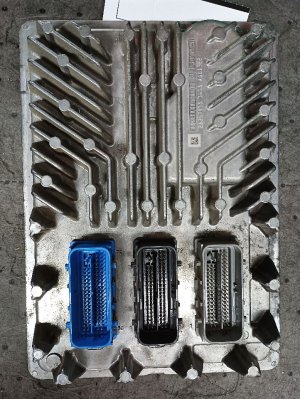
Used OEM Parts in Stock
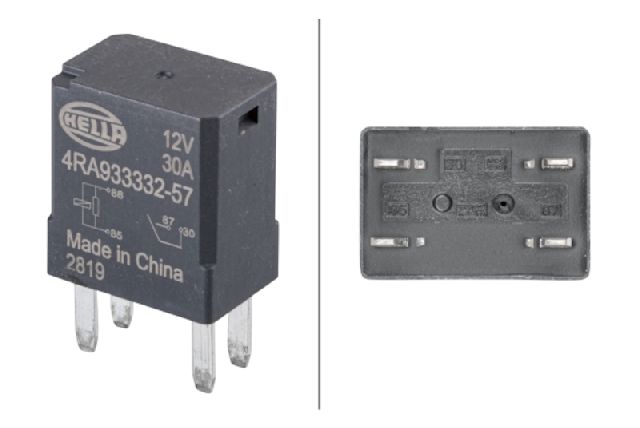
New Aftermarket Parts Available



The information in this article is provided for general reference and educational purposes only. Vehicle specifications, procedures, and part compatibility can vary by production date, trim level, and region. Always consult your vehicle's factory service manual and verify part numbers before purchasing or performing repairs. Safety-critical components such as airbags, seat belts, and braking systems should be installed by a qualified professional.
- Chevrolet SILVERADO 1500:
- 🧭 Diagnostic Flowchart
- 🎬 Helpful Videos
- 🛍️ Shop This Part
- What's Unique About the 2010-2017 Chevrolet Silverado 1500
- Symptoms You May Notice
- Most Likely Causes
- Rare But Worth Checking
- Diagnosis Steps
- Parts You'll Likely Need
- Related Codes That Often Appear With This One
- Technical Service Bulletins (TSBs) & Recalls
- Platform-Specific Known Issues
- Mechanic-Grade Diagnostic Values
- Scan Tool Commands That Help
- Wiring & Ground Locations
- Real Owner Repair Stories
- OEM Part Supersession History
- Model Year Variations Within This Range
- 🎟️ Get 5% Off