

P0087 on 2015-2020 Ford Expedition: Low Fuel Pressure Causes and Fixes
P0087 on a 2015-2020 Ford Expedition almost always points to a failing high-pressure fuel pump (HPFP) or, less commonly, a weak in-tank low-pressure fuel pump. Expect to pay $400-$800 for an OEM HPFP, with diagnosis being key to avoid replacing the wrong pump. Before replacing parts, check TSBs, especially SSM 50089, if recent engine work was performed.
- P0087 means the fuel pressure is too low for the direct injection system to work correctly.
- Do not drive the vehicle, as the engine could stall at any time, posing a serious safety risk.
- The most likely cause on the 3.5L EcoBoost is a failed high-pressure fuel pump (HPFP), located on the engine.
- Proper diagnosis is crucial. A shop should test the low-pressure pump first before condemning the expensive HPFP.
- If engine work was recently done on a 2018-2020 model, check for an incorrectly installed fuel line as described in TSB SSM 50089 before replacing parts.
What's Unique About the 2015-2020 Ford EXPEDITION

The 3.5L EcoBoost engine in the Expedition relies on a high-pressure fuel system to make its power efficiently. This system's complexity, particularly the mechanically-driven high-pressure fuel pump (HPFP), makes it a common source for this code. While many vehicles can get a P0087 code, on the Expedition it is very frequently traced back to the HPFP itself or its drive components. Additionally, for 2017 and newer models, a specific TSB notes that this code can be accidentally triggered by installing a fuel jumper line backward during an unrelated repair.
Diagnostic Flowchart

Tap your situation to follow the diagnostic path that matches what you're seeing on this vehicle.
Generation note: This range covers the end of the third generation (2015-2017) and the start of the fourth generation (2018-2020) Expedition. While the high-pressure fuel pump is a common issue on both, specific TSBs (SSM 50089, SSM 48807) regarding an incorrectly installed fuel line apply to the 2018-2020 models. TSB 16-0010 specifically addresses P0087 on 2015 models, often recommending HPFP replacement if it's the only code present.
Symptoms You May Notice
- Check Engine Light illuminated
- Engine stalling, sometimes while driving
- Lack of engine power and poor acceleration, especially under load
- Engine hesitation or stumbling
- Rough or unstable idle
- Long crank time or difficulty starting
- Shuddering or shaking from the engine
- Replacing the low-pressure pump in the tank when the high-pressure pump on the engine is the actual cause.
- Replacing the high-pressure pump when the in-tank low-pressure pump was the actual point of failure. This can be a costly mistake, as documented by owners.
- Replacing the fuel rail pressure sensor without first verifying its readings against a mechanical gauge.
Most Likely Causes

- Failing High-Pressure Fuel Pump (HPFP) 🔴 High Probability → Shop Fuel Pump The HPFP is a mechanical pump driven by the camshaft. It is a known high-failure item on the 3.5L EcoBoost engine due to mechanical wear over time. TSB 16-0010 for 2015 models points directly to replacing the HPFP if P0087 is the only code stored.
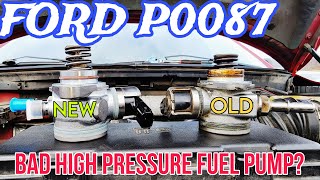
How to confirm: Use a diagnostic scan tool to monitor desired vs. actual fuel rail pressure under load. 🎬 Watch: How to diagnose a bad HPFP using live data. If actual pressure cannot keep up with desired pressure and the low-pressure system is confirmed to be working (holding 50-70 PSI), the HPFP is the likely culprit. A physical inspection may reveal a compressed piston spring on the old pump compared to a new one.
Typical fix: Replace the high-pressure fuel pump and the associated cam follower. It is critical to also inspect the camshaft lobe for wear.
Est. part cost: $400-$800 - Failing Low-Pressure Fuel Pump or Clogged Filter 🟡 Medium Probability → Shop Fuel Pump The in-tank pump supplies the HPFP. If it weakens or its integrated filter becomes clogged, it cannot provide the necessary volume of fuel for the high-pressure side to function. This is a common misdiagnosis for a bad HPFP.
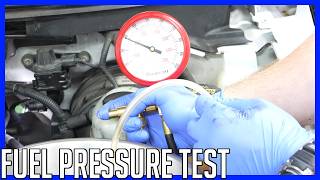
How to confirm: Connect a mechanical fuel pressure gauge to the low-pressure line. At idle and under load, pressure should be stable and within spec (typically 50-70 PSI). If the pressure is low, erratic, or drops significantly under load, the in-tank pump is failing.
Typical fix: Replace the in-tank fuel pump assembly, which includes the pump, sending unit, and fuel filter.
Est. part cost: $250-$500 - Faulty Fuel Rail Pressure Sensor ⚪ Low Probability → Shop Fuel Pressure Sensor Sensors can fail electronically, sending incorrect data to the PCM. This can trick the computer into thinking pressure is low when it is actually normal.
How to confirm: Compare the pressure reading from a mechanical gauge to the sensor's reading on a scan tool. If the readings differ significantly, the sensor is likely faulty. This is often done after confirming the low and high-pressure pumps are functioning.
Typical fix: Replace the fuel rail pressure sensor.
Est. part cost: $50-$120 - Incorrectly Installed Fuel Jumper Line (2017-2020 models) ⚪ Low Probability Per TSB SSM 50089, this specific line has a one-way check valve. If removed for other service (e.g., injector replacement) and reinstalled backward, it will restrict fuel flow and cause P0087.
How to confirm: Visually inspect the fuel line connecting the HPFP to the port injection rail. The Oetiker clamp on the line should be positioned closest to the port injection rail. If it's at the other end, the line is backward.
Typical fix: Remove the fuel jumper line and reinstall it in the correct orientation.
Est. part cost: $0 (if line is reusable)
Rare But Worth Checking
- Worn Camshaft Lobe or HPFP Follower: → Shop Engine Camshaft The HPFP is driven by a lobe on the camshaft via a small roller or bucket called a follower. If the lobe or follower wears down, the pump's stroke is reduced, leading to low pressure. This should always be inspected when replacing the HPFP. A damaged cam lobe requires camshaft replacement.
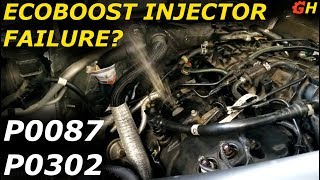
- Leaking Fuel Injector: → Shop Fuel Injector A stuck-open fuel injector can cause a drop in rail pressure, as the fuel is constantly escaping into the cylinder. This would typically be accompanied by a misfire code for a specific cylinder (e.g., P0302), excessive smoke from the tailpipe, and a strong smell of fuel in the engine oil. 🎬 See how to diagnose a leaking injector causing low pressure.
Diagnosis Steps
- Connect an OBD-II scanner and confirm P0087 is present. Check for any other codes, especially P008A, P0191, or misfire codes.
- Using the scanner's live data function, monitor 'Desired Fuel Rail Pressure' and 'Actual Fuel Rail Pressure'. Note any large discrepancies, especially under acceleration.
- Test the low-pressure fuel system first. Connect a fuel pressure gauge to the low-side feed line. 🎬 Watch: A simple guide to testing low-side fuel pressure. With the key on and engine running, verify pressure is stable and within the manufacturer's specification (typically 50-70 PSI).
- If low-pressure is out of spec, the problem is likely the in-tank fuel pump, its driver module (FPDM), or a clogged filter. A real-world owner experience showed this was the ultimate fix after a dealer first replaced the HPFP.
- If low-pressure is good, the problem is on the high-pressure side. Rev the engine while monitoring live data. If 'Actual' pressure falls far behind 'Desired' pressure, the HPFP is the primary suspect.
- For 2018-2020 models, if any recent engine work was performed, inspect the fuel jumper line orientation per TSB SSM 50089. This is a simple visual check that can save a lot of money.
- Before replacing the HPFP, check the engine oil for a strong smell of gasoline. This could indicate a leaking injector or a severely failed HPFP leaking into the crankcase.
- If replacing the HPFP, it is critical to remove the old pump and inspect the camshaft follower and the camshaft lobe for any signs of wear, scoring, or damage. Always replace the follower with the new pump as a best practice.
Parts You'll Likely Need
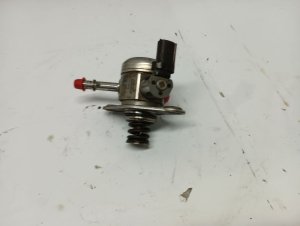
- High Pressure Fuel Pump
(OEM #BL3Z-9350-D (or superseding part number, fits 2015-2017 Expedition). Note: Part numbers can change; always verify with VIN.)— This is the most frequent cause of P0087 on the 3.5L EcoBoost engine due to mechanical wear.
Trusted brands: Motorcraft, Bosch
OEM price range: $400-$800
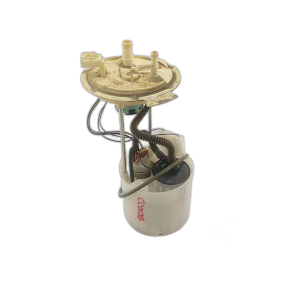
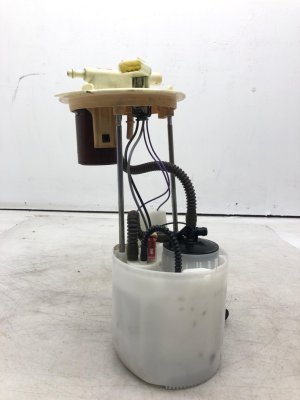
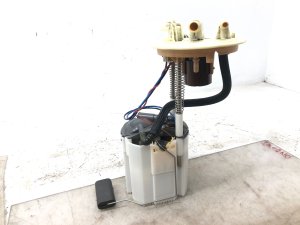
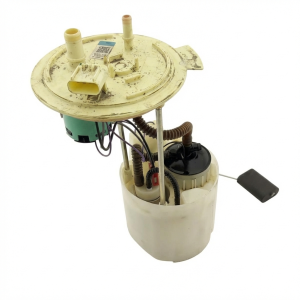
Aftermarket price range: $250-$500 - Low Pressure Fuel Pump Assembly — A failing in-tank pump will starve the HPFP of fuel, causing low rail pressure. It is the second most likely cause and a common point of misdiagnosis.
Trusted brands: Motorcraft, Delphi, Spectra Premium
OEM price range: $350-$550
Aftermarket price range: $200-$400 - Fuel Rail Pressure Sensor
(OEM #BU5Z-9F972-B)— A faulty sensor can send incorrect readings, falsely triggering the code. It's a common diagnostic step to rule this out before replacing expensive pumps.
Trusted brands: Motorcraft, Standard Motor Products
OEM price range: $70-$120
Aftermarket price range: $40-$80
Related Codes That Often Appear With This One
- P008A — This code specifically indicates a problem in the low-pressure side of the fuel system. Seeing it with P0087 strongly suggests the issue is with the in-tank pump or its supply line.
- P0191 — This code indicates a problem with the fuel rail pressure sensor's circuit range or performance. It can appear with P0087 if the sensor is failing or providing erratic readings.
- P0627 — This code stands for 'Fuel Pump 'A' Control Circuit/Open'. It often appears alongside P0087 when there is an electrical issue with the low-pressure fuel pump or its driver module.
Technical Service Bulletins (TSBs) & Recalls
- SSM 50089
- TSB 16-0010
- SSM 48807
Platform-Specific Known Issues
- Owner Story: The Misdiagnosis Trap: On the Ford Expedition Forum, a member shared their story of ge
Mechanic-Grade Diagnostic Values
- Low-Pressure Fuel System Pressure (at idle) — expected: 50 - 70 PSI, stable.. Failure: Pressure is below 50 PSI, is erratic, or drops significantly under load.
- High-Pressure Fuel Rail (Scan Tool, KOER at idle) — expected: Actual pressure should closely match desired pressure, typically 300-500 PSI.. Failure: Actual pressure is significantly lower than desired. For example, actual reads 81 PSI when desired is 416 PSI, or actual is 130 PSI when desired is 600 PSI.
- High-Pressure Fuel Rail (Scan Tool, under load) — expected: Actual pressure should track desired pressure, which can exceed 2,000 PSI (13,790 kPa).. Failure: Actual pressure fails to rise with desired pressure during acceleration.
- Direct Fuel Injector Resistance — expected: 0.5 - 1.0 Ohms.. Failure: Resistance is outside of this range, indicating a faulty injector coil.
Scan Tool Commands That Help
- OBD-II Scanner / Manual Procedure: Clear Flood Crank Test — Used to confirm a suspected stuck-open fuel injector after a specific cylinder misfire is identified (e.g., P030X). With the spark plug removed from the cylinder, press the accelerator pedal to the floor and crank the engine. This disables fuel and spark. If a stream of fuel ejects from the spark plug hole, the injector is mechanically stuck open, causing the P0087 code by bleeding off rail pressure.
- Advanced Scan Tool (e.g., Ford IDS): Cylinder Contribution / Power Balance Test — This should be one of the first tests performed when P0087 is accompanied by a general misfire code (P0300) or a specific one. It helps identify which cylinder is underperforming, pointing the diagnostic path toward a specific injector rather than a system-wide pump issue.
Wiring & Ground Locations
- PCM Connector — The Powertrain Control Module (PCM) is typically located in the engine bay, often on the firewall or inner fender.. A documented cause for P0087 was two pushed-out wire pins in the main PCM connector. This created a poor connection, mimicking a fuel pump or sensor failure. This is critical to inspect if the vehicle has a history of accidents or major engine-out services.
Real Owner Repair Stories
- ScannerDanner Forum (2014 Ford Fusion 2.0L (similar GDI system)) — Long crank time, poor acceleration, P0087.
❌ Tried (didn't work) Replaced low-pressure fuel sensor, Replaced high-pressure fuel sensor, Installed a used high-pressure fuel pump
✅ What actually fixed it The technician inspected the PCM connector and found two pins were pushed out and not making contact, likely from a previous accident repair. Reseating the pins and securing the connector resolved all issues. - GearHeads YouTube Channel (2011 Ford F-150 3.5L EcoBoost) — P0087 (Fuel Rail Pressure Too Low) and P0302 (Cylinder 2 Misfire), heavy smoke from exhaust, strong fuel smell in oil.
❌ Tried (didn't work) Initial diagnosis focused on pumps before identifying the accompanying misfire code.
✅ What actually fixed it A stuck-open fuel injector on cylinder 2 was dumping fuel, causing the rail pressure to drop and triggering P0087. This was confirmed by performing a 'clear flood crank' with the spark plug removed, which showed raw fuel spraying out of the cylinder. Replacing the faulty injector fixed both codes. - Ford F150 Forum (Ford Escape 2.0L EcoBoost (similar fuel system)) — P0087, engine stumbling and stalling in traffic.
❌ Tried (didn't work) Initial suspicion was on the high-pressure fuel pump (HPFP).
✅ What actually fixed it The root cause was a faulty low-pressure fuel sensor located before the HPFP. The sensor was sending a bogus low reading (around 50 PSI) to the computer. The computer then commanded the wrong fuel rate, causing the engine to run overly rich and stall. Replacing the low-pressure sensor resolved the issue.
When the Usual Fixes Don't Work
- While the high-pressure fuel pump (HPFP) is the most common culprit for P0087, it should not be replaced without thorough diagnosis. Real-world repair cases confirm that identical symptoms—long crank, stalling, and low actual fuel pressure on a scan tool—can be caused by less expensive and overlooked components. A stuck-open fuel injector can bleed off rail pressure, perfectly mimicking a weak HPFP but will usually be accompanied by a specific cylinder misfire code (e.g., P0302). Furthermore, electrical issues, such as a faulty low-pressure sensor providing incorrect data or even loose pins in the main computer harness from a past repair, have been the confirmed root cause after pumps and sensors were needlessly replaced.
Helpful Videos
Used OEM Parts in Stock
New Aftermarket Parts Available




The information in this article is provided for general reference and educational purposes only. Vehicle specifications, procedures, and part compatibility can vary by production date, trim level, and region. Always consult your vehicle's factory service manual and verify part numbers before purchasing or performing repairs. Safety-critical components such as airbags, seat belts, and braking systems should be installed by a qualified professional.
- Ford EXPEDITION:
- 🧭 Diagnostic Flowchart
- 🎬 Helpful Videos
- 🛍️ Shop This Part
- What's Unique About the 2015-2020 Ford EXPEDITION
- Symptoms You May Notice
- Most Likely Causes
- Rare But Worth Checking
- Diagnosis Steps
- Parts You'll Likely Need
- Related Codes That Often Appear With This One
- Technical Service Bulletins (TSBs) & Recalls
- Platform-Specific Known Issues
- Mechanic-Grade Diagnostic Values
- Scan Tool Commands That Help
- Wiring & Ground Locations
- Real Owner Repair Stories
- When the Usual Fixes Don't Work
- 🎟️ Get 5% Off