

P0087 on 2009-2016 GMC Acadia 3.6L: Low Fuel Pressure Causes and Fixes
On a 2009-2016 GMC Acadia, code P0087 is almost always caused by a failing high-pressure fuel pump (HPFP). This is a very common issue on the 3.6L V6 engine, leading to reduced power and potential stalling. GM acknowledged the high failure rate with Special Coverage Adjustment 14329. Expect a repair cost of $400-$800+ depending on parts and labor.
- P0087 on your Acadia almost certainly means the high-pressure fuel pump (HPFP) has failed.
- When the code appears, immediately check your engine oil for a gasoline smell. If fuel is present, do not drive the vehicle and plan for an oil change with the pump replacement.
- Diagnosis is best confirmed with a scan tool by comparing desired vs. actual fuel rail pressure.
- This is not a simple DIY job for beginners due to the high fuel pressures and labor involved in accessing the pump.
- Always use a quality replacement pump from a reputable brand like ACDelco or Delphi to ensure longevity.
What's Unique About the 2009-2016 GMC Acadia
The 3.6L V6 engine (both LLT and LFX versions) used in the first-generation Acadia and its platform-mates is notorious for premature failure of the high-pressure fuel pump (HPFP). This part fails so frequently that it's the immediate suspect for a P0087 code, often appearing with related codes like P0089 (Fuel Pressure Regulator Performance) and P228C (Fuel Pressure Regulator Control Limit Exceeded). When this pump fails, it can also leak fuel internally into the engine oil, identifiable by a strong gasoline smell on the dipstick. This creates a risk of severe engine damage if not addressed promptly.
Symptoms You May Notice
- Reduced Engine Power message on the dashboard
- Significant lack of acceleration or hesitation
- Engine runs rough or idles poorly
- Engine stalls, especially under load or without warning
- Hard starting or long crank times
- Check Engine Light is on
- Strong smell of gasoline in the engine oil
- White smoke that smells of gasoline (as reported in NHTSA ODI #10854957)
- Replacing the in-tank low-pressure fuel pump when the high-pressure pump is the actual failure point.
- Replacing fuel injectors when the issue is fuel pressure.
- Replacing only the fuel rail pressure sensor without confirming it's faulty, when the pump is the actual cause.
Most Likely Causes
- Failing High-Pressure Fuel Pump (HPFP) 🔴 High Probability → Shop Fuel Pump The HPFP is a widely documented, high-failure part on the GM 3.6L V6 engine. GM acknowledged the issue with a special coverage program for many models due to the high failure rate.
How to confirm: Use a scan tool to compare 'Desired Fuel Rail Pressure' vs. 'Actual Fuel Rail Pressure'. A large deficit where the actual pressure is much lower than desired confirms a high-pressure side failure. For example, a scan tool may show the desired pressure is ~4 MPa while the actual pressure is only 1-2 MPa. Also, check the engine oil for a strong gasoline smell, which indicates the pump's internal seals have failed and it is leaking into the crankcase.
Typical fix: Replace the high-pressure fuel pump and the single-use high-pressure fuel feed line. It is also critical to change the engine oil and filter if fuel contamination is present to prevent bearing damage.
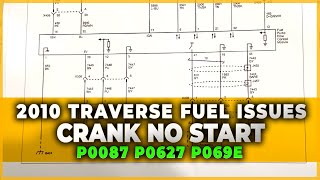
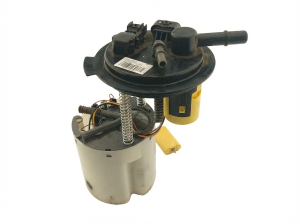
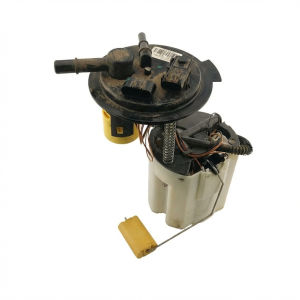
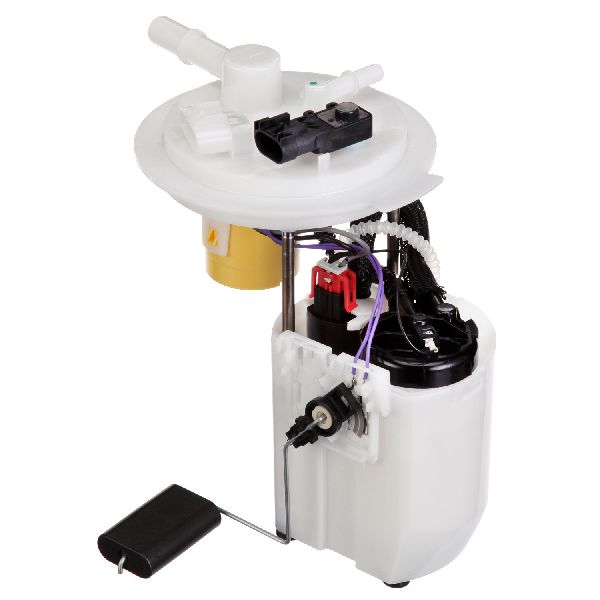
Est. part cost: $200-$500 - Failing Low-Pressure (In-Tank) Fuel Pump or Fuel Pump Control Module (FPCM) 🟡 Medium Probability → Shop Fuel Pump While less common than HPFP failure, the in-tank pump or its control module can fail, starving the HPFP of fuel. A faulty FPCM was the root cause for P0087 in one documented case on a Traverse. 🎬 Watch: Troubleshooting a P0087 crank no start condition. Manufacturer Bulletin #18NA103 notes that the in-tank fuel pump may cause a loss of power and MIL illumination with P0087 at temperatures below -6C or 20F.
How to confirm: Connect a mechanical fuel pressure gauge to the low-pressure test port (Schrader valve) on the engine fuel line. The pressure should be stable and within the manufacturer's specification (typically 50-65 PSI). If pressure is low, erratic, or zero, test for power and ground at the FPCM and the pump itself to isolate the fault.
Typical fix: Replace the in-tank fuel pump module or the Fuel Pump Control Module (FPCM), which may require programming.
Est. part cost: $250-$450 - Faulty Fuel Rail Pressure Sensor (FRPS) ⚪ Low Probability → Shop Fuel Pressure Sensor
How to confirm: This is an unlikely cause if there are severe drivability symptoms. However, if symptoms are intermittent, you can back-probe the sensor connector to check for a stable 5V reference and ground. Compare the sensor's reported pressure on a scan tool to a known good mechanical gauge if possible, though this is difficult on the high-pressure side. A scan tool showing erratic, stuck, or implausible pressure readings (e.g., 2000+ PSI with engine off) points to the sensor.
Typical fix: Replace the fuel rail pressure sensor.
Est. part cost: $50-$104
Rare But Worth Checking
- Worn Camshaft Lobe: → Shop Engine Camshaft The HPFP is driven by a dedicated lobe on the camshaft. If this lobe becomes worn, it cannot properly actuate the pump, leading to low pressure. This is a rare but possible cause, especially on high-mileage engines, and should be inspected when the HPFP is replaced.
- Clogged or Defective Fuel Feed Line: A kinked, restricted, or internally degraded fuel line between the in-tank pump and the HPFP can restrict flow and cause P0087 under high demand.
- Fuel System Contamination: As noted in Manufacturer Bulletin #PIP5151F, if contamination is found during inspection for P0087 and P0191, the complete fuel system may require service.
- Damaged Wiring or Connector: Though less common, chafed wiring or corrosion at the HPFP, FPCM, or fuel rail pressure sensor connectors can cause incorrect readings or loss of power, triggering P0087.
Diagnosis Steps
- Connect a scan tool and confirm P0087 is present. Note any other codes like P0089, P228C, P0191, or P069E.
- Using the scan tool's live data, monitor 'Desired Fuel Rail Pressure' and 'Actual Fuel Rail Pressure' at idle and while carefully increasing engine RPM.
- If 'Actual' pressure is significantly and consistently lower than 'Desired' pressure, the HPFP is the primary suspect.
- To rule out the low-pressure side, connect a fuel pressure gauge to the Schrader valve test port on the low-pressure feed line. Verify the in-tank pump maintains a steady pressure within the 50-65 PSI range. If low, further diagnosis of the in-tank pump 🎬 Watch: How to replace the in-tank low-pressure fuel pump. and FPCM is needed.
- Carefully check the engine oil dipstick for a strong smell of raw fuel. If present, this is a very strong indicator that the HPFP has failed internally and is leaking into the crankcase.
- Before beginning replacement, relieve all fuel system pressure using a scan tool function or by disabling the fuel pump and running the engine until it stalls. This is a critical safety step.
- Upon removing the HPFP, inspect the camshaft lobe and the pump's follower for any signs of unusual wear or damage.
- Always replace the single-use high-pressure fuel line that connects to the pump to prevent dangerous leaks upon reassembly.
Parts You'll Likely Need
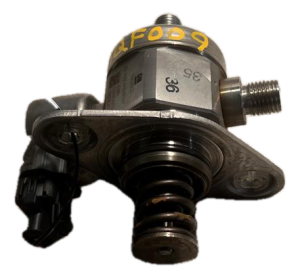
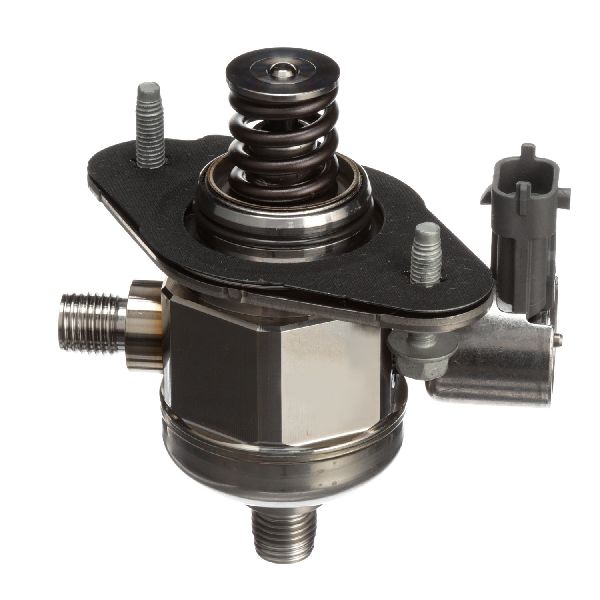
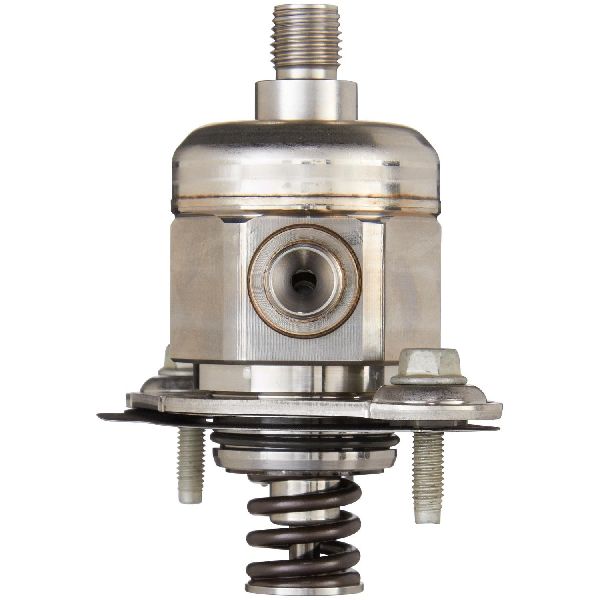
- Direct Injection High Pressure Fuel Pump
(OEM #12658552 (supersedes 12626234, 12634492, 12639260, 12614934, 12647344, 12676667))— This is the most common failure point on the 3.6L V6 engine that causes code P0087.
Trusted brands: GM Genuine Parts, ACDelco, Bosch
OEM price range: $350-$500
Aftermarket price range: $120-$350 - High Pressure Fuel Pipe
(OEM #12591197)— This is a single-use, torque-to-yield part that must be replaced any time it is disconnected to ensure a leak-free seal on the high-pressure system.
Trusted brands: GM Genuine Parts, ACDelco, Standard Motor Products
OEM price range: $30-$60
Aftermarket price range: $20-$40 - Engine Oil and Filter — An oil change is mandatory if the old high-pressure fuel pump was found to be leaking fuel into the crankcase, to prevent catastrophic engine bearing damage.
Trusted brands: ACDelco, Mobil 1, Pennzoil
OEM price range: $50-$80
Aftermarket price range: $40-$60
Related Codes That Often Appear With This One
- P0089 — This code for 'Fuel Pressure Regulator Performance' often appears with P0087 because the regulator is integrated into the HPFP. A failing pump cannot regulate pressure correctly.
- P228C — This code for 'Fuel Pressure Regulator Control Limit Exceeded' also points directly to the HPFP's inability to maintain commanded pressure.
- P0191 — This code for 'Fuel Rail Pressure Sensor Circuit Range/Performance' can be triggered by the erratic pressures caused by a failing HPFP. Manufacturer Bulletin #PIP5151F notes this code can appear alongside P0087 during fuel system inspections.
- P069E — This code indicates the Fuel Pump Control Module (FPCM) has requested the check engine light. It is commonly seen with other fuel system codes like P0087 when a fault is detected.
Technical Service Bulletins (TSBs) & Recalls
- GM Special Coverage for HPFP: While the specific bulletin number is not as consistently documented as others, GM did issue a special coverage program extending the warranty on the high-pressure fuel pump for many 3.6L V6 vehicles, including the Acadia, due to high failure rates.
- Bulletin #PIP5151F: This bulletin advises technicians that vehicles may exhibit hard start, no start, or rough running conditions accompanied by DTCs P0087, P0088, P0191, and P128E.
- Bulletin #18NA103: This manufacturer bulletin notes that P0087 may be set in the ECM alongside a loss of power and MIL illumination, specifically related to the fuel pump at temperatures below -6C or 20F.
- Special Coverage 14329: This TSB addresses power steering pump wear and loss of steering assist on 2007-2011 models, not the fuel pump.
Platform-Specific Known Issues
- The high-pressure fuel pump (HPFP) on the 3.6L LLT and LFX engines has a very high failure rate, making it a pattern failure for this platform.
- Failure of the HPFP can lead to fuel contaminating the engine oil, which requires an immediate oil change to prevent catastrophic engine bearing damage.
Mechanic-Grade Diagnostic Values
- Low-Side Fuel Pressure (In-tank pump) — expected: 50–65 PSI (345–414 kPa). Failure: Pressure below 50 PSI indicates a weak in-tank pump or FPCM issue.
- High-Side Fuel Pressure (Scan Tool, at Idle) — expected: ~500-700 PSI (Approx 3.4 - 4.8 MPa). Failure: Actual pressure consistently reading less than half of the desired pressure (e.g., Desired: 4 MPa, Actual: 1-2 MPa) strongly indicates a failing HPFP.
- Fuel Rail Pressure Sensor (FRPS) Signal Voltage (KOEO) — expected: Approximately 0.5V at zero pressure.. Failure: A reading of 0V or 5V with the key on and engine off points to a sensor or wiring fault.
- Fuel Rail Pressure Sensor (FRPS) 5V Reference — expected: A steady 5.0 Volts at the sensor connector with key on, engine off.. Failure: No voltage or low voltage indicates a wiring or ECM problem, not a faulty sensor.
Scan Tool Commands That Help
- GDS2 / Tech2 (or equivalent professional scan tool): Fuel System Pressure Relief / Fuel Pump Disable — This command is a critical safety step used before servicing the high-pressure fuel system. It turns off the fuel pumps, allowing the technician to run the engine until it stalls, safely depressurizing the high-pressure lines which can hold thousands of PSI.
- GDS2 / Tech2 (or equivalent professional scan tool): Fuel Injector Balance Test — While not a direct test for P0087, if misfires are also present, this test can help rule out individual injectors by measuring the pressure drop for each one. A significant deviation can indicate a leaking or clogged injector, though this is an uncommon cause for P0087.
Wiring & Ground Locations
- G103 / G104 — Primary engine grounds bolted to the cylinder heads. G103 is often on the front of the passenger side (Bank 1) head, and G104 is on the rear of the driver's side (Bank 2) head.. A loose or corroded ground at these points can create an unstable reference voltage for the ECM and its sensors, leading to erratic or incorrect readings from the fuel rail pressure sensor, potentially mimicking a sensor failure.
- G110 — Located on the right rear of the engine, sometimes mounted to a bracket above the power steering pump pressure hose.. This is another critical engine-to-chassis ground. Verifying all engine grounds are clean and tight is a fundamental step in diagnosing any electrical fuel system code like P0087.
- Fuel Rail Pressure Sensor Connector — Under the intake manifold, connected to the fuel rail.. This connector is in a high-heat environment and can become brittle or corroded. The 5V reference, ground, and signal wires can be tested here. A pinout document shows the 5V reference is on pin J1-34 of the ECM connector.
Real Owner Repair Stories
- YouTube channel 'Rainman Ray's Repairs' (2009-2016 GMC Acadia (or platform mate like Enclave/Traverse)) — Check Engine Light with codes P0089, P228C, and a 'Reduced Engine Power' message on the dash.
❌ Tried (didn't work) Initial diagnosis focused on scan tool data, which immediately pointed away from low-priority causes.
✅ What actually fixed it Scan tool data showed desired fuel pressure at ~4 MPa, but actual pressure was only half that, around 1-2 MPa. This confirmed a high-pressure side failure. The high-pressure fuel pump was replaced, which resolved all codes and symptoms. The camshaft follower was inspected during the repair and found to be in good condition. - NHTSA ODI #10626295 — An owner reported that their vehicle went into limp mode on the highway. After connecting an OBDII reader, it displayed code P0087 for low fuel rail pressure. The owner attempted to change the fuel filter as a precaution.
OEM Part Supersession History
12614934, 12626234, 12634492, 12639260, 12647344, 12676667→12658552— GM regularly updates service parts to integrate new materials and technologies for improved durability and reliability. This series of supersessions reflects ongoing revisions to address the high failure rate of the HPFP.Not specified→12591197 (ACDelco)— This is the part number for the single-use high-pressure fuel feed pipe that connects to the HPFP. It must be replaced whenever it is removed to ensure a proper seal.
Model Year Variations Within This Range
- 2009-2011 (LLT Engine) vs. 2012-2016 (LFX Engine): The engine was updated from the LLT to the LFX for the 2012 model year. While architecturally similar, the LFX has integrated exhaust manifolds, a composite intake manifold (vs. aluminum on LLT), and uses a different Delphi ECM (vs. Bosch on LLT). The high-pressure fuel pump was also updated for the LFX, though the failure pattern remains. While many parts are similar, it is critical to verify fitment by VIN, especially for the HPFP, intake gaskets, and injectors.
Diagnostic Flowchart
Other Known Issues on This Vehicle
Issues unrelated to this code that are worth knowing about as an owner of this generation:
- Premature Timing Chain Stretch 🔴 High — Very common, especially on 2007-2012 models. Often appears between 70,000 and 120,000 miles. Caused by a combination of chain design and long oil change intervals. (Ref: Special Coverage Adjustment #11340C extended the warranty to 10 years/120,000 miles for 2007-2009 models.)
- Broken 3-5-R Transmission Wave Plate 🔴 High — Common on 2007-2009 models, leading to loss of 3rd, 5th, and Reverse gears and potential transmission failure. Typically occurs before 100,000 miles. (Ref: Special Coverage Adjustment #14404B extended the warranty for this specific failure.)
- Power Steering Pump Failure / Leaks 🟠 Medium — Common across 2007-2011 models, causing whining noises, fluid leaks, and a sudden loss of power steering assist, especially at low speeds. (Ref: Special Coverage Adjustment #14329 extended the warranty for the power steering pump and related components.)
- Carbon Buildup on Intake Valves 🟠 Medium — A common issue for all direct-injection (DI) engines like the 3.6L LLT/LFX. Causes cold start misfires, rough idle, and reduced performance over time. Typically requires cleaning after 60,000-80,000 miles.
Used vs. New Parts: Buying Guide for This Vehicle
When a used part is the smart pick: For this specific P0087 repair, using a used part is almost never a smart choice. The primary cause, the High-Pressure Fuel Pump (HPFP), is a known high-failure component. A used pump from a donor vehicle carries a very high risk of either being already faulty or failing shortly after installation.
Donor-vehicle mileage cap: roughly under 30000 miles for the part to have meaningful remaining life.
What to inspect on the donor part:
- If forced to consider a used HPFP, source it from the lowest-mileage, latest-model-year donor possible (e.g., a 2016 LFX over a 2009 LLT).
- There are no reliable external cues to determine the health of a used HPFP.
- Avoid any pump from a vehicle that had known running issues or fuel-in-oil contamination.
OEM-only on this vehicle (don't cheap out):
- High-Pressure Fuel Pump (HPFP)
- High-Pressure Fuel Pipe
Aftermarket brands forum-validated for this vehicle:
- Bosch (often the OEM supplier)
- Delphi
- Standard Motor Products
Brands owners have reported issues with on this vehicle:
- Unnamed, no-brand, or suspiciously cheap HPFPs sold on marketplaces like eBay or Amazon should be avoided. Forum discussions frequently cite premature failures with these units, making the labor-intensive repair a waste of time and money.
Real Owner Stories
Aggregated from forums and TSBs cited above. Mileages and costs reflect what owners reported in those sources.
2009 GMC Acadia
Symptoms: Reduced engine power message, CEL, and four codes including P0087 and P0089. Freeze frame data showed fuel rail pressure at 638.166 psi and an 'open loop due to insufficient engine temperature' status.
What fixed it: The owner reported the dealership repeatedly replaced the fuel pump drive modules (FPCM), though the owner suspected an underlying board or electrical failure.
Source hint: Reddit - r/MechanicAdvice: '2009 GMC Acadia with 4 CEL and reduced power'
2010 GMC Acadia
Symptoms: The owner observed white smoke that smelled of gasoline. An OBD II reader confirmed failure codes P0087 and P0089, indicating low fuel rail pressure and injector issues.
What fixed it: Subsequent research led the owner to TSB PIP4924D regarding these symptoms.
Source hint: NHTSA ODI #10854957
Related OBD-II Codes
Frequently Asked Questions
Is there a special coverage program for the high-pressure fuel pump on my GMC Acadia?
Why does my engine oil smell like gasoline along with the P0087 code?
Does TSB 14329 cover my fuel system issues?
What parts should I replace besides the pump itself to fix P0087?
Can a faulty Fuel Pump Control Module (FPCM) cause P0087 on the Acadia platform?
My Acadia has P0087 and P069E; what does the second code mean?
Helpful Videos

Used OEM Parts in Stock
New Aftermarket Parts Available


The information in this article is provided for general reference and educational purposes only. Vehicle specifications, procedures, and part compatibility can vary by production date, trim level, and region. Always consult your vehicle's factory service manual and verify part numbers before purchasing or performing repairs. Safety-critical components such as airbags, seat belts, and braking systems should be installed by a qualified professional.
- GMC Acadia:
- 🧭 Diagnostic Flowchart
- 🎬 Helpful Videos
- 🛍️ Shop This Part
- What's Unique About the 2009-2016 GMC Acadia
- Symptoms You May Notice
- Most Likely Causes
- Rare But Worth Checking
- Diagnosis Steps
- Parts You'll Likely Need
- Related Codes That Often Appear With This One
- Technical Service Bulletins (TSBs) & Recalls
- Platform-Specific Known Issues
- Mechanic-Grade Diagnostic Values
- Scan Tool Commands That Help
- Wiring & Ground Locations
- Real Owner Repair Stories
- OEM Part Supersession History
- Model Year Variations Within This Range
- Other Known Issues on This Vehicle
- Used vs. New Parts: Buying Guide for This Vehicle
- Real Owner Stories
- 2009 GMC Acadia
- 2010 GMC Acadia
- Related OBD-II Codes
- Frequently Asked Questions
- 🎟️ Get 5% Off