

P0087 on 2014-2016 Kia Soul: Fuel Rail Pressure Too Low Causes & Fixes
On a 2014-2016 Kia Soul, code P0087 is most often caused by a failing high-pressure fuel pump (HPFP), a common issue on GDI engines. A restricted low-pressure fuel line is also a known cause per a Kia TSB. A missing cam follower after a previous repair is a less common but critical cause to verify. Expect to pay $250-$500 for a new HPFP, with DIY replacement being moderately difficult.
- P0087 on a 2014-2016 Soul means the fuel pressure is too low for the GDI engine.
- The most likely cause is a failing high-pressure fuel pump (HPFP), but a faulty fuel rail pressure sensor is also common.
- Always check for the less common but documented issue of a restricted low-pressure fuel line, as noted in Kia TSB #PS476. [PS476]
- Proper diagnosis involves using a scan tool to compare desired vs. actual fuel pressure and may require a mechanical gauge to test the low-pressure pump.
- Driving with this code can lead to stalling and is not recommended.
What's Unique About the 2014-2016 Kia SOUL

The 2014-2016 Kia Soul uses a Gasoline Direct Injection (GDI) engine, which requires very high fuel pressure supplied by a mechanical high-pressure fuel pump (HPFP) driven by the camshaft. While HPFP failure is a common cause for P0087 across many GDI vehicles, Kia has specifically issued Technical Service Bulletins (TSBs) for this platform pointing to a restricted low-pressure fuel line as a possible culprit for intermittent power loss and a P0087 code. [PS476, PS476_R1, 5] This makes inspecting the low-pressure side just as important as immediately suspecting the high-pressure pump.
Diagnostic Flowchart

Tap your situation to follow the diagnostic path that matches what you're seeing on this vehicle.
Symptoms You May Notice
- Hesitation or stumbling upon acceleration. [PS476, PS476_R1, 26]
- Intermittent lack of power. [PS476, PS476_R1, 26]
- Engine stalls, especially at idle or under load.
- Extended crank time / hard starting.
- Reduced fuel economy.
- Check Engine Light is on.
- Rattling or ticking noise from the top of the engine, indicating a worn HPFP plunger or follower.
- Replacing the in-tank (low-pressure) fuel pump when the high-pressure fuel pump is actually the cause. It's crucial to diagnose which part of the dual-pump system has failed.
- Replacing multiple parts like the in-tank pump and sensors without first confirming low-side pressure and verifying the HPFP's mechanical actuation (including the cam follower).
Most Likely Causes

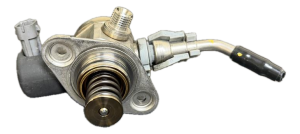
- Failing High-Pressure Fuel Pump (HPFP) 🔴 High Probability → Shop Fuel Pump The mechanical HPFP is a known failure point on many GDI engines, including those used by Kia/Hyundai. Wear on the internal components or the camshaft follower that drives it can reduce its ability to generate pressure.
How to confirm: Use a scan tool to monitor desired vs. actual fuel rail pressure. If actual pressure consistently fails to meet the desired pressure, especially under acceleration, the HPFP is a likely cause.
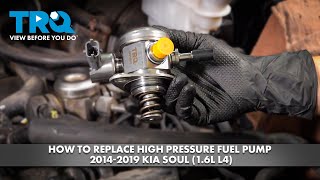
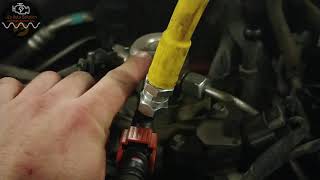
Typical fix: Replace the high-pressure fuel pump and its mounting bolts. It is also highly recommended to replace the high-pressure fuel line at the same time, as it is a one-time use part. Before installing the new pump, it is critical to rotate the crankshaft so the cam lobe driving the pump is at its lowest point to avoid damage. Loosen and tighten the mounting bolts gradually and evenly to counteract the internal spring pressure and avoid cracking the housing. 🎬 See this step-by-step walkthrough for replacing the high-pressure pump.
Est. part cost: $250 - $500 - Restricted Low-Pressure Fuel Line 🟡 Medium Probability → Shop Fuel Line Kia issued TSBs #PS476 and #PS476_R1 specifically mentioning that a restricted low-pressure fuel line can cause P0087 and hesitation on 2014 models. [PS476, PS476_R1, 5] This restriction starves the HPFP of fuel.
How to confirm: Visually inspect the entire length of the low-pressure fuel line from the tank to the HPFP for any kinks, damage, or blockages. Test the low-pressure fuel system with a pressure gauge to ensure it meets specification (69.6 PSI for 1.6L, 71.8 PSI for 2.0L).
Typical fix: Repair or replace the damaged or kinked section of the fuel line.
Est. part cost: $20 - $100 - Faulty Fuel Rail Pressure Sensor 🟡 Medium Probability → Shop Fuel Pressure Sensor The sensor can fail and send inaccurate low-pressure readings to the ECM, even if the actual pressure is correct.
How to confirm: Compare the live data from the sensor on a scan tool to a reading from a mechanical fuel pressure gauge. If the readings differ significantly, the sensor is likely faulty. In some cases, a faulty sensor may report a static, incorrect low pressure (e.g., 87 PSI) at all RPMs, which is a strong indicator of a sensor or wiring failure rather than a mechanical pump issue.
Typical fix: Replace the fuel rail pressure sensor. On the 1.6L engine, this may be possible by removing the alternator for access.
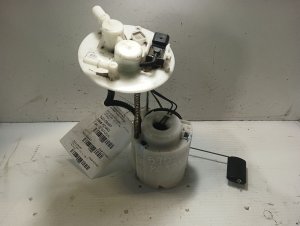
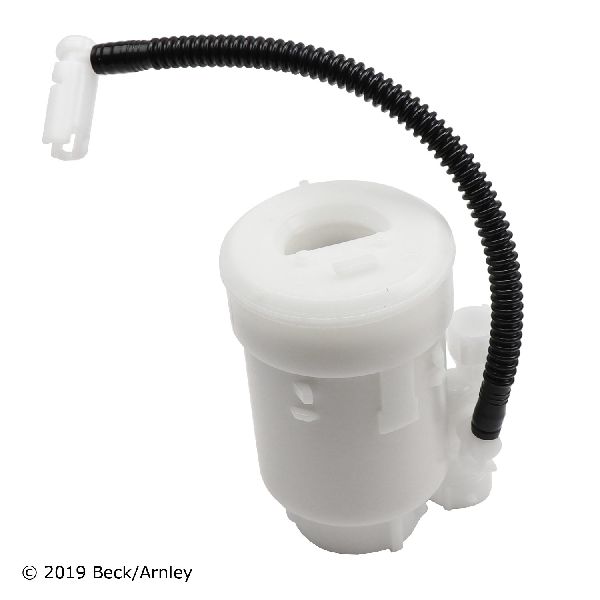
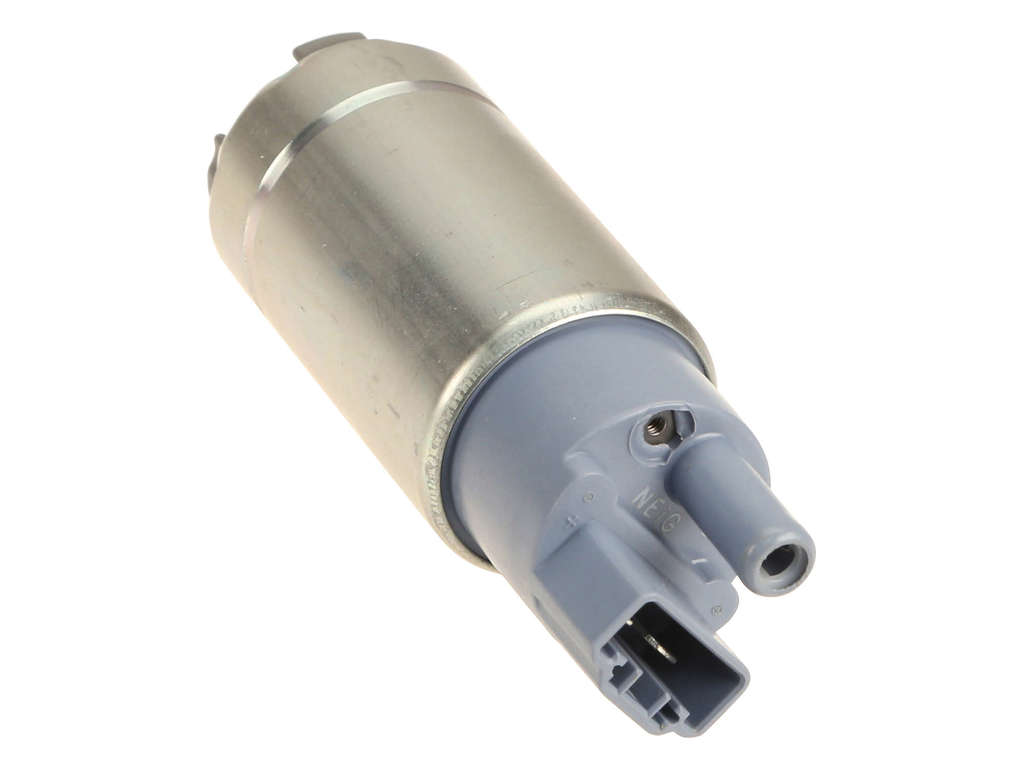
Est. part cost: $50 - $150 - Failing In-Tank Low-Pressure Fuel Pump or Clogged Filter ⚪ Low Probability → Shop Fuel Pump The in-tank pump supplies fuel to the HPFP. If it's weak or the integrated fuel filter is clogged, it cannot provide enough volume, causing the high-pressure side to fall below spec.
How to confirm: Connect a fuel pressure gauge to the low-pressure line's service port. The pressure should be steady and within the manufacturer's specification. If it's low, the in-tank pump is the likely issue. A weak in-tank pump often causes issues under high demand, like acceleration or climbing a hill.
Typical fix: Replace the in-tank fuel pump assembly, which includes the pump, filter, and sending unit.
Est. part cost: $150 - $350
Rare But Worth Checking
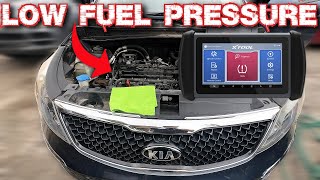
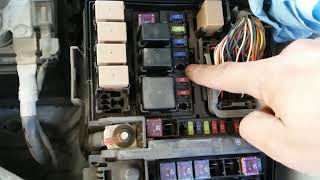
- Missing or Incorrectly Installed HPFP Cam Follower (Tappet): → Shop Fuel Pump This is most likely to occur after a previous repair, such as an engine or HPFP replacement. A missing cam follower (the small metal bucket between the pump and the camshaft) will result in the pump not actuating at all, causing immediate low pressure and a no-start or very poor running condition. This exact failure was documented on a 2016 Kia Sportage with a 2.4L GDI engine; after a customer replaced all major fuel components, a technician found the missing follower was the root cause. 🎬 Watch this diagnosis and fix for low fuel rail pressure.
Diagnosis Steps
- Check for any other stored trouble codes that could provide more clues.
- Connect a scan tool and observe the 'Desired Fuel Rail Pressure' and 'Actual Fuel Rail Pressure' data streams.
- At idle, the values should be close. Rev the engine; the actual pressure should follow the desired pressure. A large discrepancy points to a fuel delivery problem.
- As per TSB #PS476, inspect the low-pressure fuel line from the tank to the engine for any visible kinks, bends, or damage.
- Test the low-pressure fuel system. Connect a fuel pressure gauge to the low-pressure line. With the key on and engine off (or at idle), pressure should be within spec (1.6L: 69.6 PSI, 2.0L: 71.8 PSI). If pressure is low, suspect the in-tank pump or a clogged filter.
- If low-pressure is good but high-pressure is low, the problem lies with the high-pressure fuel pump (HPFP), the fuel rail pressure sensor, or the HPFP's drive mechanism (cam follower).
- Test the fuel rail pressure sensor by comparing its scan tool reading to a mechanical gauge. If they don't match, or if the scan tool shows a nonsensical, static reading (like 87 PSI), the sensor or its wiring is likely bad.
- If the sensor is good and the low-pressure side is healthy, the high-pressure fuel pump is the most probable cause of failure. If the HPFP was recently replaced, physically inspect for the presence and correct installation of the cam follower (tappet).
Parts You'll Likely Need
- High-Pressure Fuel Pump
(OEM #35320-2B220 (for 1.6L, may be superseded by or interchangeable with 35320-2B130, 35320-2B140))— This is the most common failure point for code P0087 on GDI engines. It is a mechanical pump that wears out over time.
Trusted brands: Bosch, Delphi, Standard Motor Products
OEM price range: $400-$600
Aftermarket price range: $250-$450 - Fuel Rail Pressure Sensor
(OEM #35342-2GGA0 (for 2.0L engine))— This sensor can fail and provide incorrect readings to the ECM, falsely triggering the P0087 code.
Trusted brands: Denso, NTK, Vemo
OEM price range: $100-$180
Aftermarket price range: $50-$120 - In-Tank Fuel Pump Assembly
(OEM #31111-1R500 (Pump only, fits multiple models))— If the low-pressure side of the system is diagnosed as faulty, this assembly (which includes the pump and filter) needs to be replaced.
Trusted brands: Spectra Premium, Carter
OEM price range: $250-$400
Aftermarket price range: $150-$300
Related Codes That Often Appear With This One
- P0300-P0304 — Low fuel pressure can lead to a lean air/fuel mixture, causing random or cylinder-specific misfires.
- P0191 — This code for 'Fuel Rail Pressure Sensor Circuit Range/Performance' often appears alongside P0087, pointing more directly toward a faulty sensor or its wiring. 🎬 Watch a professional technician diagnose P0087 and P0193 codes.
Technical Service Bulletins (TSBs) & Recalls

- PS476_R1: Notes that intermittent lack of power or hesitation, with or without a P0087 code, may be due to a restricted low pressure fuel line.
Platform-Specific Known Issues
- Kia Technical Service Bulletin #PS476 and #PS476_R1 specifically identify a 'restricted low pressure fuel line' as a potential cause for P0087 and intermittent lack of power on 2014 models. [PS476, PS476_R1, 5]
- Kia has issued recalls for some 2012-2016 Soul models with the 1.6L GDI engine related to engine damage from catalytic converter overheating (SC176), which can cause abnormal combustion. While not directly for P0087, it highlights the stresses on the GDI fuel and engine systems.
- Technician error during HPFP replacement is a notable cause. Forgetting to install the small cam follower (tappet) between the pump and camshaft will lead to a P0087 code immediately, as the pump will not be driven by the engine.
Mechanic-Grade Diagnostic Values
- Low-Pressure Fuel System Pressure (at fuel tank output) — expected: 1.6L Engine: 69.6 PSI, 2.0L Engine: 71.8 PSI. Failure: Pressure is significantly below the specified value, especially when hesitation occurs.
- High-Pressure Fuel System Pressure (at idle) — expected: Approximately 508-798 PSI (3.5-5.5 MPa). Failure: Actual pressure on scan tool is significantly lower than desired pressure, or does not increase with RPM.
- Fuel Rail Pressure Sensor Signal Voltage (engine running) — expected: Varies with load, typically 0.5V at low pressure to 4.5V at high pressure. A good idle reading might be around 1.7V.. Failure: Voltage is static (e.g., stuck at 0.5V) or does not change logically with engine RPM and load.
Scan Tool Commands That Help
- Kia GDS or professional equivalent: Fuel Rail Pressure Control — To manually command an increase or decrease in fuel rail pressure while monitoring the sensor data. This helps verify the functionality of the high-pressure pump's control solenoid and the sensor's response without having to drive the vehicle.
Wiring & Ground Locations
- CHGINJ (12-BLK) — Likely a main engine harness connector related to the fuel injection system.. A Kia TSB for similar GDI engines identifies this connector as a key inspection point for electrical issues related to the fuel system. Corrosion or loose pins here could disrupt signals to or from the HPFP or pressure sensor.
Real Owner Repair Stories
- Reddit user, r/MechanicAdvice (2017 Kia Soul (similar GDI system)) — After a new crate engine was installed, the vehicle had a hard time starting and no power, with code P0087.
❌ Tried (didn't work) The user was questioning if there was a major leak or mechanical failure.
✅ What actually fixed it The key diagnostic finding was that the scan tool reported the 'actual fuel rail pressure' was stuck at exactly 87 PSI at all RPMs, from idle to higher revs. This is a classic symptom of a faulty fuel rail pressure sensor or a wiring/connector issue sending a default or out-of-range signal, rather than a true mechanical pressure problem. The static, nonsensical number is the clue.
OEM Part Supersession History
35320-2B130, 35320-2B140→35320-2B220— Likely an internal revision for improved reliability or manufacturing efficiency.
Heads up: These part numbers are generally considered interchangeable for the 1.6L GDI engine in this application.
Model Year Variations Within This Range
- 2014-2016: Within the 2014-2016 model years, the 1.6L and 2.0L GDI engines and their corresponding fuel systems remained consistent. No significant variations that would affect the diagnosis or common causes of P0087 have been noted.
Helpful Videos


Used OEM Parts in Stock
New Aftermarket Parts Available


The information in this article is provided for general reference and educational purposes only. Vehicle specifications, procedures, and part compatibility can vary by production date, trim level, and region. Always consult your vehicle's factory service manual and verify part numbers before purchasing or performing repairs. Safety-critical components such as airbags, seat belts, and braking systems should be installed by a qualified professional.
- Kia SOUL:
- 🧭 Diagnostic Flowchart
- 🎬 Helpful Videos
- 🛍️ Shop This Part
- What's Unique About the 2014-2016 Kia SOUL
- Symptoms You May Notice
- Most Likely Causes
- Rare But Worth Checking
- Diagnosis Steps
- Parts You'll Likely Need
- Related Codes That Often Appear With This One
- Technical Service Bulletins (TSBs) & Recalls
- Platform-Specific Known Issues
- Mechanic-Grade Diagnostic Values
- Scan Tool Commands That Help
- Wiring & Ground Locations
- Real Owner Repair Stories
- OEM Part Supersession History
- Model Year Variations Within This Range
- 🎟️ Get 5% Off