

P0087 on 2018-2020 Lexus LC500: Fuel Pressure Too Low Causes and Fixes
P0087 on a Lexus LC500 indicates low pressure in the high-pressure fuel system. The most common causes are a failing high-pressure fuel pump (HPFP) or a weak in-tank low-pressure fuel pump. A recall (J2B/JLB) was issued for the 2018 LC500's high-pressure fuel pumps for a leak risk, and a separate recall (20LA01) was issued for the 2018-2020 LC500's low-pressure pump for a stalling risk.
- P0087 on the LC500 means the engine isn't getting enough fuel pressure, which is a serious issue.
- The most likely culprits are the high-pressure fuel pumps (HPFPs), which were subject to a recall on 2018 models, or the in-tank low-pressure pump.
- Do not ignore this code. Driving can lead to stalling and potential engine damage.
- This is not a simple DIY fix. Repairing the high-pressure fuel system requires special tools and expertise to be done safely.
What's Unique About the 2018-2020 Lexus LC500
The Lexus LC500's 5.0L V8 (2UR-GSE) uses a sophisticated dual high-pressure fuel pump setup to feed its direct injection system. A known issue with these pumps led to a recall (J2B/JLB) for the 2018 model year, where a pulsation damper inside the pump could fail, leading to a fuel leak and potential fire risk. While this recall addresses a leak, the high-pressure pumps themselves are a known failure point that can also cause the low-pressure condition of P0087. Furthermore, a separate, widespread recall (20LA01) was issued for the in-tank low-pressure pump on 2018-2020 models, which can suddenly fail, causing stalling and triggering P0087.
🎬 Watch: Understanding the common causes of the P0087 codeDiagnostic Flowchart
Tap your situation to follow the diagnostic path that matches what you're seeing on this vehicle.
Symptoms You May Notice
- Check Engine Light is on
- Reduced engine power ('limp mode') and sluggish acceleration
- Engine hesitation or stumbling, especially when demanding power
- Engine stalling unexpectedly, potentially at high speeds
- Rough or uneven idle
- Hard starting or extended cranking time
- Engine cuts out completely above a certain RPM (e.g., 2,500 RPM) but idles fine
- Replacing only one high-pressure fuel pump when both are the same age and were replaced as a pair under the recall.
- Replacing oxygen sensors when lean codes (P0171/P0174) appear alongside P0087. The lean condition is a symptom of the low fuel pressure, not the root cause.
Most Likely Causes
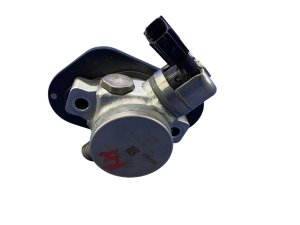
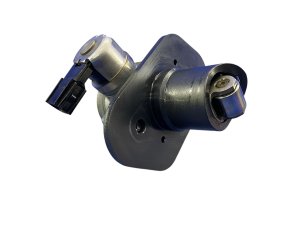
- Failing High-Pressure Fuel Pump (HPFP) 🔴 High Probability → Shop Fuel Pump The 2018 LC500 was subject to a recall (J2B/JLB) for its dual high-pressure fuel pumps due to a defect in the pulsation damper that could cause leaks and fire risk. These pumps are a known failure point on the 2UR-GSE engine, leading to low pressure and P0087. A ClubLexus owner with an IS F (same engine family) traced P0087 to a failed HPFP cam follower because a gasket was missing on installation.
How to confirm: A technician will use a diagnostic scan tool (like Toyota's Techstream) to monitor 'Fuel Press' vs. 'Desired Fuel Rail Pressure'. A significant drop in actual pressure under load points to a failing HPFP. The high-pressure system can exceed 2,000 psi.
Typical fix: Replace both high-pressure fuel pumps. The official recall remedy was to replace both pumps with improved ones.
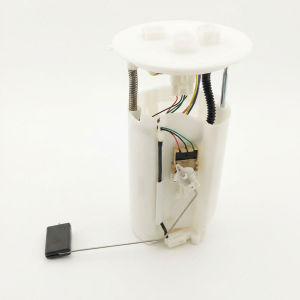
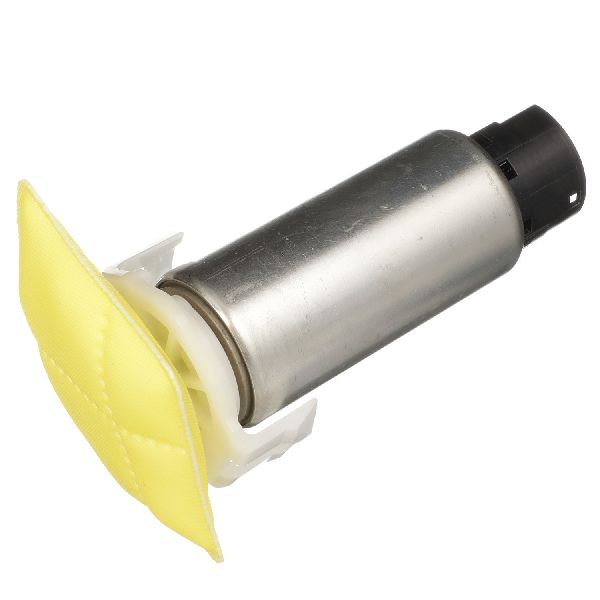
Est. part cost: $400-$800 for the OEM recall kit (Part No. 04007-60136) which includes both pumps and necessary gaskets. - Failing Low-Pressure In-Tank Fuel Pump 🔴 High Probability → Shop Fuel Pump A major recall (20LA01 / 20V682) was issued for the 2018-2020 LC500 because the Denso in-tank low-pressure fuel pump impeller can deform and cause the pump to stop working suddenly. A weak low-pressure pump cannot supply enough fuel to the high-pressure pumps, causing them to starve and triggering P0087.
How to confirm: Connect a manual fuel pressure gauge to the low-pressure feed line. If the pressure is below specification (target is often 40-65 PSI on similar Toyota systems), the in-tank pump is weak. This can also be commanded and checked using Techstream's Active Test feature.
Typical fix: Replace the in-tank fuel pump module assembly. This should be done for free by a dealer if the vehicle is covered under recall 20LA01.
Est. part cost: $200-$450 for the OEM assembly. - Clogged Fuel Filter ⚪ Low Probability → Shop Fuel Filter The fuel filter is integrated into the in-tank fuel pump assembly. While not a common failure point on its own, it can become clogged over time, especially if low-quality fuel is used. It is typically replaced with the pump.
How to confirm: Diagnosis is the same as for a failing low-pressure pump; low pressure readings on a manual gauge would point to a restriction or a weak pump.
Typical fix: The entire fuel pump module, which includes the filter, is replaced.
Est. part cost: $200-$450 (as part of the pump assembly) - Faulty Fuel Rail Pressure Sensor ⚪ Low Probability → Shop Fuel Pressure Sensor
How to confirm: Compare the pressure reading from the sensor on a scan tool to the reading from a mechanical fuel pressure gauge connected to the low-pressure line at idle. If the scan tool reading is erratic or significantly different from the expected value, the sensor may be faulty. For example, a generic sensor might read 0.5V at low pressure and 4.5V at full pressure; a constant low voltage could indicate a defect.
Typical fix: Replace the fuel rail pressure sensor. A related issue on older IS F models involved a leaking gasket for this sensor, covered under campaign ELF.
Est. part cost: $200-$300
Rare But Worth Checking
- Worn Camshaft Lobe or HPFP Follower: → Shop Engine Camshaft The high-pressure fuel pumps are driven by lobes on the camshafts. In some direct-injection engines, these lobes or their followers can wear down, reducing the pump's stroke and causing low pressure. One owner on ClubLexus found a destroyed cam follower was the cause of P0087 after a shop installed an HPFP without a gasket. This is a rare but possible mechanical failure.
- Leaking Fuel Injector: → Shop Fuel Injector A direct injector that is stuck open can cause a drop in rail pressure. However, this would typically be accompanied by other codes for a rich condition (P0172/P0175) or misfires on a specific cylinder (P030X), making it easier to isolate.
Diagnosis Steps
- Verify the code P0087 and any other codes (like P0171/P0174) with an OBD-II scanner.
- Check for open recalls. Enter the VIN on the NHTSA website or Lexus recall lookup site. Specifically check for Safety Recall J2B/JLB (HPFPs, 2018 models) and 20LA01 (LPFP, 2018-2020 models).
- Use a scan tool (Techstream is ideal) to monitor live data for 'Fuel Press' and 'Desired Fuel Rail Pressure'. Observe the values at idle, during free revving, and during a short test drive under load.
- If actual pressure is significantly lower than desired pressure, especially under load, suspect a fuel delivery issue.
- Test the low-pressure fuel system. Use the 'Control the Fuel Pump / Speed' active test in Techstream to check pump operation. Alternatively, connect a mechanical pressure gauge to the fuel line feeding the HPFPs. Standard pressure should be around 196 to 588 kPa (28 to 85 psi) according to a service manual for the same engine family. If low-pressure is below spec, the in-tank pump or filter is the likely cause.
- If low-pressure is within spec, the issue is in the high-pressure system. Inspect the high-pressure fuel pumps, lines, and the rail pressure sensor for any visible leaks or damage.
- Given the platform's history, if the low-pressure side is healthy, the most probable cause is one or both 🎬 See how a technician diagnosed and fixed a P0087 fault of the high-pressure fuel pumps.
Parts You'll Likely Need
- High-Pressure Fuel Pump Kit
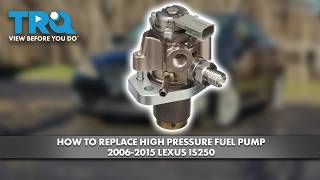
(OEM #04007-60136)— This is the most common failure point for P0087 on the 2UR-GSE engine and was subject to recall J2B/JLB on the 2018 model. The kit includes both pumps and required gaskets. 🎬 Watch: A walkthrough of the high-pressure fuel pump replacement
Trusted brands: Lexus (OEM)
OEM price range: $400-$800 for the kit
Aftermarket price range: Not Recommended - In-Tank Fuel Pump Assembly
(OEM #23221-31130)— If the low-pressure pump is weak or has failed (as covered under recall 20LA01), it will starve the high-pressure pumps. This is the second most likely cause.
Trusted brands: Denso, Lexus (OEM)
OEM price range: $300-$450
Aftermarket price range: $150-$250 - Fuel Rail Pressure Sensor
(OEM #89458-30011)— Less common, but a faulty sensor can send incorrect low-pressure readings to the ECM, triggering the code.
Trusted brands: Denso, Lexus (OEM)
OEM price range: $220-$320
Aftermarket price range: $100-$180
Related Codes That Often Appear With This One
- P0171 — System Too Lean (Bank 1) - The engine is not receiving enough fuel, causing a lean air/fuel mixture. This is a direct result of the low fuel pressure indicated by P0087. TSB LSB000523 specifically links these codes.
- P0174 — System Too Lean (Bank 2) - Same as P0171, but for the opposite cylinder bank. It's common to see both with P0087. TSB LSB000523 specifically links these codes.
- P0300-P0308 — Random or specific cylinder misfire codes can occur because the low fuel pressure prevents proper combustion, leading to misfires under load.
Technical Service Bulletins (TSBs) & Recalls
- LSB000523: Addresses MIL ON condition with DTCs P0087, P0171, and/or P0174, indicating a low fuel pressure condition that requires diagnosis of the fuel delivery system.
Platform-Specific Known Issues
- Safety Recall J2B/JLB - High-Pressure Fuel Pumps: → Shop Fuel Pump Affects 2018 LC500. A pulsation damper inside one of the two high-pressure fuel pumps could be damaged, potentially leading to a fuel leak and increasing fire risk. The remedy is to replace both high-pressure fuel pumps.
- Safety Recall 20LA01 (NHTSA 20V-682) - Low-Pressure Fuel Pump: → Shop Fuel Pump Affects 2018-2020 LC500 models. The in-tank low-pressure fuel pump can fail due to a deformed impeller. This can cause the engine to stall while driving, increasing crash risk. The remedy is to replace the fuel pump assembly.
Mechanic-Grade Diagnostic Values
- Low-Pressure Fuel System Pressure (at HPFP inlet) — expected: 196 to 588 kPa (28 to 85 psi). Failure: Pressure below this range indicates a fault with the in-tank pump, filter, or low-pressure lines.
- Fuel Rail Pressure Sensor Voltage (Key On, Engine Off) — expected: Typically ~0.5 V. Failure: A voltage significantly different from the baseline, or a constant low voltage that doesn't change when the engine starts, can indicate a faulty sensor.
- Live Data Fuel Trims (Short Term and Long Term) — expected: Close to 0% (+/- 10%). Failure: Consistently high positive fuel trims (e.g., +20% or higher) alongside P0087 indicate the ECM is trying to compensate for a lean condition caused by low fuel pressure.
Hidden / Shadow Codes Worth Checking
- P008700: This is an information code that may accompany the primary P0087 DTC. The '00' suffix is often used by Toyota/Lexus to provide more specific fault data and is visible on dealer-level scan tools like Techstream. Its presence confirms the 'Fuel Rail/System Pressure - Too Low' fault without adding new information for the technician, but confirms the ECM has registered the fault according to manufacturer-specific parameters. (see via Toyota Techstream or equivalent professional J2534 scan tool.)
Scan Tool Commands That Help
- Techstream: Control the Fuel Pump / Speed — This Active Test allows a technician to directly command the in-tank low-pressure fuel pump to run at various speeds. It is used to verify if the pump is operational and can build pressure without the engine running, helping to isolate a failed low-pressure pump from a high-pressure system fault.
- Techstream: ECU Flash Reprogramming — In some cases, particularly on other Lexus models, a false P0087 could be triggered due to overly sensitive ECM logic. Lexus has issued TSBs to update the ECM calibration. If no mechanical or sensor faults are found, a technician would check if a newer calibration file is available to prevent false triggers.
Wiring & Ground Locations
- Fuel Pump Driver Module — On many modern vehicles, the fuel pump driver module is located in the rear of the car, either under the rear seat, in the trunk area near the fuel tank, or mounted to the frame. A technician would consult the service manual for the exact location on the LC500.. This module controls the voltage supplied to the low-pressure fuel pump. A failure in the module or its wiring/ground connection can prevent the low-pressure pump from supplying adequate fuel to the high-pressure pumps, leading to P0087.
Real Owner Repair Stories
- ClubLexus user on an IS F forum (same 2UR-GSE engine family) (2008 Lexus IS F with 167,000 miles, running an E40 ethanol blend tune.) — Sudden onset of P0087, car would start and idle fine but would jerk and enter limp mode, unable to rev past ~2,500 RPM under load.
❌ Tried (didn't work) Replacing the in-tank low-pressure fuel pump with an aftermarket AEM unit.
✅ What actually fixed it The root cause was a previously installed passenger-side High-Pressure Fuel Pump (HPFP) that was missing its thick gasket. This incorrect installation caused the pump's cam follower to be destroyed by the camshaft lobe, preventing the pump from actuating. The fix was to replace the damaged HPFP and its follower, ensuring the new gasket was installed correctly.
OEM Part Supersession History
Varies (e.g., 89663-78052-00)→Varies (e.g., 89663-78053-00)— ECM Logic Update
Heads up: While specific to other models like the NX200t, Lexus has a history of issuing updated ECM calibration files to resolve false P0087 triggers. A dealer using Techstream can check if a newer calibration ID is available for the LC500's ECM, which may resolve the code if no mechanical fault is found.
Model Year Variations Within This Range
- 2019-2020: For 2019, Lexus updated the 10-speed transmission's shift logic and made changes to the Adaptive Variable Suspension. For 2020, accelerator control logic was updated for a smoother feel. These are software and minor hardware changes not directly related to the fuel system components that cause P0087.
- 2018: The 2018 model year had a stiffer suspension setup compared to later years. It was also the only year in this range subject to the high-pressure fuel pump recall (J2B/JLB).
Helpful Videos
Used OEM Parts in Stock
New Aftermarket Parts Available


The information in this article is provided for general reference and educational purposes only. Vehicle specifications, procedures, and part compatibility can vary by production date, trim level, and region. Always consult your vehicle's factory service manual and verify part numbers before purchasing or performing repairs. Safety-critical components such as airbags, seat belts, and braking systems should be installed by a qualified professional.
- Lexus LC500:
- 🧭 Diagnostic Flowchart
- 🎬 Helpful Videos
- 🛍️ Shop This Part
- What's Unique About the 2018-2020 Lexus LC500
- Symptoms You May Notice
- Most Likely Causes
- Rare But Worth Checking
- Diagnosis Steps
- Parts You'll Likely Need
- Related Codes That Often Appear With This One
- Technical Service Bulletins (TSBs) & Recalls
- Platform-Specific Known Issues
- Mechanic-Grade Diagnostic Values
- Hidden / Shadow Codes Worth Checking
- Scan Tool Commands That Help
- Wiring & Ground Locations
- Real Owner Repair Stories
- OEM Part Supersession History
- Model Year Variations Within This Range
- 🎟️ Get 5% Off