

P0087 on 2013-2015 Lincoln MKZ: Low Fuel Pressure Causes and Fixes
For a 2013-2015 Lincoln MKZ with the 2.0L EcoBoost engine, code P0087 most often points to a failed Fuel Low Pressure (FLP) sensor. This is a known issue highlighted in Ford's Technical Service Bulletin SSM 48397. Before suspecting expensive components like the high-pressure fuel pump, diagnosis should focus on verifying the FLP sensor's accuracy. Replacing this sensor is a common, well-documented, and relatively inexpensive fix.
- P0087 on a 2013-2015 MKZ 2.0L means fuel pressure is too low.
- Before suspecting expensive fuel pumps, check the Fuel Low Pressure (FLP) sensor first; it's a known failure item according to a manufacturer TSB (SSM 48397).
- Symptoms include stalling, hesitation, and significant loss of power.
- Diagnosing the issue requires a scan tool to read live fuel pressure data and comparing it with a mechanical gauge to confirm sensor accuracy.
- Driving with this code is not recommended as it can cause dangerous stalling and potentially damage the high-pressure fuel pump.
What's Unique About the 2013-2015 Lincoln MKZ
The 2.0L GTDI (EcoBoost) engine in the Lincoln MKZ and its platform mates (like the Ford Fusion and Escape) have a documented weakness in the fuel system. Specifically, Ford issued a Technical Service Bulletin (SSM 48397) that directly links code P0087 to a faulty or biased Fuel Low Pressure (FLP) sensor. This makes a failed sensor a much more likely cause on this specific vehicle compared to the general population of cars, where a weak fuel pump or clogged filter might be the first suspect. Many owners and technicians misdiagnose the issue by replacing the expensive high-pressure pump when only the sensor is at fault.
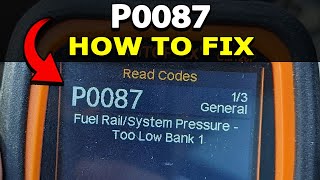
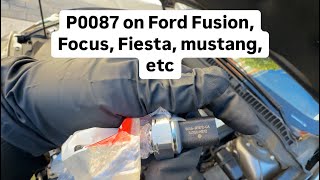
🎬 Watch: How to fix stalling and P0087 on EcoBoost engines.Diagnostic Flowchart
Tap your situation to follow the diagnostic path that matches what you're seeing on this vehicle.
Symptoms You May Notice
- Check Engine Light is on
- Lack of engine power or poor acceleration, especially under load
- Engine stalling, sometimes shortly after starting or at low speeds
- Engine hesitation or sputtering
- Rough running or misfiring
- Difficulty starting the engine or long crank times
- Engine bucking or jerking during acceleration
- Replacing the high-pressure fuel pump (HPFP) when only the inexpensive low-pressure sensor has failed. The TSB for this vehicle makes it critical to diagnose the sensor first before condemning the expensive HPFP.
- Replacing the in-tank fuel pump when the low-pressure sensor is providing a false reading to the PCM.
Most Likely Causes
- Failed Fuel Low Pressure (FLP) Sensor 🔴 High Probability → Shop Fuel Pressure Sensor A Ford Technical Service Bulletin (SSM 48397) specifically identifies this sensor as a common failure point for this code on this platform. The sensor can provide a biased reading (e.g., getting stuck at a high PSI value) to the PCM, which then incorrectly commands lower fuel flow, starving the engine and triggering the code.
How to confirm: Use a scan tool to monitor the Fuel Low Pressure (FLP) sensor PID. On a Ford Fusion, one technician noted the sensor was stuck at 109 PSI while a mechanical gauge showed the actual pressure was dropping below 30 PSI. If the PID value is static or differs significantly from a mechanical gauge, the sensor is faulty. Disconnecting the sensor should cause a change in the reading; if it doesn't, the sensor is likely bad.
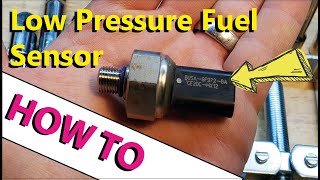
Typical fix: Replace the Fuel Low Pressure sensor. It is located on the fuel supply line leading to the high-pressure pump, near the back of the engine by the firewall. The OEM part number is BU5Z-9F972-B, which supersedes BU5Z-9F972-A.
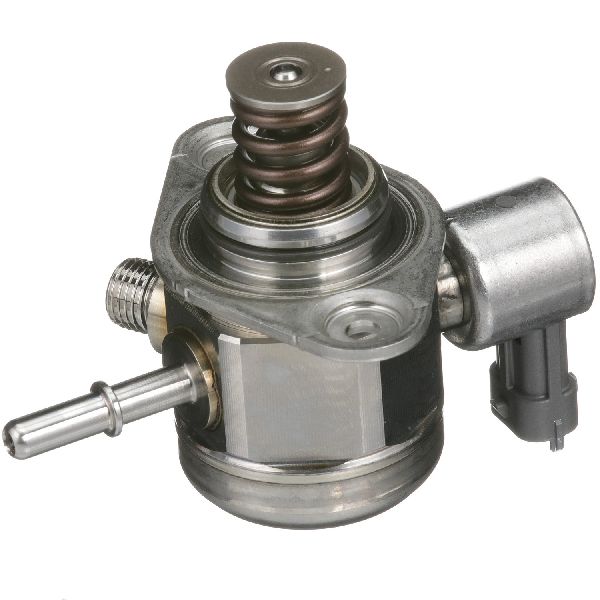
Est. part cost: $25-$110 - Failing High-Pressure Fuel Pump (HPFP) 🟡 Medium Probability → Shop Fuel Pump The HPFP is a mechanically driven pump that is a known wear item on many direct injection engines. While less common than the sensor failure on this platform, it can fail, especially if it has been running starved of fuel due to a faulty low-pressure system.
How to confirm: After confirming the low-pressure system (pump and sensor) is working correctly, monitor the high-pressure fuel rail sensor data ('FRP' PID) with a scan tool, especially under load (wide-open throttle). If the actual pressure cannot meet the desired pressure, the HPFP is likely weak.
Typical fix: Replace the high-pressure fuel pump. It is recommended to also replace the cam follower (tappet) at the same time. A common OEM part number is AG9Z-9350-B, with Bosch being a primary OEM supplier (part number 66800).
Est. part cost: $200-$800 - Clogged Fuel Filter ⚪ Low Probability → Shop Fuel Filter
How to confirm: If the vehicle has high mileage and the fuel filter has never been replaced, it's a potential cause of fuel restriction. Confirm by checking low-side fuel pressure; if it's consistently low and the pump is working hard, the filter could be the restriction.
Typical fix: Replace the fuel filter. On the Lincoln MKZ, the primary fuel filter is integrated into the in-tank fuel pump module and is generally considered non-serviceable separately. This makes it a less common standalone repair.
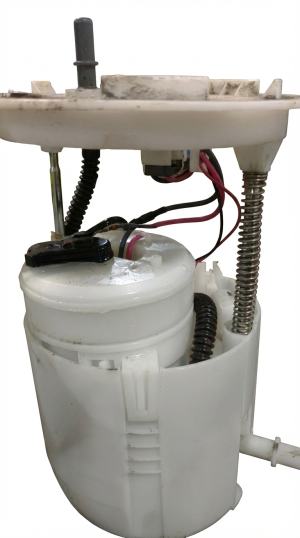
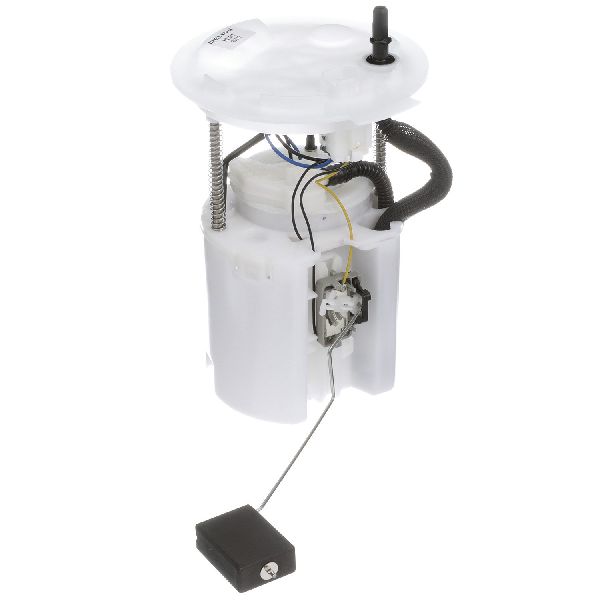
Est. part cost: $50-$300 (if part of pump assembly) - Failing In-Tank Low-Pressure Fuel Pump ⚪ Low Probability → Shop Fuel Pump
How to confirm: Connect a mechanical fuel pressure gauge to the low-pressure fuel line. If the pressure is below specification (typically around 60-85 PSI for this platform) at idle, the in-tank pump is weak.
Typical fix: Replace the in-tank fuel pump module.
Est. part cost: $200-$500
Rare But Worth Checking
- Worn HPFP Cam Lobe/Follower:
- Wiring Issue to PCM or Sensors:
Diagnosis Steps
- Check for other diagnostic trouble codes (DTCs) that may provide more clues, such as codes for specific sensors (P018C) or the high-pressure side.
- Using a capable OBD-II scanner, monitor the live data for 'Fuel Rail Pressure' (FRP - high side) and 'Fuel Low Pressure' (FLP - low side).
- Per TSB SSM 48397, the most crucial step is to verify the Fuel Low Pressure (FLP) sensor. Compare the sensor's PID reading on the scan tool to a mechanical fuel pressure gauge connected to the low-pressure line. If the values don't match (e.g., scanner shows a static 109 PSI while the gauge shows 40 PSI), the sensor is bad.
- If the low-pressure sensor is accurate and the pressure is indeed low (below ~60 PSI at idle), inspect the in-tank fuel pump, its module (FPDM), and wiring for issues.
- If the low-pressure side is healthy (correct pressure and accurate sensor), the problem is likely on the high-pressure side. Inspect the high-pressure fuel pump (HPFP) for leaks or damage.
- Monitor the high-pressure reading (FRP) during a wide-open throttle acceleration. If the actual pressure fails to meet the desired pressure, the HPFP is the likely culprit.
Parts You'll Likely Need
- Fuel Low Pressure Sensor
(OEM #BU5Z-9F972-B)— This is the most common failure point for code P0087 on this vehicle, as documented in Ford's TSB SSM 48397 and confirmed in numerous owner forums and repair videos.
Trusted brands: Motorcraft, Bosch
OEM price range: $60-$110
Aftermarket price range: $25-$70 - High-Pressure Fuel Pump
(OEM #AG9Z-9350-B)— If the low-pressure system is confirmed to be working correctly, the mechanical high-pressure pump is the next most likely cause of low fuel pressure.
Trusted brands: Motorcraft, Bosch
OEM price range: $400-$800
Aftermarket price range: $200-$500
Related Codes That Often Appear With This One
- P00C6 — This code for 'Fuel Rail Pressure Too Low - Engine Cranking' often appears with P0087 as it relates to the same low-pressure condition, just at a different engine state. The TSB SSM 48397 lists them together.
- P018C — This code for 'Fuel Pressure Sensor 'B' Circuit Low' points directly to an electrical issue with the low-pressure fuel sensor, which is a primary cause of P0087 on this vehicle. The TSB also groups these codes.
- P0148 — This code for 'Fuel Delivery Error' is often seen alongside P0087, as a low pressure condition is a type of delivery error. A technician working on a 2016 Fusion found both codes were caused by the faulty low-pressure sensor.
Technical Service Bulletins (TSBs) & Recalls
- SSM 48397: For 2013-2015 Fusion/MKZ/Escape/MKC with 1.5L, 1.6L, or 2.0L GTDI engines exhibiting lack of power or stall with DTCs P00C6, P0087, P008A, P008B, P018C, or P018D. Advises that the Fuel Low Pressure (FLP) sensor is available for service separately.
Platform-Specific Known Issues
- A Technical Service Bulletin (SSM 48397) was issued for 2013-2015 Lincoln MKZ models with the 2.0L GTDI engine that experience a lack of power or stalling with code P0087. The bulletin advises that if diagnosis points to a failed Fuel Low Pressure (FLP) sensor, the sensor is available to be replaced by itself without needing to replace the entire fuel line assembly.
Mechanic-Grade Diagnostic Values
- Low-Pressure Fuel System Pressure (at idle) — expected: 60-85 PSI. Failure: A reading below 60 PSI indicates a weak in-tank pump or restriction. A reading that is static on the scan tool but fluctuating on a mechanical gauge indicates a bad sensor.
- Low-Pressure Fuel Sensor Voltage (at idle) — expected: ~2.5V - 3.5V (varies with pressure). Failure: A voltage that is static (e.g., stuck at 4.82V) while desired pressure changes indicates a failed sensor.
- Low-Pressure Fuel Sensor PID vs. Mechanical Gauge — expected: Scan tool PID should closely match the reading from a mechanical gauge.. Failure: A significant discrepancy, such as the scan tool showing a static 109 PSI while a mechanical gauge reads a fluctuating 30-80 PSI, definitively proves the sensor has failed.
Wiring & Ground Locations
- Fuel Pump Control Module — For the 2014 MKZ Hybrid, it is listed as being in the left front of the luggage compartment. For the non-hybrid, it is often located in the trunk behind the rear seat or under the car on a frame rail.. The Fuel Pump Control Module (also called the Fuel Pump Driver Module or FPDM) regulates the voltage to the in-tank low-pressure pump. A failure in this module can cause the pump to run slow or not at all, leading to low fuel volume and triggering P0087.
- G304 — Located at the left 'C' pillar.. This is a ground point associated with the fuel pump control module on the 2014 MKZ Hybrid wiring diagram. A poor ground here could cause erratic fuel pump operation.
- PCM (Powertrain Control Module) — Located in the right rear of the engine compartment.. The PCM receives data from all fuel pressure sensors and commands the fuel pump driver module. A case has been documented where pushed-out pins at the PCM connector caused an intermittent P0087.
Real Owner Repair Stories
- YouTube channel 'gopowersports' (2016 Ford Fusion (mechanically similar platform)) — Check engine light with codes P0087 and P0148, hesitation, jerking, and shaking.
❌ Tried (didn't work) The customer had already replaced the high-pressure fuel pump, the low-pressure (in-tank) fuel pump, and the fuel pump module.
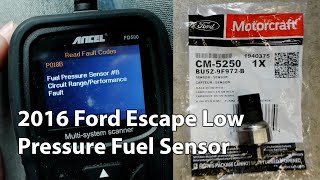
✅ What actually fixed it The low-pressure fuel sensor was diagnosed as faulty. The scan tool showed the sensor was stuck at 109 PSI, while a mechanical gauge confirmed the actual pressure was dropping below 30 PSI. Replacing the low-pressure sensor (Part No. BU5Z-9F972-B / CM-5250) resolved the issue. - YouTube channel 'L8R-HP' (2014 Ford Focus 2.0L with 141,000 miles (similar GDI fuel system)) — Long crank to start, engine revs high on startup, lack of power (limp mode), check engine light with code P0087.
❌ Tried (didn't work) Initial thought was a transmission issue due to the feeling of slipping.
✅ What actually fixed it The high-pressure fuel pump was identified as the cause of the long crank and low power. After replacing the HPFP, the car started immediately and regained full power, clearing the P0087 code. - ScannerDanner forum user (2014 Ford Fusion 2.0L) — Long crank time to start, poor acceleration, and code P0087.
❌ Tried (didn't work) The customer had already replaced the low and high-pressure fuel sensors and installed a used high-pressure fuel pump.
✅ What actually fixed it The root cause was found to be two pushed-out connector pins at the Powertrain Control Module (PCM) socket, which had occurred during a previous accident repair. Reseating the pins fixed the fuel pressure issue.
When the Usual Fixes Don't Work
- While the low-pressure fuel sensor is the most common culprit as per TSB SSM 48397, it is not the only cause. There are confirmed repair cases where the code was resolved only after replacing the high-pressure fuel pump (HPFP), especially on higher-mileage vehicles. In another rare instance, after all major fuel components were replaced, the fault was traced to a damaged wiring connector at the PCM, highlighting the need to consider the entire circuit, not just the components.
OEM Part Supersession History
BU5Z-9F972-A→BU5Z-9F972-B— This is the low-pressure fuel sensor. Part revisions typically address reliability issues or minor design improvements. Given the high failure rate of the original sensor documented in TSBs, the -B revision is the required replacement part.CU5Z-9D370-E→CU5Z-9D370-F— This is the Fuel Pump Driver Module. Part supersessions indicate an updated or revised component.
Helpful Videos

Used OEM Parts in Stock
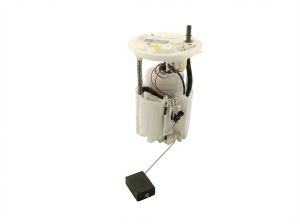
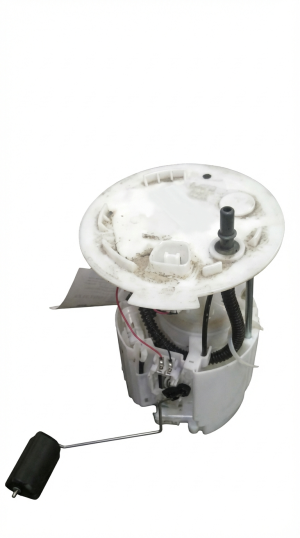
New Aftermarket Parts Available


The information in this article is provided for general reference and educational purposes only. Vehicle specifications, procedures, and part compatibility can vary by production date, trim level, and region. Always consult your vehicle's factory service manual and verify part numbers before purchasing or performing repairs. Safety-critical components such as airbags, seat belts, and braking systems should be installed by a qualified professional.
- Lincoln MKZ:
- 🧭 Diagnostic Flowchart
- 🎬 Helpful Videos
- 🛍️ Shop This Part
- What's Unique About the 2013-2015 Lincoln MKZ
- Symptoms You May Notice
- Most Likely Causes
- Rare But Worth Checking
- Diagnosis Steps
- Parts You'll Likely Need
- Related Codes That Often Appear With This One
- Technical Service Bulletins (TSBs) & Recalls
- Platform-Specific Known Issues
- Mechanic-Grade Diagnostic Values
- Wiring & Ground Locations
- Real Owner Repair Stories
- When the Usual Fixes Don't Work
- OEM Part Supersession History
- 🎟️ Get 5% Off