

P0087 on 2014-2021 Mazda 6: Fuel Pressure Too Low Causes and Fixes
On a 2014-2021 Mazda 6, code P0087 is most often caused by a failing low-pressure fuel pump (LPFP) in the gas tank or a failing high-pressure fuel pump (HPFP) on the engine. For 2018 models, a recall for the LPFP is the most likely cause. A fix can range from a free recall repair to over $1,000 for an HPFP replacement.
- For a 2018 Mazda 6, immediately check if your vehicle is covered by the fuel pump recall (5121K).
- The most likely causes are either the low-pressure pump in the tank or the high-pressure pump on the engine.
- Diagnosis should start with the low-pressure fuel system, as a weak in-tank pump is a known issue that causes this code on Mazda vehicles.
- This is not a beginner-friendly DIY repair due to the high pressures and fire risk involved with the direct-injection fuel system.
What's Unique About the 2014-2021 Mazda 6
The Mazda 6 Skyactiv-G engine uses a sophisticated dual-pump fuel system: a low-pressure pump in the tank and a high-pressure, mechanically-driven pump on the engine. While the P0087 code points to a problem in the high-pressure rail, Mazda has issued recalls and service bulletins that often trace the root cause back to a weak low-pressure pump failing to adequately supply the high-pressure pump. A key Mazda TSB (01-003/18) for the related CX-9 engine explains that a PCM update was issued to specifically set code P0087 when the low-pressure pump is weak; previously, the car would just suffer from low power with no code. Therefore, unlike on some other vehicles, diagnosis on a Mazda 6 should often start with the low-pressure side, even though it seems counterintuitive.
Symptoms You May Notice
- Check Engine Light is on
- Engine hesitation or stumbling during acceleration
- Significant loss of engine power, especially when going uphill
- Rough or uneven idle
- Engine stalling, sometimes at low speeds or even highway speeds
- Difficulty starting the engine
- Engine goes into "limp mode," limiting RPMs to around 3,000
- Black smoke from exhaust during rough running episodes
- Replacing the High-Pressure Fuel Pump (HPFP) when the Low-Pressure Fuel Pump (LPFP) is actually the cause. Mazda's own service bulletin (01-003/18 for the CX-9) explicitly advises testing the LPFP first, as it's a known failure point that can cause P0087.
Most Likely Causes
- Failing Low-Pressure Fuel Pump (LPFP) 🔴 High Probability → Shop Fuel Pump A major recall (NHTSA Campaign 21V913000, Mazda recall 5121K) was issued for the 2018 Mazda 6 due to defective impellers in the LPFP that could crack, deform, and cause the pump to fail. This is the first thing to check on an affected vehicle. Even on non-recalled models, a weak LPFP is a primary suspect per Mazda's own TSBs.
How to confirm: Check if your vehicle's VIN is part of recall campaign 5121K on Mazda's official recall site. A technician can perform a low-pressure fuel system test with a scan tool or a mechanical gauge to verify the pump's output pressure under load. If pressure is low, the pump is faulty.
Typical fix: Replace the low-pressure fuel pump assembly located in the fuel tank. 🎬 See this walkthrough for replacing the low-pressure fuel pump. If under the recall, this is performed by a Mazda dealer free of charge.
Est. part cost: $200-$400 - Failing High-Pressure Fuel Pump (HPFP) 🟡 Medium Probability → Shop Fuel Pump The HPFP is a mechanical pump driven by the camshaft. Over time, the internal components or the cam follower can wear out, reducing its ability to generate the high pressure required for direct injection. Forum discussions on Mazda forums confirm this is a known, though less frequent, failure point than the LPFP.
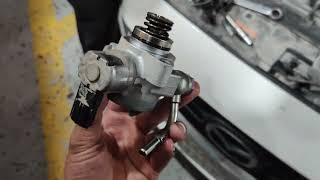
How to confirm: A technician will use a scan tool to monitor desired vs. actual fuel rail pressure. If the low-pressure pump is confirmed to be working correctly but the high-pressure reading is still low, the HPFP is the likely culprit. A YouTube video on a 2017 Mazda 6 demonstrates this failure, showing a worn internal piston on the old pump. 🎬 Watch: Diagnostic video showing a high-pressure pump failure.
Typical fix: Replace the high-pressure fuel pump, which is mounted on the engine's cylinder head. This often involves replacing the O-ring and low-pressure feed line as well.
Est. part cost: $400-$800 - Clogged Fuel Filter ⚪ Low Probability → Shop Fuel Filter The primary fuel filter is integrated into the low-pressure fuel pump module in the tank. While not a separate service item, a severely clogged filter can starve the entire system of fuel, causing the P0087 code. This is more likely on higher mileage vehicles or those that have been run on poor quality fuel.
How to confirm: This is typically diagnosed by observing low fuel volume during a low-pressure system test. Since the filter is part of the pump assembly, the fix is the same.
Typical fix: Replace the complete low-pressure fuel pump assembly.
Est. part cost: $200-$400
Rare But Worth Checking
- Faulty Fuel Rail Pressure Sensor: → Shop Fuel Pressure Sensor While less common than pump failure, a faulty sensor can send incorrect low-pressure readings to the PCM, triggering the code even if the pressure is normal. A diagnostic test comparing a mechanical gauge reading to the sensor's reported value on a scan tool can confirm a bad sensor.
- Restricted or Kinked Fuel Line: → Shop Fuel Line Physical damage to a fuel line between the tank and the engine can restrict flow and cause a pressure drop. This is unlikely but worth a visual inspection.
- Loose High-Pressure Fuel Pump Mounting Bolts: → Shop Fuel Pump A documented case on a 2016 CX-9 (a platform mate) on the Mazdas247.com forum showed P0087 was caused by the HPFP becoming physically loose due to a missing and a broken mounting bolt. This resulted in a significant fuel leak. A visual inspection for fuel leaks around the HPFP is warranted.
- Corroded Fuel Pump Electrical Connector: → Shop Fuel Pump On a high-mileage (206k km) 2017 Mazda 6, symptoms identical to P0087 were traced back to a poor electrical connection at the low-pressure fuel pump. Cleaning the corrosion and securing the plug resolved the hard starting, stalling, and rough running.
Diagnosis Steps
- Check for Recalls: First, use your VIN to check for open recalls on the Mazda or NHTSA websites. For 2018 models, Recall 5121K / 21V913000 for the low-pressure fuel pump is the top priority. Have this free repair done before any other diagnosis.
- Scan Tool Data: Connect an OBD-II scanner with live data capability (like FORScan for Mazdas). Monitor 'FRP_DES' (Desired Fuel Rail Pressure) and 'FRP' (Actual Fuel Rail Pressure). A large, consistent discrepancy confirms the low-pressure condition. Also check for other stored codes like P0192.
- Test the Low-Pressure System: Following Mazda's diagnostic logic, test the low-pressure fuel pump's output. A healthy pump should deliver steady pressure in the 55-71 PSI range to the engine. If the pressure is low or erratic, the LPFP assembly is likely faulty and needs replacement.
- Inspect the High-Pressure System: If the low-pressure side is healthy, visually inspect the HPFP (mounted on the engine) for any fuel leaks. Check that the mounting bolts are secure, as a loose pump has been reported on a platform mate.
- Test the High-Pressure Fuel Pump: If the actual fuel rail pressure is still low with a good LPFP, the HPFP is the primary suspect. A technician may also inspect the camshaft lobe that drives the pump for wear.
- Check Sensor and Wiring: If both pumps test good, inspect the fuel rail pressure sensor and its wiring for damage or corrosion. Compare the sensor's live data reading to a mechanical fuel pressure gauge to verify its accuracy. Also inspect the main fuel pump electrical connector for corrosion, which has been reported to cause these symptoms.
Parts You'll Likely Need
- Low-Pressure Fuel Pump Assembly
(OEM #PYML-13-35XB (2018-2021), PE11-13-35X (2014-2017))— This is the subject of a major recall for the 2018 model year and a known failure point that causes P0087. It is located inside the fuel tank.
Trusted brands: Mazda OE, Delphi, Denso
OEM price range: $300-$450
Aftermarket price range: $150-$300 - High-Pressure Fuel Pump
(OEM #PE19-20-3F0 (or superseded versions like PE18-20-3F0))— This is the second most common cause. As a mechanical pump, it is subject to wear and tear, leading to an inability to generate the required rail pressure. Multiple parts sellers confirm PE19-20-3F0 fits the 2014-2018 Mazda 6.
Trusted brands: Bosch, Mazda OE, Standard Motor Products
OEM price range: $600-$850
Aftermarket price range: $350-$600
Related Codes That Often Appear With This One
- P0192 — This code for 'Fuel Rail Pressure Sensor Circuit Low Input' is often cited alongside P0087 in Mazda Technical Service Bulletins, as both relate to problems detected by the high-pressure fuel sensor. A P0192 code may point more directly to a sensor or wiring issue, but can also be triggered by a failing HPFP.
Technical Service Bulletins (TSBs) & Recalls
- 01-003/18 - Lack of Power, No Warning Lights On (for CX-9, but relevant)
- Bulletin #01-003-18-3421: This manufacturer bulletin notes that PCM control logic was modified so that DTCs P0192:00 or P0087:00 are stored when the fuel injection amount is insufficient.
Platform-Specific Known Issues
- Recall 5121K (NHTSA ID 21V913000): Affects certain 2018 Mazda 6 vehicles (and other models). The low-pressure fuel pump impeller can crack and deform, causing the pump to fail, which can lead to engine stalling and trigger code P0087.
- TSB 01-003/18: While for the CX-9, this TSB is highly relevant. It notes that after a PCM update, P0087 can be stored due to insufficient fuel flow from a weak low-pressure pump. It instructs technicians to test the low-pressure fuel pump first before suspecting the high-pressure side.
Mechanic-Grade Diagnostic Values
- Low-Pressure Fuel System Pressure (In-tank pump output) — expected: 55 - 71 PSI. Failure: Pressure below 55 PSI or erratic readings under load.
- High-Pressure Fuel System Pressure (At fuel rail, full throttle) — expected: Up to 200 bar (2900 PSI); one source cites at least 2176 PSI.. Failure: Scan tool showing 'Actual Fuel Rail Pressure' significantly lower than 'Desired Fuel Rail Pressure' during acceleration.
- Fuel Rail Pressure Sensor Voltage (Key On, Engine Off) — expected: ~0.5 Volts. Failure: Voltage significantly different, or 0V / 5V.
- Fuel Rail Pressure Sensor Voltage (Engine at Idle) — expected: ~1.3 Volts. Failure: Voltage that is erratic or does not correspond to stable idle pressure.
Scan Tool Commands That Help
- Mazda M-MDS / FORScan: Low-Pressure Fuel Pump Inspection/Test — As per Mazda TSB 01-003/18, this is the first diagnostic step to take when P0087 is present. It allows a technician to command the pump and verify its performance before suspecting more expensive high-pressure components.
- FORScan: Live Data Monitoring (PIDs: FRP, FRP_DES) — Essential for diagnosing P0087. This allows for real-time comparison of the PCM's desired fuel rail pressure (FRP_DES) versus the actual pressure reported by the sensor (FRP). A large gap between these values under load points directly to a fuel delivery problem.
Wiring & Ground Locations
- Fuel Pump Fuse (25A) — In the under-hood fuse box, next to the battery. The fuse diagram on the underside of the lid identifies it as 'FUEL PUMP'.. Before testing pumps, verifying this fuse is intact is a basic but critical step. A blown fuse will cut power to the low-pressure pump, causing an immediate P0087.
- Fuel Pump Control Module (FPCM) — Typically located under the rear seat cushion, providing access to the in-tank fuel pump assembly below. On some vehicles, it can be on the frame near the tank.. The FPCM regulates voltage to the low-pressure pump. A failure in this module can mimic a failed fuel pump, leading to misdiagnosis. Its connector is also a potential point of corrosion or failure.
Real Owner Repair Stories
- Mazda Forum user 'DarrenR' (2017 Mazda 6 Atenza, 80,000 km) — Unspecified symptoms leading to HPFP failure diagnosis.
✅ What actually fixed it Replacement of the high-pressure fuel pump (HPFP). Another user with a 2018 CX-5 at 53,000 miles also had the HPFP fail shortly after the LPFP was replaced under recall. - Carly forum user 'oliverwerner1' (2017 Mazda 6, 206,000 km) — Hard to start, stalling at idle, rough running, increased fuel consumption, and a fuel pump related error code.
❌ Tried (didn't work) Initial visual inspection of the fuel pump connection showed no obvious problems.
✅ What actually fixed it A mechanic confirmed a poor connection at the low-pressure fuel pump. Cleaning the corroded contacts and securing the plug resolved all symptoms. - YouTube channel 'Your car technician' (2017 Mazda 6) — Car jerking when accelerating above 80 km/h, P0087 code stored.
❌ Tried (didn't work) The technician first checked the low-pressure fuel pump and confirmed its pressure was good.
✅ What actually fixed it Replacement of the high-pressure fuel pump (HPFP). The video shows a visual comparison where the piston on the old, failed pump was visibly depressed and stuck compared to the new one. - NHTSA ODI #11584010 — An owner of a platform-mate vehicle reported that after the fuel pump was fixed, the "front" fuel pump (HPFP) showed code P0087, causing the car to stall and be unable to pick up speed.
OEM Part Supersession History
PE18-20-3F0, PE01203F0B through PE01203F0F→PE19-20-3F0— Standard part revision and consolidation by the manufacturer.
Heads up: The PE19-20-3F0 pump is specified for many 2.0L/2.5L engines from 2012-2018, but one seller explicitly notes it is NOT a replacement for part number PE22-20-3F0, indicating a critical difference in some applications.PYML-13-35X, PYML-13-35XA→PYML-13-35XB— Part revision, likely related to addressing the impeller failure issue that led to the 2018 model year recall.
Model Year Variations Within This Range
- 2014-2017: These years use the earlier low-pressure fuel pump assembly, OEM part number PE11-13-35X. They are not part of the major 2018 LPFP recall, but the pump can still fail from normal wear.
- 2018-2021: These years use the later low-pressure fuel pump assembly, OEM part number PYML-13-35XB. The 2018 model year specifically is subject to NHTSA recall 21V913000 for a defective LPFP impeller. The 2.5L engine also gained cylinder deactivation starting in 2018.
Diagnostic Flowchart
Used vs. New Parts: Buying Guide for This Vehicle
When a used part is the smart pick: For this specific P0087 issue, sourcing a used fuel pump (either low or high pressure) is generally not recommended. The low-pressure pump has a known defect leading to a major recall, making a used part a significant gamble. The high-pressure pump is a mechanical wear item, and its remaining lifespan is impossible to determine from a donor vehicle.
Donor-vehicle mileage cap: roughly under 50000 miles for the part to have meaningful remaining life.
What to inspect on the donor part:
- Verify the donor vehicle was not part of the fuel pump recall, or has proof of the recall being performed.
- For an HPFP, only consider from a very low-mileage, collision-damaged vehicle.
- Inspect electrical connectors for any signs of heat damage, melting, or corrosion.
OEM-only on this vehicle (don't cheap out):
- Low-Pressure Fuel Pump (LPFP): Due to the impeller defect recall, using an OEM or OEM-supplier (Bosch, Denso) new part is critical for reliability.
- High-Pressure Fuel Pump (HPFP): This is a high-precision, high-stress component. While top-tier aftermarket brands like Bosch are viable, cheap, unbranded aftermarket pumps are a significant risk.
Aftermarket brands forum-validated for this vehicle:
- Bosch (Often an OEM supplier)
- Denso (Often an OEM supplier)
- Delphi (Generally considered good, though some forum users report occasional quality issues)
Brands owners have reported issues with on this vehicle:
- Airtex (Frequently cited in forums for high failure rates)
- Carter (Mentioned alongside Airtex for poor reliability)
- Unbranded/generic pumps from online marketplaces.
Helpful Videos
We Have This Part in Stock


The information in this article is provided for general reference and educational purposes only. Vehicle specifications, procedures, and part compatibility can vary by production date, trim level, and region. Always consult your vehicle's factory service manual and verify part numbers before purchasing or performing repairs. Safety-critical components such as airbags, seat belts, and braking systems should be installed by a qualified professional.
- Mazda 6:
- 🧭 Diagnostic Flowchart
- 🎬 Helpful Videos
- 🛍️ Shop This Part
- What's Unique About the 2014-2021 Mazda 6
- Symptoms You May Notice
- Most Likely Causes
- Rare But Worth Checking
- Diagnosis Steps
- Parts You'll Likely Need
- Related Codes That Often Appear With This One
- Technical Service Bulletins (TSBs) & Recalls
- Platform-Specific Known Issues
- Mechanic-Grade Diagnostic Values
- Scan Tool Commands That Help
- Wiring & Ground Locations
- Real Owner Repair Stories
- OEM Part Supersession History
- Model Year Variations Within This Range
- Used vs. New Parts: Buying Guide for This Vehicle
- 🎟️ Get 5% Off