

P0087 on 2018-2020 Toyota Avalon: Fuel Pressure Too Low Causes and Fixes
P0087 on a 2018-2020 Toyota Avalon most often indicates a failing high-pressure fuel pump (HPFP), an issue acknowledged by Toyota in a Technical Service Bulletin (TSB). However, a widespread recall for the low-pressure in-tank fuel pump also affects these models and can cause identical symptoms. Diagnosis involves differentiating between a high-pressure and low-pressure side fault.
- P0087 on a 2018-2020 Avalon means the fuel pressure is too low, most likely due to a failing high-pressure fuel pump (HPFP).
- This is a known issue, and Toyota has issued a Technical Service Bulletin (TSB000923) about it.
- Look for other codes like P0171 (System Too Lean) which often appear alongside P0087 and point to the same root cause.
- Symptoms include hard starting, engine hesitation, stalling, and a significant loss of power.
- Due to the complexity and fire risk of high-pressure fuel systems, professional diagnosis and repair are strongly recommended.
What's Unique About the 2018-2020 Toyota AVALON
The 2018-2020 Avalon uses Toyota's D-4S direct and port injection system, which relies on both a low-pressure in-tank pump and a high-pressure, engine-mounted pump. Both pumps have been identified as significant failure points. The high-pressure fuel pump (HPFP) is a known issue addressed in TSB T-SB-0009-23 for causing P0087, often with lean codes (P0171/P0174). Simultaneously, these Avalon models were included in a massive safety recall (NHTSA Campaign 20V012000, expanded multiple times) for the low-pressure in-tank fuel pump, which can suddenly fail and cause the engine to stall. Therefore, diagnosis must carefully distinguish which pump is at fault.
Diagnostic Flowchart
Tap your situation to follow the diagnostic path that matches what you're seeing on this vehicle.
Generation note: This range covers two Avalon generations. The 2018 model is the end of the 4th generation (XX40), typically with a 2GR-FE 3.5L V6. The 2019-2020 models are the start of the 5th generation (XX50), using an updated 2GR-FKS 3.5L V6 or an A25A-FKS I4 hybrid powertrain. While the engines differ, both the high-pressure fuel pump issue (per TSB) and the low-pressure fuel pump recall are common to Toyota's direct injection systems of this period.
Symptoms You May Notice
- Check Engine Light is on
- Engine is hard to start or has long crank times
- Rough idling or stalling, sometimes unexpectedly while driving
- Hesitation or stumbling during acceleration
- Noticeable loss of engine power, especially under load
- Reduced fuel economy
- Engine sputtering at high speeds
- Engine may not restart after stalling
- Replacing fuel injectors when the issue is fuel pressure.
- Replacing the in-tank low-pressure pump when the high-pressure fuel pump is the actual cause, or vice-versa. Proper diagnosis is key.
- Replacing the fuel pressure sensor when the pump is mechanically failing.
Most Likely Causes
- Failing High-Pressure Fuel Pump (HPFP) 🔴 High Probability → Shop Fuel Pump This is a known issue on many 2014-2020 Toyota vehicles with direct injection, as acknowledged in TSB T-SB-0009-23. The pump is mechanically driven by the camshaft and can wear internally, failing to generate the required pressure, which can be thousands of PSI.
How to confirm: A technician will use a scan tool (like Toyota's Techstream) to monitor 'Fuel Pressure (High)' vs. 'Target Fuel Pressure' data. A significant lag or inability to reach target pressure under load points to a failing HPFP. In a Lexus forum discussing a similar engine, a user noted their actual pressure was ~200 kPa while the target was 40-41 MPa, a clear HPFP failure.
Typical fix: Replacement of the high-pressure fuel pump.
Est. part cost: $400-$800 - Failing In-Tank (Low-Pressure) Fuel Pump 🔴 High Probability → Shop Fuel Pump 2018-2020 Avalons were included in Toyota's large-scale fuel pump recall (20TA02 / 20LA01). The low-pressure pump's impeller can degrade and cause the pump to stop working entirely, starving the HPFP of fuel and triggering P0087 before a complete stall.
How to confirm: Testing fuel pressure on the low-pressure side. A fuel pressure gauge is connected to the low-pressure line to see if the in-tank pump is delivering adequate pressure (typically 50-70 PSI) to the HPFP. If low-side pressure is weak or zero, the in-tank pump has failed.
Typical fix: Replacement of the in-tank fuel pump assembly, which may be covered by Toyota's recall.
Est. part cost: $200-$400 - Clogged Fuel Filter ⚪ Low Probability → Shop Fuel Filter The fuel filter is integrated into the in-tank fuel pump assembly. While it can clog, it's more likely for the pump motor itself to fail, as noted in the recall. A clogged filter would present with the same symptoms as a weak low-pressure pump.
How to confirm: If low-side pressure is weak, the entire pump and filter assembly is typically replaced, addressing both possibilities.
Typical fix: Replacement of the in-tank fuel pump and filter assembly.
Est. part cost: $200-$400 - Faulty Fuel Pressure Sensor ⚪ Low Probability → Shop Fuel Pressure Sensor
How to confirm: If both low and high-pressure tests show good mechanical pressure, but the code persists, the sensor providing the reading to the ECM may be faulty. This is confirmed by comparing scan tool data to a manual pressure gauge reading. If the gauge shows 60 PSI and the scan tool shows 40 PSI, the sensor is suspect.
Typical fix: Replacement of the fuel rail pressure sensor.
Est. part cost: $70-$150
Rare But Worth Checking
- Worn camshaft lobe that drives the high-pressure fuel pump.
- Leaking fuel injectors, which would prevent the rail from holding pressure.
- Damaged or pinched fuel lines between the low and high-pressure pumps.
Diagnosis Steps
- Verify the code with an OBD-II scanner.
- Check the vehicle's VIN against Toyota's recall database for the low-pressure fuel pump recall (NHTSA Campaign 20V012000, Toyota recall 20TA02). If the recall is open, this is the most likely cause and should be addressed by a dealer.
- Check for any accompanying codes, such as P0171 or P0174, which strengthen the diagnosis of a fuel delivery issue per TSB T-SB-0009-23.
- Using a professional scan tool (like Toyota Techstream), monitor the live data for 'Fuel Pressure (High)' and 'Target Fuel Pressure'. Perform a test drive and observe these values under acceleration. A large discrepancy points towards the HPFP.
- Test the low-pressure fuel system. Connect a fuel pressure gauge to the low-pressure feed line to ensure the in-tank pump is delivering sufficient pressure (typically 50-70 PSI). Note that on many Toyotas, a special adapter may be needed as there is no service port.
- If low-side pressure is weak, the in-tank pump/filter assembly is faulty. This aligns with the recall issue.
- If low-side pressure is strong but high-side pressure is weak, the HPFP is the most likely culprit per TSB T-SB-0009-23.
- If all mechanical pressure tests are good but the code remains, investigate the fuel pressure sensor and its wiring for faults by comparing manual gauge readings to scan tool data.
Parts You'll Likely Need
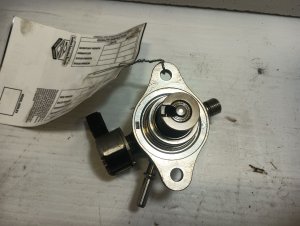
- High-Pressure Fuel Pump
(OEM #23101-F0021 (verify by VIN))— This is a frequent failure point for code P0087 on this vehicle, as documented by Toyota's own service bulletin.
Trusted brands: Toyota (Genuine OEM), Denso
OEM price range: $600-$900
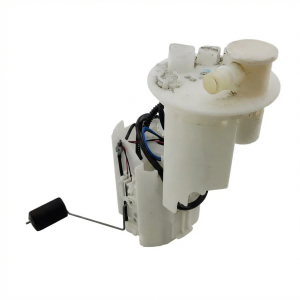
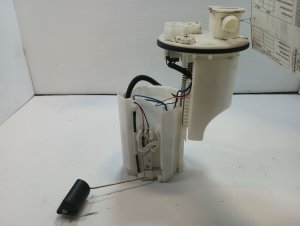
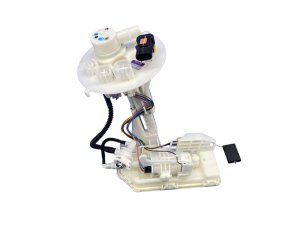
Aftermarket price range: $350-$600 - Fuel Pump and Filter Assembly (In-Tank)
(OEM #Varies by recall batch, e.g., 23220-31600 (verify by VIN))— This part is subject to a major safety recall and a common cause of fuel pressure loss. It is typically replaced as a whole unit.
Trusted brands: Toyota (Genuine OEM), Denso
OEM price range: $300-$500
Aftermarket price range: $150-$300
Related Codes That Often Appear With This One
- P0171 — System Too Lean (Bank 1) - Insufficient fuel pressure causes less fuel to be injected than expected, leading to a lean (too much air) condition. This is explicitly mentioned in TSB T-SB-0009-23.
- P0174 — System Too Lean (Bank 2) - Same as P0171, but for the second bank of cylinders on V6 engines. This is also explicitly mentioned in TSB T-SB-0009-23.
Technical Service Bulletins (TSBs) & Recalls
- T-SB-0009-23: Addresses a MIL ON condition with DTCs P0087, P0171, and/or P0174, indicating low fuel rail pressure, often pointing to the high-pressure pump.
- NHTSA Campaign 20V012000 / Toyota Recall 20TA02: A safety recall for the low-pressure in-tank fuel pump which can fail and cause stalling. Symptoms directly overlap with P0087.
Platform-Specific Known Issues
- Toyota Technical Service Bulletin T-SB-0009-23 was issued for a range of 2014-2020 vehicles, including the Avalon, for a hard start and/or MIL ON with DTC P0087, P0171, and P0174, related to insufficient high-pressure fuel pump performance.
- Safety Recall 20V-012 (Toyota Campaign 20TA02): Affects 2018-2020 Avalons. The in-tank low-pressure fuel pump can fail, causing the engine to stall while driving, increasing crash risk. This is a very common cause for these symptoms and should be checked first.
Mechanic-Grade Diagnostic Values
- Low-Pressure Fuel System Pressure (at idle) — expected: 40-70 PSI. Failure: Pressure below this range indicates a problem with the in-tank fuel pump or filter.
- Fuel Rail Pressure Sensor Voltage (Key On, Engine Off) — expected: Approximately 0.5 V. Failure: Voltage significantly different from 0.5V with no actual pressure, or a constant low voltage when pressure is known to be good, suggests a faulty sensor or wiring.
- Fuel Rail Pressure Sensor Voltage (Max Pressure) — expected: Approximately 4.5 V. Failure: Sensor voltage that does not increase with fuel pressure indicates a faulty sensor.
Scan Tool Commands That Help
- Toyota Techstream: Active Test: Fuel Pump / Circuit Relay (or FUEL PUMP / SPD) — This command manually activates the low-pressure in-tank fuel pump. It is used to verify the pump is functional (audibly) and to check if it can build and hold pressure on a manual gauge without the engine running.
- Toyota Techstream: Active Test: Control the Injection Mode — This advanced test, detailed in TSB-0015-21 for the 2019-2021 Avalon, allows a technician to force the D-4S system into direct-only or port-only injection modes. This can help isolate whether the pressure drop occurs under high-demand (direct injection) or low-demand scenarios, helping to differentiate an HPFP issue from other system faults.
Wiring & Ground Locations
- Engine Harness Grounds — On 2GR engines, common grounding points for the main engine harness are on the side of the cylinder heads, often under the intake or throttle body area.. A poor engine ground can cause erratic sensor readings, including from the fuel pressure sensor, leading the ECM to incorrectly report low pressure. Verifying these grounds are clean and tight is a crucial step in diagnosing electrical faults.
- Engine to Chassis Grounds — Typically found as braided straps or heavy gauge wires running from the valve covers or engine block to the chassis frame rails, often near the strut towers.. These main grounds ensure the entire engine block has a solid connection to the battery negative. A loose or corroded ground here can cause a wide range of issues, including problems with the high-pressure fuel pump's electronic controls.
- Fuel Rail Pressure Sensor Connector — The electrical connector on the fuel pressure sensor, which is mounted to the high-pressure fuel rail.. The female pins within this connector can loosen over time, creating a poor connection. This can cause an intermittent or consistently low voltage signal to the ECM, triggering P0087 even if the sensor and pumps are mechanically sound.
When the Usual Fixes Don't Work
- While the overwhelming majority of P0087 cases on this platform are caused by either the low-pressure or high-pressure fuel pump, it should not be assumed to be the only cause. In other vehicles with similar D-4S fuel systems, there are documented cases where P0087 persisted after pump replacement. The final culprit was found to be one or more leaking direct fuel injectors, which bled off rail pressure faster than the pump could supply it. This highlights the importance of a comprehensive diagnosis rather than immediately replacing the most common-fail parts.
OEM Part Supersession History
23101-25040→23101-F0010— Standard part revision or update by the manufacturer.
Heads up: The new part number (23101-F0010) is the correct replacement for the original. Using old stock of the original part number is not advised if the updated part is available.
Model Year Variations Within This Range
- 2018 vs. 2019-2020: Toyota TSB-0009-23, which addresses P0087, explicitly directs technicians to different sections of the official Repair Manual depending on the model year and engine. For a 2018 Avalon, the procedure is under '2GR-FE (Fuel)'. For a 2019-2020 Avalon, it's under '2GR-FKS (Fuel)' or 'A25A-FXS (Fuel)'. This confirms that while the symptoms are the same, the specific on-vehicle inspection and diagnostic steps may vary.
Used OEM Parts in Stock
New Aftermarket Parts Available


The information in this article is provided for general reference and educational purposes only. Vehicle specifications, procedures, and part compatibility can vary by production date, trim level, and region. Always consult your vehicle's factory service manual and verify part numbers before purchasing or performing repairs. Safety-critical components such as airbags, seat belts, and braking systems should be installed by a qualified professional.
- Toyota AVALON:
- 🧭 Diagnostic Flowchart
- 🛍️ Shop This Part
- What's Unique About the 2018-2020 Toyota AVALON
- Symptoms You May Notice
- Most Likely Causes
- Rare But Worth Checking
- Diagnosis Steps
- Parts You'll Likely Need
- Related Codes That Often Appear With This One
- Technical Service Bulletins (TSBs) & Recalls
- Platform-Specific Known Issues
- Mechanic-Grade Diagnostic Values
- Scan Tool Commands That Help
- Wiring & Ground Locations
- When the Usual Fixes Don't Work
- OEM Part Supersession History
- Model Year Variations Within This Range
- 🎟️ Get 5% Off