

P0087 on 2017-2020 Toyota Sienna: Fuel Pressure Too Low Causes and Fixes
P0087 on a 2017-2020 Sienna indicates fuel pressure is critically low. The most common cause is a failing low-pressure fuel pump in the tank, which is part of a major safety recall (NHTSA #20V-012, Toyota #20TA02). Check if your vehicle's VIN is affected. If not covered by the recall, the high-pressure fuel pump on the engine is the next most likely culprit, though this is less common. Stalling while driving is a significant risk.
- P0087 on a 2017-2020 Sienna is a critical code indicating dangerously low fuel pressure that can cause the engine to stall.
- The first and most important step is to check if your vehicle is part of the massive Toyota fuel pump recall (NHTSA #20V-012). If so, the repair is free at a dealership.
- The vehicle has two fuel pumps; diagnosis requires determining if the fault is with the low-pressure pump (in the tank) or the high-pressure pump (on the engine).
- Do not drive the vehicle. A sudden stall, especially at high speed, is a significant safety risk.
What's Unique About the 2017-2020 Toyota SIENNA

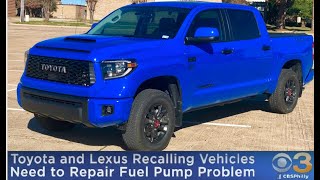
The 2017-2020 Sienna uses the 2GR-FKS engine with Toyota's D-4S direct injection, which has two fuel pumps: a low-pressure electric pump in the fuel tank and a high-pressure mechanical pump driven by the camshaft. This dual-pump setup makes diagnosis more complex than on a standard port-injected engine. Critically, the low-pressure pump in this Sienna generation is known to be faulty and was included in a massive safety recall by Toyota 🎬 Watch: Why you shouldn't ignore this Toyota fuel pump recall. for sudden failure and engine stalling. The faulty pumps were manufactured by Denso and used an impeller that could degrade and cause the pump to stop operating.
Diagnostic Flowchart

Tap your situation to follow the diagnostic path that matches what you're seeing on this vehicle.
Symptoms You May Notice
- Engine stalling while driving, sometimes without the ability to restart.
- Vehicle enters "limp mode" with severely reduced power.
- Hesitation or sputtering, especially under acceleration or at highway speeds.
- Loss of engine power, feeling sluggish or weak.
- Difficulty starting the engine or extended cranking time.
- Illuminated Check Engine Light.
- Loud whining or humming noise from the fuel tank area.
- Engine runs rough or idles unevenly.
- Replacing the high-pressure fuel pump (HPFP) when the actual cause is the recalled low-pressure pump in the tank.
- Replacing fuel injectors when the issue is a fuel delivery problem from one of the pumps.
- Overlooking a simple clogged fuel filter or kinked fuel line.
Most Likely Causes

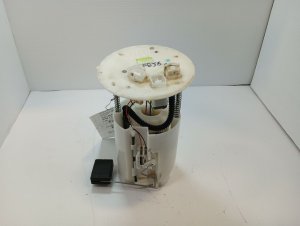
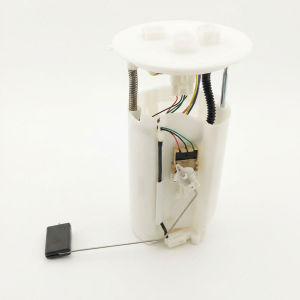
- Failing Low-Pressure Fuel Pump (In-Tank) 🔴 High Probability → Shop Fuel Pump These vehicles were part of a massive safety recall (NHTSA campaign 20V-012 and its expansion 20TA02) for defective Denso low-pressure fuel pumps. The impeller within the pump, made of a specific resin, can absorb fuel, deform, and cause the pump to seize or stop operating, leading to a sudden loss of fuel pressure.
How to confirm: First, check if your vehicle's VIN is included in the recall on the NHTSA or Toyota recall website. A technician can perform a fuel pressure test on the low-pressure system to see if it meets specifications. At idle, this system should typically maintain pressure between 28 and 121 psi (196 to 833 kPa), though a significant drop below the lower threshold indicates a problem.
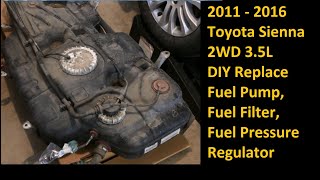
Typical fix: If covered by the recall, a Toyota dealer will replace the fuel pump assembly with an improved part, free of charge. If not covered, the in-tank fuel pump module must be replaced. 🎬 Watch this DIY walkthrough for replacing the in-tank fuel pump. A class-action settlement extended warranty coverage for this specific part for some owners.
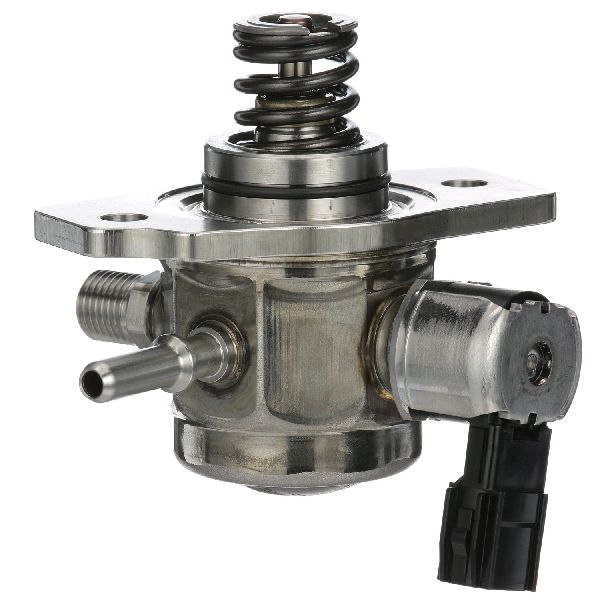
Est. part cost: $0 (if recall applies) - $350 - Failing High-Pressure Fuel Pump (HPFP) 🟡 Medium Probability → Shop Fuel Pump The HPFP is a mechanical pump driven by the camshaft. Like any mechanical part, it can wear out over time, especially the internal components or the camshaft lobe that drives it. While less common than the low-pressure pump failure on this model, it is the next logical point of failure in the fuel system.
How to confirm: Requires a scan tool capable of reading high-pressure fuel rail data. Compare the desired fuel pressure with the actual fuel pressure under various loads. The high-pressure system should operate between approximately 348 to 2,828 psi (2,400 to 19,500 kPa). If the low-pressure pump is confirmed to be working correctly but the high-pressure side cannot meet demand, the HPFP is the likely cause.
Typical fix: Replacement of the high-pressure fuel pump located on the engine. This requires relieving the high pressure in the fuel system before disassembly.
Est. part cost: $300-$600 - Clogged Fuel Filter ⚪ Low Probability → Shop Fuel Filter The fuel filter is integrated into the low-pressure fuel pump module in the tank. While not as common as outright pump failure, a severely clogged filter can restrict flow and cause low pressure. It is almost never the root cause on its own unless the vehicle was subjected to contaminated fuel.
How to confirm: Diagnosis is difficult without removing the pump assembly. It's typically replaced along with the low-pressure pump as a single unit.
Typical fix: Replacement of the entire in-tank fuel pump and filter assembly.
Est. part cost: $250-$450
Rare But Worth Checking
- Faulty Fuel Pressure Sensor: → Shop Fuel Pressure Sensor The system has sensors for both low and high pressure. A faulty sensor can send incorrect low-pressure readings to the ECM, triggering the P0087 code even if the pressure is normal. This can be confirmed by comparing the sensor's reading on a scan tool to a reading from a mechanical fuel pressure gauge.
- Leaking Fuel Injector: → Shop Fuel Injector A fuel injector stuck open can cause a drop in rail pressure. This would typically be accompanied by other symptoms like a strong fuel smell, black smoke from the exhaust, and specific misfire codes.
Diagnosis Steps
- Check for Recalls: Enter your vehicle's VIN on the NHTSA website to see if it is affected by the fuel pump safety recall (NHTSA #20V-012, Toyota #20TA02). If it is, schedule a free repair at a Toyota dealership.
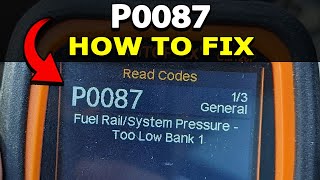
- Scan for Codes: Use an OBD-II scanner to confirm P0087 and check for any other 🎬 See expert advice on diagnosing and fixing the P0087 code. related codes, like P0171 or P0174. Note any pending or history codes.
- Monitor Low-Pressure Fuel System: Using a scan tool, observe the live data for the low-pressure fuel system. If the pressure is below specification (typically ~30-40 psi at a minimum), or if it drops intermittently, suspect the in-tank fuel pump or a clogged filter.
- Monitor High-Pressure Fuel System: If the low-pressure side is stable and within spec, use the scan tool to monitor the desired vs. actual pressure on the high-pressure rail, especially during acceleration. If the actual pressure cannot keep up with the desired pressure, the high-pressure fuel pump (HPFP) is the primary suspect.
- Inspect for Leaks: Visually inspect all fuel lines, the high-pressure pump, and the fuel rail for any signs of external fuel leaks.
- Check the Fuel Pressure Sensor: If scan tool data seems erratic or doesn't match symptoms, compare the sensor's readings to a mechanical pressure gauge to rule out a faulty sensor.
- Check Fuel Trims: Observe Short Term Fuel Trim (STFT) and Long Term Fuel Trim (LTFT) values. High positive values (e.g., >15-20%) on both banks indicate the engine is trying to compensate for a lack of fuel, supporting the low-pressure diagnosis.
Parts You'll Likely Need
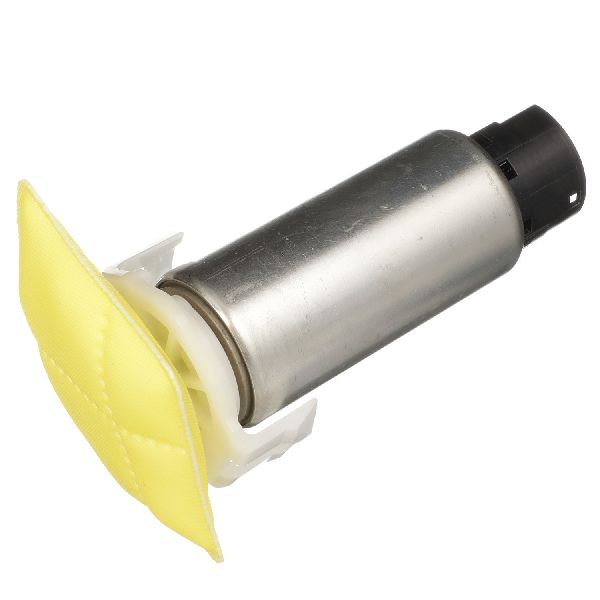
- Low-Pressure Fuel Pump Assembly
(OEM #Part numbers for the recalled Denso pumps often have prefixes like 23220- or 23221-.)— This is the most common failure point for this code on the 2017-2020 Sienna, due to a widespread manufacturing defect covered by a safety recall.
Trusted brands: Denso (OEM), Aisin
OEM price range: $300-$450
Aftermarket price range: $150-$250 - High-Pressure Fuel Pump
(OEM #23101-31090 (Superseded by 23101-0P020))— If the low-pressure pump is working correctly, the mechanical high-pressure pump is the next most likely component to fail and cause a P0087 code.
Trusted brands: Toyota (OEM), Bosch, Hitachi
OEM price range: $450-$600
Aftermarket price range: $250-$400
Related Codes That Often Appear With This One
- P0171 — System Too Lean (Bank 1) - Low fuel pressure causes less fuel to be injected than commanded, resulting in an air-heavy (lean) mixture. This is mentioned in Toyota's TSB #TSB000923 and T-SB-0025-23.
- P0174 — System Too Lean (Bank 2) - Same reason as P0171, but for the second bank of cylinders on the V6 engine. Also mentioned in TSB #TSB000923 and T-SB-0025-23.
- P107A2A — Fuel Rail Pressure Sensor (Low) Signal Stuck in Range - This code may be set along with P0087 in specific situations, such as high altitude and high temperature operation, pointing towards a condition that may require an ECM logic update rather than a hard part replacement.
Technical Service Bulletins (TSBs) & Recalls

- TSB #TSB000923: Notes that P0087 may appear with lean codes P0171/P0174 due to a low fuel pressure condition.
- T-SB-0025-23 (Supersedes TSB000923): Confirms that P0087 along with P0171/P0174 can be caused by loss of fuel pressure and points to diagnosis of the fuel pump assembly.
Platform-Specific Known Issues
- Safety Recall 20V-012 (expanded by 20TA02): Toyota recalled millions of vehicles, including the 2017-2020 Sienna, for a defective Denso low-pressure fuel pump that could fail and cause the engine to stall while driving.
- TSB T-SB-0115-22: Some 2017-2020 Siennas with the 2GR-FKS engine may exhibit a knocking noise from the vacuum pump at idle, which is located near the high-pressure fuel pump. While not directly related to P0087, it's a known issue with this engine and can cause confusion during diagnosis due to its location.
Mechanic-Grade Diagnostic Values
- Low-Pressure Fuel System Pressure — expected: 196 to 833 kPa (28 to 121 psi). Failure: Pressure consistently below the minimum threshold, especially under load.
- High-Pressure Fuel System Pressure (at 3000 rpm, warmed up) — expected: 2,400 to 19,500 kPa (348 to 2,828 psi). Failure: Actual pressure on scan tool fails to meet desired pressure commanded by the ECM.
- High-Pressure Fuel Pump Malfunction Threshold (Example from similar engine) — expected: Difference between actual and target pressure should be greater than -5 MPa (-725 psi).. Failure: When the actual pressure is more than 5 MPa below the target pressure for over 10 seconds, the DTC may be set.
- Direct Injection Fuel Injector Resistance — expected: 1.74 to 2.04 Ω at 20°C (68°F). Failure: Resistance is outside of the specified range, indicating a faulty injector coil.
- Fuel Pump Assembly Resistance — expected: 0.45 to 0.55 Ω at 20°C (68°F). Failure: Resistance outside this narrow range can indicate a problem with the in-tank pump motor.
- High-Pressure Fuel Pressure Sensor Signal Voltage — expected: 0.5V to 4.5V, varying with engine load.. Failure: Voltage is stuck at 0V, 5V, or does not change when engine load changes.
Hidden / Shadow Codes Worth Checking
- Permanent DTC (P-DTC): If P0087 was set because the vehicle ran out of fuel, the code may be stored as a 'Permanent DTC' that cannot be cleared by a simple scan tool command. (see via Visible with professional scan tools like Techstream. Clearing requires completing a specific drive cycle without the fault reoccurring.)
Scan Tool Commands That Help
- Toyota Techstream: Active Test: Fuel Pump / Spd — Use this command to manually activate the in-tank low-pressure fuel pump. This helps verify if the pump motor, relays, and wiring are functional by listening for the pump to turn on.
Wiring & Ground Locations
- Fuel Pump Relay — In the main fuse/relay box in the engine compartment, on the driver's side.. This relay, along with the C/OPN relay, provides power to the low-pressure fuel pump. A failure of this relay will cut power to the pump, causing P0087. It can be swapped with a non-critical relay (like the horn) for a quick diagnostic test.
- C/OPN (Circuit Opening) Relay — In the main fuse/relay box in the engine compartment, near the Fuel Pump relay.. This is a critical safety relay in the fuel pump circuit, controlled by the ECM. The ECM must see a signal that the engine is cranking or running to energize this relay and allow the fuel pump to operate. A failure here will prevent the pump from running.
- Fuel Pump Assembly Connector — On top of the fuel tank, accessible after lowering the tank or through an access panel under the seats (if equipped).. This is the main electrical connection for the in-tank low-pressure fuel pump and sending unit. Checking for power and ground at this connector is a key step to determine if the issue is with the vehicle's wiring or the pump assembly itself.
Real Owner Repair Stories
- NZ DIAGNOSTICS YouTube Channel (Vehicle with direct injection, symptoms consistent with Sienna 2GR-FKS) — Vehicle would stall and die after 20-30 minutes of idling and driving.
❌ Tried (didn't work) Initial diagnosis could have incorrectly pointed to the low-pressure pump.
✅ What actually fixed it The technician monitored both low and high-pressure systems. The low-pressure pump held steady at 55 PSI. However, the scan tool showed the actual high-pressure reading could not meet the desired pressure before stalling. The final fix was the replacement of the high-pressure fuel pump (HPFP) on the engine.
OEM Part Supersession History
23101-31090→23101-0P020— Part update/revision by Toyota for the High-Pressure Fuel Pump.2GR-FKS HPFP→V35A-FTS HPFP— N/A - Comparison part
Heads up: The HPFP from the twin-turbo V35A-FTS engine (Lexus) has the same bolt pattern as the Sienna's 2GR-FKS pump, but the body is rotated by about 20 degrees. While it can physically bolt to the engine, the fuel line connections will not align.
Helpful Videos

Used OEM Parts in Stock
New Aftermarket Parts Available


The information in this article is provided for general reference and educational purposes only. Vehicle specifications, procedures, and part compatibility can vary by production date, trim level, and region. Always consult your vehicle's factory service manual and verify part numbers before purchasing or performing repairs. Safety-critical components such as airbags, seat belts, and braking systems should be installed by a qualified professional.
- Toyota SIENNA:
- 🧭 Diagnostic Flowchart
- 🎬 Helpful Videos
- 🛍️ Shop This Part
- What's Unique About the 2017-2020 Toyota SIENNA
- Symptoms You May Notice
- Most Likely Causes
- Rare But Worth Checking
- Diagnosis Steps
- Parts You'll Likely Need
- Related Codes That Often Appear With This One
- Technical Service Bulletins (TSBs) & Recalls
- Platform-Specific Known Issues
- Mechanic-Grade Diagnostic Values
- Hidden / Shadow Codes Worth Checking
- Scan Tool Commands That Help
- Wiring & Ground Locations
- Real Owner Repair Stories
- OEM Part Supersession History
- 🎟️ Get 5% Off