

P0088 on 2015-2017 Chevrolet Silverado: High Fuel Pressure Causes and Fixes
P0088 on a 2015-2017 Silverado indicates fuel pressure is too high. This is most often caused by a failing high-pressure fuel pump (HPFP) or a faulty fuel rail pressure sensor. A critical sign of HPFP failure is the smell of gasoline in the engine oil, which requires immediate attention to prevent engine damage.
- P0088 on a 2015-2017 Silverado is a critical code indicating dangerously high fuel pressure.
- The most important first step is to check the engine oil for a gasoline smell, which strongly points to a failed high-pressure fuel pump (HPFP).
- Do not drive the vehicle. A leaking HPFP can destroy the engine by diluting the oil.
- The two most likely causes are a failed HPFP or a bad fuel rail pressure sensor.
- Due to the high pressures and risk of engine damage, professional diagnosis and repair are strongly recommended.
What's Unique About the 2015-2017 Chevrolet SILVERADO
The 2015-2017 Silverado uses the EcoTec3 engine family, which features gasoline direct injection (GDI). This system uses two fuel pumps: a low-pressure pump in the tank and a high-pressure, engine-mounted mechanical pump (HPFP) driven by the camshaft. Code P0088 on these trucks almost always relates to the high-pressure side of the system, with the HPFP being a common failure point. A unique and critical symptom on this platform is fuel from a failing HPFP leaking past its internal seals into the crankcase. This dilutes the engine oil, severely compromising lubrication and risking catastrophic engine failure by washing oil from cylinder walls and damaging piston rings.
Diagnostic Flowchart
Tap your situation to follow the diagnostic path that matches what you're seeing on this vehicle.
Symptoms You May Notice
- Check Engine Light is on
- Hard starting or no-start conditions
- Rough running or idling
- Engine stalling or hesitation
- Reduced engine power or "limp mode"
- Strong smell of gasoline in the engine oil
- Black smoke from the exhaust
- Reduced fuel economy
- Rattling or ticking noise from the engine bay, specifically from the high-pressure fuel pump
- Replacing the in-tank (low-pressure) fuel pump. P0088 on these trucks is almost always related to the high-pressure side of the system, which is controlled by the engine-mounted HPFP.
- Replacing the High-Pressure Fuel Pump when the Fuel Rail Pressure Sensor is actually at fault. Verifying with a mechanical gauge is a critical step to avoid this.
Most Likely Causes
- Failing High-Pressure Fuel Pump (HPFP) 🔴 High Probability → Shop Fuel Pump The mechanically-driven HPFP is a well-documented failure point on these direct injection engines. Internal seals can fail, causing both over-pressurization and fuel leakage into the crankcase, a critical issue for this platform.
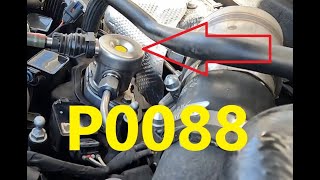
How to confirm: The most definitive sign is a strong smell of gasoline on the engine oil dipstick. A technician can also monitor desired vs. actual fuel pressure with a scan tool; if actual pressure is consistently and significantly higher than desired 🎬 Watch: Understanding common causes and fixes for the P0088 code., the pump is suspect. A rattling noise from the pump area can also indicate failure.
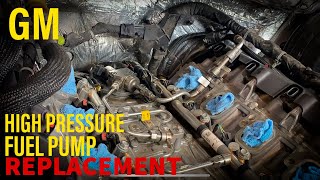
Typical fix: Replace the high-pressure fuel pump, the one-time-use high-pressure fuel line, and perform an engine oil and filter change 🎬 Watch: Complete guide to replacing the high pressure fuel pump. to remove fuel contamination.
Est. part cost: $250-$600 - Faulty Fuel Rail Pressure Sensor 🟡 Medium Probability → Shop Fuel Pressure Sensor The sensor can fail electronically and send erroneously high voltage signals (approaching 4.5-5.0V) to the ECM, making the computer believe the pressure is too high even when it's normal.
How to confirm: Compare the fuel rail pressure reading on a scan tool with a reading from a mechanical fuel pressure gauge. If the scan tool shows high pressure but the mechanical gauge shows normal pressure, the sensor is faulty. A scan tool reading that is stuck at a maximum, fixed value (e.g., 4,626 PSI) also strongly points to a bad sensor or a shorted circuit.
Typical fix: Replace the fuel rail pressure sensor.
Est. part cost: $50-$150 - Fuel System Contamination ⚪ Low Probability As noted in GM Technical Service Bulletins #PIP5151F and #16-NA-102, contamination from water (causing rust), debris, or other fluids can cause the high-pressure pump's internal regulator to stick or fail, triggering P0088.
How to confirm: This is difficult to confirm without disassembling parts of the fuel system. TSB #16-NA-102 advises inspecting the HPFP's pressure regulator for magnetic debris after removal. If debris is found, contamination is confirmed. It's usually suspected after other causes are ruled out.
Typical fix: Per TSB #PIP5151F, if contamination is found, the entire fuel system may need to be cleaned or replaced, including the tank, lines, and pumps, which is a very extensive and costly repair.
Est. part cost: $1000+
Rare But Worth Checking
- Wiring Issues: A short circuit in the fuel rail pressure sensor's 5V reference or signal wire can cause a false high reading. This is often caused by rodent damage to the harness on top of the engine. 🎬 See how to diagnose fuel rail pressure sensor wiring issues. TSB #PIP5119 also warns that connectors for fuel rail pressure sensors can be accidentally swapped after a repair, causing this code.
- Blocked Fuel Return Line: Though less common on modern GDI systems which are primarily returnless on the high-pressure side, a restriction in any part of the low-pressure return system (if applicable) or a clogged fuel filter can contribute to pressure regulation issues.
- Faulty Engine Control Module (ECM): → Shop Engine Control Module (ECM) In very rare instances, the ECM itself can have an internal fault or corrupted software, causing it to misinterpret correct sensor data and falsely trigger a P0088 code.
Diagnosis Steps
- Connect an OBD-II scanner to confirm P0088 is the active code and check for any other codes like P0087, P0191, or P0172/P0175.
- Carefully check the engine oil dipstick for a strong smell of gasoline. If present, stop immediately. The high-pressure fuel pump has likely failed and is contaminating the oil.
- Use the scan tool to monitor live data for 'Desired Fuel Rail Pressure' and 'Actual Fuel Rail Pressure'. Note the readings at idle and under light load.
- If the actual pressure is significantly and consistently higher than desired, the issue is likely mechanical (e.g., the HPFP or a restriction).
- If the pressure reading is stuck at a very high, fixed number (like 4,626 PSI) or the sensor voltage is stuck at 4.5V or higher, suspect a faulty fuel rail pressure sensor or a short in its wiring.
- If possible, verify the electronic reading with a mechanical fuel pressure gauge. A significant discrepancy between the two confirms a bad sensor or wiring issue.
- Inspect the wiring harness and connectors for the fuel rail pressure sensor, especially on top of the engine, for any signs of rodent damage, corrosion, or swapped connectors.
- If all other components test good, investigate the possibility of fuel contamination as outlined in TSBs #PIP5151F and #16-NA-102.
Parts You'll Likely Need
- High-Pressure Fuel Pump
(OEM #12679090 (superseded by 12694391 or 12688607))— This is the most common mechanical failure causing P0088 on these direct-injection engines. It can over-pressurize the system and leak fuel into the engine oil. Always verify the part number with the vehicle's VIN.
Trusted brands: ACDelco, GM Genuine, Bosch
OEM price range: $400-$600
Aftermarket price range: $250-$450 - Fuel Rail Pressure Sensor
(OEM #12673824 (may also be listed as 12623130))— This sensor can fail and send false high-pressure signals to the computer, triggering the code even when the mechanical pressure is normal.
Trusted brands: ACDelco, GM Genuine, Bosch
OEM price range: $80-$150
Aftermarket price range: $50-$100 - High-Pressure Fuel Line — This line, which connects the HPFP to the fuel rail, is a one-time-use part and must be replaced anytime it is disconnected to ensure a proper seal and prevent dangerous leaks.
Trusted brands: ACDelco, GM Genuine
OEM price range: $30-$70
Aftermarket price range: $20-$50
Related Codes That Often Appear With This One
- P0087 — Fuel Rail Pressure Too Low. Seeing both codes can indicate a wildly fluctuating pressure, often due to an erratic sensor or a severe mechanical issue with the HPFP's internal regulator.
- P0191 — Fuel Rail Pressure Sensor Circuit Range/Performance. This code points more directly toward a problem with the sensor or its electrical circuit, and often appears with P0088.
- P128E — This is a GM-specific code for a fuel system fault that is often cited alongside P0088 in technical service bulletins like PIP5151F and PIP4949D.
- P0172 / P0175 — System Too Rich (Bank 1 / Bank 2). These codes can be triggered when a failing HPFP leaks a significant amount of fuel into the crankcase, which then gets recirculated through the PCV system, creating a rich condition.
Technical Service Bulletins (TSBs) & Recalls
- PIP5151F: Mentions P0088 in relation to hard start, no start, or rough running, and points to fuel system contamination as a possible cause requiring extensive inspection and cleaning/replacement of the entire fuel system.
- PIP4949D: Links P0088 with hard start or no-start conditions and advises following standard diagnostic procedures.
- 16-NA-102: Provides a specific diagnostic procedure for fuel contamination issues causing P0088, including inspecting the HPFP regulator for debris.
- PIP5119: Warns technicians that after engine service, the Fuel Rail Pressure 1 and 2 connectors can be accidentally swapped, leading to P0088.
Platform-Specific Known Issues
- A known and critical issue is the high-pressure fuel pump failing and leaking fuel into the crankcase, contaminating the engine oil. This requires immediate attention to prevent catastrophic engine damage.
- GM TSB #PIP5119 warns of a specific reassembly error where fuel rail pressure sensor connectors can be accidentally swapped, causing false P0088 codes.
- GM TSBs #PIP5151F and #16-NA-102 highlight that fuel system contamination is a potential root cause for P0088, which can necessitate a complete fuel system replacement.
Mechanic-Grade Diagnostic Values
- High-Pressure Fuel System at Idle — expected: 500-600 PSI. Failure: Pressure is stuck high, unresponsive, or significantly exceeds the commanded pressure on a scan tool.
- Fuel Rail Pressure Sensor (FRPS) Signal with Key On, Engine Off — expected: Approximately 177 PSI after the low-pressure pump primes.. Failure: A reading of 4,626 PSI indicates the sensor's signal wire is shorted to the 5V reference wire.
- Fuel Rail Pressure Sensor (FRPS) Signal with Sensor Unplugged — expected: 0 PSI on a scan tool.. Failure: If the reading is not 0 PSI, it may indicate a wiring issue between the sensor and the ECM.
Scan Tool Commands That Help
- GDS2 / Tech2: Fuel System Live Data Monitoring — Used to compare 'Desired Fuel Rail Pressure' against 'Actual Fuel Rail Pressure'. A large, persistent discrepancy where actual pressure is higher than desired points towards a mechanical fault like a stuck regulator in the HPFP, rather than a sensor issue.
Wiring & Ground Locations
- G103 / G104 — Typically located on the engine block or cylinder heads. On the K2XX platform, these are key grounds often found on the frame rails behind the front wheels or on the engine itself. For the 5.3L V8, G103 is often on the front of the passenger side cylinder head.. These are primary grounds for the ECM and other critical engine components. Corrosion or a loose connection at these points can cause erratic sensor readings and unpredictable behavior from the fuel control system, potentially leading to false P0088 codes.
- Fuel Rail Pressure Sensor Connector — On the high-pressure fuel rail, at the rear of the engine near the firewall.. This connector provides the 5V reference, signal, and ground for the sensor. Damage to the harness (often from rodents) or corrosion in the connector can cause a short, leading to a fixed high-pressure reading (4,626 PSI) and a P0088 code.
- ECM Connector X3, Pin 3 — On the Engine Control Module (ECM), located in the engine bay.. For the 2015 L83 engine, Pin 3 (Brown/Yellow wire) on connector X3 is the specific signal wire from the Fuel Rail Pressure Sensor. Technicians can test for voltage and continuity at this pin to diagnose wiring faults between the sensor and the ECM.
Real Owner Repair Stories
- TahoeYukonForum.com user (2015 Chevrolet Tahoe LTZ (K2XX Platform)) — Check engine light, StabiliTrak warning, multiple codes, vehicle going into limp mode.
❌ Tried (didn't work) Replacing the battery, Replacing the BCM
✅ What actually fixed it The owner located the main grounds on the frame under the driver's side (G103/G104), found them to be corroded, and resolved all codes and symptoms by removing, cleaning, and re-securing them.
OEM Part Supersession History
12679090→12688607, which was then superseded by 12711668— Likely internal design improvements for durability and reliability.
Heads up: Part number 12679090 is listed as an interchange for 12688607. However, GM Parts Giant shows 12679090 and 12688607 are both superseded by 12711668. Always confirm the latest part number with a dealer using the vehicle's VIN to ensure compatibility.
Model Year Variations Within This Range
- 2015-2016 vs 2017: GM changed the fuel rail pressure sensor design around the 2017 model year. Early models (approx. 2015-2016) use a 4-pin analog sensor (PN 12673824), while later models (approx. 2017+) use a 3-pin digital sensor (PN 12684286). The wiring harnesses are different and not interchangeable, so it is critical to use the correct sensor for the vehicle's specific build.
Helpful Videos
Used OEM Parts in Stock
New Aftermarket Parts Available


The information in this article is provided for general reference and educational purposes only. Vehicle specifications, procedures, and part compatibility can vary by production date, trim level, and region. Always consult your vehicle's factory service manual and verify part numbers before purchasing or performing repairs. Safety-critical components such as airbags, seat belts, and braking systems should be installed by a qualified professional.
- Chevrolet SILVERADO:
- 🧭 Diagnostic Flowchart
- 🎬 Helpful Videos
- 🛍️ Shop This Part
- What's Unique About the 2015-2017 Chevrolet SILVERADO
- Symptoms You May Notice
- Most Likely Causes
- Rare But Worth Checking
- Diagnosis Steps
- Parts You'll Likely Need
- Related Codes That Often Appear With This One
- Technical Service Bulletins (TSBs) & Recalls
- Platform-Specific Known Issues
- Mechanic-Grade Diagnostic Values
- Scan Tool Commands That Help
- Wiring & Ground Locations
- Real Owner Repair Stories
- OEM Part Supersession History
- Model Year Variations Within This Range
- 🎟️ Get 5% Off