

P0088 on 2010 Chevrolet Silverado 2500: Fuel Pressure Too High Causes & Fixes
On a 2010 Silverado 2500 with the 6.6L Duramax LMM engine, P0088 means the fuel rail pressure is dangerously high. This is most often caused by a faulty fuel pressure regulator on the high-pressure pump. Do not drive the vehicle, as this can lead to catastrophic fuel system damage.
- P0088 on a 2010 Duramax is a critical code indicating dangerously high fuel pressure.
- DO NOT continue to drive the vehicle. This can cause a catastrophic failure of the high-pressure fuel system, a multi-thousand dollar repair.
- The most likely cause is a failed fuel pressure regulator located on the high-pressure CP3 pump.
- Diagnosis requires a scan tool that can read live fuel rail pressure data to compare actual vs. desired pressure.
- This is not a beginner-friendly DIY repair due to the extreme pressures and safety risks involved in the diesel fuel system.
What's Unique About the 2010-2010 Chevrolet SILVERADO 2500
The 2010 Silverado 2500 with the 6.6L Duramax LMM engine uses a high-pressure common rail fuel system. Unlike gasoline engines of the same year, this diesel system operates at extremely high pressures (up to 26,000 PSI). The code P0088 is a critical warning on these trucks, often pointing directly to a failure of the fuel pressure regulator (also known as the Fuel Control Actuator or FCA), which is mounted on the Bosch CP3 high-pressure fuel pump. While the CP3 pump is generally robust, its regulator is a known failure point that can stick, causing dangerous pressure spikes.
Diagnostic Flowchart
Tap your situation to follow the diagnostic path that matches what you're seeing on this vehicle.
Symptoms You May Notice
- Check Engine Light is on
- Vehicle enters 'limp mode' (reduced engine power)
- Hard starting or no start condition.
- Rough or inconsistent idle (surging or lopey idle).
- Engine sputtering or stalling.
- Audible engine knock or rattle from high pressure
- Sudden spike in rail pressure observed on a scan tool, sometimes exceeding 29,000 PSI.
- Replacing the fuel filter. While a clogged filter is a common maintenance item, it typically causes low fuel pressure (P0087), not high pressure. A user on Diesel Bombers noted replacing the filter did not solve their P0088 code.
- Replacing fuel injectors. Injector issues usually cause rough running, smoke, or low pressure from excessive return flow, but they are not a primary cause of system-wide high pressure.
Most Likely Causes
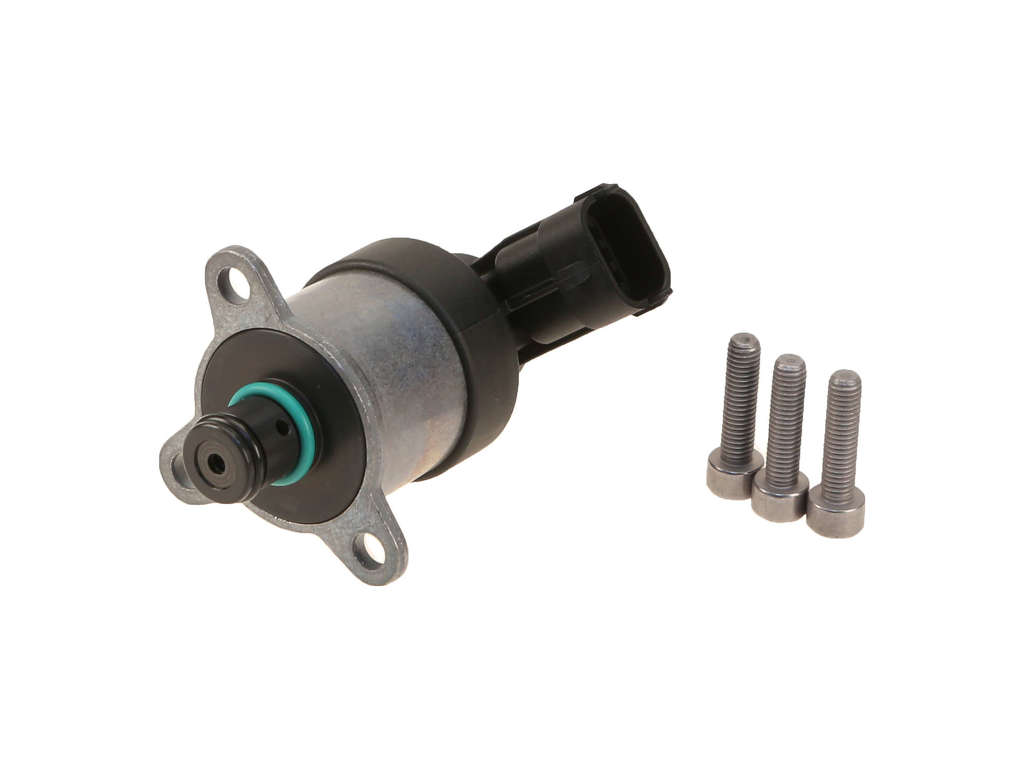
- Faulty Fuel Pressure Regulator 🔴 High Probability → Shop Fuel Injection Pressure Regulator The fuel pressure regulator on the CP3 high-pressure pump is a common failure item. It can stick closed, preventing excess pressure from being returned, causing a spike in the fuel rail. This is the most frequent cause cited in owner forums.
How to confirm: Use a scan tool to monitor desired vs. actual fuel rail pressure. If actual pressure spikes far above desired pressure, especially on deceleration, the regulator is the prime suspect. A resistance test across the regulator's terminals should yield a reading between 2.0 and 3.5 ohms. A user also fixed the issue by replacing a non-OEM regulator with a genuine Bosch part, highlighting the importance of part quality.
Typical fix: Replace the fuel pressure regulator on the high-pressure fuel pump. 🎬 Watch: Step-by-step guide to replacing the fuel pressure regulator. One owner confirmed this fixed their P0088 issue, but noted access is difficult and may require modified T-25 Torx keys. 🎬 See these crucial mistakes to avoid during regulator installation.
Est. part cost: $150-$250 - Faulty Fuel Rail Pressure Sensor 🟡 Medium Probability → Shop Fuel Pressure Sensor The sensor can fail and send an inaccurate, high-voltage signal to the ECM, tricking it into thinking the pressure is too high when it's actually normal.
How to confirm: Compare the scan tool's pressure reading with a mechanical gauge if possible. With Key On, Engine Off, the sensor should read close to 0 PSI (or 1-1.8 MPa). If the scan tool shows high pressure but a mechanical gauge shows normal pressure, the sensor is likely faulty. The sensor's signal voltage should operate between 0.5V and 4.8V; a reading stuck high indicates a problem. Unplugging the sensor should cause the code to change from P0192 (low voltage) to P0193 (high voltage), indicating the wiring is likely intact.
Typical fix: Replace the fuel rail pressure sensor.
Est. part cost: $150-$250 - Restricted Fuel Return Line ⚪ Low Probability Kinks or blockages in the fuel return lines can prevent the system from bleeding off excess pressure, causing it to build up in the rail.
How to confirm: Visually inspect all fuel return lines from the engine back to the tank for any signs of damage, kinks, or crushing.
Typical fix: Repair or replace the damaged section of the fuel line.
Est. part cost: $50-$200 - Wiring Issues ⚪ Low Probability The engine harness, particularly the wiring for the fuel rail pressure sensor, can chafe and short to voltage, often behind the A/C compressor, causing a false high-pressure reading. A loose ground wire, specifically the cab-to-engine ground on the driver's side rear of the head, has also been reported by an owner to cause intermittent max rail pressure spikes.
How to confirm: Inspect the wiring harness for the fuel rail pressure sensor and fuel pressure regulator for any signs of chafing, melting, or corrosion. Pay close attention to where the harness may contact other engine components. Check main engine and body ground connections for tightness and cleanliness.
Typical fix: Repair the damaged wiring and secure the harness away from any contact points.
Est. part cost: $20-$100
Rare But Worth Checking
- Failing High-Pressure Fuel Pump (CP3): → Shop Fuel Pump While more known for causing low pressure (P0087), an internal failure of the pump itself can, in rare cases, cause the pressure regulation to fail and create a P0088 code.
- Fuel Contamination: As mentioned in TSB #PIP5151B and its successor PIP5151C, contaminated fuel (with water, rust, or DEF) can cause components like the fuel pressure regulator to stick or fail, leading to pressure issues. A Reddit user with P0088 on an LMM found "rusty metal bits" in their fuel filter, corroborating this. If contamination is found, the entire fuel system may need to be cleaned.
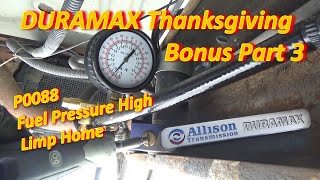
- Aftermarket Lift Pump Pressure Set Too High: If the truck has a non-OEM aftermarket lift pump, its output pressure might be set too high (e.g., 15 PSI). This can overwhelm the high-pressure pump's regulator, especially during deceleration, triggering a P0088 code. A detailed diagnostic video showed this exact scenario, which was fixed by adjusting the lift pump's output pressure down to around 5-9 PSI. 🎬 Watch: Diagnosing a P0088 limp mode caused by lift pump pressure.
- Clogged Fuel Rail Pressure Relief Valve: A small screen on the fuel rail pressure relief valve, located on the driver's side fuel rail, can become clogged with debris. This can prevent it from opening to relieve excess pressure, causing a P0088 code. Often, the valve can be cleaned and reinstalled.
Diagnosis Steps
- Verify the code with a quality OBD-II scanner.
- Use the scanner to monitor live data for 'Desired Fuel Rail Pressure' and 'Actual Fuel Rail Pressure'.
- Observe the pressure readings during idle, light acceleration, and especially during deceleration (coasting). Note if the actual pressure spikes significantly above the desired pressure (e.g., over 2900 PSI difference).
- Check Fuel Rail Pressure with Key On, Engine Off (KOEO). The reading should be near 0 PSI (or 1-1.8 MPa). A high reading indicates a faulty sensor.
- If an aftermarket lift pump is installed, check its output pressure. If it is adjustable, try reducing the pressure to below 10 PSI and re-test.
- Inspect the wiring harness for the fuel pressure regulator and fuel rail pressure sensor for any visible damage, chafing, or corrosion, especially near the A/C compressor. Check for loose ground wires, particularly the cab-to-engine ground on the driver's side rear of the head.
- Test the Fuel Pressure Regulator. Check for a resistance of 2.0-3.5 ohms across its terminals. Use a scan tool with bidirectional controls to command rail pressure to a high value (e.g., 21,000 PSI) and observe if the regulator responds correctly.
- Inspect and consider cleaning the Fuel Rail Pressure Relief Valve on the driver's side fuel rail. A small screen on the valve can get clogged.
- If the actual pressure reads high but the engine runs normally, suspect a faulty fuel rail pressure sensor. Test the sensor's output voltage, which should be between 0.5V and 4.8V.
- Inspect the fuel return lines for any kinks or blockages.
- If fuel contamination is suspected, check the fuel filter for debris like rust or metal shavings. As per TSB #PIP5151C, finding contamination may require cleaning the entire fuel system.
Parts You'll Likely Need
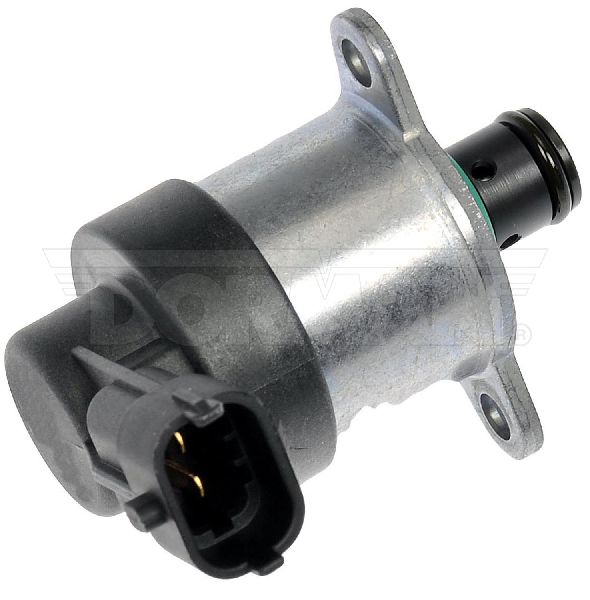
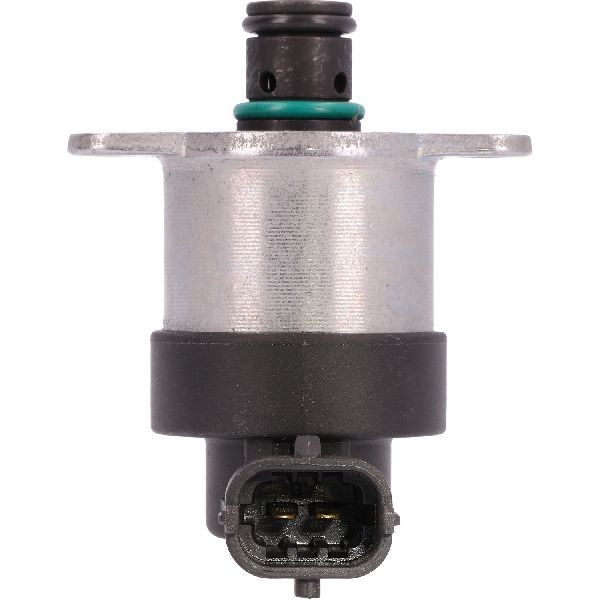
- Fuel Pressure Regulator
(OEM #97384667)— This is the most common failure point for a P0088 code on the LMM Duramax. It gets stuck and fails to regulate pressure in the high-pressure pump.
Trusted brands: Bosch (OEM Manufacturer), ACDelco
OEM price range: $200-$250
Aftermarket price range: $150-$200
Related Codes That Often Appear With This One
- P0087 — Fuel Rail/System Pressure - Too Low. This can appear with P0088 if the fuel pressure regulator is failing erratically, causing pressure to be both too high and too low at different times. Both are mentioned in TSBs PIP4949E and PIP5151B/C.
- P0191 — Fuel Rail Pressure Sensor Circuit Range/Performance. This code often accompanies P0088 because the extreme pressure reading is outside the sensor's expected performance range, or the sensor itself is the cause of the fault. The TSBs PIP4949E and PIP5151B/C also list this code in conjunction with P0088.
- P128E — A manufacturer-specific code related to fuel rail pressure performance, often set in conjunction with P0087 or P0088 as noted in TSBs PIP4949E and PIP5151B/C.
Technical Service Bulletins (TSBs) & Recalls
- PIP4949E: Addresses hard start or no start conditions with DTCs P0087, P0088, P0191, or P128E.
- PIP5151B / PIP5151C: Diagnostic tip for hard start, no start, rough running, or low fuel pressure with DTCs P0087, P0088, P0191, and P128E. Emphasizes checking for fuel system contamination (water, rust, DEF) as a primary cause of component failure.
Platform-Specific Known Issues
- The provided TSBs #PIP4949E and #PIP5151C indicate that P0088 is often part of a cluster of fuel system codes related to hard start or no-start conditions, sometimes caused by fuel contamination.
- A known issue on modified trucks is an aftermarket lift pump with its pressure set too high, which can cause P0088 during deceleration. The fix is to adjust the lift pump pressure down.
- The wiring harness is known to chafe behind the A/C compressor, which can cause a short and lead to false high-pressure readings.
Mechanic-Grade Diagnostic Values
- Fuel Rail Pressure Sensor (KOEO) — expected: ~0 PSI (or 1.0-1.8 MPa). Failure: Any significant pressure reading with the engine off indicates a faulty sensor.
- Fuel Rail Pressure Sensor Signal Voltage — expected: 0.5V to 4.8V. Failure: A voltage reading stuck high (near 5V) or low suggests a sensor or wiring fault.
- Fuel Pressure Regulator Coil Resistance — expected: 2.0 to 3.5 Ohms. Failure: A reading outside this range indicates a faulty regulator coil.
- Scan Tool Live Data: Actual vs. Desired Fuel Rail Pressure — expected: Actual pressure should closely track desired pressure.. Failure: Actual pressure exceeding desired by more than 2,900 PSI, especially on deceleration, triggers P0088.
Scan Tool Commands That Help
- GDS2 / Tech2 or equivalent professional scanner: Fuel Pressure Control / Fuel Rail Pressure Test — This bidirectional command allows a technician to manually increase fuel rail pressure while the engine is idling (e.g., command 21,000 PSI). It is used to verify the functionality of the fuel pressure regulator and to check for leaks from the fuel pressure relief valve under high pressure without having to drive the vehicle.
Wiring & Ground Locations
- Cab-to-Engine Ground Strap — Connects from the main body/cab to a stud on the driver's side rear of the cylinder head.. A poor connection at this primary ground point can cause erratic behavior in the engine's electronic controls, including the fuel pressure regulator, leading to intermittent pressure spikes and P0088.
- Main Battery Ground — The main ground cable from the negative battery terminal connects to the front of the passenger side cylinder head.. This is a primary ground for the entire engine management system. Corrosion or a loose connection here can cause widespread electrical issues.
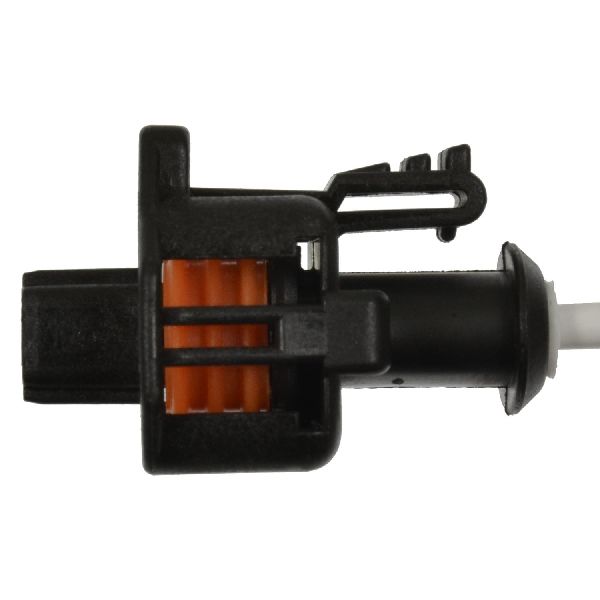
- Fuel Rail Pressure Sensor Connector — On the fuel rail, located behind the intake tube on the passenger side of the engine compartment.. The wire colors for the pigtail are Blue/Black, Black/Blue, and Yellow. Knowing the correct order is critical when replacing a damaged connector to avoid short circuits or incorrect signals.
Real Owner Repair Stories
- Diesel Bombers user 'clcreek' (2006 Silverado 6.6L Duramax LBZ (similar architecture to LMM)) — Inconsistent idle after startup, Check Engine Light, limp mode.
❌ Tried (didn't work) Replacing the fuel filter.
✅ What actually fixed it The fuel pressure regulator on the high-pressure injection pump was replaced. The user noted that access was very difficult and required modified T-25 Torx keys to reach the bolts. - Reddit user 'Vegetable-Common-148' (Duramax LMM) — P0088 code, rough running, and limp mode immediately after replacing fuel lines and sending unit.
❌ Tried (didn't work) Replacing the fuel filter after finding rusty metal bits inside it.
✅ What actually fixed it After finding contamination, the user added injector cleaner and let the engine idle for approximately 30 minutes. The engine sputtered, and then the fuel pressure returned to normal and the code cleared, suggesting a piece of debris had been temporarily lodged in the fuel pressure regulator and was successfully passed through the system. - DuramaxDiesels.com user 'Yngdmax92' (2008 LMM) — Fuel pressure was erratic, fluctuating high and low compared to the commanded pressure at idle and while driving.
❌ Tried (didn't work) Unplugging the aftermarket lift pump had no effect.
✅ What actually fixed it The user noted that receipts showed the fuel pressure regulator (FPR) had been replaced 3 years prior. Upon inspection and removal, the old part had no markings indicating it was a genuine Bosch part. Installing a new, genuine Bosch OEM fuel pressure regulator resolved the erratic pressure and the code.
When the Usual Fixes Don't Work
- While replacing the fuel pressure regulator is the most common fix for P0088, it is not always required. In a documented case involving fuel contamination, an owner found rusty metal bits in the fuel filter and experienced a P0088 code. Instead of replacing parts, they added injector cleaner and idled the engine for 30 minutes. This action successfully cleared the presumed blockage in the regulator, resolving the code without part replacement. This suggests that in cases where contamination is suspected, attempting to clean the system with an additive is a worthwhile first step before committing to component replacement.
OEM Part Supersession History
Bosch 0928400673→Bosch 1465ZS0063— Standard part revision and update by the OEM manufacturer.
Heads up: These parts are for the 2006-2010 LBZ/LMM engines. The GM part number for this regulator is 97384667. Do not confuse with GM part 97369850, which is for the older 2004.5-2005 LLY engine.
Helpful Videos

We Have This Part in Stock


The information in this article is provided for general reference and educational purposes only. Vehicle specifications, procedures, and part compatibility can vary by production date, trim level, and region. Always consult your vehicle's factory service manual and verify part numbers before purchasing or performing repairs. Safety-critical components such as airbags, seat belts, and braking systems should be installed by a qualified professional.
- Chevrolet SILVERADO 2500:
- 🧭 Diagnostic Flowchart
- 🎬 Helpful Videos
- 🛍️ Shop This Part
- What's Unique About the 2010-2010 Chevrolet SILVERADO 2500
- Symptoms You May Notice
- Most Likely Causes
- Rare But Worth Checking
- Diagnosis Steps
- Parts You'll Likely Need
- Related Codes That Often Appear With This One
- Technical Service Bulletins (TSBs) & Recalls
- Platform-Specific Known Issues
- Mechanic-Grade Diagnostic Values
- Scan Tool Commands That Help
- Wiring & Ground Locations
- Real Owner Repair Stories
- When the Usual Fixes Don't Work
- OEM Part Supersession History
- 🎟️ Get 5% Off