

P0088 on 2019-2023 Genesis G70: Fuel Pressure Too High Causes and Fixes
On a 2019-2023 Genesis G70 with the 2.0T engine, code P0088 is almost always caused by a failing High-Pressure Fuel Pump (HPFP). This is a known issue addressed by Genesis Safety Recall 023G and a warranty extension (Z05G) to 15 years/150,000 miles. The repair, which involves an ECU update and potential HPFP replacement, should be performed by a dealer at no cost.
- P0088 on a 2019-2023 G70 2.0T is a serious code indicating excessively high fuel pressure, almost always caused by a defective High-Pressure Fuel Pump (HPFP).
- This is a known manufacturing defect related to the Fuel Control Valve (FCV) plunger inside the pump.
- Do not pay for a repair. This issue is covered by Genesis Safety Recall 023G and a 15-year/150,000-mile warranty extension (Z05G).
- Contact a Genesis dealer immediately to schedule the free recall service, which includes a mandatory software update and a new fuel pump kit if the code is present.
- Driving the vehicle is not recommended as it can lose power unexpectedly, increasing the chance of a crash.
What's Unique About the 2019-2023 Genesis G70
The 2019-2023 Genesis G70, specifically models with the 2.0L Turbo (Theta II) engine, is highly prone to this code due to a well-documented defect in the High-Pressure Fuel Pump (HPFP). The fuel control valve (FCV) plunger inside the pump can wear prematurely, allowing excessive fuel to enter the pump. This leads to over-pressurization, a rich air/fuel mixture, and the triggering of P0088. This issue is so prevalent that Genesis has issued a safety recall (Recall 023G) and extended the warranty on the HPFP, making this a platform-specific problem rather than a generic fault. As of July 2024, Genesis confirmed 2,460 related incident reports in the U.S. market for this issue.
Diagnostic Flowchart
Tap your situation to follow the diagnostic path that matches what you're seeing on this vehicle.
Generation note: The 2019-2023 year range covers the first generation (IK) of the Genesis G70, including the 2021 model year facelift. The High-Pressure Fuel Pump issue and associated recall apply to the entire 2019-2023 range for vehicles equipped with the 2.0T engine produced from May 2, 2018, to October 16, 2023. For the 2024 model year, the 2.0T engine was replaced by a larger 2.5T engine.
Symptoms You May Notice
- Check Engine Light is on.
- Reduction or sudden loss of engine power, especially at low speeds or when accelerating from a stop.
- Vehicle enters 'limp mode,' limiting acceleration and RPM, sometimes to 40 MPH or 3000 RPM.
- Engine hesitation, stumbling, or jerking during acceleration.
- Rough idle, shaking, or misfiring.
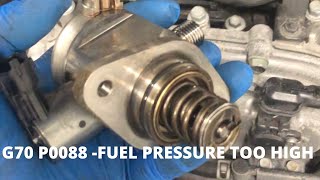
- Difficulty starting the engine or engine stalling immediately after starting. 🎬 Watch: See a G70 start and stall due to P0088.
- Black smoke from the exhaust due to a rich fuel mixture.
- Reduced fuel economy.
- Oil dilution with fuel, which can be identified by a fuel smell in the engine oil.
- Replacing fuel injectors
- Replacing the in-tank low-pressure fuel pump
- Replacing the fuel rail pressure sensor without confirming HPFP function.
Most Likely Causes
- Defective High-Pressure Fuel Pump (HPFP) 🔴 High Probability → Shop Fuel Pump The Fuel Control Valve (FCV) plunger inside the original HPFP is known to wear down gradually, allowing too much fuel into the pump. This is a widespread manufacturing defect specific to the 2.0T Theta II engine in this platform and its relatives, like the Kia Stinger.
How to confirm: A Genesis dealer will use a GDS scan tool to confirm the presence of DTC P0088 or P008800. This is the primary diagnostic step for the recall. An owner can first check their VIN for open recalls (Recall 023G) or the warranty extension (Z05G) on the Genesis or NHTSA corporate website. Independent diagnosis would involve monitoring live fuel rail pressure, which may show readings spiking to 8,000 PSI or more, far exceeding the desired pressure.
Typical fix: The official remedy involves a dealer performing a mandatory ECM software update (GDS Event #1140). If code P0088 is present in the system's history, the dealer will also replace the High-Pressure Fuel Pump and high-pressure pipe at no cost under the recall or warranty extension. An oil change is also recommended due to likely fuel dilution of the engine oil.
Est. part cost: $0
Rare But Worth Checking
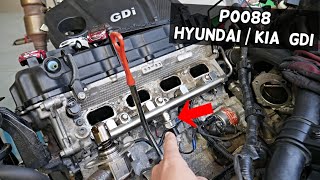
- Faulty Fuel Rail Pressure Sensor: → Shop Fuel Pressure Sensor While the HPFP is the most likely culprit, a faulty sensor could theoretically send incorrect high-pressure readings to the ECM. A technician can verify this by scoping the sensor's voltage to see if it accurately reflects the pressure; 🎬 Watch: How to diagnose P0088 on Hyundai and Kia GDI engines. a reading near 4.5 volts corresponds to an extremely high (and likely false) pressure reading. However, given the known HPFP issues, this is a very rare cause for this specific vehicle and code.
- Wiring Issues: Damaged wiring or a poor connection in the fuel pressure sensor circuit could cause erroneous signals, but this is far less common than the pump failure itself. This would typically be inspected after confirming the sensor is functioning correctly.
- Clogged or Kinked Fuel Return Line: A restriction in the fuel return line could prevent excess pressure from bleeding off, causing it to build up in the rail. This is a generic possibility for this code but is not specifically documented as a common failure point for the G70.
Diagnosis Steps
- Check your vehicle's VIN on the Genesis or NHTSA recall website to see if it is covered by Safety Recall 023G or the HPFP Warranty Extension Z05G.
- If covered, schedule an appointment with a Genesis dealer immediately. The diagnosis and repair will be performed at no cost.
- The dealer will connect a GDS (Global Diagnostic System) scan tool to the vehicle.
- The technician will perform a fault code search to confirm if DTC P0088 or P008800 is stored in the ECM's history.
- Regardless of whether the code is found, the technician will perform a mandatory ECM software update as per TSB 24-01-076G (GDS Event #1140).
- If DTC P0088/P008800 is found, the technician will proceed with replacing the High-Pressure Fuel Pump, the high-pressure fuel pipe, and associated gaskets.
- For independent diagnosis, a technician would use a professional scan tool to monitor live fuel rail pressure data. A reading that spikes dramatically higher than the desired pressure (e.g., 8,000+ PSI vs. a target of ~1500 PSI) confirms an over-pressurization event.
Parts You'll Likely Need
- High-Pressure Fuel Pump Kit
(OEM #35399-2C333QQH)— This is the official kit specified by Genesis for the recall and warranty extension repair. It contains the updated HPFP and required single-use hardware.
Trusted brands: Genuine Genesis
OEM price range: $0 (under recall/warranty)
Aftermarket price range: N/A - High-Pressure Fuel Pump (in kit)
(OEM #35320-2CTB1)— This is the specific part number for the updated pump itself, which is included in the QQH kit. It supersedes the previous part number 35320-2CTB0.
Trusted brands: Genuine Genesis
OEM price range: N/A (part of kit)
Aftermarket price range: N/A - High-Pressure Pipe (in kit)
(OEM #35305-2CTA0)— This is a single-use pipe that connects the HPFP to the fuel rail. It must be replaced anytime it is loosened, as per the service procedure.
Trusted brands: Genuine Genesis
OEM price range: N/A (part of kit)
Aftermarket price range: N/A
Related Codes That Often Appear With This One
- P0091 — A related NHTSA complaint (ODI #11680743) mentions P0091 (Fuel Pressure Regulator 1 Control Circuit Low) in the context of an HPFP issue, suggesting it can sometimes appear alongside or instead of P0088 when the fuel control valve circuit is compromised.
- P053F — A forum user on a platform-mate Kia Stinger reported seeing P053F (Cold Start Fuel Pressure Performance Bank 1) along with P0088, indicating the pressure issue is also present during cold starts.
- P016B — A G70 owner reported getting a P016B code (Too Rich Fuel/Air Ratio) after having the HPFP and pressure sensor replaced, indicating a persistent fuel control issue that was ultimately suspected to be a leaking injector.
Technical Service Bulletins (TSBs) & Recalls
- 25-FL-002G: Describes the P0088 condition, the symptom of power loss, and the associated warranty extension for the High-Pressure Fuel Pump to 15 years/150,000 miles.
- 24-01-076G: This is the service procedure for Recall 023G, detailing the steps for a technician to inspect for DTC P0088, update the ECM (Event #1140), and replace the HPFP kit (35399-2C333QQH) if necessary.
Platform-Specific Known Issues
- Safety Recall 023G: Genesis issued this recall to address the faulty HPFP, which can cause a loss of power. The fix involves an ECM update for all affected vehicles and, if P0088 is found, a replacement of the HPFP and high-pressure pipe.
- Warranty Extension Z05G (TSB 25-FL-002G): Genesis extended the warranty for the High-Pressure Fuel Pump to 15 years or 150,000 miles for this specific issue, providing long-term coverage for owners whose vehicles experience this failure.
Mechanic-Grade Diagnostic Values
- Low-Pressure Fuel Pump (In-tank) — expected: Approx. 60-75 PSI (4.9 - 5.3 kgf/cm2). Failure: Significantly lower pressure indicates a failing in-tank pump, though this is not the common cause for P0088.
- High-Pressure Fuel Rail (at idle) — expected: ~500-800 PSI. Failure: With P0088, the actual pressure spikes dramatically, often to 4,000-8,000+ PSI immediately after starting, causing the engine to stall.
- Fuel Rail Pressure Sensor Signal Voltage — expected: Voltage changes in response to pressure. A normal idle might be around 1.0-1.5V.. Failure: A voltage reading that is stuck, or one that reads extremely high (approaching 4.5V), can indicate either a massive, real pressure spike or a failed sensor reporting a false high reading.
Hidden / Shadow Codes Worth Checking
- P008800: This is an extended format of the P0088 code that may be displayed on the Genesis GDS dealer scan tool. It does not represent a different fault, but is the more specific identifier used in the official TSB. (see via Genesis GDS (Global Diagnostic System) scan tool.)
Scan Tool Commands That Help
- GDS (Global Diagnostic System): ECU Upgrade - Event #1140 — This is a mandatory software update required by Recall 023G for all affected vehicles, regardless of whether P0088 is present. It updates the ECM logic for the high-pressure fuel pump to improve limp-home mode behavior.
- GDS (Global Diagnostic System): Fault Code Searching — This is the first diagnostic step in the recall procedure. If DTC P0088 or P008800 is found in the ECM's history, the high-pressure fuel pump must be replaced along with performing the ECU update.
Real Owner Repair Stories
- Reddit user eda111 (2022 Genesis G70 2.0T with 50k miles) — Daily limp mode, rough starts, P016B (too rich) code, and the smell of fuel in the engine oil.
❌ Tried (didn't work) Replacing the High-Pressure Fuel Pump (HPFP), Replacing the fuel pressure sensor, Performing a software update per a TSB
✅ What actually fixed it The issue was not resolved in the thread, but the user suspected a leaking fuel injector was the root cause after the primary recall-related parts were replaced without success. - Reddit user on r/GenesisG70 (2019 Genesis G70 2.0T) — Intermittent acceleration failure, vehicle would not accelerate past 40 MPH, misfires above 3000 RPM, P0088 code logged.
❌ Tried (didn't work) Replacing fuel injectors, Replacing fuel pressure sensors
✅ What actually fixed it The issue was finally resolved by replacing the High-Pressure Fuel Pump (HPFP).
When the Usual Fixes Don't Work
- In one documented case, a 2022 G70 2.0T owner continued to experience daily limp mode, rough starts, and a rich condition (P016B) even after the dealer replaced both the high-pressure fuel pump and the pressure sensor under warranty. The owner noted the smell of fuel in the oil and suspected the actual underlying cause was a leaking fuel injector, which was not resolved by the standard P0088 recall procedure.
OEM Part Supersession History
35320-2CTB0→35320-2CTB1— The original part is prone to premature wear of the internal Fuel Control Valve (FCV) plunger. The new part is the updated design used for the recall and warranty replacement.
Model Year Variations Within This Range
- 2019-2021 vs 2022-2023: The G70 received a significant facelift for the 2022 model year, including new exterior styling and a larger 10.25-inch infotainment screen. However, the 2.0T engine and its associated high-pressure fuel pump issue remained the same across the entire 2019-2023 range until the engine was replaced with a 2.5T for the 2024 model year.
Helpful Videos
We Have This Part in Stock

The information in this article is provided for general reference and educational purposes only. Vehicle specifications, procedures, and part compatibility can vary by production date, trim level, and region. Always consult your vehicle's factory service manual and verify part numbers before purchasing or performing repairs. Safety-critical components such as airbags, seat belts, and braking systems should be installed by a qualified professional.
- Genesis G70:
- 🧭 Diagnostic Flowchart
- 🎬 Helpful Videos
- 🛍️ Shop This Part
- What's Unique About the 2019-2023 Genesis G70
- Symptoms You May Notice
- Most Likely Causes
- Rare But Worth Checking
- Diagnosis Steps
- Parts You'll Likely Need
- Related Codes That Often Appear With This One
- Technical Service Bulletins (TSBs) & Recalls
- Platform-Specific Known Issues
- Mechanic-Grade Diagnostic Values
- Hidden / Shadow Codes Worth Checking
- Scan Tool Commands That Help
- Real Owner Repair Stories
- When the Usual Fixes Don't Work
- OEM Part Supersession History
- Model Year Variations Within This Range
- 🎟️ Get 5% Off