

P0089 on 2014-2016 Chevrolet Tahoe: Fuel Pressure Regulator Performance Causes and Fixes
For 2015-2016 models with direct injection, this code usually points to a failing high-pressure fuel pump (HPFP), a ~$300-$500 part. For the 2014 model, suspect the fuel pump driver module located near the spare tire. Check for fuel smell in the oil on 2015-2016 models immediately, as this is a definitive sign of HPFP failure.
- First, confirm your vehicle year. A 2014 Tahoe has a different fuel system and different common problems for P0089 than a 2015 or 2016 model.
- For 2015-2016 Tahoes, immediately check the engine oil for a gasoline smell. If detected, the high-pressure fuel pump has likely failed and the vehicle should not be driven.
- For 2014 Tahoes, the most likely culprit is the fuel pump driver module (FPDM) located under the vehicle by the spare tire, which often fails from corrosion.
- On 2015-2016 models, replacing the high-pressure fuel pump is a complex job that requires removing the intake manifold and should be done along with an oil change.
What's Unique About the 2014-2016 Chevrolet TAHOE
The 2014-2016 Tahoe range spans two completely different fuel systems, which is critical for diagnosis. The 2014 model (GMT900 platform) uses traditional Port Fuel Injection. The 2015-2016 models (K2XX platform) use a more complex Gasoline Direct Injection (GDI) system with both a low-pressure and a high-pressure fuel pump. On the 2015-2016 GDI models, P0089 is most often related to the high-pressure fuel pump, while on the 2014 model, issues with the fuel pump driver module are more common.
Diagnostic Flowchart
Tap your situation to follow the diagnostic path that matches what you're seeing on this vehicle.
Generation note: This range covers two generations. The 2014 Tahoe is the last year of the GMT900 platform with Port Fuel Injection. The 2015 and 2016 Tahoe are the first years of the K2XX platform, which introduced the 5.3L EcoTec3 engine with Gasoline Direct Injection (GDI). Causes and parts are significantly different between these generations.
Symptoms You May Notice
- Check Engine Light is on
- Engine hesitation or stumbling on acceleration
- Lack of engine power, especially under heavy load, sometimes triggering 'Reduced Engine Power' mode
- Rough or erratic idle
- Engine stalling unexpectedly
- Extended cranking time to start the engine
- Strong gasoline smell from the engine oil (2015-2016 models)
- Rising oil level on the dipstick (2015-2016 models)
- Poor fuel economy
- Replacing only the in-tank fuel pump on a 2015-2016 GDI model, when the issue is with the high-pressure system.
- Replacing fuel injectors when the root cause is unstable fuel pressure from a failing pump or sensor.
- On a 2014 model, replacing the expensive in-tank fuel pump before thoroughly inspecting the much cheaper and more failure-prone Fuel Pump Driver Module (FPDM).
Most Likely Causes
- High-Pressure Fuel Pump (HPFP) Failure (2015-2016 GDI Models) 🔴 High Probability → Shop Fuel Pump The HPFP is a mechanically-driven pump and a known common failure point on GM's direct injection engines. Internal seals can fail, causing both performance issues and fuel leakage into the crankcase, which is a critical issue.
How to confirm: Use a scan tool to monitor desired vs. actual fuel rail pressure; a significant deviation under load points to the pump. The most definitive sign is a strong gasoline smell on the oil dipstick and a rising oil level. If these signs are present, the pump has failed.
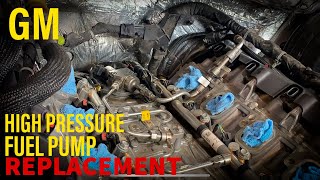
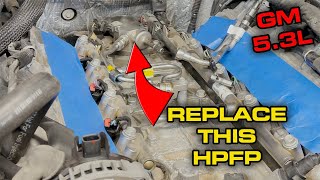
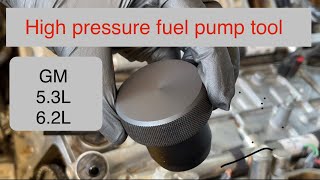
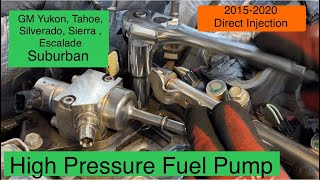
Typical fix: Replace the high-pressure fuel pump, the associated single-use high-pressure fuel line, 🎬 Watch: How to use the specialized high-pressure pump install tool. and change the engine oil and filter to remove fuel contamination. The intake manifold must be removed for access. 🎬 Watch: A complete guide to replacing the high-pressure fuel pump.
Est. part cost: $300-$550 - Fuel Pump Driver Module (FPDM) Failure (2014 Port Injection Model) 🔴 High Probability → Shop Fuel Pump The FPDM is mounted on a frame crossmember near the spare tire, making it highly susceptible to corrosion from road salt and moisture, which damages the electronics and connector. This is a very common failure point on GMT900 trucks and SUVs.
How to confirm: Visually inspect the module and its connector for corrosion or damage. The module's aluminum backing plate will often show significant bubbling or flaking from corrosion. Test for power and ground at the module. If the in-tank pump doesn't run but has power when jumped directly, the FPDM is the likely culprit.
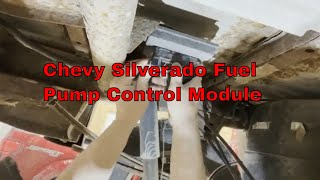
Typical fix: Replace the Fuel Pump Driver Module. Aftermarket modules from brands like Dorman are available and often pre-programmed, requiring no dealer visit. 🎬 See how to locate and replace the fuel pump driver module. OEM parts may require programming to the vehicle's VIN.
Est. part cost: $70-$150 - Fuel Rail Pressure Sensor (FRPS) Failure (2015-2016 GDI Models) 🟡 Medium Probability → Shop Fuel Pressure Sensor The sensor provides the critical feedback for fuel pressure control. GM issued TSB PIP5279A suggesting this sensor as a potential fix if diagnostics for P0089 and other fuel pressure codes are inconclusive.
How to confirm: Monitor the sensor's readings on a scan tool for erratic or illogical values (e.g., high pressure with engine off). Test the sensor's voltage output against specifications. Diagnosis can be difficult without a known-good sensor to compare against. TSB PIP5279A advises replacing the sensor if other diagnostics don't lead to a clear cause.
Typical fix: Replace the fuel rail pressure sensor. It is located on the fuel rail, under the intake manifold.
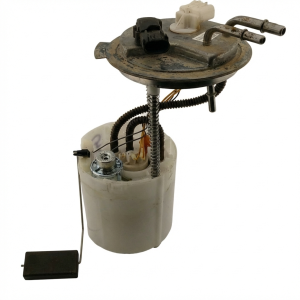
Est. part cost: $60-$100 - In-Tank Fuel Pump / Regulator Assembly Failure (2014 Port Injection Model) ⚪ Low Probability → Shop Fuel Pump The fuel pressure regulator is integrated into the fuel pump assembly on the 2014 model. A weak pump or failing internal regulator can cause pressure performance issues, though the FPDM is a more common failure point.
How to confirm: Connect a mechanical fuel pressure gauge to the fuel rail's service port. Check that pressure is within OEM specification at idle and does not drop off under load. This test should be performed after confirming the FPDM is functioning correctly.
Typical fix: Replace the in-tank fuel pump module assembly. This requires dropping the fuel tank.
Est. part cost: $200-$400
Rare But Worth Checking
- Wiring Harness Issues (2015-2016 GDI Models): Several TSBs point to wiring problems. TSB 20-NA-197 details how corrosion in the fuel pressure sensor connector can cause P0089 and other codes; the fix is to inspect, clean with dielectric grease, and replace the connector if damaged. TSB 21-NA-149 points to harness chafing against the ECM/TCM bracket, upper control arm, and shock tower bolt, which can short out various circuits.
- Restricted Fuel Feed Line to HPFP (2015-2016 GDI Models): A specific batch of fuel feed lines was manufactured with an extra internal check valve, causing fuel starvation and a P0089 code under hard acceleration. This is documented in GM TSB 15-06-04-001.
Diagnosis Steps
- Identify the Fuel System: Determine if you have a 2014 (Port Injection) or 2015-2016 (GDI) model, as the diagnostic path differs significantly.
- Scan for All Codes: Check for any other codes that may provide clues, such as rich codes (P0172/P0175) or other fuel pressure codes (P228C).
- (2015-2016 GDI) Check Engine Oil: Carefully smell the oil on the dipstick for a strong gasoline odor. If present, the HPFP has failed internally. Do not drive the vehicle. This is the most critical first check.
- (2015-2016 GDI) Monitor Fuel Pressure: Use an advanced scan tool to graph desired vs. actual fuel rail pressure. Perform a cautious test drive with light and heavy acceleration. A large discrepancy or pressure drop under load points to a weak HPFP or a restriction.
- (2014 Port Injection) Inspect FPDM: Locate the Fuel Pump Driver Module on the frame crossmember near the spare tire. Unplug and inspect the module and harness connector for green or white corrosion and flaking on the module's metal backplate.
- (2014 Port Injection) Test Fuel Pressure: Connect a mechanical gauge to the fuel rail. Verify pressure is within OEM specifications at idle and under load. This validates the in-tank pump's health.
- Inspect Wiring (GDI Models): Following TSB 21-NA-149, visually inspect the engine wiring harness for any signs of chafing, especially near the ECM bracket, upper control arm, and shock tower. Per TSB 20-NA-197, check the fuel pressure sensor connector for corrosion.
- Test Sensors: If the pump and wiring seem okay, test the fuel pressure sensor's circuit and output to ensure it is sending accurate signals to the ECM. If all other diagnostics are inconclusive, TSB PIP5279A suggests replacing the sensor.
Parts You'll Likely Need
- High-Pressure Fuel Pump (HPFP)
(OEM #12694362 (Superseded by 12710389, 12677329))— This is the most frequent cause of P0089 on 2015-2016 GDI models. Failure leads to incorrect fuel pressure and potential engine damage from oil contamination.
Trusted brands: ACDelco, Bosch
OEM price range: $400-$550
Aftermarket price range: $250-$400 - Fuel Pump Driver Module (FPDM)
(OEM #20964305 (or 20964304))— The primary cause of fuel delivery issues, including P0089, on the 2014 Port Injection model due to its vulnerable mounting location and susceptibility to corrosion.
Trusted brands: ACDelco, Dorman (601-130), Standard Motor Products (FPM108)
OEM price range: $150-$240
Aftermarket price range: $70-$120
Related Codes That Often Appear With This One
- P228C / P228D — P228C means 'Fuel Pressure Regulator 1 Exceeded Control Limits - Pressure Too Low' and P228D means 'Pressure Too High'. They are often set along with P0089 when the high-pressure fuel pump on GDI models is failing or the sensor is erratic.
- P0172 / P0175 — These 'System Too Rich' codes can appear on GDI models when the HPFP fails and leaks fuel into the engine oil. The PCV system pulls the fuel vapors from the crankcase into the intake, creating a rich condition that the oxygen sensors detect.
- P0192 / P0193 — These codes for 'Fuel Rail Pressure Sensor Circuit Low/High' are often seen with P0089 and point towards a faulty sensor or wiring issue, as noted in TSB PIP5279A.
Technical Service Bulletins (TSBs) & Recalls
- PIP5279A: Recommends replacing the Fuel Rail Pressure Sensor (FRPS) if diagnostics for P0089 and related codes are inconclusive.
- 20-NA-197: Addresses corrosion in the fuel pressure sensor connector as a cause for P0089, advising inspection and replacement of the connector pigtail with application of dielectric grease.
- 21-NA-149: Details multiple locations where the engine wiring harness can chafe and short out, including against the ECM bracket and upper control arm, causing various DTCs.
- 15-06-04-001: Identifies a batch of fuel feed lines with an extra internal check valve that can cause fuel restriction and trigger P0089 under load.
Platform-Specific Known Issues
- On 2015-2016 models, internal failure of the High-Pressure Fuel Pump can cause fuel to leak into the crankcase, contaminating the engine oil and leading to catastrophic engine damage if not addressed immediately.
Mechanic-Grade Diagnostic Values
- Low-Side Fuel Pressure (2014 Port Injection Model) — expected: 55-65 PSI with Key On, Engine Off (KOEO). At idle, pressure should be 43-45 PSI for FlexFuel engines or 52-59 PSI for non-FlexFuel.. Failure: Pressure below 55 PSI at KOEO or significantly outside the idle range indicates a weak in-tank pump or failing FPDM.
- High-Side Fuel Rail Pressure (2015-2016 GDI Models) — expected: 300-400 PSI while cranking. At idle, pressure can range from 500-1000 PSI. Under load, the system is capable of 2,000-2,800 PSI.. Failure: Failure to build pressure while cranking, or pressure that is significantly lower than desired on a scan tool, points to a failing HPFP.
- Fuel Rail Pressure Sensor (FRPS) Signal Voltage (2015-2016 GDI Models) — expected: Approximately 1.5V to 1.8V with Key On, Engine Off.. Failure: Voltage stuck at 0V, 5V, or a reading that doesn't correspond to pressure changes indicates a faulty sensor or wiring issue.
- FPDM Command Signal Voltage (2014 Port Injection Model) — expected: 12V pulse for 2-3 seconds on the Dark Green/White wire at Pin 13 of the FPDM connector when the key is first turned on.. Failure: No voltage signal from the PCM indicates a wiring issue or a fault in the PCM itself.
Hidden / Shadow Codes Worth Checking
- P069E: Fuel System Control Module (FSCM) Requested MIL Illumination. This code specifically indicates that the FPDM itself has detected an internal fault or a problem with the circuit it controls and has requested the Check Engine Light. (see via Standard OBD-II scanner. While not 'hidden', it's a critical code that directly implicates the FPDM on 2014 models.)
Scan Tool Commands That Help
- GDS2 / Tech2: Fuel Pump ON/OFF Command — For 2014 models, this command in the ECM output controls allows a technician to manually turn the fuel pump on and off to verify the FPDM, relay, and pump are functioning without the engine running.
- GDS2: Camshaft Position Actuator System Control — For 2015-2016 GDI models, if other codes like P00C6 are present, TSB PIP5130C suggests cycling the cam phaser solenoid 4-5 times. A stuck phaser can affect the lobe that drives the HPFP, causing pressure issues.
- Advanced Scan Tool (e.g., GDS2, Snap-on): Fuel Pressure Bleed-Down / Fuel Pump Disable — Before servicing the high-pressure fuel system on 2015-2016 models, a scan tool can be used to disable the fuel pumps, and the engine is then run until it stalls. This safely depressurizes the high-pressure lines.
Wiring & Ground Locations
- FPDM Connector (2014 Model) — On the Fuel Pump Driver Module, mounted to the frame crossmember near the spare tire.. Allows for direct testing. Pin 13 (Dark Green/White) is the 'on' signal from the PCM. Pin 32 (Red/White) is battery power. Pin 47 (Gray) is voltage output to the pump. Pin 1 (Black) is ground. Jumping Pin 32 to 47 should manually run the pump, bypassing the module for testing.
- Main Chassis/Cab Ground (K2XX) — On the passenger side frame rail, often requiring removal of the fender liner for access.. Corrosion at this primary ground point on 2015-2016 models is a known cause of numerous, difficult-to-diagnose electrical issues, including erratic sensor readings and module behavior that could trigger a P0089.
- Firewall to Engine Block Ground Strap — A braided strap connecting the firewall on the passenger side to the rear of the engine block.. This ground is critical for reducing electronic 'noise' for engine sensors. A corroded or broken strap can lead to incorrect signals from the fuel pressure sensor, causing the ECM to set performance codes.
Real Owner Repair Stories
- YouTube channel 'G Auto Repair' (2015 Chevrolet Equinox 2.4L (Different vehicle, but same GDI HPFP concept and codes)) — P0089 and P228D codes, engine running rough only when reaching operating temperature (around 215°F).
❌ Tried (didn't work) Initial diagnosis pointed towards the HPFP or sensor, but the problem was intermittent and temperature-dependent.
✅ What actually fixed it The root cause was a cheap, aftermarket timing chain tensioner from a previous repair that was losing oil pressure when hot. This caused the intake cam timing to wander slightly, which directly affected the cam-driven HPFP's performance and triggered the fuel pressure codes. Replacing the faulty tensioner with an OEM part resolved the issue. - Reddit user in r/mechanic (2013 Chevrolet Malibu (Similar GM fuel system logic)) — P228D and P0089, car went into limp mode.
❌ Tried (didn't work) Owner was preparing to diagnose the fuel pump, driver module, or sensor.
✅ What actually fixed it The user discovered the gas cap was not tightened correctly. After securing the gas cap and clearing the codes, the problem was resolved and did not return.
"I Checked Everything" — The Actual Cause
- In GDI engines like the 2015-2016 Tahoe, P0089 can be caused by a failing timing chain tensioner. Because the high-pressure fuel pump is driven by a lobe on the intake camshaft, a tensioner that loses oil pressure (especially when hot) can cause slight, erratic timing deviations. This directly impacts the pump's ability to build pressure correctly. This fault would not be found with a fuel system smoke test or pressure test, as the issue is mechanical and related to the base engine timing, not a leak in the fuel system itself.
OEM Part Supersession History
20964304→20964305— Updated hardware/software revision for the Fuel Pump Driver Module (FPDM) for 2014 models.
Heads up: 20964305 is the correct and backward-compatible replacement. Note that these modules often require VIN programming, though some aftermarket suppliers sell them pre-programmed.12694362, 12677329→12710389— Multiple revisions of the High-Pressure Fuel Pump (HPFP) for 2015-2016 GDI models to improve reliability.
Model Year Variations Within This Range
- 2014 vs 2015-2016: The fundamental fuel system change from Port Fuel Injection (PFI) in 2014 to Gasoline Direct Injection (GDI) in 2015 is the most critical variation. Diagnostic procedures and common failure parts (FPDM vs. HPFP) are completely different between these years and are not interchangeable.
Helpful Videos
Used OEM Parts in Stock
New Aftermarket Parts Available


The information in this article is provided for general reference and educational purposes only. Vehicle specifications, procedures, and part compatibility can vary by production date, trim level, and region. Always consult your vehicle's factory service manual and verify part numbers before purchasing or performing repairs. Safety-critical components such as airbags, seat belts, and braking systems should be installed by a qualified professional.
- Chevrolet TAHOE:
- 🧭 Diagnostic Flowchart
- 🎬 Helpful Videos
- 🛍️ Shop This Part
- What's Unique About the 2014-2016 Chevrolet TAHOE
- Symptoms You May Notice
- Most Likely Causes
- Rare But Worth Checking
- Diagnosis Steps
- Parts You'll Likely Need
- Related Codes That Often Appear With This One
- Technical Service Bulletins (TSBs) & Recalls
- Platform-Specific Known Issues
- Mechanic-Grade Diagnostic Values
- Hidden / Shadow Codes Worth Checking
- Scan Tool Commands That Help
- Wiring & Ground Locations
- Real Owner Repair Stories
- "I Checked Everything" — The Actual Cause
- OEM Part Supersession History
- Model Year Variations Within This Range
- 🎟️ Get 5% Off