

P0089 on 2006-2014 Ford Transit 2.2L TDCi: Causes and Fixes for Fuel Pressure Regulator Performance
On a 2006-2014 Ford Transit with the 2.2L TDCi engine, code P0089 almost always points to a faulty Suction Control Valve (SCV) on the high-pressure fuel pump. This valve, also known as a Fuel Metering Valve, is a well-documented failure point. Replacing the SCV is the most common fix, with genuine Denso parts being strongly recommended by owners to avoid repeat failures. Aftermarket parts cost around $50-$100, while a genuine Denso unit is slightly more.
- P0089 on a 2.2L TDCi Transit almost always points to the Suction Control Valve (SCV) on the high-pressure fuel pump.
- Symptoms are serious and include stalling and limp mode, making the vehicle unreliable.
- Always start diagnosis by checking the fuel filter, as a clogged filter can cause similar pressure issues.
- After replacing the SCV, you MUST use a capable scan tool to perform a 'pump learn' or adaptation procedure for the repair to be successful.
- Do not immediately assume the entire high-pressure pump needs replacement; the SCV is a separate, much cheaper component that is the far more likely culprit.
What's Unique About the 2006-2014 Ford Transit
The Ford Transit of this era uses a high-pressure common-rail fuel system, typically from Denso. The 'fuel pressure regulator' for this code is not on the fuel rail itself, but is a Suction Control Valve (SCV) or Fuel Metering Valve mounted on the high-pressure pump. This valve controls the volume of fuel entering the pump's high-pressure chambers. It is a well-documented failure point on the 2.2L Duratorq engine, often sticking or failing electronically, leading directly to the P0089 code. Some owners and TSBs also mention a Pressure Relief Valve (PRV) on the fuel rail which can activate due to pressure spikes from a faulty SCV, sometimes leading to confusion.
Generation note: The 2006-2014 period primarily covers the Ford Transit Mk7 (which launched in 2006). A facelift occurred in mid-2006 which included updating the diesel engines to TDCi common-rail systems. The fourth generation (Mk8) began to launch in 2013/2014. However, the 2.2L Duratorq TDCi fuel system architecture (often Denso) is similar across these models, making the diagnosis for P0089 consistent. This issue is also prevalent on the 2.4L and 3.2L Duratorq engines of the same era.
Symptoms You May Notice
- Check engine light or powertrain warning light (cog with exclamation mark) is on.
- Engine goes into "limp mode" with severely reduced power.
- Engine cuts out or stalls, especially under load, when climbing hills, or when accelerating.
- Erratic, hunting, or lumpy idle, sometimes fluctuating by 100-200 RPM. 🎬 See how a faulty SCV causes erratic idle and hunting.
- Difficulty starting the engine, or it starts and then dies after a few seconds.
- Poor acceleration and general lack of power, feeling like a non-turbo engine.
- Visible clouds of grey or black smoke from the exhaust when accelerating.
- Replacing the entire high-pressure fuel pump when only the Suction Control Valve (SCV) is faulty.
- Replacing the fuel rail pressure sensor without first verifying its readings are incorrect or that the SCV is functioning properly.
- Replacing the Pressure Relief Valve (PRV) without addressing the root cause of the overpressure, which is usually the SCV.
Most Likely Causes
- Faulty Suction Control Valve (SCV) / Fuel Metering Valve 🔴 High Probability The SCV on the Denso high-pressure fuel pump is a very common failure item on the 2.2L and 2.4L Duratorq engines. It can stick due to internal wear or contamination from fuel, causing pressure to be unregulated.
How to confirm: Monitor 'FRP_DES' (Desired Fuel Rail Pressure) vs. 'FRP' (Actual Fuel Rail Pressure) with a scan tool like FORScan. A large, erratic discrepancy, especially under load, points to the SCV. The code P0089 itself 🎬 Watch: Diagnosing P0089 and air flow codes on a 2.2L Transit. is a strong indicator. Forum users strongly recommend using a genuine Denso SCV, as aftermarket versions often fail quickly or don't allow the 'pump learn' procedure to complete successfully.
Typical fix: Replace the Suction Control Valve on the high-pressure fuel pump. After replacement, a 'pump learn' or 'fuel injection pump adaptation' procedure must be performed with a capable scan tool like FORScan or Ford's IDS. Resetting the PRV (Pressure Relief Valve) counters may also be necessary.
Est. part cost: $50 - $180 - Clogged Fuel Filter 🟡 Medium Probability → Shop Fuel Filter Diesel fuel systems are sensitive to contamination. A clogged filter restricts fuel flow to the high-pressure pump, causing it to struggle to meet pressure demands, which can trigger P0089.
How to confirm: Check the vehicle's service history. If the fuel filter hasn't been replaced in over 15,000-20,000 miles, it's a prime suspect. This should be the first step in diagnosis due to its low cost.
Typical fix: Replace the fuel filter with a new, high-quality OEM or equivalent unit. Ensure the housing is properly sealed to prevent air ingress.
Est. part cost: $25 - $60 - Air in the Fuel System ⚪ Low Probability Air can be drawn into the low-pressure side through aging seals, loose connections, a cracked fuel filter housing, or even poorly fitted filters. Air is compressible and causes wild fluctuations in fuel pressure.
How to confirm: Visually inspect all fuel lines and the fuel filter housing for signs of leaks or damage. A Ford Technical Service Bulletin (TSB) specifically notes that P0089 can be triggered by air in the fuel, and that a PCM software update was released for vehicles built before mid-2009 to make the system less sensitive.
Typical fix: Locate and repair the source of the air leak. This may involve replacing O-rings, fuel lines, or the filter housing. In some cases, a PCM re-program to the latest calibration is required.
Est. part cost: $10 - $200 - Faulty Fuel Rail Pressure (FRP) Sensor ⚪ Low Probability → Shop Fuel Pressure Sensor
How to confirm: Monitor the fuel rail pressure reading on a scan tool with the key on, engine off. The reading should be close to zero (or atmospheric pressure). If it shows significant pressure when the engine isn't running, the sensor is likely faulty. However, forum members note that this sensor fails much less frequently than the SCV.
Typical fix: Replace the fuel rail pressure sensor, which is located on the end of the fuel rail.
Est. part cost: $40 - $120
Rare But Worth Checking
- Failing High-Pressure Fuel Pump: → Shop Fuel Pump While the SCV is the most common part to fail on the pump, the pump itself can fail mechanically, for instance, due to a broken internal plunger spring. This is a much more expensive repair and is often misdiagnosed when the SCV is the actual problem.
- Leaking Fuel Injectors: → Shop Fuel Injector An injector that is leaking excessively (either internally via the return line or externally) can cause a drop in rail pressure, potentially triggering P0089. A leak-off test can help diagnose this. In one forum thread, replacing two badly leaking injectors was part of the diagnostic process, though the P0089 code remained until other issues were addressed.
- Wiring Issues: Damaged wiring or a poor connection to the SCV or the fuel rail pressure sensor can cause erratic signals and trigger the code. A TSB mentions inspecting the wiring to the FRP sensor and SCV as a diagnostic step.
- Activated/Failed Pressure Relief Valve (PRV): The PRV is a safety device on the fuel rail that opens if pressure gets too high (often due to a sticking SCV). Sometimes it can fail or get stuck open, causing a permanent loss of pressure. A TSB and many forum posts discuss resetting the 'PRV counters' after a repair.
Diagnosis Steps
- Connect a diagnostic scan tool (ideally one with Ford-specific software like FORScan) to read the fault codes and any associated freeze frame data. Note any other codes present, like P1250 or P0087/P0088.
- Check the fuel filter. If its age is unknown or it's overdue for replacement, replace it with a quality part as a first, low-cost step.
- Using the scan tool, monitor the live data for 'FRP_DES' (Desired Fuel Rail Pressure) and 'FRP' (Actual Fuel Rail Pressure) at idle and while driving under load. At idle, pressure should be around 230 bar (23,000 kPa). Significant deviations or fluctuations point towards a regulation issue.
- Inspect the wiring and connectors at the Suction Control Valve (SCV) on the high-pressure pump and the Fuel Rail Pressure (FRP) sensor for any signs of damage, corrosion, or looseness.
- Given the high probability, the next logical step is to replace the Suction Control Valve (SCV). It is highly recommended to use a genuine Denso part to avoid compatibility issues.
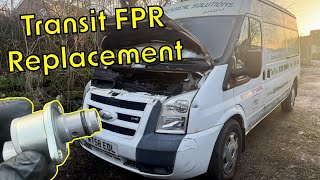
- After replacing the SCV, use the scan tool to perform the 'Fuel Injection Pump Learn' and 'Reset PRV counters' functions. This is a critical step for the PCM to adapt to the new valve and is essential for the fix to work. 🎬 Watch: Step-by-step SCV replacement and fuel pump relearn procedure.
- If the code returns, perform a fuel injector leak-off test to check for faulty injectors.
- If all else fails, further diagnosis of the high-pressure pump itself, or checking for intermittent air leaks in the low-pressure fuel lines, is necessary.
Parts You'll Likely Need
- Fuel Pump Suction Control Valve
Related Codes That Often Appear With This One
- P0088 — This code means 'Fuel Rail/System Pressure - Too High'. It often appears with P0089 when the SCV sticks and causes a pressure spike, which may then activate the pressure relief valve (PRV).
- P0087 — This code means 'Fuel Rail/System Pressure - Too Low'. It can occur if the SCV fails in a way that starves the pump of fuel, or if the fuel filter is severely clogged.
- P1250 — This is a Ford-specific code that can indicate a fault in the SCV control circuit or that the SCV has seized, directly pointing to the valve as the source of the pressure control problem.
- P121C — A Ford-specific code for 'Cylinder Balance - Injector Restricted' or related to fuel pressure. It is sometimes seen alongside P0089 when pressure issues affect injector performance.
Technical Service Bulletins (TSBs) & Recalls
- A Ford TSB for 2006.5+ Transit models up to build date 30.06.2009 addresses P0089. It states that if P0089 appears without certain other codes (like P1250), the cause is likely the system's response to air in the fuel. The fix is to reprogram the PCM with an updated calibration, reset the PRV counters, and clear DTCs. If code P1250 is also present, it points directly to a seized SCV due to contamination.
Platform-Specific Known Issues
- The 'Pump Learn' and 'PRV Reset' are Critical: Numerous owner experiences confirm that simply replacing the Suction Control Valve is not enough. The PCM must be told to adapt to the new valve using a diagnostic tool like FORScan to perform the 'Fuel Injection Pump Learn' procedure. Forgetting this step almost always results in the code returning immediately.
- Genuine Denso Parts are Highly Recommended: A recurring theme in owner forums is the failure of cheaper, non-branded aftermarket SCVs. Many users report chasing the P0089 fault after installing an aftermarket valve, only to solve it by installing a genuine Denso (DCRS300260) or Ford-branded part.
- PCM Update for Air-in-Fuel Sensitivity: According to a Ford TSB for models built before July 2009, the P0089 code could be triggered too sensitively in response to minor amounts of air in the fuel system. A PCM software update was issued to correct this, making the system more robust. If the vehicle falls in this range, checking the calibration level is a valid diagnostic step.
Mechanic-Grade Diagnostic Values
- Fuel Rail Pressure (FRP) at idle — expected: Approximately 230 bar (23,000 kPa), with a tolerance of +/- 10-15%.. Failure: Wild fluctuations (e.g., 200-230 bar), or pressure that is stuck significantly high (e.g., 500-600 bar) or low.
- Injector leak-off volume — expected: 25-40ml over a timed test.. Failure: Significantly more volume than other injectors, indicating excessive internal leakage.
- Fuel Rail Pressure Sensor (FRP) voltage — expected: Approximately 0.5V at KOEO (Key On Engine Off) and increasing with pressure.. Failure: A reading of significant pressure at KOEO, or voltage that doesn't correspond to actual pressure. One user noted 2V on the signal wire during a fault condition where pressure was stuck high.
Hidden / Shadow Codes Worth Checking
- P1250-71-XX: Indicates the Suction Control Valve (SCV) has seized, causing a loss of fuel pressure control. This is often due to fuel contamination or internal wear. (see via Ford IDS or other advanced diagnostic tools that can read manufacturer-specific status bytes.)
- P1250-13-XX: Indicates the SCV wiring has an open circuit. This points to a wiring or connector fault rather than a mechanical issue with the valve itself. (see via Ford IDS or other advanced diagnostic tools that can read manufacturer-specific status bytes.)
- P116E: Fuel Pressure Relief Valve (PRV) activated. This code was added in a later PCM calibration. If P0089 is present without P116E on a pre-2009 vehicle, it indicates the PCM software is outdated and should be updated. (see via Standard OBD-II scanner, FORScan, or Ford IDS.)
Scan Tool Commands That Help
- FORScan / Ford IDS: Reset the fuel pressure relief valve counter — This is a mandatory first step after replacing the SCV or PRV. Failure to reset this counter can prevent the PCM from clearing the P0089 code, even if the mechanical fault is fixed.
- FORScan / Ford IDS: Fuel Injection Pump Learn — This procedure calibrates the PCM to the characteristics of the new SCV. It must be performed after replacing the SCV for the system to regulate pressure correctly. It should be done after resetting the PRV counter.
- FORScan / Ford IDS: Pilot Correction Learn / Injector Learn — This is the final step in the fuel system calibration process, performed after the pump learn. It fine-tunes the injector timing and fuel delivery based on the newly learned pump parameters.
- Ford IDS: Module Reprogramming -> PCM — For vehicles built before mid-2009, this is used to update the PCM to a newer software version that is less sensitive to minor amounts of air in the fuel, which could otherwise trigger P0089.
Wiring & Ground Locations
- Fuse Box Ground — Under the under-hood fuse box (on the right side when facing the engine). The fuse box bracket and several earth wires bolt to the inner wing/fender.. This is a critical ground point for many engine management systems. Corrosion here due to water ingress is a well-known Transit issue and can cause a host of intermittent electronic faults, including erratic sensor readings that could contribute to fuel pressure regulation problems.
- Engine/Gearbox Ground Strap — Connects the engine block or gearbox housing to the vehicle's chassis/frame. On RWD models, it often runs from a starter motor mounting bolt to the chassis. On FWD models, a strap runs from the gearbox to the inner wing below the fuse box.. A poor engine ground can cause the PCM and its sensors to have an unstable voltage reference, leading to incorrect readings from the Fuel Rail Pressure sensor and improper command signals to the Suction Control Valve.
- Battery Main Ground — The main negative battery cable connects to the floor pan under the driver's seat, often at one of the seat rail mounting bolts.. While less likely to cause this specific code than the engine grounds, a poor main ground can cause widespread electrical problems and starting issues that may confuse diagnosis.
Real Owner Repair Stories
- Ford Transit Forum thread 'Fault code P0089-7A-28' (2008 Ford Transit 2.2TDI FWD) — Limp mode, P0089 code present.
❌ Tried (didn't work) Replaced SCV, PRV, and fuel pressure regulator sensor., Ran 'pump learn' procedure., The code remained and fuel pressure was stuck extremely high at 500-600 bar.
✅ What actually fixed it The owner had coincidentally ordered two SCVs. Out of desperation, they swapped the first new SCV for the second new one. This immediately solved the problem; pressure returned to normal, the pump learn completed, and the van drove perfectly. The first new SCV was faulty out of the box. - Ford Transit Forum thread 'Mk7 2.4TCDi RWD, Loss of Power, P0089 and P121C' (Ford Transit Mk7 2.4TCDi RWD) — Limp mode, loss of power under load, P0089 and P121C codes.
❌ Tried (didn't work) Replaced PRV and SCV with aftermarket parts (from PF Jones)., Performed 'Pump learn' and 'cleared the PRV count' using FORScan.
✅ What actually fixed it The P0089 code returned immediately after the repair. A forum veteran diagnosed the issue remotely, stating that non-genuine (aftermarket) SCVs rarely pass the learn procedures correctly or they fail soon after. The implied fix was to replace the parts with genuine Ford or Denso units. - Ford Transit Forum thread '2012 2.2 CYRA engine p0089 and limp mode help' (2012 Ford Transit 2.2 FWD (CYRA engine)) — Loss of power, engine malfunction light, P0089 code.
❌ Tried (didn't work) Replacing two badly leaking injectors., Replacing the SCV with a genuine Ford item and calibrating it., Performing a PCM update., Resetting counters and performing pump learn., Checking wiring for chafing.
✅ What actually fixed it The issue remained unresolved in the thread, but the diagnostic path highlights a complex case where multiple faults (leaking injectors, potential SCV issue) were present. The fault only occurred under load, suggesting the problem might be related to the high-pressure pump's ability to sustain volume, a subtle air leak, or a faulty PRV, which was the final suggestion offered.
"I Checked Everything" — The Actual Cause
- In the context of P0089, the equivalent of a 'smoke test clean' scenario is when all standard checks seem to pass, but the fault persists. One owner reported their mechanic performed a smoke test which revealed no leaks, yet the P0089 code would not clear after replacing the SCV and PRV with aftermarket parts. The actual, unconfirmed cause was almost certainly the use of non-genuine parts that could not perform to OEM specifications, even though they were new and appeared to function.
When the Usual Fixes Don't Work
- While Pass 2 correctly identifies the SCV as the most common culprit, real-world technician stories show that simply replacing the valve is not a guaranteed fix. In one documented case, a user replaced the SCV, PRV, and FRP sensor, but the P0089 code and limp mode persisted with fuel pressure stuck at a dangerously high 600 bar. The root cause was a brand-new, out-of-the-box SCV that was defective. Replacing the faulty new part with another new SCV instantly resolved the issue. This serves as a critical counterpoint: even with a correct diagnosis, the repair can fail due to poor quality control on replacement parts, leading a mechanic to wrongly question their initial diagnosis.
OEM Part Supersession History
6C1Q-9358-AA, 294200-0160→Ford: 1514885, 6C1Q-9358-AB / Denso: DCRS300260, 294200-0360— Revisions to improve reliability and performance.
Heads up: The common SCV for the Euro 4 engine (approx. 2006-2011) will NOT fit the Euro 5 engines used from 2011 onwards. Visual confirmation between the old and new part is recommended as 'long' and 'short' body versions exist.
Model Year Variations Within This Range
- 2006 - Mid-2009: Vehicles built before 06/30/2009 have a PCM calibration that is overly sensitive to small amounts of air in the fuel system, which can trigger P0089. A Ford TSB recommends a PCM software update as the primary fix if no other mechanical faults are found.
- 2011 - 2014: These later models use a Euro 5 compliant 2.2L Duratorq engine. The Suction Control Valve (SCV) and other fuel system components are different from the earlier Euro 4 engines. Part numbers are not interchangeable.
Diagnostic Flowchart
Used vs. New Parts: Buying Guide for This Vehicle
When a used part is the smart pick: For this specific P0089 fault, using used parts is strongly discouraged. The key components (SCV, PRV) are high-wear, precision electronic items where remaining life is impossible to determine. A used part is highly likely to have the same wear or sticking issues that caused the original fault.
OEM-only on this vehicle (don't cheap out):
- Suction Control Valve (SCV)
- Pressure Relief Valve (PRV)
Aftermarket brands forum-validated for this vehicle:
- Denso (This is the Original Equipment Manufacturer)
Brands owners have reported issues with on this vehicle:
- Unbranded 'white-box' parts from online marketplaces.
- One user specifically reported that parts from 'PF Jones' did not resolve the P0089 code even after the correct learn procedures were performed.
Real Owner Stories
Aggregated from forums and TSBs cited above. Mileages and costs reflect what owners reported in those sources.
2012 Ford Transit 2.2L (CYRA engine)
Symptoms: The vehicle had code P0089 and was stuck in limp mode.
What fixed it: The owner went through a long diagnostic process that ultimately involved fixing leaking injectors, replacing the Suction Control Valve (SCV/IMV), and performing a PCM update.
Source hint: https://www.fordtransitforum.com/forum/viewtopic.php?f=5&t=159353 - A 2016 thread titled '2012 2.2 CYRA engine p0089 and limp mode help'
2006-2014 Ford Transit (Mk7)
Symptoms: The P0089 code persisted even after the owner replaced the Suction Control Valve (SCV), Pressure Relief Valve (PRV), and Fuel Rail Pressure (FRP) sensor.
What fixed it: The owner was advised that the 'pump learn' procedure often fails when using non-genuine parts, and the likely solution was to install a genuine Denso SCV and correctly perform the adaptation procedure.
Source hint: https://www.fordtransitforum.com/forum/viewtopic.php?f=5&t=209778 - A 2023 thread where a user replaced the SCV, PRV, and FRP sensor but still had the code
2006-2014 Ford Transit 2.2L TDCi
Symptoms: Owners reported chasing the P0089 fault after installing a new, but non-genuine, aftermarket Suction Control Valve.
What fixed it: The problem was resolved only after replacing the aftermarket part with a genuine Denso (DCRS300260) or Ford-branded SCV and performing the pump learn procedure.
Source hint: vehicle_specific_issues: Genuine Denso Parts are Highly Recommended
Related OBD-II Codes
Frequently Asked Questions
I replaced the Suction Control Valve (SCV) on my Transit, but the P0089 code came back. What did I miss?
Does it matter what brand of Suction Control Valve I use to fix P0089?
My 2008 Transit has code P0089. Is there a Ford TSB or recall for this?
What is the correct fuel rail pressure for a 2.2L Duratorq TDCi at idle?
What's the first and cheapest thing I should check when I get a P0089 code?
The Ford TSB for P0089 mentions code P1250. What does it mean if I have both codes?
Helpful Videos


We Have This Part in Stock

The information in this article is provided for general reference and educational purposes only. Vehicle specifications, procedures, and part compatibility can vary by production date, trim level, and region. Always consult your vehicle's factory service manual and verify part numbers before purchasing or performing repairs. Safety-critical components such as airbags, seat belts, and braking systems should be installed by a qualified professional.
- Ford Transit:
- 🧭 Diagnostic Flowchart
- 🎬 Helpful Videos
- 🛍️ Shop This Part
- What's Unique About the 2006-2014 Ford Transit
- Symptoms You May Notice
- Most Likely Causes
- Rare But Worth Checking
- Diagnosis Steps
- Parts You'll Likely Need
- Related Codes That Often Appear With This One
- Technical Service Bulletins (TSBs) & Recalls
- Platform-Specific Known Issues
- Mechanic-Grade Diagnostic Values
- Hidden / Shadow Codes Worth Checking
- Scan Tool Commands That Help
- Wiring & Ground Locations
- Real Owner Repair Stories
- "I Checked Everything" — The Actual Cause
- When the Usual Fixes Don't Work
- OEM Part Supersession History
- Model Year Variations Within This Range
- Used vs. New Parts: Buying Guide for This Vehicle
- Real Owner Stories
- 2012 Ford Transit 2.2L (CYRA engine)
- 2006-2014 Ford Transit (Mk7)
- 2006-2014 Ford Transit 2.2L TDCi
- Related OBD-II Codes
- Frequently Asked Questions
- 🎟️ Get 5% Off