

OBD-II Code P0096: Intake Air Temperature Sensor 2 Performance Problem
What P0096 means, why it triggers, and how to fix it
- Code P0096 triggers when Intake Air Temperature (IAT) Sensor 2 sends an illogical reading, immediately dropping fuel economy by up to 25%.
- Verify the sensor is actually bad by comparing live data on a cold engine; IAT1, IAT2, and Coolant Temperature should all read within 2°F of each other.
- Inspect the sensor's wiring harness and connector first, as heat damage or corrosion causes 25% of P0096 codes.
- Ford EcoBoost and Chevy Cruze owners should check for specific Technical Service Bulletins (TSBs), as integrated TMAP sensor failures frequently cause this code.
What Does P0096 Mean?
The Powertrain Control Module (PCM) detected an erratic or out-of-range signal from Intake Air Temperature (IAT) Sensor 2. This sensor measures air temperature after the turbocharger or supercharger. An irrational signal disrupts the PCM's air-fuel mixture and ignition timing calculations.
Technical definition: SAE/OBD-II defines P0096 as "Intake Air Temperature Sensor 2 Circuit Range/Performance (Bank 1)". The PCM flags this when the IAT2 signal fails a plausibility check against IAT Sensor 1 or the Engine Coolant Temperature (ECT) sensor. On a cold start (engine off for 5+ hours), the PCM expects the IAT2 reading to be within 2°F of the IAT1 and ECT sensors.
Can I Drive With P0096?
Yes, But With Caution. You can drive with this code, but expect poor fuel economy and reduced engine power. Fix it within two weeks. Ignoring it causes long-term damage like carbon buildup and catalytic converter failure, adding $900 to $2,500 to your repair bill.
Common Causes
- Faulty Intake Air Temperature (IAT) Sensor 2 (Very Common) — Accounts for up to 70% of cases. The sensor's internal thermistor fails from age or heat exposure and sends incorrect, but not absent, readings.
- Wiring or Connector Issues (Common) — Fixes about 25% of issues. Wires sustain damage from engine heat, vibration, or rodents. Connectors become loose, corroded, or contaminated with oil, degrading the signal.
- Dirty or Contaminated Sensor (Less Common) — Oil or PCV grime coats the sensor element, insulating it from the air and causing delayed or inaccurate temperature readings.
- Blocked Intercooler or Aftermarket Modifications (Less Common) — Aftermarket accessories like winches or light bars blocking airflow to the intercooler cause intake temperatures to spike, triggering this code on vehicles like the Ford Bronco.
- Intake Airflow Restrictions or Leaks (Rare) — Boost leaks or a severely clogged engine air filter alter the temperature and pressure of the air reaching the sensor, causing implausible readings compared to PCM expectations.
- Faulty Powertrain Control Module (PCM) or Software Anomaly (Very Rare) — The internal circuit fails or the software has a logic error. Several TSBs require a PCM reflash to correct how it interprets sensor data. Consider this only after exhausting all other possibilities.
Symptoms
- Check Engine Light is On — The first and sometimes only symptom. The light illuminates when the PCM flags the sensor's performance as irrational.
- Reduced Fuel Economy — Expect a 15-25% drop in MPG. The PCM defaults to a richer, less efficient fuel map to protect the engine.
- Sluggish Acceleration and Turbo Lag — The car feels slow, hesitates during acceleration, and limits turbo boost to prevent engine damage from perceived high intake temperatures.
- Rough Idle or Stalling — The engine shakes or runs unevenly when stopped, and occasionally stalls because the air-fuel mixture is incorrect for idle conditions.
- Hard Starting — The vehicle struggles to start in very hot or cold weather because the PCM receives incorrect temperature data for the initial fuel mixture.
- Black Smoke from Exhaust — An incorrect sensor reading causes an overly rich fuel mixture, resulting in black smoke from unburnt fuel during acceleration.
Diagnostic Flowchart
Tap your situation to follow the diagnostic path that matches what you're seeing on this code.
Common Fixes & Costs
- Replace IAT Sensor 2 — Parts: $30-$100, Labor: $75-$200, ~0.5 hr book time (DIY)
- Clean IAT Sensor 2 and Connector — Parts: $10-$15, Labor: $0, ~0.2 hr book time (DIY)
- Repair Wiring or Replace Connector — Parts: $15-$40, Labor: $150-$300, ~1.5 hr book time (Intermediate)
- Professional Diagnosis — Parts: $0, Labor: $120-$180, ~1.2 hr book time (Pro)
- Replace Engine Air Filter — Parts: $15-$50, Labor: $0-$25, ~0.2 hr book time (DIY)
Used vs. New Parts: Buying Guide
When a used part is worth it: Buying a used electronic sensor is not recommended due to the low cost of new aftermarket parts. Consider a used sensor only as a last resort for budget-critical repairs on an older, high-mileage vehicle.
Donor-vehicle mileage cap: roughly under 50000 miles for the part to have meaningful remaining life.
Donor quality checklist:
- Verify the part number is an exact match.
- Inspect connector pins for corrosion, bending, or water damage.
- Avoid parts from vehicles in regions with heavy road salt use.
Decision logic:
- If The cost of a new aftermarket sensor is under $100. → Always buy new. The reliability and warranty outweigh the minimal savings.
- If Vehicle is over 150,000 miles AND the budget is extremely tight. → A used part from a low-mileage donor is a calculated risk.
- If The part is integrated into a more expensive assembly (like a TMAP sensor). → Favor a new part to avoid paying for labor twice if the used part fails prematurely.
Warranty tradeoff: Used parts typically come with a 30-90 day warranty. New aftermarket parts offer a 1-year to limited lifetime warranty. New OEM parts offer a 1-2 year warranty.
Worst-case if a used part fails: $150-$350 if a used sensor fails after installation, accounting for repeat diagnostic fees and labor.
What Happens If You Wait — Timeline
- 0-2 weeks: Code sets and MIL illuminates. Driver notices a slight increase in fuel consumption. (MPG impact: 0-5%% · Added cost: $0-$20 in wasted fuel)
- 2 weeks - 3 months: Engine consistently runs on a default rich fuel map. MPG loss becomes obvious. Occasional hesitation or rough idle on cold starts. (MPG impact: 5-15%% · Added cost: $50-$150 in wasted fuel)
- 3-8 months: Sustained rich mixture causes the catalytic converter to operate at excessively high temperatures, degrading the precious metals. Carbon buildup occurs on spark plugs. (MPG impact: 10-20%% · Added cost: $900-$2,500 as catalytic converter efficiency drops below threshold.)
- 8+ months: Complete catalytic converter meltdown occurs. The internal honeycomb structure collapses, creating a major exhaust blockage leading to severe power loss and stalling. (MPG impact: 20-35%+% · Added cost: $1,500-$3,000+ for catalytic converter replacement and fouled spark plugs.)
Cost of Not Fixing It
- 0-1 month: Noticeable decrease in fuel economy (up to 25%), poor acceleration, and rough idling. (Added cost: $20-$60 in wasted fuel per month.)
- 1-6 months: Running a consistently rich fuel mixture causes carbon buildup on engine components and begins to overheat the catalytic converter. (Added cost: $900-$2,500 if the catalytic converter requires replacement.)
- 6+ months: Severe and irreversible damage to the catalytic converter is highly likely. Spark plug fouling and increased stress on internal engine components occur. (Added cost: $1,200-$2,800+ for catalytic converter and secondary engine repairs.)
Diagnosis Steps
- Read Codes & Live Data (Cold Start Check)
With the engine off and cold (sitting for 5+ hours), use an OBD-II scanner to view live data. The IAT Sensor 2 reading must be within 2-3°F of the IAT Sensor 1 and Engine Coolant Temperature (ECT) sensors. If it's significantly different, or stuck at an extreme value (-40°F or 250°F), the sensor or circuit is faulty.
Tools: ['OBD-II Scan Tool with Live Data'] - Visually Inspect the Sensor and Wiring
Locate IAT Sensor 2 (often in a charge pipe after the turbo/intercooler or integrated into the MAP sensor). Look for cracked plastic, loose or corroded connector pins, oil contamination, or frayed wires. Ensure the connector is plugged in securely.
Tools: ['Flashlight'] - Clean the Sensor
If the sensor looks dirty, remove it and clean the tip with dedicated Mass Airflow Sensor cleaner. Do not touch the sensing element. Allow it to dry completely before reinstalling, clear the codes, and test drive.
Tools: ['MAF Cleaner', 'Screwdriver or Socket Set'] - Test the Sensor's Resistance (Pro Tip 1)
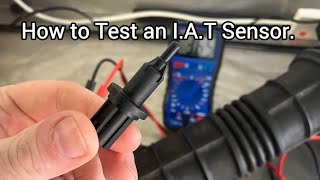
Unplug the sensor and use a multimeter set to Ohms (Ω) to measure resistance across its terminals. Compare this to the service manual chart (e.g., ~37,000Ω at 32°F, ~2,500Ω at 122°F). Gently heat the sensor with a hairdryer; resistance must decrease smoothly. If it's out of spec or static, replace the sensor.
Tools: ['Multimeter', 'Hairdryer'] - Test the Circuit Wiring (Pro Tip 2)
With the key on, engine off, and sensor unplugged, use a multimeter to check the connector. One wire must have a 5-volt reference signal from the PCM; the other must show continuity to ground (<0.1Ω). Perform a 'wiggle test' by shaking the harness while monitoring live data; temperature jumps confirm an intermittent wiring fault.
Tools: ['Multimeter', 'Backprobe Pins'] - Inspect for Mechanical Issues
If electrical tests pass, inspect the charge air cooler (intercooler) for blockages from debris or aftermarket accessories. Check for boost leaks in the intake tract between the turbo and the engine, which skew temperature readings.
Tools: ['Basic Hand Tools']
When This Code Triggers (Freeze-Frame Conditions)
- Engine Coolant Temp: 180-200°F (82-93°C) (During normal operation after warm-up, or during a cold start plausibility check where it's compared to IAT1.)
- RPM: 1500-2500 (Sets during steady-state cruising or moderate acceleration when sensor readings should be stable.)
- Engine Load: 30-60% (Under moderate load, such as climbing a slight incline, when the PCM actively cross-references sensor data.)
- Vehicle Speed: 35-55 mph (56-88 kph) (Occurs during city or highway driving when airflow and temperature are relatively consistent.)
Related Codes
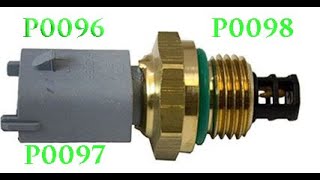
- P0095 — Indicates a circuit malfunction (open or short) for IAT Sensor 2. P0096 is for performance (illogical signal), while P0095 means the signal is completely missing or stuck at a hard electrical limit (-40°F).
- P0097 — Indicates the IAT Sensor 2 circuit voltage is stuck low. Low voltage is interpreted as high temperature, showing an impossibly high reading on a scan tool. P0096 is a rationality check failure, not a hard circuit fault.
- P0098 — Indicates the IAT Sensor 2 circuit voltage is stuck high. High voltage is interpreted as very low temperature (-40°F). P0096 is triggered by a signal that is present but illogical.
- P0111 — A range/performance code for IAT Sensor 1 (pre-turbo). Seeing both P0111 and P0096 together points to a larger intake system issue, a shared wiring harness problem, or an ECM software issue.
Climate & Environmental Factors
- Hot Weather: High ambient temperatures exacerbate issues with inefficient intercoolers or airflow blockages (e.g., from aftermarket accessories), causing IAT2 readings to exceed thresholds.
- Cold Weather: A slow or inaccurate sensor causes hard starting and rough running as the PCM struggles to calculate the correct cold-start fuel mixture.
- High Humidity: Accelerates corrosion on connector pins and wiring, leading to poor electrical connections and intermittent sensor signals.
How to Talk to a Mechanic About This Code
Say this: "I have an OBD-II code P0096 for the IAT Sensor 2 performance. Before replacing any parts, please check the live data from the IAT1, IAT2, and Coolant Temp sensors on a cold engine to see if one is an outlier. Also, visually inspect the sensor's wiring and connector for heat damage or corrosion."
This signals you understand the correct diagnostic procedure. It directs the mechanic to perform a data-driven diagnosis rather than just replacing the most common part, saving you money if the issue is a simple wiring fault.
Avoid saying:
- 'Just fix whatever's wrong'
- 'My check engine light is on, can you look at it?' (too vague — invites upsell)
- 'Whatever you recommend'
Questions to ask before authorizing the repair:
- What were the temperature readings for IAT1, IAT2, and ECT on the cold engine scan?
- Did you find any visible damage, corrosion, or oil contamination on the sensor's wiring or connector?
- If you are recommending a sensor replacement, did you test the old sensor's resistance or voltage to confirm it was faulty?
- Have you checked for any Technical Service Bulletins (TSBs) related to code P0096 for my specific vehicle?
Where to Take It: Dealer vs Independent vs Chain
- Dealer:
Best for: Vehicles still under powertrain or emissions warranty, Known manufacturer-specific issues covered by a TSB (e.g., Ford EcoBoost PCM reflash), Complex electrical diagnostics
Downsides: Highest labor rates (1.5-2x vs. independent shops), May recommend replacing a larger assembly when only a small part has failed (Typical cost: +50% vs. baseline) - Independent Shop:
Best fit. P0096 is a common code that most competent independent shops diagnose and repair effectively, offering the best balance of expertise and cost.
Best for: Out-of-warranty vehicles where cost is a factor, Common codes like P0096 with well-known fixes, Sensor replacement and basic wiring repairs
Downsides: Quality varies widely—vet shops based on reviews and ASE certifications, May lack expensive, dealer-specific diagnostic software for complex issues (Typical cost: +0% vs. baseline) - Chain Shop:
Acceptable, but with caution. Best used only if you have already diagnosed a faulty sensor and just need it replaced. AVOID for initial diagnosis of the code.
Best for: Simple, straightforward part replacements when you are certain of the diagnosis
Downsides: Technician skill varies dramatically, High pressure to upsell services and parts, May struggle with diagnosing intermittent wiring issues or less common causes (Typical cost: -10% vs. baseline)
When to Walk Away From the Repair
If the estimated repair cost for P0096 exceeds 40-50% of your car's private-party value (check Kelley Blue Book), pause and consider your options.
- Car worth $3000, fix is $600: Borderline. The repair is a significant percentage of the car's value. Get a second opinion before authorizing, especially if the diagnosis points to complex wiring issues.
- Car worth $15000, fix is $300: Fix it. The repair cost is well below the threshold and restores fuel economy and performance.
- Car worth $2000, fix is $1200: Walk away. The repair cost is too high relative to the vehicle's value. This cost suggests a rare PCM failure, which is not worth fixing on a low-value car.
What Scan Tool You Need for This Code
Minimum: An OBD-II reader that displays live sensor data.
A basic $20 code reader only tells you code P0096 is present. It cannot show live temperature data from the IAT1, IAT2, and ECT sensors, which is the critical first step to diagnose the problem correctly. Without live data, you are guessing.
Budget: BlueDriver Bluetooth Pro or Foxwell NT301 (~$100) — Connects to your smartphone to read/clear codes and displays live sensor data. This is enough to perform the cold-start plausibility check and monitor the sensor's behavior while driving.
Mid-range: Innova 5610 or CGSULIT SC530 (~$160) — Offers robust live data, freeze frame details, and manufacturer-specific codes. The Innova 5610 features bi-directional control, which helps test circuits but is not strictly necessary for a P0096 diagnosis.
Professional: Autel MaxiCOM MK808S or XTOOL D7 (~$450-550) — Provides full bidirectional control, access to all vehicle modules, and OEM-level diagnostic functions. Overkill for just P0096, but a worthwhile investment for a serious DIY mechanic.
Rent vs buy: If this is a one-time diagnosis, auto parts stores like AutoZone and O'Reilly offer loaner tools. You 'buy' a scanner capable of reading live data and return it for a full refund. This is the most cost-effective option for a single repair.
How to Clear the Code After You Fix It
- Use an OBD-II scan tool to clear the P0096 code.
- Perform a complete OBD-II drive cycle to allow the system's readiness monitors to run.
- Verify the code does not return and that the relevant readiness monitors show a 'Ready' status.
Drive cycle (~30 minutes): A universal drive cycle includes: 1) Cold start and idle for 2-3 minutes. 2) Drive in stop-and-go city traffic for 10-15 minutes. 3) Drive at a steady highway speed (55 mph) for 10-15 minutes. 4) Allow the vehicle to cool down completely.
Readiness monitors affected: Catalyst (CAT) monitor, Oxygen (O2) sensor monitor, Fuel System monitor
Before emissions retest: drive at least 100 miles to fully set monitors.
Watch out for:
- Disconnecting the battery clears the code but resets all readiness monitors to 'Not Ready', causing an automatic emissions test failure.
- Clearing the code without performing a drive cycle results in a 'Not Ready' status at the inspection station.
- If the root cause is not fixed, the code reappears during the drive cycle.
Will This Fail Emissions / State Inspection?
Yes — this code typically fails an OBD-II emissions inspection.
- California: An active Check Engine Light results in an automatic failure. After repair, drive 50-100 miles over several trips to set readiness monitors before a retest.
- New York: The NYS DMV inspection includes an OBD-II scan. An illuminated Check Engine Light for code P0096 causes an automatic failure.
- Texas: In the 17 counties requiring emissions testing, an active P0096 code causes an automatic failure. After clearing, a 2001+ vehicle can pass with one monitor 'Not Ready'.
Most Commonly Affected Vehicles
- Ford F-150 EcoBoost, Mustang EcoBoost (2011-2021) — Very common on EcoBoost engines. For 2017-2021 F-150s with the 2.7L engine, TSB 21-2084 points to a faulty MAP sensor (which includes the IAT2 function).
- Chevrolet / GMC Cruze, Silverado, Sonic, Equinox (2011-2024) — Commonly found on turbocharged models. The IAT2 sensor is integrated into the TMAP sensor. Wiring harness damage from chafing or heat is a known issue.
- BMW 335i, 535i, X5 (N54/N55 engines) (2007-2015) — These models use a TMAP sensor that includes the IAT2 function. Located on the charge pipe before the throttle body, it is a frequent failure item.
- Volkswagen / Audi Golf GTI, Passat, Tiguan / A4, A6, Q7 (2008-2018) — Prevalent on VW/Audi models with turbocharged engines (TSI, TFSI). The sensor is often integrated with the boost pressure sensor in the charge air cooler outlet pipe.
- Ford Bronco (2021-2024) — A known issue appearing with code P007B in hot weather. TSB SSM 52702 links this to aftermarket accessories blocking airflow to the intercooler.
- Honda CR-V, Accord, Civic (2013-2022) — Occurs on 1.5L and 2.0L turbocharged engines. The sensor is typically located in the charge air pipe.
- Nissan X-Trail (1.6dci) (2014-2020) — A known fault on this diesel model where a failed sensor prevents the Diesel Particulate Filter (DPF) from regenerating.
- Mercedes-Benz C-Class, E-Class, ML-Class (Turbo models) (2008-2016) — Affects turbocharged gasoline and diesel models. The IAT2 sensor is often part of the boost pressure sensor assembly.
- Subaru / Volvo WRX, Forester XT / S60, XC90 (Turbo models) (2008-2018) — Common on turbocharged models which rely heavily on post-intercooler temperature readings for performance and safety.
Manufacturer-Specific Notes
- General Motors (Chevy/GMC): On turbocharged models like the Cruze and Sonic, the IAT2 sensor function is integrated into the TMAP sensor in the intake manifold. A failure of the temperature-sensing portion sets IAT-related codes.
- Ford: On EcoBoost engines, the IAT2 sensor is integrated into the MAP sensor (TMAP). TSB 21-2084 addresses this for 2017-2021 2.7L F-150s, instructing technicians to replace the MAP sensor.
- BMW / Mini: Uses a combined TMAP sensor located on the charge pipe just before the throttle body. A P0096 code almost always refers to the temperature-sensing element within this TMAP sensor, a frequent failure point on N54/N55 engines.
- Ford (Bronco): TSB SSM 52702 covers 2021-2024 Bronco vehicles showing P0096. It notes aftermarket accessories blocking airflow to the charge air cooler cause this in hot weather, advising to check for obstructions before replacing parts.
Real Owner Stories
2018 Ford F-150 2.7L EcoBoost at 70K miles
Check Engine Light came on with code P0096. No noticeable performance issues.
What they tried:
- Replaced the IAT2 sensor, but the code returned.
- Replaced a slightly dirty stock air filter; code returned again.
Outcome: The issue is a known problem covered by Ford TSB 21-2084, pointing to a faulty MAP sensor (which integrates the IAT2 function). Replacing the MAP sensor (Motorcraft CX-2569) fixed it.
Lesson: Always check for Technical Service Bulletins (TSBs). For many Ford EcoBoost engines, P0096 is caused by the integrated MAP/IAT sensor, not a standalone part.
2015 Chevy Cruze 1.4L with multiple codes
Car had sluggish acceleration and codes P0096, P0097, P0171, P2199, and P2227.
What they tried:
- Cleaned and then replaced the MAF sensor, but all codes returned immediately.
Outcome: The owner heard a whistling sound at idle and discovered a failed valve cover diaphragm. Replacing the valve cover assembly resolved all codes.
Lesson: A cluster of intake-related codes (IAT, lean condition, barometric pressure) indicates a mechanical vacuum leak, not a sensor failure. On a Chevy Cruze, a bad valve cover is a frequent culprit.
2013 Chevy Cruze with IAT codes P0096, P0097, P2199
Check Engine Light was on. Scan tool showed IAT2 temperature stuck at -40°F.
What they tried:
- Searched for a separate IAT sensor 2 but found it integrated into the MAF sensor.
Outcome: While monitoring live data, the owner wiggled the wiring harness near the MAF sensor. The temperature jumped from -40°F to 59°F, confirming a break in the wiring harness.
Lesson: A stuck, extreme temperature reading (-40°F or 250°F) points to a circuit problem. Perform a 'wiggle test' on the harness while watching live data before replacing the sensor.
How to Prevent This Code From Triggering
- Regularly Inspect and Clean the Engine Air Filter (Every 15,000-30,000 miles) — A clean air filter ensures proper airflow, critical for accurate temperature readings. A clogged filter alters air velocity and temperature, contributing to sensor performance issues.
- Clean the IAT Sensor Periodically (Every 30,000-50,000 miles) — Oil vapor and grime from the PCV system coat the sensor, insulating it and causing slow or inaccurate readings. Cleaning it with MAF cleaner restores sensitivity.
- Protect Wiring from Engine Heat (During any under-hood repairs) — High temperatures degrade wire insulation, leading to shorts. Use heat-resistant loom or tape to shield sensor wiring routed near hot components like the turbocharger.
- Address Engine Oil Leaks Promptly (As needed) — Leaking oil contaminates the IAT sensor's connector and element, causing connection issues and inaccurate readings.
Frequently Asked Questions
What is the difference between IAT Sensor 1 and IAT Sensor 2?
IAT Sensor 1 measures ambient air temperature before it enters the turbocharger. IAT Sensor 2 measures the air temperature after it has been compressed and heated by the turbocharger and cooled by the intercooler. This second reading is critical for accurate fuel calculations under boost.
Where is the IAT Sensor 2 located?
It is always located after the turbocharger or supercharger. Common locations include the charge air pipe between the intercooler and throttle body, or integrated directly into the MAP sensor on the intake manifold.
Can a bad IAT sensor cause a misfire?
Yes. An incorrect temperature reading causes the PCM to calculate the wrong air-fuel mixture. If the mixture is too lean or too rich, it fails to ignite properly, leading to a misfire, hesitation, and a rough idle.
What are the most common misdiagnosis mistakes for P0096?
A common mistake is replacing the IAT sensor without testing it or the wiring. Always compare the IAT1, IAT2, and ECT sensor readings on a cold engine with a scan tool first. If the readings match, the issue is likely intermittent wiring or a blocked intercooler, not a failed sensor.
Why did the P0096 code come back after I replaced the sensor?
The problem was likely an intermittent fault in the wiring harness, a corroded pin in the connector, or a required software update (PCM reflash) that was never performed.
Can aftermarket parts cause a P0096 code?
Yes. Modifications that alter intake airflow or temperature trigger this code. Aftermarket bumpers, winches, or large light bars that obstruct airflow to the intercooler cause intake temperatures to spike, especially on the Ford Bronco.
How much does it cost to fix code P0096?
A DIY sensor replacement costs $30-$100 for the part. At a repair shop, a complete diagnosis and sensor replacement typically costs between $105 and $300. Complex wiring problems or a faulty PCM cost significantly more.
Is P0096 a serious code?
It is moderately serious. While it won't leave you stranded immediately, ignoring it leads to poor performance and bad fuel economy. Over time, running an incorrect air-fuel ratio damages your catalytic converter, resulting in a very expensive repair.
Will a P0096 code fail an emissions test?
Yes. An active P0096 code illuminates the Check Engine Light, which is an automatic failure in most regions. The underlying fault also causes the engine to produce excess emissions.
Key Takeaways
- Code P0096 triggers when Intake Air Temperature (IAT) Sensor 2 sends an illogical reading, immediately dropping fuel economy by up to 25%.
- Verify the sensor is actually bad by comparing live data on a cold engine; IAT1, IAT2, and Coolant Temperature should all read within 2°F of each other.
- Inspect the sensor's wiring harness and connector first, as heat damage or corrosion causes 25% of P0096 codes.
- Ford EcoBoost and Chevy Cruze owners should check for specific Technical Service Bulletins (TSBs), as integrated TMAP sensor failures frequently cause this code.
Helpful Videos

Shop the Parts Behind P0096
Below are the parts most often responsible for code P0096, ranked by how frequently each one is the actual culprit (per the diagnosis above). Tap any to see what we have for your vehicle.



The information in this article is provided for general reference and educational purposes only. Vehicle specifications, procedures, and part compatibility can vary by production date, trim level, and region. Always consult your vehicle's factory service manual and verify part numbers before purchasing or performing repairs. Safety-critical components such as airbags, seat belts, and braking systems should be installed by a qualified professional.
- 🧭 Diagnostic Flowchart
- 🎬 Helpful Videos
- 🛍️ Shop This Part
- What Does P0096 Mean?
- Can I Drive With P0096?
- Common Causes
- Symptoms
- Common Fixes & Costs
- Used vs. New Parts: Buying Guide
- What Happens If You Wait — Timeline
- Cost of Not Fixing It
- Diagnosis Steps
- When This Code Triggers (Freeze-Frame Conditions)
- Related Codes
- Climate & Environmental Factors
- How to Talk to a Mechanic About This Code
- Where to Take It: Dealer vs Independent vs Chain
- When to Walk Away From the Repair
- What Scan Tool You Need for This Code
- How to Clear the Code After You Fix It
- Will This Fail Emissions / State Inspection?
- Most Commonly Affected Vehicles
- Manufacturer-Specific Notes
- Real Owner Stories
- 2018 Ford F-150 2.7L EcoBoost at 70K miles
- 2015 Chevy Cruze 1.4L with multiple codes
- 2013 Chevy Cruze with IAT codes P0096, P0097, P2199
- How to Prevent This Code From Triggering
- Frequently Asked Questions
- What is the difference between IAT Sensor 1 and IAT Sensor 2?
- Where is the IAT Sensor 2 located?
- Can a bad IAT sensor cause a misfire?
- What are the most common misdiagnosis mistakes for P0096?
- Why did the P0096 code come back after I replaced the sensor?
- Can aftermarket parts cause a P0096 code?
- How much does it cost to fix code P0096?
- Is P0096 a serious code?
- Will a P0096 code fail an emissions test?
- Key Takeaways
- 🎟️ Get 5% Off