

P0100 on 2025-2026 Ram 3500: Mass Air Flow Circuit Causes and Fixes
On a 2025-2026 Ram 3500, especially with the 6.7L Cummins engine, code P0100 is most often caused by an air leak in the intake system after the MAF sensor or a dirty MAF sensor. Cleaning the sensor and inspecting the intake for cracked hoses or loose clamps is the most likely fix. In many cases, this code appears alongside P2281, strongly indicating an air leak.
- P0100 on a 2025-2026 Ram 3500 indicates a fault in the Mass Air Flow sensor circuit.
- Before replacing any parts, first inspect for and repair any air leaks in the intake system, as this is a documented issue for this truck.
- The second most likely fix is cleaning the MAF sensor with a dedicated cleaner spray.
- If the sensor is clean and there are no leaks, test the sensor's signal with a scan tool before replacing it.
- Always use high-quality OEM or reputable aftermarket parts for replacement, as cheap sensors are often unreliable.
What's Unique About the 2025-2026 Ram 3500
On the Ram 3500, particularly with the 6.7L Cummins Turbo Diesel, the P0100 code has a strong association with air leaks in the pressurized intake tract. The high-pressure turbocharger puts significant stress on all plumbing downstream. Manufacturer Technical Service Bulletins (TSBs) explicitly link this MAF code with another code, P2281, which indicates an 'Air Leak Between Maf And Throttle Body'. This makes inspecting the intake boots and connections for leaks just as important as checking the sensor itself, as unmetered air entering the system is a documented issue on this platform. Forum discussions among owners confirm that chasing a persistent P2281 code, often by replacing expensive EGR components, can sometimes be traced back to a simple intake boot leak or a faulty MAF sensor throwing the whole system off.
Diagnostic Flowchart
Tap your situation to follow the diagnostic path that matches what you're seeing on this vehicle.
Symptoms You May Notice
- Check Engine Light is on
- Reduced engine power and sluggish acceleration (Limp Mode)
- Rough or unstable idle
- Engine hesitation or stumbling
- Black smoke from the exhaust (especially on Cummins diesel models)
- Decreased fuel economy
- Difficulty starting the engine
- A 'whooshing' sound from the engine bay under acceleration, indicating an air leak
- Replacing the MAF sensor without first checking for intake air leaks. Given the TSBs for this platform, an air leak is a very common cause and replacing the sensor will not fix the problem.
- Replacing expensive EGR components to fix an air leak code (P2281) when the actual cause is a simple cracked intake boot or faulty MAF sensor.
Most Likely Causes
- Air leak in the intake system (post-MAF) 🔴 High Probability The Cummins diesel engine uses a high-pressure turbocharger. The intake boots and clamps, especially the charge air cooler hoses, are under significant pressure and heat, making them susceptible to developing cracks or leaks over time. TSB #18-025-26 directly links P0100 to air leak code P2281.
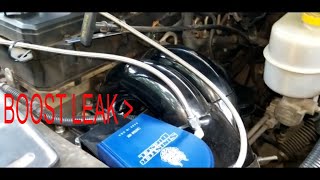
How to confirm: Perform a thorough visual inspection of all intake hoses and clamps between the MAF sensor and the engine's intake manifold. Look for cracks, loose connections, or oily residue which often collects near a leak. A smoke test or a boost leak test (pressurizing the system to 20-30 PSI with the engine off) is the most effective way to pinpoint a leak. 🎬 Watch: How to find and fix a boost leak on a Cummins.
Typical fix: Tighten loose clamps or replace the cracked/damaged intake hose or boot. It is recommended to use heavy-duty silicone boots for better durability.
Est. part cost: $50-$250 - Dirty or contaminated MAF sensor 🔴 High Probability → Shop Fuel Injection Air Flow Meter Oil vapors from the crankcase ventilation (CCV) system can coat the MAF sensor's delicate sensing element over time, especially on diesel engines. Aftermarket oiled air filters are a common source of contamination if over-oiled.
How to confirm: Remove the MAF sensor and visually inspect the small wires or film inside. If they appear dirty, oily, or covered in debris, they need cleaning.
Typical fix: Clean the sensor element using only a dedicated Mass Air Flow sensor cleaner spray. Do not touch the element or use other chemicals like brake cleaner. Note: Cleaning may be a temporary fix if the sensor's protective coating is damaged or if it is already failing electronically.
Est. part cost: $10-$20 - Faulty Mass Air Flow (MAF) sensor 🟡 Medium Probability → Shop Fuel Injection Air Flow Meter While durable, the sensor can fail electronically over time. Owners often report that cheap aftermarket sensors cause immediate issues, reinforcing the need for a quality OEM part. 🎬 See how a real P0102 circuit issue was diagnosed and solved.
How to confirm: If the sensor is clean, the wiring is intact, and no intake leaks are found, the sensor's internal electronics may have failed. This can be confirmed by monitoring live MAF data with an OBD-II scan tool; if the readings are stuck at zero or don't change smoothly with RPM, the sensor is likely bad.
Typical fix: Replace the MAF sensor. It is highly recommended to use an OEM Mopar part to avoid compatibility issues.
Est. part cost: $70-$450 - Damaged wiring or poor connector connection ⚪ Low Probability
How to confirm: Visually inspect the MAF sensor's electrical connector and wiring harness for any signs of corrosion, frayed wires, or loose pins. Wiggle the connector with the engine running to see if it affects the idle or live data readings.
Typical fix: Clean the connector terminals and apply dielectric grease. Repair any damaged sections of the wiring harness.
Est. part cost: $5-$50
Rare But Worth Checking
- Severely clogged engine air filter: → Shop Air Cleaner Assembly A filter that is extremely clogged can restrict airflow to the point of causing an implausible signal from the MAF sensor.
- Faulty Powertrain Control Module (PCM): This is very rare. The PCM should only be considered after all other possibilities (sensor, wiring, leaks) have been definitively ruled out. Sometimes a PCM software update (reflash) is required to fix logic errors, as indicated by various TSBs.
Diagnosis Steps
- Read all fault codes using an OBD-II scanner. Note any other codes that are present, especially P2281, which strongly points to an air leak.
- Perform a thorough visual inspection of the air intake system. Check the entire path from the air filter box to the turbo/intake manifold for cracks, loose clamps, or disconnected hoses. Pay close attention to the rubber/silicone intercooler boots.
- Inspect the engine air filter. If it is excessively dirty or clogged, replace it.
- Inspect the MAF sensor's electrical connector. Ensure it is securely plugged in and check for any corrosion or damaged wires.
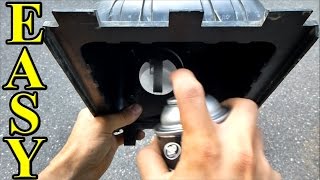
- Remove and inspect the MAF sensor. If the sensing element appears dirty, clean it with dedicated MAF sensor cleaner spray and allow it to dry completely before reinstalling. 🎬 Watch: A detailed guide on how to clean your MAF sensor.
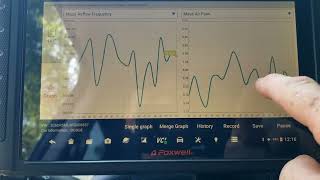
- If the code persists, use a scan tool to monitor live data from the MAF sensor. The reading (in grams/second or g/s) should increase smoothly as you raise the engine RPM. For a large diesel engine like the 6.7L, a healthy idle reading is typically higher than a small gas engine, potentially in the 14-16 g/s range. If the reading is stuck, erratic, or does not rise with RPM, the sensor is likely faulty.
- If no issues are found with the sensor or wiring, perform a smoke test or boost leak test to check for hard-to-see leaks in the intake system.
- If all other steps fail to identify the issue, the MAF sensor itself has likely failed and should be replaced with a quality OEM part.
Parts You'll Likely Need
- Mass Air Flow (MAF) Sensor
(OEM #68444077AA (supersedes 68206023AB, 68244577AA, 68253199AA), 68002441AC, 68334657AA)— If cleaning the sensor doesn't resolve the issue and no leaks are present, the sensor's internal electronics have likely failed. Using a genuine Mopar part is highly recommended.
Trusted brands: Mopar, Bosch, Denso
OEM price range: $200-$450
Aftermarket price range: $70-$180 - Intake Air Hose / Boot — This is a primary cause of P0100 on Ram Cummins trucks, as documented by TSBs and numerous owner accounts. The rubber or plastic can crack from age, heat, and pressure, causing an unmetered air leak.
Trusted brands: Mopar, Mishimoto, Sinister Diesel
OEM price range: $100-$250
Aftermarket price range: $50-$150 - MAF Sensor Cleaner — Often, the sensor is just dirty and does not need to be replaced. This is the first and most cost-effective repair attempt.
Trusted brands: CRC, Liqui Moly, WD-40 Specialist
OEM price range: $10-$20
Aftermarket price range: $10-$20
Related Codes That Often Appear With This One
- P2281 — This code for 'Air Leak Between MAF and Throttle Body' is explicitly linked to P0100 in manufacturer TSBs and owner forums for this vehicle, indicating a high probability of an intake leak.
- P0101, P0102, P0103, P0104 — These are all related MAF sensor codes indicating different types of circuit faults (Range/Performance, Low Input, High Input, Intermittent).
- P226C / P229F / P20EE / P0423 — These codes, related to boost control, NOx sensors, and catalyst efficiency, were also listed alongside P0100 in TSBs. This suggests that an incorrect airflow reading from the P0100 fault can cause cascading problems throughout the emissions control system.
Technical Service Bulletins (TSBs) & Recalls
- 18-025-26: Group of potential DTCs including P0100 and P2281 (Air Leak).
- OTHERDOC_147: List of DTCs including P0100 (MAF Sensor) and P2281 (Mass Charge Flow).
Platform-Specific Known Issues
- TSB #18-025-26: Ram issued this bulletin for 2026 models, which lists P0100-00 - Mass Or Volume Air Flow Sensor "A" Circuit among a group of codes that can be set. Crucially, it also lists P2281-00 - Air Leak Between Maf And Throttle Body, directly linking the MAF code to intake lea
Mechanic-Grade Diagnostic Values
- MAF Sensor Live Data (g/s) at Idle (6.7L Cummins) — expected: 5.0 - 10.0 g/s. Failure: A reading consistently below 5 g/s, fluctuating wildly, or dropping to zero at a stable idle suggests a faulty sensor or a major air leak.
- MAF Sensor Live Data (g/s) at 2500 RPM (No Load) — expected: 15 - 25 g/s (will vary by engine). Failure: Reading does not rise smoothly and linearly with RPM, or rises too slowly.
- MAF Sensor Signal Voltage at Idle — expected: 0.5 - 0.8 V. Failure: Voltage is outside this range, stuck, or does not respond to changes in RPM.
- MAF Sensor Signal Voltage at Wide-Open Throttle (WOT) — expected: 2.0 - 2.5 V. Failure: Voltage does not reach this range under heavy load.
Scan Tool Commands That Help
- OBD-II Scanner or Manual Procedure: ECU/KAM Reset — After replacing or cleaning the MAF sensor, a reset is necessary for the Engine Control Unit (ECU) to clear learned values and adapt to the new/clean sensor's readings. This can be done by clearing codes with a scan tool or by disconnecting the negative battery terminal for at least 15 minutes.
Wiring & Ground Locations
- MAF Sensor Connector Pigtail — The electrical connector at the MAF sensor, located in the intake tube just after the air filter box.. The connector pins can corrode or wires can fray, causing an open or short in the MAF circuit. Aftermarket pigtail harnesses (e.g., Fleece FPE-HAR-CUMM-MAF-PT) are commonly available, indicating this is a frequent failure point that requires cutting out the old connector and splicing in a new one.
Real Owner Repair Stories
- AliExpress Product Review/User Story (2018 Dodge RAM 2500 with 6.7L Cummins engine) — Erratic idle behavior, reduced fuel economy, and a P0101 code (Mass or Volume Air Flow "A" Circuit Range/Performance).
❌ Tried (didn't work) The user confirmed no vacuum leaks were present before suspecting the sensor.
✅ What actually fixed it Replacing the MAF sensor. The user noted that before replacement, live data showed g/s values fluctuating wildly and dropping to zero below 1000 RPM. After replacement, the g/s readings showed a smooth curve, fuel trims were stable, and fuel efficiency improved by approximately 1.8 MPG.
"I Checked Everything" — The Actual Cause
- If P0100 is present with P2281 (Air Leak) but a smoke test of the intake system comes back clean, the fault is highly likely to be the MAF sensor itself. A failing sensor can send implausible airflow data to the PCM that mimics the signature of an air leak, causing both codes to be set even with a perfectly sealed intake tract. In this scenario, the next step is to test the sensor's live data and voltage directly.
OEM Part Supersession History
68206023AB, 68244577AA, 68253199AA→68444077AA— Part revision and consolidation for 2013-2024+ models.
Heads up: Part number 68444077AA is the correct OEM part for the 2019+ model years, including the 2025-2026 range. Using older superseded parts is not recommended.68002441AA, 68002441AB→68002441AC— Part revision for 2007.5-2018 models.
Heads up: This part number series is for the previous generation of Ram trucks and should not be used on a 2025-2026 model.
Model Year Variations Within This Range
- 2025 vs 2026: While the core 6.7L Cummins and 6.4L HEMI engines are expected to be mechanically similar, manufacturer TSBs have been issued for each model year separately (OTHERDOC_147 for 2025, 18-025-26 for 2026). This indicates potential differences in software calibration within the PCM. A software-related issue causing P0100 may require a year-specific reflash from the dealer.
Helpful Videos

The information in this article is provided for general reference and educational purposes only. Vehicle specifications, procedures, and part compatibility can vary by production date, trim level, and region. Always consult your vehicle's factory service manual and verify part numbers before purchasing or performing repairs. Safety-critical components such as airbags, seat belts, and braking systems should be installed by a qualified professional.
- Ram 3500:
- 🧭 Diagnostic Flowchart
- 🎬 Helpful Videos
- What's Unique About the 2025-2026 Ram 3500
- Symptoms You May Notice
- Most Likely Causes
- Rare But Worth Checking
- Diagnosis Steps
- Parts You'll Likely Need
- Related Codes That Often Appear With This One
- Technical Service Bulletins (TSBs) & Recalls
- Platform-Specific Known Issues
- Mechanic-Grade Diagnostic Values
- Scan Tool Commands That Help
- Wiring & Ground Locations
- Real Owner Repair Stories
- "I Checked Everything" — The Actual Cause
- OEM Part Supersession History
- Model Year Variations Within This Range
- 🎟️ Get 5% Off