

P0101 on 2018-2022 Chevrolet Equinox: MAF Sensor and Charge Air Cooler Fixes
On 2018-2022 Equinox models, P0101 is most often caused by a disconnected charge air cooler (CAC) outlet tube at the throttle body. Before replacing any parts, inspect this connection. Re-seating the hose and installing an updated retainer clip (GM Part #13434668) often resolves the issue. This is a known issue covered by multiple GM service bulletins.
- For a 2018-2022 Equinox, P0101 is most likely caused by the charge air cooler tube blowing off the throttle body, not a bad MAF sensor.
- Always perform a visual inspection of the intake piping, specifically where the large hose connects to the engine throttle body, before buying any parts.
- This code is often accompanied by P1101, P0172, P0299, and P0506, all pointing to the same root cause of a massive air leak.
- The vehicle will likely enter a 'Reduced Engine Power' mode, making it sluggish but generally drivable to a safe location for repair.
- If the tube is disconnected, simply re-securing it may fix the problem. Only replace parts if they are visibly damaged during the event.
What's Unique About the 2018-2022 Chevrolet EQUINOX

For the third-generation Equinox and its platform mates with turbocharged engines, the P0101 code is uniquely and frequently tied to a specific mechanical failure rather than a sensor failure. Multiple GM Technical Service Bulletins (TSBs) and an emissions recall (#N192271200) point to the charge air cooler (CAC) outlet tube separating from the throttle body. This massive air leak downstream of the MAF sensor causes the sensor's readings to be completely illogical compared to the actual air entering the cylinders, triggering the P0101 code and often several others related to rich fuel conditions and underboost.
Diagnostic Flowchart

Tap your situation to follow the diagnostic path that matches what you're seeing on this vehicle.
Symptoms You May Notice
- Check Engine Light (Malfunction Indicator Lamp) is on
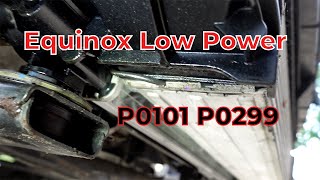
- "Reduced Engine Power" message on the dashboard 🎬 Watch this video to see how this common failure strands drivers.
- Hesitation or surging during acceleration
- Rough or low idle, sometimes stalling
- Poor fuel economy
- Difficulty starting the engine
- Audible 'whoosh' or hissing sound from the engine bay when accelerating
- Replacing the MAF sensor without first checking for a disconnected charge air cooler tube. Many owners and shops replace the sensor only to have the code return because the root cause is the massive air leak.
Most Likely Causes

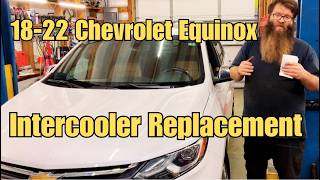
- Charge Air Cooler (CAC) Outlet Tube Disconnected 🔴 High Probability → Shop Intercooler As documented in multiple GM TSBs (e.g., #PIP5710A, #22-NA-224) and recall #N192271200, the connection between the charge air cooler outlet pipe and the throttle body is a known weak point on the 1.5L and 2.0L turbo engines. The original retainer clip can fail, causing the tube to blow off under boost pressure. GM released an improved retainer to address this.
How to confirm: Visually inspect the large air duct connecting to the engine's throttle body. It is located on the driver's side of the engine. Check if it is loose, completely disconnected, or if the retaining clamp is broken or out of place. This is the most common cause and should be the first check.
Typical fix: Reconnect the tube to the throttle body. It is highly recommended to replace the original wire-style retainer with the updated, more robust retainer clip, GM Part #13434668. Inspect the tube's O-ring seal for damage before reassembly. If the tube or throttle body is damaged, it must be replaced.
Est. part cost: $10-$20 for an updated retainer clip, or $150-$250 for a new tube assembly (GM Part #84534355 or #84940481) if damaged. - Dirty or Faulty Mass Air Flow (MAF) Sensor 🟡 Medium Probability → Shop Fuel Injection Air Flow Meter MAF sensors are sensitive and can become contaminated by dirt, debris, or oil (especially from over-oiled aftermarket air filters), causing inaccurate readings. While less common than the CAC tube issue on this platform, it remains a possible cause.
How to confirm: Remove the sensor (located on the air intake tube after the air filter box) and inspect the hot wires for contamination. You can try cleaning it with a dedicated MAF sensor cleaner. If cleaning doesn't work, the sensor may have failed and can be tested with a scan tool that reads live data to check for erratic or non-responsive readings.
Typical fix: Clean the sensor with MAF sensor cleaner. If the code returns, replace the MAF sensor.
Est. part cost: $10 for cleaner, $80-$150 for a new sensor. - Clogged Engine Air Filter ⚪ Low Probability → Shop Air Cleaner Assembly
How to confirm: Inspect the engine air filter. If it is visibly dirty, black, or clogged with debris, it is restricting airflow and can cause the MAF to read out of range.
Typical fix: Replace the engine air filter.
Est. part cost: $20-$40 - Vacuum Leak (other than CAC tube) ⚪ Low Probability
How to confirm: Listen for hissing sounds around the engine bay. A smoke test is the most effective way to find leaks in intake gaskets, vacuum hoses, or cracks in the intake tubing itself.
Typical fix: Replace the leaking hose or gasket.
Est. part cost: $10-$100 depending on the part.
Rare But Worth Checking
- Clogged Catalytic Converter: A clogged catalytic converter can create excessive backpressure, restricting airflow through the engine and triggering a P0101 code. This is more likely on higher mileage vehicles and is usually accompanied by a severe lack of power, a rotten egg smell, and potentially other codes like P0420.
- Damaged Throttle Body: → Shop Fuel Injection Throttle Body In cases where the charge air cooler tube blows off forcefully, it can damage the plastic throttle body housing where it connects. TSB #22-NA-224 notes that if abnormal witness marks or physical damage are present on the throttle body inlet, it may require replacement.
- Wiring or Connector Issue: An open, short, or poor connection in the wiring harness to the MAF sensor can cause the signal to be lost or erratic. This requires checking for power, ground, and signal integrity at the connector with a multimeter.
- Diesel Particulate Filter (DPF) Issues (1.6L LH7 Diesel): For the 1.6L Turbo-Diesel engine, a P0101 code can be related to issues with the DPF system. A Reddit user with a 2018 diesel model reported a recurring P0101 code that was ultimately tied to an emissions system fault, which could indicate a clogged DPF or sensor issue within that system.
Diagnosis Steps
- Read all stored fault codes with an OBD-II scanner. Note if codes P1101, P0172, P0299, or P0506 are present with P0101. 🎬 See a real-world diagnosis of these codes on a 2018 Equinox.
- Visually inspect the engine bay, focusing on the large air intake hose that connects to the throttle body on the driver's side of the engine. This is the charge air cooler outlet tube. Check if it has popped off or is loose. This is the most likely cause.
- If the tube is disconnected, inspect the tube end, O-ring, and throttle body inlet for damage before reconnecting. Look for cracks or deep gouges on the throttle body inlet as described in TSB #22-NA-224.
- Securely reconnect the tube. It is strongly recommended to replace the original wire clip with the updated retainer clip (GM Part #13434668) to prevent a recurrence.
- If the tube is secure, inspect the engine air filter to ensure it is clean and properly seated.
- Locate the MAF sensor (in the air intake tube after the air filter box) and inspect its electrical connector for a secure fit and any signs of damage.
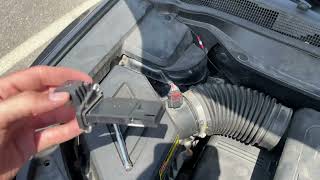
- Remove the MAF sensor (usually with a Torx T-20 bit) and inspect its sensing elements for dirt or oil contamination. Clean it ONLY with dedicated MAF sensor cleaner if it appears dirty. 🎬 Watch: A quick guide to safely cleaning your MAF sensor.
- If the problem persists, perform a smoke test on the entire intake system to check for other, less obvious, vacuum leaks.
- If no leaks are found, monitor the MAF sensor's live data with a scan tool to see if its readings are erratic or non-responsive, which would indicate a failed sensor.
- Check for wiring issues by testing for 5V reference, ground, and signal integrity at the MAF sensor connector with a multimeter.
Parts You'll Likely Need
- Charge Air Cooler Retainer Clip (Improved)
(OEM #13434668)— This is the updated part specified in GM's recall #N192271200 to permanently fix the issue of the charge air cooler tube blowing off the throttle body.
Trusted brands: GM Genuine Parts
OEM price range: $10-$20
Aftermarket price range: $5-$15 - Charge Air Cooler Outlet Tube
(OEM #84534355 (superseded by 84940481 for 1.5L))— This tube can become disconnected or the end can be damaged when it blows off the throttle body, which is the most common cause of P0101 on this vehicle.
Trusted brands: ACDelco, GM Genuine Parts
OEM price range: $150-$250
Aftermarket price range: $80-$150
Related Codes That Often Appear With This One
- P1101 — Intake Air Flow System Performance. This code is often set with P0101 because they both relate to the ECM detecting an unexpected amount of air entering the system. The disconnected charge air cooler tube is a common cause for both. [Bulletin #PIP5710A]
- P0172 — System Too Rich. When the CAC tube disconnects, the MAF sensor reports very low airflow, but the oxygen sensors detect a very rich condition because the ECM is injecting fuel for air that isn't being properly measured, leading to this code. [Bulletin #22-NA-224]
- P0299 — Engine Underboost. A disconnected charge air cooler tube means the pressurized air from the turbocharger is escaping instead of entering the engine, resulting in a lack of boost pressure. [Bulletin #N192271200]
- P0506 — Idle Air Control System RPM Lower Than Expected. The massive unmetered air leak disrupts the engine's ability to control its idle speed, often causing it to be too low or stall. [Bulletin #PIE0569B]
Technical Service Bulletins (TSBs) & Recalls

- N192271200: An emission recall to install an 'improved charge air cooler retainer' (Part #13434668) on 2019 Equinox, Terrain, and Malibu models with the 1.5L engine to prevent the duct from disconnecting.
- 22-NA-224: A service bulletin providing a diagnostic and repair procedure for the group of codes (P0101, P0172, P0299, etc.) caused by the CAC tube separating. It includes photos showing the difference between normal 'witness marks' and actual damage to the throttle body requiring replacement.
- PIP5651E: A preliminary information bulletin that also identifies the CAC outlet hose disconnecting from the throttle body as the primary cause for these codes on the Equinox and GMC Terrain.
- PIP5710A: Similar to other bulletins, this communicates the possibility of the CAC tube disconnecting and causing a specific set of DTCs.
Platform-Specific Known Issues
- A disconnected charge air cooler (CAC) outlet tube from the throttle body is a widely documented issue for 2018-2022 Equinox models with the 1.5L turbo engine. GM has issued multiple Technical Service Bulletins (TSBs) about this specific problem, including #PIP5710A, #22-NA-224, and #PIP5651G. These bulletins confirm the issue causes P0101 along with other codes like P0172, P0299, P0506, and P1101, and results in reduced engine power.
Mechanic-Grade Diagnostic Values
- MAF Sensor Reading (Scan Tool Live Data) — expected: At idle, a reading of 2-7 grams/second (g/s) is typical, depending on engine size. The value should rise smoothly and quickly to 15-25 g/s or higher when the engine is revved to 2500 RPM.. Failure: A reading that is stuck, unresponsive, erratic, or does not increase proportionally with engine RPM suggests a faulty sensor or a massive air leak.
- MAF Sensor Signal (Frequency) — expected: Using a multimeter that can read frequency (Hz), the signal wire should show a stable frequency at idle (typically 2.0-3.5 KHz for GM engines) that increases smoothly upon acceleration.. Failure: No signal, a fixed signal that doesn't change, or a very jumpy/erratic signal indicates a sensor or wiring problem.
- MAF Sensor Power Supply — expected: With the key on and engine off, the power supply pin (typically pink wire) on the MAF sensor connector should have 10-12 Volts DC.. Failure: No voltage indicates a blown fuse or a break in the power wire.
- MAF Sensor Ground Circuit — expected: Using a multimeter in Volts DC mode, probing the ground pin (typically black/white wire) and the battery's positive terminal should show full battery voltage, confirming a good ground path.. Failure: Low or no voltage indicates a poor or open ground connection.
Scan Tool Commands That Help
- GDS2 / Professional Scan Tool: Graphing MAF Sensor PID — This is a critical diagnostic step, not a specific command. Graphing the MAF sensor's output (in g/s or Hz) against engine RPM allows a technician to visually confirm if the sensor is responding smoothly and correctly throughout the engine's operating range. A choppy or flat graph indicates a problem.
Wiring & Ground Locations
- G101 — Typically located on the left front of the engine, lower block area.. This is a primary engine ground point that provides the ground path for the Engine Control Module (ECM) and the Mass Air Flow (MAF) sensor. A corroded or loose connection here can cause erratic sensor readings and trigger a P0101.
- G104 — Located at the right rear corner of the engine compartment.. This is another major engine compartment ground. While not directly tied to the MAF in all diagrams, ensuring all major grounds are clean and tight is a crucial step when diagnosing any electronic fault code.
- MAF Sensor Connector — On the air intake tube, immediately downstream of the air filter housing.. The connector itself can be a point of failure. The pins for power (12V), ground, and signal (Hz output) must be clean and making good contact. The MAF signal wire is often yellow and can be found at pin 37 of the ECM's X1 connector.
Real Owner Repair Stories
- Reddit user post in r/Chevy (2020 Chevrolet Equinox, 1.5L, 54,000 miles) — Check engine light on, vehicle went into reduced power mode. Occurred after a week of below-zero temperatures.
❌ Tried (didn't work) Owner took it to the dealer, initial diagnosis was given but owner could not afford the repair at the time.
✅ What actually fixed it The dealership diagnosed a broken PCV valve which allowed moisture to get into the charge air cooler, causing it to freeze and create a blockage. The quoted repair was $2,400 for the PCV valve and charge air cooler replacement. - Paycheck Monster YouTube Channel (2019 Chevrolet Equinox, 1.5L Ecotec) — DTC P0299 (Engine Underboost), which is commonly associated with P0101.
❌ Tried (didn't work) A smoke test revealed leaks at the intercooler and a charge tube, which were replaced., The boost sensor was replaced as it came with the new intercooler., The bypass valve was commanded on/off and then removed for visual inspection, and it appeared fine.
✅ What actually fixed it Even after fixing the boost leaks found with the smoke machine, the vehicle still had an underboost condition according to scan tool data. The final repair was the replacement of the entire turbocharger assembly.
"I Checked Everything" — The Actual Cause
- According to GM TSB #18-NA-020, it is possible for the charge air cooler (CAC) to pass a smoke test (indicating no leaks) but still be the cause of codes like P0299. In high humidity or very cold conditions, moisture can collect and freeze inside the CAC, creating an internal restriction that blocks airflow. This blockage will not be detected by a smoke test, which only checks for external leaks. The official fix in this scenario is to replace the charge air cooler with an updated part.
When the Usual Fixes Don't Work
- While the most common cause of P0101 on this platform is the charge air cooler tube disconnecting from the throttle body, this is not the only possible cause. In one documented case involving a 2020 Equinox, the root cause was a broken PCV valve that allowed moisture to enter and freeze inside the charge air cooler, creating a blockage even though there were no air leaks. In another case with a 2019 model, after minor leaks were found via smoke test and repaired, an underboost condition persisted, and the ultimate fix was a complete turbocharger replacement. These cases show that if the primary, common fix does not resolve the issue, further diagnosis of the entire air induction and PCV system is required.
OEM Part Supersession History
84534355→84940481— This is the Charge Air Cooler Outlet Tube for the 1.5L engine. The part was likely updated to improve fitment or durability at the throttle body connection.
Model Year Variations Within This Range
- 2018-2020: The 2.0L LTG turbo engine was available during these years. It was discontinued for the 2021 model year.
- 2018-2019: The 1.6L LH7 turbo-diesel engine was available as an option during these two model years only.
- 2022: The Equinox received a mid-cycle refresh with new front/rear fascias and a new RS trim level. Critically, for this model year, the only engine available was the 1.5L LYX turbo I4.
Helpful Videos

The information in this article is provided for general reference and educational purposes only. Vehicle specifications, procedures, and part compatibility can vary by production date, trim level, and region. Always consult your vehicle's factory service manual and verify part numbers before purchasing or performing repairs. Safety-critical components such as airbags, seat belts, and braking systems should be installed by a qualified professional.
- Chevrolet EQUINOX:
- 🧭 Diagnostic Flowchart
- 🎬 Helpful Videos
- What's Unique About the 2018-2022 Chevrolet EQUINOX
- Symptoms You May Notice
- Most Likely Causes
- Rare But Worth Checking
- Diagnosis Steps
- Parts You'll Likely Need
- Related Codes That Often Appear With This One
- Technical Service Bulletins (TSBs) & Recalls
- Platform-Specific Known Issues
- Mechanic-Grade Diagnostic Values
- Scan Tool Commands That Help
- Wiring & Ground Locations
- Real Owner Repair Stories
- "I Checked Everything" — The Actual Cause
- When the Usual Fixes Don't Work
- OEM Part Supersession History
- Model Year Variations Within This Range
- 🎟️ Get 5% Off