

P0101 on 1998-2001 Ford Ranger 2.5L: MAF Sensor Causes and Fixes
On a 1998-2001 Ranger with the 2.5L engine, code P0101 is most often caused by a dirty Mass Airflow (MAF) sensor or a vacuum leak from a cracked rubber intake hose. Cleaning the MAF sensor with a dedicated cleaner and inspecting all intake hoses for cracks is the most likely fix, costing under $15 for the cleaner.
- Always start with the cheapest and easiest fix: clean the MAF sensor with dedicated cleaner.
- Thoroughly inspect all rubber intake hoses between the MAF sensor and the engine for cracks; this is a very common problem on older Rangers.
- A P0171 (System Too Lean) code appearing with P0101 is a strong indicator of a vacuum leak.
- If you must replace the MAF sensor, using a Ford/Motorcraft OEM part is recommended to avoid issues with incorrect calibration from aftermarket parts.
What's Unique About the 1998-2001 Ford Ranger
The 2.5L Lima engine in this generation of Ranger is a workhorse, but its age means rubber and plastic components in the engine bay are prone to cracking. While a dirty MAF sensor is a universal cause for P0101, these Rangers are particularly susceptible to vacuum leaks from brittle PCV hoses and the large, ribbed air intake duct between the airbox and throttle body. These cracks introduce unmetered air, confusing the sensor. Owners often chase this code by replacing the sensor, when the actual fault is a simple, inexpensive vacuum hose.
Symptoms You May Notice
- Check Engine Light is on
- Rough or inconsistent idle
- Hesitation or lack of power during acceleration
- Poor fuel economy
- Difficulty starting the engine
- Black smoke from the exhaust in some cases
- Engine stalling unexpectedly, especially when coming to a stop
- Replacing the MAF sensor without first checking for vacuum leaks. A cracked intake boot is a very common cause of P0101 on older trucks and is much cheaper to fix.
- Replacing oxygen sensors. While O2 sensors can be affected by the incorrect air/fuel mixture that P0101 causes, they are not the root cause of the MAF performance code.
Most Likely Causes
- Dirty or Contaminated MAF Sensor 🔴 High Probability → Shop Fuel Injection Air Flow Meter Over time, dust and oil vapor (especially from aftermarket oiled air filters) can coat the sensor's delicate hot wire, insulating it and causing inaccurate readings.
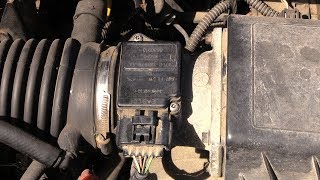
How to confirm: Remove the sensor from the air intake tube. Visually inspect the small wires inside the sensor housing. If they appear dirty or coated, they need cleaning. The sensor is held in by two T-20 security Torx screws.
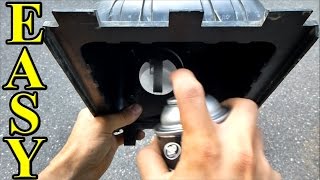
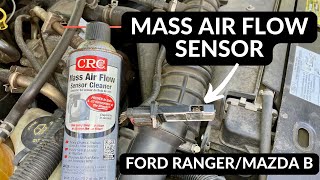
Typical fix: Clean the sensor elements using only dedicated Mass Airflow Sensor Cleaner spray. 🎬 Watch: A quick guide to cleaning your Ranger's MAF sensor. Do not touch the wires. Allow it to dry completely before reinstalling. One user on a Ford Truck Enthusiasts forum reported this simple cleaning fixed a P0102 (MAF Circuit Low) code on a similar 2.5L system after other attempted fixes failed.
Est. part cost: $10-$15 for MAF cleaner spray. - Vacuum Leak (Cracked Intake Hoses) 🔴 High Probability The rubber and plastic hoses on the 2.5L Lima engine become brittle with age and heat cycles. The large intake air tube between the MAF sensor and the throttle body, as well as smaller PCV and vacuum hoses, are common failure points.
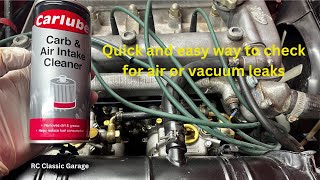
How to confirm: With the engine running, listen for a hissing sound. You can also carefully spray short bursts of brake cleaner or unlit propane around vacuum lines and intake gaskets. If the engine idle changes, you've found the leak. A smoke test is the most definitive method. 🎬 See how to find a vacuum leak in about a minute.
Typical fix: Replace the cracked hose. The PCV hose and intake air duct are the most common culprits. The intake duct is a known weak point and often develops cracks in the ribbed sections.
Est. part cost: $15-$60 for replacement hoses. - Faulty Mass Airflow (MAF) Sensor 🟡 Medium Probability → Shop Fuel Injection Air Flow Meter While durable, the sensor can fail electronically after many years and miles. This is especially true if cleaning does not resolve the issue and no vacuum leaks are found.
How to confirm: After confirming no vacuum leaks and cleaning the original sensor, the code returns. A scan tool can monitor live MAF data (g/s) to see if readings are erratic or unresponsive to throttle changes. Disconnecting the MAF while the engine is running and seeing no change in performance is a strong indicator of a failed sensor.
Typical fix: Replace the MAF sensor. It is highly recommended to use an OEM Ford/Motorcraft part, as some aftermarket sensors are known to cause persistent issues. After replacement, it is good practice to reset the PCM's Keep-Alive Memory (KAM) by disconnecting the battery for 15-20 minutes to allow the computer to relearn fuel trims with the new sensor.
Est. part cost: $75-$150 for a quality aftermarket sensor, $150-$250 for an OEM Motorcraft sensor. - Dirty or Clogged Air Filter ⚪ Low Probability → Shop Air Cleaner Assembly A severely clogged filter can restrict airflow enough to cause the MAF readings to be lower than what the PCM expects for a given engine speed and throttle opening.
How to confirm: Visually inspect the engine air filter. If it is visibly black, filled with debris, or has not been changed in a long time, it is suspect.
Typical fix: Replace the engine air filter.
Est. part cost: $15-$30
Rare But Worth Checking
- Clogged Catalytic Converter: A restricted exhaust can cause a lack of air movement through the engine, leading to lower-than-expected MAF readings. This would typically be accompanied by a significant loss of power, especially at higher RPMs, and potentially other codes like P0420.
- Wiring or Connector Issue: Damaged wires or a corroded connector at the MAF sensor can cause an intermittent or out-of-range signal. Inspect the harness for any visible damage, and ensure the connector pins are clean and making good contact.
Diagnosis Steps
- Read the Code: Confirm P0101 is the primary code. Note any other codes, especially P0171, which strongly suggests a vacuum leak.
- Inspect the Air Filter: Check the engine air filter and replace it if it is dirty or clogged.
- Visually Inspect for Vacuum Leaks: Carefully inspect the entire air intake system from the MAF sensor to the engine for cracks, loose connections, or disconnected hoses. Pay close attention to the large rubber intake boot (Part F87U-9R504-BA or XL5U-9R504-BA) and all PCV hoses.
- Clean the MAF Sensor: Disconnect the battery. Unplug and remove the MAF sensor using a T-20 security Torx bit. Spray the internal wires generously with dedicated MAF sensor cleaner. Do not use other chemicals or touch the wires. Let it air dry completely before reinstalling.
- Clear Codes and Reset KAM: Reconnect the MAF sensor. Leave the negative battery cable disconnected for at least 15 minutes to clear the Keep-Alive Memory (KAM). Reconnect the battery, clear codes with a scanner, and test drive.
- Perform a Smoke Test: If the code returns, a smoke test is the most effective way to find hairline cracks in hoses or leaking gaskets that are not visible to the naked eye.
- Check MAF Sensor Wiring: Inspect the MAF sensor connector and wiring for any signs of damage, corrosion, or loose pins. Check for stable voltage and ground at the connector.
- Test or Replace the MAF Sensor: If all other steps fail to resolve the code, the sensor itself has likely failed. Replace it, preferably with a Motorcraft part.
Parts You'll Likely Need
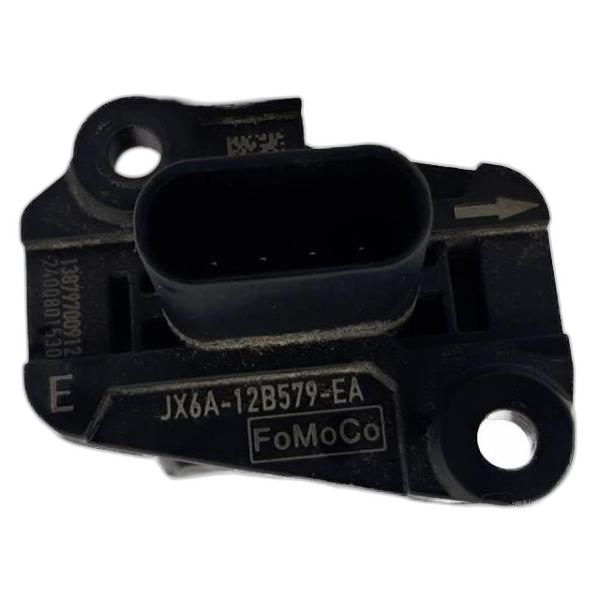
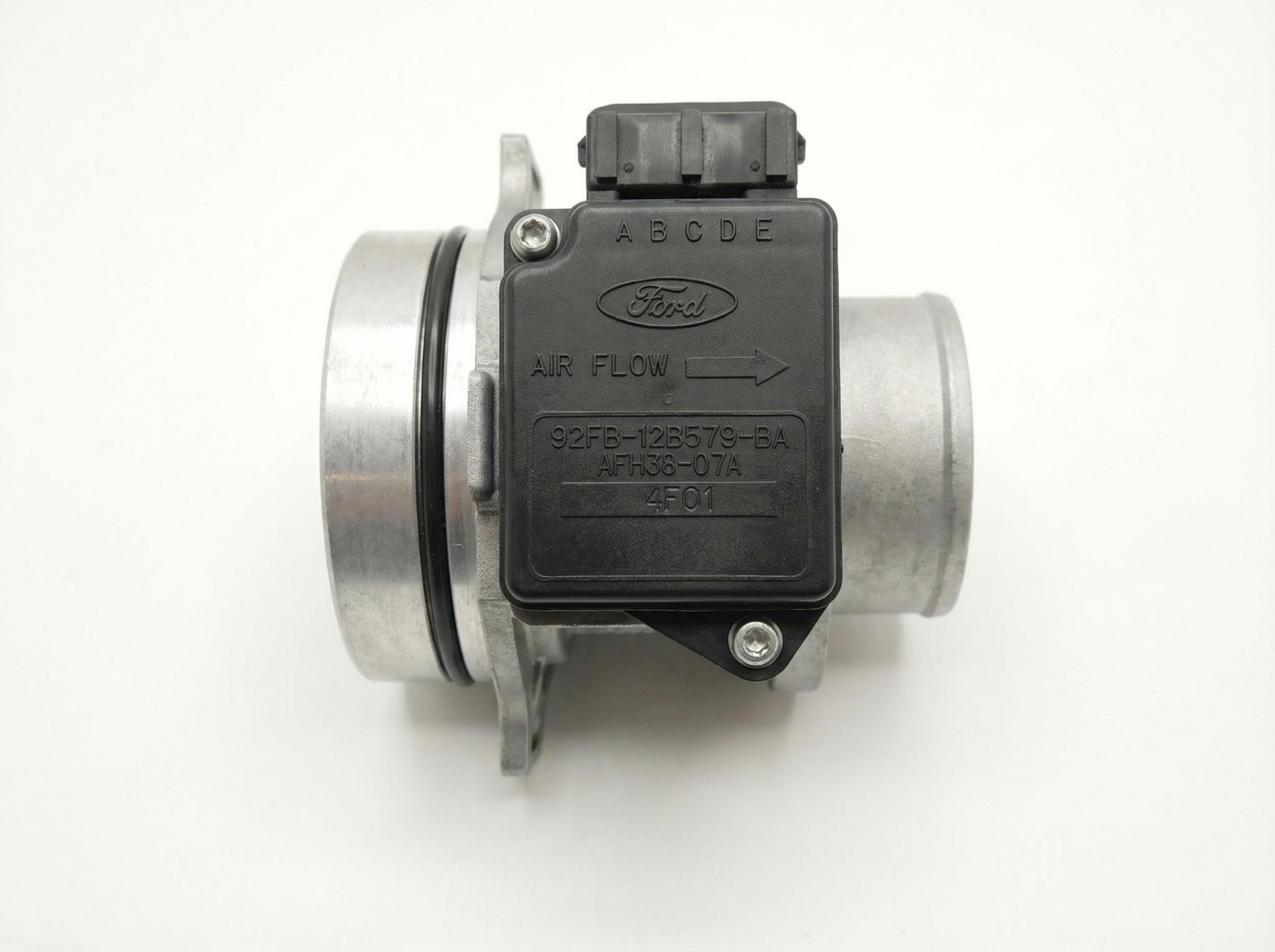
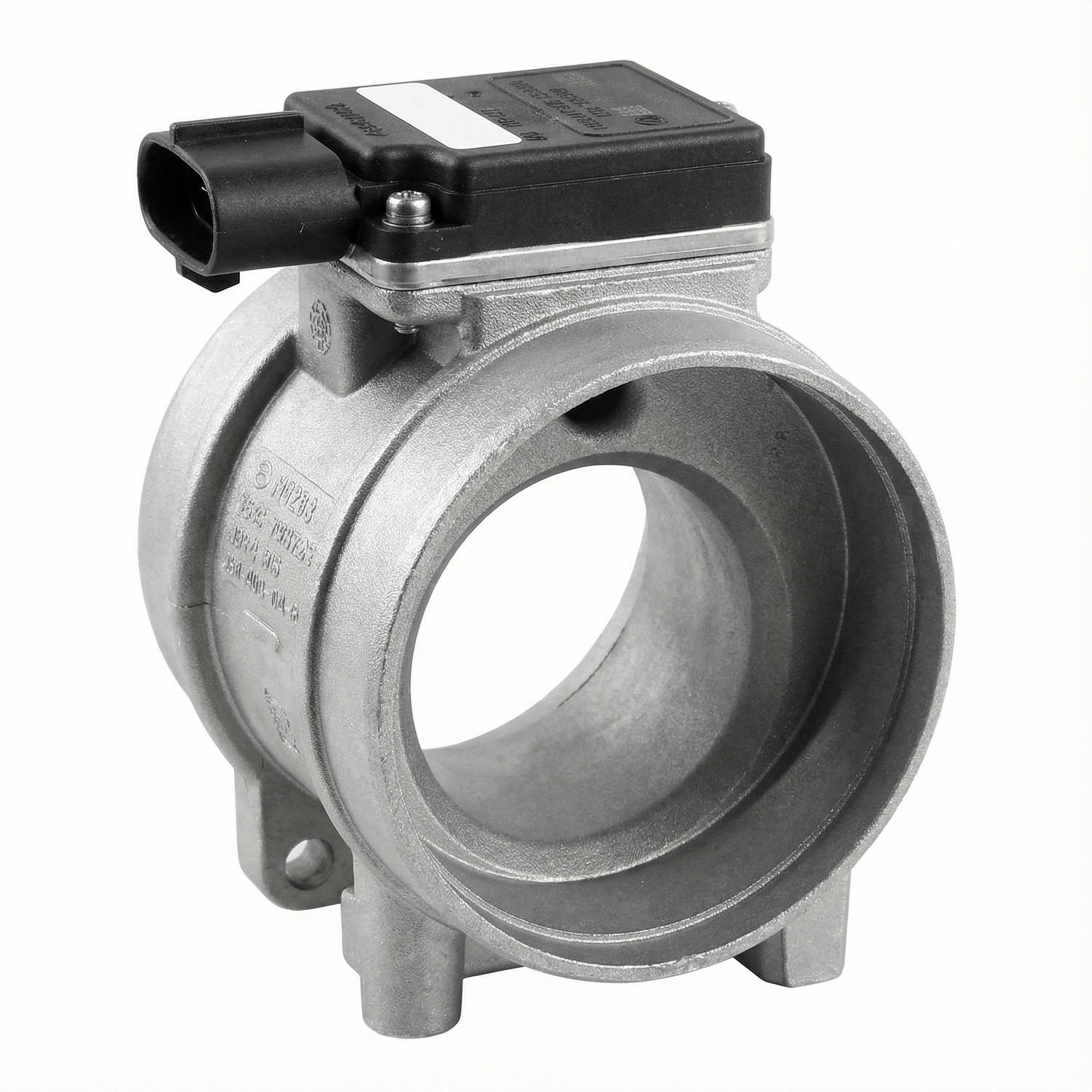
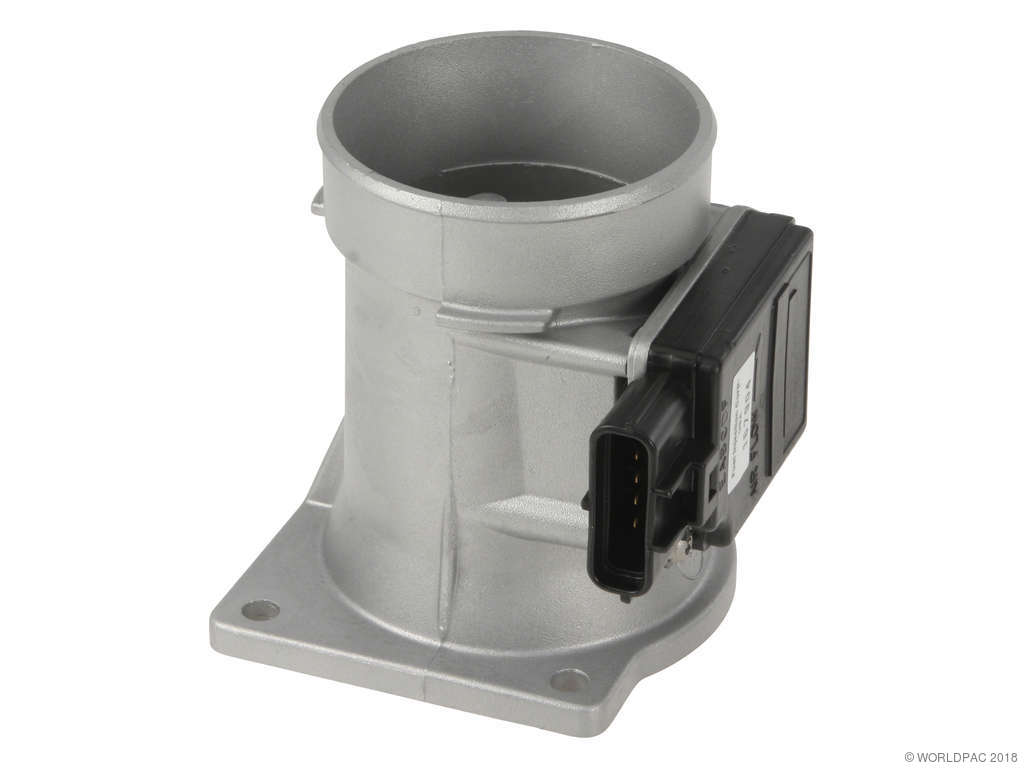
- Mass Airflow Sensor
(OEM #F67Z-12B579-EA)— This is the sensor that measures airflow. It is the primary component related to the code, and often fails after cleaning and vacuum leak checks are performed. This part number may be superseded or discontinued, but cross-references are available.
Trusted brands: Motorcraft (OEM), Bosch, Delphi, NTK
OEM price range: $150-$250
Aftermarket price range: $75-$150 - Mass Airflow Sensor Cleaner — Often, the sensor is just dirty. This specialty cleaner is the first and most cost-effective repair step.
Trusted brands: CRC, WD-40 Specialist, Liqui Moly
Aftermarket price range: $10-$15 - Intake Air Duct Hose
(OEM #F87U-9R504-BA (1998-1999), XL5U-9R504-BA (2000-2001))— This large rubber hose between the air filter box and the throttle body is a common failure point, developing cracks in its accordion-like ribs due to age and heat, causing vacuum leaks. 🎬 Watch: See how a vacuum leak can damage a 2.5L engine.
Trusted brands: Motorcraft (OEM), Dorman, Gates
OEM price range: $40-$70
Aftermarket price range: $20-$40
Related Codes That Often Appear With This One
- P0171 — System Too Lean (Bank 1). This code is very common with P0101. A vacuum leak allows unmetered air into the engine after the MAF sensor, causing the MAF to report less air than is actually entering. The engine computer sees extra oxygen via the O2 sensor and flags a lean condition.
- P0102 — Mass or Volume Air Flow Circuit Low Input. This code can appear if the sensor has an internal electronic failure or a significant airflow restriction is present.
- P0103 — Mass or Volume Air Flow Circuit High Input. This code points to an electrical issue or sensor failure causing an abnormally high signal voltage.
Mechanic-Grade Diagnostic Values
- MAF Sensor Live Data (g/s) at Idle — expected: Approximately 3.0 g/s at a warm 800 RPM idle. A general rule is g/s should roughly equal engine displacement in liters at ~500-700 RPM.. Failure: Readings significantly lower than 2.5 g/s may indicate a dirty sensor or a vacuum leak. Readings that are stuck, erratic, or do not increase smoothly with RPM point to a failing sensor.
- MAF Sensor Signal Voltage at PCM — expected: Approximately 1.18V at idle, smoothly increasing to 2.75-3.0V around 3,000 RPM.. Failure: Voltage that is stuck, drops out, or does not correspond to engine RPM changes indicates a sensor or wiring fault.
- MAF Sensor Power Supply Voltage (KOEO) — expected: 10V to 12V DC at the RED wire on the MAF sensor connector with the key on, engine off.. Failure: No voltage indicates a blown fuse or a break in the power supply wire.
Wiring & Ground Locations
- PCM Pin 88 — On the 104-pin PCM connector, located on the engine firewall.. This is the Mass Air Flow (MAF) Sensor Signal wire (LT BLU/RED). Technicians can back-probe this pin to verify the signal the PCM is receiving directly from the sensor, bypassing the harness.
- PCM Pin 36 — On the 104-pin PCM connector on the firewall.. This is the MAF Sensor Ground wire (TAN/LT BLU). A poor connection here can cause an unstable signal, leading to a P0101 code.
- G100 — Located on the left-hand (driver's side) front of the engine compartment, below the battery.. This is a primary engine bay ground. A corroded or loose connection at G100 can cause various sensor reading issues, including for the MAF sensor.
- G101 — Located on the left-hand (driver's side) of the upper radiator support.. This ground point is for headlights and various relays. While not a direct sensor ground, poor grounding in the engine bay can create electrical noise that affects sensitive sensor circuits.
Real Owner Repair Stories
- Ranger-Forums user 'uksparky' (1998 Ford Ranger 2.5L) — P0171 (System Too Lean) code, which is often paired with P0101.
❌ Tried (didn't work) Initial diagnosis pointed towards common causes like vacuum leaks or a faulty MAF.
✅ What actually fixed it The user reported that after cleaning the Idle Air Control (IAC) valve, the lean condition and associated running issues were resolved. A dirty IAC can stick, allowing unmetered air to enter at idle, which the PCM misinterprets as a MAF range issue, sometimes triggering P0101.
"I Checked Everything" — The Actual Cause
- In some cases, a poor engine ground connection, like the main strap from the firewall to the engine block, can cause erratic MAF sensor readings and trigger a P0101 code. This electrical fault would not be found with a smoke test.
OEM Part Supersession History
F67Z-12B579-EA→F67Z-12B579-MRM (Remanufactured)— Original part was discontinued by Ford. The official replacement is a remanufactured Motorcraft unit.
Heads up: Using non-OEM, cheap aftermarket sensors is highly discouraged as they are known to cause persistent performance issues and codes on this platform.
Model Year Variations Within This Range
- 1998-2000 vs 2001: The DPFE (Differential Pressure Feedback EGR) sensor signal wire color at the PCM changed from BRN/LT GRN in 1998-2000 to BRN/ORG in 2001. While not directly related to the MAF, it's a known wiring variation in the same harness.
- 1998-1999 vs 2000-2001: The Intake Air Duct Hose has a different part number for 1998-1999 (F87U-9R504-BA) versus 2000-2001 (XL5U-9R504-BA), indicating a design change. Ensure the correct part is ordered for the specific model year.
Diagnostic Flowchart
Other Known Issues on This Vehicle
Issues unrelated to this code that are worth knowing about as an owner of this generation:
- Timing Belt Maintenance 🔴 High — Replacement is recommended every 80,000 to 100,000 miles. While the engine is non-interference (no valve/piston damage if it breaks), a failure will leave the driver stranded.
- Recessed Exhaust Valve Seats 🟠 Medium — A well-documented issue on dual-plug Lima heads. Symptoms include intermittent misfiring at idle, stalling after deceleration, and eventual loss of compression in the affected cylinder. Often misdiagnosed.
- Camshaft Position Sensor/Synchronizer Failure (V6 Only) 🔴 High — While this article covers the I4, it's critical to note that on V6 Rangers of the same era, a chirping noise from the rear of the engine often signals a failing camshaft synchronizer. If it seizes, it can shear the oil pump drive, leading to catastrophic engine failure. This does not apply to the 2.5L I4 engine. (Ref: There are TSBs related to this issue on V6 models.)
- Weak Connecting Rods 🟡 Low — The 2.5L has longer and weaker connecting rods than the 2.3L it was based on. While reliable under normal use, they are a known weak point if the engine is modified for more power or subjected to unusual loads.
Used vs. New Parts: Buying Guide for This Vehicle
When a used part is the smart pick: For this repair, sourcing a used Intake Air Duct Hose from a junkyard is a very smart choice. It's a simple rubber part, and as long as it's free of cracks, it will function perfectly. Given the high failure rate from age, a visual inspection is sufficient.
Donor-vehicle mileage cap: roughly under 150000 miles for the part to have meaningful remaining life.
What to inspect on the donor part:
- For an Intake Air Duct Hose, bend and flex it in your hands, especially at the accordion ribs. Look for any signs of dry rot, brittleness, or hairline cracks.
- Check that the rubber is still pliable and not hardened.
- Ensure the ends where the clamps attach are not torn or deformed.
OEM-only on this vehicle (don't cheap out):
- Mass Airflow (MAF) Sensor. Forum consensus and mechanic experience strongly advise against using aftermarket MAF sensors for this truck. Many are poorly calibrated and cause persistent P0101 or lean/rich codes right out of the box. Stick with a new or remanufactured Motorcraft part.
Aftermarket brands forum-validated for this vehicle:
- For the Intake Air Duct Hose, brands like Dorman and Gates are generally considered reliable alternatives to OEM if a good used part cannot be found.
Brands owners have reported issues with on this vehicle:
- For the MAF sensor, avoid no-name, unbranded sensors from online marketplaces. While tempting due to low cost, they are a very common source of repeat repairs for this specific code.
Real Owner Stories
Aggregated from forums and TSBs cited above. Mileages and costs reflect what owners reported in those sources.
Ford Ranger 2.5L I4
Symptoms: The owner experienced a P0102 (MAF Circuit Low) code and attempted various fixes that failed to resolve the issue.
What fixed it: Cleaning the MAF sensor elements with dedicated cleaner.
Cost: $10-$15
Source hint: Ford Truck Enthusiasts forum
1998-2001 Ford Ranger 2.5L
Symptoms: Multiple users discussed P0101 codes appearing alongside performance issues.
What fixed it: Replacing old, cracked vacuum hoses and the intake air duct.
Source hint: The Ranger Station: P0101 Discussion
Related OBD-II Codes
Frequently Asked Questions
I have a 1999 Ford Ranger 2.5L with a P0101; should I be worried about the camshaft synchronizer failure I keep reading about?
Can I use any cleaner to fix my MAF sensor wires?
Is there a specific part of the intake I should check for leaks on my 2.5L Ranger?
My Ranger is stalling when I come to a stop; could this be related to the P0101 code?
Should I buy an aftermarket MAF sensor for my 2.5L Lima engine?
Does the Mazda B2500 have the same P0101 issues as the Ford Ranger?
Helpful Videos

Used OEM Parts in Stock
New Aftermarket Parts Available

The information in this article is provided for general reference and educational purposes only. Vehicle specifications, procedures, and part compatibility can vary by production date, trim level, and region. Always consult your vehicle's factory service manual and verify part numbers before purchasing or performing repairs. Safety-critical components such as airbags, seat belts, and braking systems should be installed by a qualified professional.
- Ford Ranger:
- 🧭 Diagnostic Flowchart
- 🎬 Helpful Videos
- 🛍️ Shop This Part
- What's Unique About the 1998-2001 Ford Ranger
- Symptoms You May Notice
- Most Likely Causes
- Rare But Worth Checking
- Diagnosis Steps
- Parts You'll Likely Need
- Related Codes That Often Appear With This One
- Mechanic-Grade Diagnostic Values
- Wiring & Ground Locations
- Real Owner Repair Stories
- "I Checked Everything" — The Actual Cause
- OEM Part Supersession History
- Model Year Variations Within This Range
- Other Known Issues on This Vehicle
- Used vs. New Parts: Buying Guide for This Vehicle
- Real Owner Stories
- Ford Ranger 2.5L I4
- 1998-2001 Ford Ranger 2.5L
- Related OBD-II Codes
- Frequently Asked Questions
- 🎟️ Get 5% Off