

P0101 on 2014-2021 Mazda 6 2.2L Skyactiv-D: MAF, Carbon Buildup, and Camshaft Causes
On the Mazda 6 2.2L Skyactiv-D, code P0101 is rarely just a bad Mass Airflow (MAF) sensor. It's most often a symptom of severe carbon buildup in the intake manifold or, in some cases, a worn exhaust camshaft. Cleaning the MAF sensor is a cheap first step, but be prepared for a more involved and costly carbon cleaning service (~$800-$1500) or camshaft replacement as the probable fix.
- Do not assume P0101 means you need a new MAF sensor. On this specific engine, it's usually a symptom of a deeper problem.
- The most likely cause is severe carbon buildup in the intake manifold. A visual inspection with a borescope is the best way to confirm.
- Always start with the cheapest and easiest step: clean the MAF sensor with a dedicated cleaner.
- If you replace any components (MAF, EGR) or clean the intake, you must use a scan tool to reset the engine's learned adaptations, or the code may return.
- If your car is a pre-2018 model, a worn exhaust camshaft is a distinct possibility that should be investigated if carbon cleaning doesn't solve the issue.
What's Unique About the 2014-2021 Mazda 6
While P0101 is a generic OBD-II code, its cause on the Mazda 2.2L Skyactiv-D engine is very platform-specific. In a high percentage of cases, the code is not triggered by a faulty MAF sensor itself, but by a physical restriction of airflow caused by severe carbon buildup in the intake manifold and EGR passages. This is a well-documented issue with this engine, with mechanics noting that up to 2kg of carbon can be removed from an engine with around 70k miles. Another known, though less common, cause is a worn exhaust camshaft, which prevents exhaust gases from escaping properly, causing them to back up into the intake and disrupt airflow readings. This issue is particularly noted in pre-2019 models.
Symptoms You May Notice
- Check Engine Light is on
- SCBS (Smart City Brake Support) warning light may illuminate
- Traction Control/DSC light may illuminate
- Vehicle enters 'limp mode' (reduced engine power), especially after decelerating from highway speeds
- Hesitation or jerking during acceleration or gear changes
- Loss of power
- Rough idle
- Black smoke from the exhaust
- Poor fuel economy
- Blue coolant light stays on for an unusually long time (indicative of a worn camshaft preventing the engine from warming up efficiently)
- Replacing the MAF sensor without addressing underlying carbon buildup. Many owners replace the sensor only to have the P0101 code return because the root cause is an airflow restriction, not a sensor failure.
- Cleaning the intake manifold without inspecting the exhaust camshaft. If the camshaft is worn, the P0101 code will persist even after a thorough carbon cleaning.
Most Likely Causes
- Severe Carbon Buildup in Intake Manifold and EGR System 🔴 High Probability → Shop Engine Intake Manifold Direct-injection diesel engines, particularly the Skyactiv-D, are known for accumulating heavy carbon deposits in the intake system. This physically restricts the volume of air entering the cylinders, causing the MAF sensor's readings to deviate from what the PCM expects. This is often exacerbated by frequent short trips where the engine doesn't reach optimal temperature.
How to confirm: A visual inspection using a borescope through the MAP sensor port or throttle body opening is the best method. A mechanic can also remove the intake manifold for a definitive inspection. This issue is often accompanied by code P0401 (EGR Flow Insufficient).
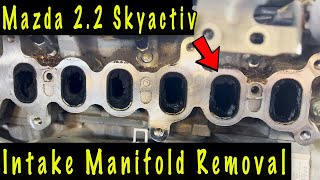
Typical fix: The intake manifold, EGR valve, and associated passages must be removed and physically cleaned. Walnut blasting is the most effective method. 🎬 See this walkthrough on removing the manifold for carbon cleaning. Chemical 'spray-in' cleaning services are generally ineffective for the heavy buildup found in these engines. This is a labor-intensive job, with repair shops quoting costs from £855 to $1700.
Est. part cost: $50-$150 for gaskets - Worn Exhaust Camshaft 🟡 Medium Probability Early versions of the Skyactiv-D engine (approx. 2012-2018) were known to have issues with premature wear on the exhaust camshaft lobes. The hardened rocker arms can wear down the 'softer' metal of the cam lobes, creating a 'lipped' profile that alters valve timing and airflow, triggering the P0101 code.
How to confirm: This requires removing the valve cover and visually inspecting the camshaft lobes for scoring, pitting, or a noticeable reduction in height compared to the intake lobes. Metal shavings from the worn cam can also travel through the oil and damage the vacuum pump, which is another indicator.
Typical fix: Replacement of the exhaust camshaft (OEM Part SH01-12-440A), rocker arms, and hydraulic lifters (tappets). This is a major engine repair. After replacement, it is critical to turn the engine over by hand several times before starting to ensure no valves are sticking, which could break the new rocker arms.
Est. part cost: $500-$1000+ - Dirty or Faulty Mass Airflow (MAF) Sensor ⚪ Low Probability → Shop Fuel Injection Air Flow Meter While less common as the root cause on this engine, oil vapors from the crankcase ventilation system can contaminate the MAF sensor's delicate sensing wire over time, causing inaccurate readings. However, it's more likely an indirect cause or a misdiagnosis.
How to confirm: First, attempt to clean the sensor using a dedicated MAF sensor cleaner spray. If the code returns, monitor live data with a scan tool to see if MAF readings are erratic or out of spec at idle (should be 2.0-3.0 g/s) and under load. Many owners replace the sensor only to have the code return.
Typical fix: Clean the sensor first. If cleaning does not resolve the issue, replace the MAF sensor (OEM Part SH01-13-215). It's also critical to perform a MAF sensor reset/relearn procedure with a capable scan tool after replacement.
Est. part cost: $100-$250 - Air/Vacuum Leak in Intake System ⚪ Low Probability Cracked hoses or loose clamps between the MAF sensor and the turbocharger can allow unmetered air to enter the system, causing the MAF reading to be lower than the actual airflow. The rubber intake hose from the airbox to the throttle body is a known weak point on Mazdas.
How to confirm: Perform a smoke test on the intake system to visually identify the source of any leaks. Visually inspect all intake piping for cracks or damage, paying close attention to the large flexible intake boot.
Typical fix: Replace the cracked hose or tighten the loose clamp.
Est. part cost: $20-$150
Rare But Worth Checking
- Faulty Vacuum Pump: A failing vacuum pump can cause a P0101 code, often accompanied by a P258B code. The failure is frequently a secondary issue, caused by metal shavings from a worn exhaust camshaft contaminating the pump. Replacing the pump without inspecting the camshaft may lead to a repeat failure.
- Leaking Injector Seals (Copper Washers): Failing injector seals (part number may include ZL01-13-ZE5) can allow combustion gases into the crankcase, increasing pressure and forcing oil vapor into the intake, which can contaminate the MAF sensor and contribute to carbon buildup. This is often a root cause of the larger carbon issue and can lead to a blocked oil pickup strainer and catastrophic engine failure if ignored.
- PCM Software Issue or Needing Reset: In some cases, the code can be triggered by a software glitch, particularly after other repairs have been performed. After performing repairs like intake cleaning or part replacement, various adaptations (MAF, EGR, injectors) must be reset using a diagnostic tool like FORScan or the Mazda IDS to prevent the code from returning.
Diagnosis Steps
- Read all fault codes stored in the PCM. Note any other codes that appear alongside P0101, especially P0401 or P258B.
- Inspect the air filter and replace if dirty.
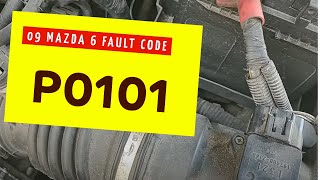
- Remove and inspect the MAF sensor. Clean it using a dedicated MAF sensor cleaner spray. Do not touch the sensing elements. 🎬 Watch: How to safely clean your Mazda's MAF sensor.
- Inspect the intake tract between the air filter box and the turbocharger for any cracks, loose connections, or signs of air leaks.
- Using a capable scan tool, monitor MAF sensor live data (g/s) at idle and while driving. Compare the readings to specified values (typically 2.0-3.0 g/s at idle).
- If possible, perform a smoke test on the intake system to check for hidden vacuum leaks.
- Using a borescope, inspect the inside of the intake manifold for carbon buildup. This can often be done by removing the MAP sensor or throttle body.
- If no significant carbon is found and other causes are ruled out, remove the valve cover to visually inspect the exhaust camshaft lobes for wear, especially on pre-2019 models.
- Check injector seals for leakage, which can be a primary contributor to carbon issues.
- After any repair, clear all codes and perform a reset of the relevant learned adaptations (MAF, EGR, injectors, etc.) using a diagnostic tool like FORScan or Mazda IDS.
Parts You'll Likely Need
- Intake Manifold Gasket Kit
(OEM #SHY1-13-Z10B (Full Gasket Set))— Required when removing the intake manifold for carbon cleaning, which is the most common fix for P0101 on this engine.
Trusted brands: Mazda OE
OEM price range: $80-$150
Aftermarket price range: $50-$90 - Exhaust Camshaft
(OEM #SH01-12-440A)— Required if inspection reveals worn lobes, a common cause of P0101 on pre-2019 engines.
Trusted brands: Mazda OE
OEM price range: $500-$800
Aftermarket price range: $300-$500 - Mass Air Flow (MAF) Sensor
(OEM #SH01-13-215)— Replaced when cleaning fails to resolve the issue, though it's often not the root cause.
Trusted brands: Mazda OE, Denso
OEM price range: $150-$250
Aftermarket price range: $80-$150 - Vacuum Pump
(OEM #SHY1-13-TJ0)— Often fails secondary to camshaft wear, causing a P258B code alongside P0101.
Trusted brands: Mazda OE
OEM price range: $300-$450
Aftermarket price range: $150-$250
Related Codes That Often Appear With This One
- P0401 — EGR Flow Insufficient. This code is very common with P0101 because the same carbon deposits that restrict intake airflow also clog the EGR passages.
- P2262 — Turbocharger Boost Pressure Not Detected. Severe intake restriction from carbon buildup can prevent the turbo from building the expected amount of boost.
- P258B — Vacuum Pump Control Range/Performance. A faulty vacuum pump can be a direct cause of the P0101 code on this engine, and its failure is often linked to a worn camshaft.
Technical Service Bulletins (TSBs) & Recalls
- 01-011/22: Addresses excessive oil consumption due to faulty exhaust valve stem seals on some Skyactiv-D engines.
- 05-002/19: Details a whining noise from the automatic transaxle due to a damaged bearing, affecting some 2014-2017 Mazda 6 models.
- 01-008/19: Notes a PCM logic issue where the flexible oil change reminder may not function correctly.
- 04-004/19: Describes a fix for squeaking rear brakes at low speeds on some CX-5 models, which may be relevant to the shared platform.
Platform-Specific Known Issues
- The 2.2L Skyactiv-D engine is widely known for severe carbon buildup in the intake manifold, which is the primary cause of P0101.
- Early production models (approx. before 2018) are susceptible to premature exhaust camshaft wear, which is another significant cause of this code.
Mechanic-Grade Diagnostic Values
- MAF Sensor Signal Voltage at Idle (Warm Engine) — expected: ~1.13 V to 1.23 V. Failure: Voltage significantly lower than 1.0V, or stuck at 0V.
- MAF Sensor Live Data at Idle (g/s, Warm Engine) — expected: ~5.0 g/s with EGR closed, dropping significantly when EGR is commanded open. Some sources report ~10.5 g/s with EGR open.. Failure: Reading is stuck, does not respond to EGR valve actuation, or is significantly different from the expected value.
- MAF Sensor Reference Voltage (Key On, Engine Off) — expected: ~5.0 V. Failure: Voltage is not present or is significantly lower, indicating a PCM or wiring issue.
- Brake Booster Pressure Sensor (related to Vacuum Pump) — expected: Should sit near 7.6 kPa at idle and return to this value quickly after pressing the brake.. Failure: Sitting high at idle (e.g., 20 kPa) and slow to return, indicating a failing vacuum pump, which is often a symptom of camshaft wear.
- Turbo Wastegate Solenoid Duty Cycle at Idle — expected: Should be low, around 10-20%.. Failure: Stuck at a high value (e.g., 85-87%) at idle, suggesting a faulty solenoid or a restriction in the turbo/exhaust system.
- Fuel Rail Pressure Sensor Voltage — expected: Engine stationary: ~0.5V. Engine idling: ~1.32V. Snap acceleration: ~3.77V+.. Failure: Voltages that are stuck or do not correspond to the engine state.
Scan Tool Commands That Help
- FORScan or Mazda IDS: Reset/Initialize EGR Valve Adaptations — Crucial after cleaning or replacing the intake manifold or EGR valve. The PCM's learned values for an obstructed system will be incorrect for a clean system, potentially re-triggering P0101.
- FORScan or Mazda IDS: Calibrate Injectors — After intake cleaning, camshaft replacement, or injector seal replacement. This resets fuel trim adaptations that may have compensated for incorrect airflow readings, and has been reported to resolve a persistent P0101 code.
- FORScan or Mazda IDS: Reset MAF/MAP Learned Values — After cleaning or replacing the MAF or MAP sensor, or after a major intake system cleaning. This forces the PCM to relearn airflow characteristics from a factory baseline.
- Mazda IDS: PCM Software Update — After major repairs like camshaft replacement or extensive carbon cleaning, a software update may be required to prevent the P0101 code from returning, even if all mechanical parts are correct.
- FORScan or Mazda IDS: EGR Valve Active Test — To diagnose a blockage. Command the EGR valve open while monitoring MAF (g/s). If the MAF reading does not drop significantly, it confirms a physical blockage in the EGR passages or cooler, not just a faulty valve.
Wiring & Ground Locations
- MAF Sensor Connector (Newer Models) — On the intake tube after the air filter box.. On newer models (approx. 2018+), the MAF sensor signal wire is ORANGE and the 5V reference wire is BROWN. This is different from earlier models and crucial for correct testing.
- MAF Sensor Connector (Older Models) — On the intake tube after the air filter box.. On some models, the MAF signal wire is BROWN/BLUE at Pin 5 of the connector, and the ground is a BROWN wire at Pin 3. Verifying pinout is critical before probing.
- Engine Ground Points (e.g., WD63397) — Multiple points on the engine block and chassis. A 2018 Mazda 6 wiring diagram shows key ground points in the engine room.. A poor engine ground can cause erratic sensor readings, including from the MAF sensor. Technicians recommend checking all major engine and body ground connections for corrosion or looseness as part of a P0101 diagnosis.
Real Owner Repair Stories
- Reddit user Sufficient_Humor_236 (2015 Mazda 6 2.2D 175hp, 250,000 km) — Persistent P0101 code for 1.5 years.
❌ Tried (didn't work) Intake manifold cleaning by a Mazda garage., Replacement of the vacuum pump., Replacement of both the MAF and MAP sensors.
✅ What actually fixed it The owner used a cheap OBD scanner with FORScan software and ran the 'initialize egr' and 'calibrate injectors' functions. The P0101 code stopped appearing and the car ran smoothly afterward. - MrNiceGuy on YouTube (Mazda CX-5 2.2D (similar engine and issue)) — P0101, limp mode, SCBS and traction control lights.
❌ Tried (didn't work) Initial diagnosis pointed away from MAF sensor itself, as it's rarely the root cause.
✅ What actually fixed it Removed the valve cover and found a worn exhaust camshaft. The final fix was replacing the camshaft, rocker arms, and injector seals. The mechanic also noted that a PCM software update is sometimes necessary after this repair to prevent the code from returning. - MrNiceGuy on YouTube (Mazda 3 2.2D (similar engine and issue)) — P0101 and P258B (Vacuum Pump Control Circuit).
❌ Tried (didn't work) Simply replacing the vacuum pump would not have been a permanent fix.
✅ What actually fixed it The root cause was an 'extremely excessively worn' exhaust camshaft. Metal shavings from the worn cam lobes contaminated the oil and destroyed the vacuum pump. The complete fix involved replacing the exhaust camshaft, rocker arms, tappets, and the damaged vacuum pump.
"I Checked Everything" — The Actual Cause
- A case was reported where a 2015 CX-5 2.2D passed a smoke test (no vacuum leaks) and had already had the intake cleaned, MAF/MAP sensors replaced, injector seals replaced, and vacuum pump replaced. The camshaft also appeared unworn. The P0101 code, which occurred during engine braking, was ultimately traced to abnormally high exhaust back pressure (over 300 kPa) and a turbo wastegate solenoid that was stuck at an 85% duty cycle at idle. The actual cause was suspected to be a faulty turbocharger or wastegate control system, not an intake leak.
OEM Part Supersession History
SHY1, SHY4, SHY6, SHY8→SH01-12-440A— Design consolidation and likely material/profile improvements for the exhaust camshaft.SH01-12-440A→SH01-12-440B— Possible revision for lobe duration or material hardness.
Heads up: One source suggests SH01-12-440A was for early 2012 models, while SH01-12-440B is correct for 2013–2017 models. It is critical to verify the correct part number for the specific vehicle's production date.
Model Year Variations Within This Range
- 2014-2018: These model years are most susceptible to the premature exhaust camshaft wear due to a 'soft' camshaft material paired with 'harder' rocker arms. This issue was reportedly addressed in engines manufactured from 2019 onwards.
- All: The exhaust gas pressure sensor was originally a plastic-bodied part prone to failure. Mazda later introduced an upgraded, more reliable metal-bodied version. If diagnosing, check which version is installed.
- Approx. 2018+: The wire colors for the MAF sensor connector changed. On newer models, the signal wire is orange, while it may be brown/blue on earlier models. This is critical for accurate electrical testing.
Diagnostic Flowchart
Other Known Issues on This Vehicle
Issues unrelated to this code that are worth knowing about as an owner of this generation:
- Leaking Injector Seals & Oil Starvation 🔴 High — Common on pre-2019 models, can occur at any mileage but more frequent above 60k miles. A catastrophic failure.
- Premature Turbocharger Failure 🔴 High → Shop Turbocharger — Common across all years, often linked to oiling issues.
- Oil Dilution from DPF Regeneration 🟠 Medium — Very common, especially for vehicles used primarily for short trips.
- Cracked Plastic Coolant Junction Pipe 🟠 Medium — A known failure point, especially in warmer climates or at higher mileage.
- Excessive Oil Consumption from Valve Stem Seals 🟠 Medium — Affects certain production runs, prompting a TSB. (Ref: TSB 01-011/22)
Used vs. New Parts: Buying Guide for This Vehicle
When a used part is the smart pick: For this repair, using used parts is generally risky. However, a used intake manifold or EGR cooler could be a cost-effective option IF they are thoroughly cleaned (e.g., walnut blasted) before installation. A used MAF sensor is a gamble but low-risk to try.
Donor-vehicle mileage cap: roughly under 80000 miles for the part to have meaningful remaining life.
What to inspect on the donor part:
- For an exhaust camshaft: MUST be from a 2019+ donor vehicle to get the revised part. Visually inspect lobes for any scoring, pitting, or wear; if any is visible, reject the part.
- For an intake manifold: Use a borescope to inspect the internal passages. If heavy, caked-on carbon is present, it may be difficult to clean completely and should be avoided.
- Check the donor vehicle's history if possible to avoid parts from poorly maintained engines.
OEM-only on this vehicle (don't cheap out):
- Exhaust Camshaft: Due to the specific material failure of the original part, only a new OEM Mazda part (or a reputable aftermarket brand that explicitly states it has improved material hardness) should be used. A used pre-2019 cam will likely fail again.
- Injector Seals (Copper Washers): These are single-use crush washers and are critical for preventing catastrophic engine failure. They are inexpensive and must always be replaced with new OEM parts during any related service.
- Vacuum Pump: If the original failed due to contamination from a worn camshaft, a used replacement will likely fail again quickly from remaining metal debris in the oil system. A new OEM pump is recommended after a thorough engine flush.
Brands owners have reported issues with on this vehicle:
- Unbranded or generic camshafts from online marketplaces are extremely high-risk for this engine, as they may replicate the original 'soft' metal defect.
Real Owner Stories
Aggregated from forums and TSBs cited above. Mileages and costs reflect what owners reported in those sources.
2014 Mazda 6 2.2L Skyactiv-D — 145000 miles
Symptoms: The exhaust camshaft showed a 'lipped' profile and heavy wear compared to the intake lobes, causing airflow deviations.
What fixed it: Replacement of the exhaust camshaft, rocker arms, and hydraulic lifters.
Source hint: Reddit r/Justrolledintotheshop - 'Just a smidge of wear in this 145k mile cam!'
2014-2021 Mazda 6 2.2L Skyactiv-D
Symptoms: SCBS Forward Malfunction warning and the car entering limp mode specifically after decelerating on the highway.
What fixed it: Diagnosis pointed toward vacuum pump failure or airflow restriction issues linked to the P0101 code.
Source hint: Reddit r/mazda6 - '2.2 Skyactiv - SCBS Forward Malfunction (P0101)'
2012-2018 Mazda 6 2.2L Skyactiv-D
Symptoms: P0101 code triggered by airflow restriction; investigation revealed the vacuum pump had failed due to metal shavings in the oil.
What fixed it: Replacement of the worn exhaust camshaft and the damaged vacuum pump.
Source hint: MrNiceGuy YouTube Channel: 'Mazda P0101 FIXED after Worn Exhaust Camshaft Replacement'
2014-2021 Mazda 6 2.2L Skyactiv-D
Symptoms: Severe carbon buildup in the intake manifold restricting air volume and causing the MAF sensor to deviate from PCM expectations.
What fixed it: Physical removal and cleaning of the intake manifold and EGR valve using walnut blasting.
Cost: $1100-$1700
Source hint: Article Context: Common Causes - Severe Carbon Buildup
Related OBD-II Codes
Frequently Asked Questions
Why is my SCBS (Smart City Brake Support) light on alongside the P0101 code?
Can I fix the carbon buildup issue with a spray-in chemical cleaner?
Is there a specific TSB for oil consumption issues on my 2.2L Skyactiv-D?
What is the specific part number for the exhaust camshaft if it is worn?
My MAF sensor readings are 2.5 g/s at idle; is this normal?
Could a whining noise from my transmission be related to the P0101 code?
Helpful Videos

We Have This Part in Stock


The information in this article is provided for general reference and educational purposes only. Vehicle specifications, procedures, and part compatibility can vary by production date, trim level, and region. Always consult your vehicle's factory service manual and verify part numbers before purchasing or performing repairs. Safety-critical components such as airbags, seat belts, and braking systems should be installed by a qualified professional.
- Mazda 6:
- 🧭 Diagnostic Flowchart
- 🎬 Helpful Videos
- 🛍️ Shop This Part
- What's Unique About the 2014-2021 Mazda 6
- Symptoms You May Notice
- Most Likely Causes
- Rare But Worth Checking
- Diagnosis Steps
- Parts You'll Likely Need
- Related Codes That Often Appear With This One
- Technical Service Bulletins (TSBs) & Recalls
- Platform-Specific Known Issues
- Mechanic-Grade Diagnostic Values
- Scan Tool Commands That Help
- Wiring & Ground Locations
- Real Owner Repair Stories
- "I Checked Everything" — The Actual Cause
- OEM Part Supersession History
- Model Year Variations Within This Range
- Other Known Issues on This Vehicle
- Used vs. New Parts: Buying Guide for This Vehicle
- Real Owner Stories
- 2014 Mazda 6 2.2L Skyactiv-D — 145000 miles
- 2014-2021 Mazda 6 2.2L Skyactiv-D
- 2012-2018 Mazda 6 2.2L Skyactiv-D
- 2014-2021 Mazda 6 2.2L Skyactiv-D
- Related OBD-II Codes
- Frequently Asked Questions
- 🎟️ Get 5% Off