

P0101 on 2010-2012 Saab 9-5: MAF Sensor Range/Performance Causes and Fixes
P0101 on a 2010-2012 Saab 9-5 most often indicates a dirty Mass Airflow (MAF) sensor or a vacuum leak in the air intake system, particularly a cracked intercooler pipe or hose. Cleaning the sensor with a dedicated cleaner and performing a smoke test to inspect the entire intake tract for leaks are the most common and effective first steps to fixing the issue.
- Always start diagnosis by inspecting for vacuum leaks and cleaning the MAF sensor with a dedicated cleaner; these are the most common and cheapest fixes.
- If you must replace the MAF sensor, it is strongly recommended to use a genuine Bosch part, as this platform is sensitive to the sensor's calibration.
- The 2.0L Turbo and 2.8L V6 engines use different, non-interchangeable MAF sensors, so ensure you purchase the correct part for your engine.
- A scan tool that can read live data is a powerful diagnostic aid for this code, allowing you to see if the sensor's readings are logical and responsive.
What's Unique About the 2010-2012 Saab 9-5
The 2010-2012 Saab 9-5 (known as the NG9-5) is a unique vehicle built on the General Motors Epsilon II platform, which it shares with the Opel/Vauxhall Insignia and Buick Regal. Its engines, the 2.0L Turbo (A20NFT) and 2.8L V6 Turbo (A28NER), were also used in these GM vehicles, meaning diagnostic knowledge is often transferable. A key issue on this platform is the propensity for air leaks in the pressurized intake tract after the turbo, such as cracked intercooler end tanks or split charge pipes, which is a very common cause for P0101. Owners and specialists strongly recommend using the OEM Bosch MAF sensor for replacement, as cheaper aftermarket sensors are known to cause persistent performance issues due to not meeting the precise calibration requirements.
Symptoms You May Notice
🎬 Watch: 7 common causes of P0101 and how to fix them.- Check Engine Light is on
- Hesitation or sluggishness during acceleration
- Rough or unstable idle
- Reduced engine power, sometimes referred to as "limp mode"
- Decreased fuel economy
- Engine stalling, especially when coming to a stop
- Black smoke from the exhaust if the engine is running excessively rich
- Turbo boost gauge not reaching full pressure
- Replacing the MAF sensor without first checking for vacuum leaks. A small, inexpensive cracked hose or intercooler end tank is often the real culprit, and a new sensor will not fix the problem.
- Replacing the throttle body. While throttle body issues can cause other codes, P0101 is almost always related to air measurement discrepancies originating from the MAF sensor or unmetered air leaks.
Most Likely Causes
- Vacuum Leak / Air Intake Leak 🔴 High Probability → Shop Engine Air Intake Resonator As a turbocharged platform, the entire intake system from the turbo to the throttle body is pressurized. Plastic and rubber components like intercooler end tanks, charge pipes, and couplers can crack or split with age and heat cycles, allowing unmetered air to enter (or metered air to escape). This is a very frequent cause of P0101 on these cars.
How to confirm: Visually inspect all intake hoses and ducts between the MAF sensor and the throttle body for cracks, splits, or loose connections. Pay close attention to the plastic end tanks on the intercooler and the flexible pipe sections. 🎬 Watch this walkthrough on replacing a split intercooler boost pipe. A smoke test is the most effective way to pinpoint a leak, as even small leaks under pressure can trigger the code.
Typical fix: Replace the cracked or leaking hose, intercooler, or gasket. Ensure all clamps are tight.
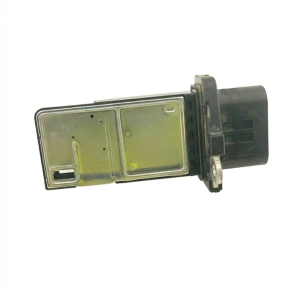
Est. part cost: $50-$400 depending on the specific hose or if the intercooler needs replacement. - Dirty or Contaminated MAF Sensor 🔴 High Probability → Shop Fuel Injection Air Flow Meter The MAF sensor's sensitive hot-film element can become contaminated by oil vapors from the PCV system or from aftermarket oiled air filters. This contamination insulates the element, causing it to misread the incoming airflow.
How to confirm: Visually inspect the sensor's wire or film element. If it appears dirty, coated in grime, or oily, it needs cleaning.
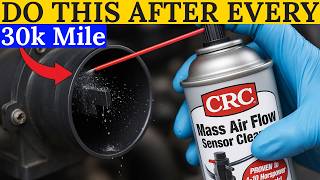
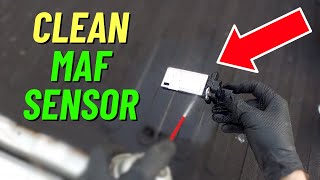
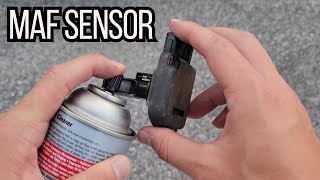
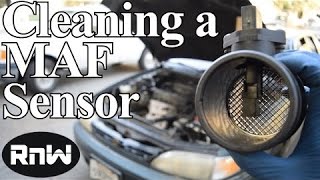
Typical fix: Remove the sensor and clean it carefully using only a dedicated MAF sensor cleaner spray. 🎬 See the right way to clean your MAF sensor safely. Do not touch the internal elements. Allow it to dry completely before reinstalling.
Est. part cost: $10-$15 for a can of MAF cleaner. - Clogged or Improperly Installed Air Filter 🟡 Medium Probability → Shop Air Cleaner Assembly
How to confirm: Inspect the engine air filter. If it is visibly dirty, clogged with debris, or was not seated correctly in the airbox, it can restrict airflow and cause an irrational reading.
Typical fix: Replace the engine air filter.
Est. part cost: $20-$50 - Failed MAF Sensor ⚪ Low Probability → Shop Fuel Injection Air Flow Meter
How to confirm: If cleaning the sensor and confirming there are no vacuum leaks does not resolve the code, the sensor itself may have failed. Use a scan tool to monitor the MAF reading (in g/s); it should be 2-6 g/s at idle and increase smoothly and rapidly to over 180 g/s on hard acceleration for the 2.0T. If the reading is stuck, erratic, or does not change with RPM, the sensor is likely bad.
Typical fix: Replace the MAF sensor. It is highly recommended to use an OEM Bosch part to avoid further issues.
Est. part cost: $115-$550 depending on engine and brand. - Wiring or Connector Issue ⚪ Low Probability
How to confirm: Inspect the MAF sensor connector for corrosion or loose pins. Use a multimeter to test for proper power (12V), ground (<5Ω to chassis ground), and signal voltage (typically a 5V reference) at the connector according to the service manual. Wiggle the harness while testing to check for intermittent breaks.
Typical fix: Repair the damaged wiring or clean/replace the connector.
Est. part cost: $5-$50 for wiring repair supplies.
Rare But Worth Checking
- Restricted Exhaust System: A clogged catalytic converter or muffler can impede airflow through the engine, causing the MAF sensor readings to be lower than expected under load. This will usually be accompanied by a significant loss of power, especially at higher RPMs, and may be seen with other codes.
- Faulty Throttle Body: → Shop Fuel Injection Throttle Body In some rare cases on related Saab models, a faulty throttle body has been found to be the root cause of a persistent P0101 code after all other options were exhausted. This is not a primary diagnostic path but a possibility.
Diagnosis Steps
- Read the fault code with an OBD-II scanner and check for any other stored codes, especially P1101, P0171, P2178, or P2188.
- Visually inspect the entire air intake system from the air filter box to the throttle body. Look for any obvious cracks in hoses, loose clamps, or disconnected lines. Pay special attention to the charge air cooler pipes and intercooler.
- Inspect the engine air filter. If it's dirty or clogged, replace it.
- Carefully remove the MAF sensor. Inspect the sensing element for any dirt, oil, or debris.
- Clean the MAF sensor using only dedicated MAF sensor cleaner spray. Let it air dry completely before reinstalling.
- Clear the fault codes with the scanner, start the engine, and perform a test drive to see if the code returns.
- If the code returns, a smoke test is the most reliable method to find intake leaks. Pressurize the system from the turbo inlet and look for smoke escaping from cracked hoses, gaskets, or the intercooler.
- If no leaks are found, use a scan tool with live data capability. Monitor the MAF sensor reading at idle (should be 2-6 g/s) and during a wide-open throttle acceleration (should exceed 180 g/s for the 2.0T). If the readings are erratic, stuck, or do not respond correctly, the sensor is suspect.
- If live data seems incorrect, check the MAF sensor's electrical connector for damage. Test the wiring for proper power (12V), ground, and signal reference using a multimeter per the service manual.
- If all wiring and intake components are confirmed to be good, the MAF sensor has likely failed and should be replaced with an OEM Bosch part.
Parts You'll Likely Need
- Mass Air Flow Sensor (2.8L V6 Turbo - A28NER)
(OEM #Bosch 0280218226 (Saab 93185455))— If cleaning the sensor and checking for leaks fails, the sensor itself is the next logical part to replace.
Trusted brands: Bosch
OEM price range: $550-$600
Aftermarket price range: $100-$250 - Mass Air Flow Sensor (2.0L 4-Cyl Turbo - A20NFT)
(OEM #Bosch 0280218254 (GM 55562426 / Saab 13244777))— If cleaning the sensor and checking for leaks fails, the sensor itself is the next logical part to replace.
Trusted brands: Bosch
OEM price range: $115-$160
Aftermarket price range: $45-$90 - MAF Sensor Cleaner — This is the first and most cost-effective step in attempting to fix a P0101 code, as contamination is a very common cause.
Trusted brands: CRC, Liqui Moly
Aftermarket price range: $10-$15 - Intercooler Charge Air Pipe — The rubber/plastic hoses are a common failure point, leading to boost leaks that trigger P0101.
Related Codes That Often Appear With This One
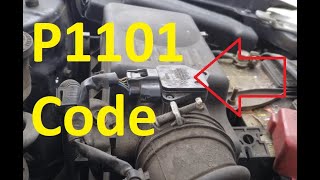
- P1101 — The SAAB Workshop Information System (WIS) and GM TSBs list P1101 (Intake Air Flow System Performance) as a companion code that is often set under the same conditions as P0101, particularly when an intake leak is present.
- P2178 or P2188 — These codes indicate a rich or lean condition off-idle. A faulty MAF sensor providing incorrect airflow data or an intake leak allowing unmetered air is a primary cause for the ECM to command an improper fuel mixture, leading to these fuel trim codes.
- P0171 — This code for 'System Too Lean' is frequently triggered by the same unmetered air leak that causes P0101. The leak allows extra air into the engine that the MAF sensor didn't measure.
Technical Service Bulletins (TSBs) & Recalls
- GM TSB #PIP5402B/C - (Buick Regal): Although for the Buick Regal, this TSB is highly relevant as it concerns the shared 2.0L Turbo engine. It addresses P0101 and P1101 codes caused by a missing or damaged O-ring on the charge air cooler (CAC) coupler, leading to an air leak.
Platform-Specific Known Issues
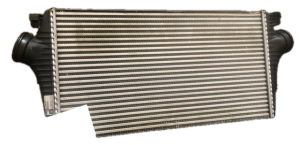
- Cracked Intercooler or Charge Pipes: → Shop Intercooler A very common failure leading to P0101 is a crack in the plastic end tanks of the intercooler or a split in one of the rubber/plastic charge pipes connecting the turbo to the intercooler and the intercooler to the throttle body. Owners on SaabTuning.pl specifically mention that the intercoolers are weak and prone to bursting at the plastic sides, and that this is a more likely cause than a bad MAF sensor. A visual inspection may reveal oil residue around the crack, which is a tell-tale sign of a boost leak.
- Charge Air Cooler (CAC) Coupler O-Ring Leak: → Shop Intercooler On the closely related Buick Regal with the same 2.0L Turbo engine, GM issued TSB #PIP5402B/C for a P0101/P1101 condition caused by a missing or damaged O-ring seal on the charge air cooler outlet coupler. This allows pressurized air to leak out, creating a mismatch between measured and expected airflow. This is a known issue on the platform and should be inspected.
Mechanic-Grade Diagnostic Values
- MAF Sensor Live Data (g/s) at Idle — expected: 2-6 g/s. Failure: Reading is stuck, erratic, or significantly outside this range at a stable idle.
- MAF Sensor Live Data (g/s) at Wide-Open Throttle (WOT) — expected: Greater than 180 g/s at the time of the 1-2 shift (for 2.0T engine). Failure: Reading fails to increase rapidly and smoothly, or does not reach the peak value.
- MAF Sensor Connector - Ground Circuit Resistance — expected: Less than 5 Ω between the ground circuit terminal (Pin 2) and chassis ground.. Failure: Resistance is higher than 5 Ω, indicating a poor ground connection.
- MAF Sensor Connector - Ignition Circuit Voltage — expected: Greater than 11V (or battery voltage) between the ignition circuit terminal (Pin 4) and ground with ignition ON.. Failure: Voltage is significantly lower than battery voltage, indicating a power supply issue.
- MAF Sensor Connector - Signal Circuit Reference Voltage — expected: 4.8-5.2 V between the signal circuit terminal (Pin 5) and ground with ignition ON.. Failure: Voltage is outside this range, indicating a fault in the ECM or the wiring.
Scan Tool Commands That Help
- Tech2 / GDS2: Idle Learn Reset — After cleaning or replacing the throttle body. The ECM learns airflow characteristics, and if the throttle body's state changes (e.g., coke deposit removal), the learned values must be reset to prevent an unstable idle or related DTCs like P0101.
Wiring & Ground Locations
- G2 — On the left-hand structural member in the engine bay, behind the headlamp, in front of the battery.. This is a primary chassis and battery ground point. High resistance here can cause erratic voltage and unstable sensor readings across the entire engine management system.
- G7 — On the side of the intake manifold (for 4-cyl engines).. This is a critical ground point for engine sensors. A loose or corroded connection here can directly affect the MAF sensor's ground reference, leading to incorrect readings and P0101.
- G25 — On the gearbox, serving as a main battery ground.. This is the main grounding path for the engine and transmission assembly. Poor contact can lead to a host of electrical issues, including sensor data problems.
- MAF Sensor Connector (B75) — The electrical connector on the Mass Airflow Sensor itself.. Specific pins must be tested for power, ground, and signal. Pin 2 is ground, Pin 4 is ignition voltage, and Pin 5 is the signal circuit.
Real Owner Repair Stories
- SaabCentral Forums (2011 Saab 9-5 Turbo4 (A20NFT)) — Check Engine Light with codes P0101 and P1101, hesitation under acceleration.
❌ Tried (didn't work) Cleaning the MAF sensor, Replacing the MAF sensor, Replacing the air filter
✅ What actually fixed it A smoke test revealed a significant leak from a cracked plastic end tank on the intercooler. Replacing the intercooler resolved both codes and all symptoms.
"I Checked Everything" — The Actual Cause
- In cases related to the GM 1.4T engine (a relative of the A20NFT), P1101 (a companion to P0101) can be set even if a smoke test is clean. The cause is often a failed internal diaphragm in the PCV system integrated into the valve cover. This allows unmetered air from the crankcase to be drawn into the intake manifold under certain vacuum conditions, which a standard smoke test at atmospheric pressure may not reveal.
When the Usual Fixes Don't Work
- A user on 2CarPros with a 2003 Saab 9-5 reported a persistent P0101 code even after replacing the MAF sensor twice and the throttle body once. This highlights that even with new parts, the issue can persist if the root cause is a vacuum leak, a wiring issue with high resistance, or if the replacement MAF sensors (even OEM) are faulty out of the box, which the responding technician noted can happen.
OEM Part Supersession History
Bosch 0280218254→Bosch 0280218268, Bosch 0280218429— Product revision and consolidation.
Heads up: While these parts are listed as supersessions, owner and specialist forums strongly advise using the exact original Bosch part number specified for the vehicle to avoid subtle calibration issues that can cause persistent, difficult-to-diagnose performance problems.
Diagnostic Flowchart
Real Owner Stories
Aggregated from forums and TSBs cited above. Mileages and costs reflect what owners reported in those sources.
Saab 9-5 2.0T
Symptoms: P0101 code triggered, but the MAF sensor was not the actual problem.
What fixed it: Found an air leak in the intake system caused by a burst intercooler at the plastic side tanks.
Source hint: SaabTuning.pl - 'P0101 - błąd przepływomierza, ale zwykle to coś innego...'
Saab 9-5
Symptoms: The P0101 code persisted during hard acceleration even after replacing the MAF sensor and checking the wiring.
What fixed it: The eventual culprit was diagnosed as a hard-to-find intake leak or a faulty throttle body after a long battle of misdiagnosis.
Source hint: Saabclub.fi - 'vikakoodi p0101'
Saab 9-5
Symptoms: Loss of power, turbo gauge not responding correctly, and the P0101 code appearing.
What fixed it: The owner cleaned the MAF and had a shop check for leaks with no initial success, highlighting the difficulty of diagnosing this without a systematic smoke test.
Source hint: SAABNet.Ru - 'Р0101, нет динамики разгона'
2.0L Turbo Engine (Shared GM Platform)
Symptoms: P0101 and P1101 codes present due to an air leak creating a mismatch between measured and expected airflow.
What fixed it: Replaced a missing or damaged O-ring seal on the charge air cooler (CAC) outlet coupler.
Source hint: GM TSB #PIP5402B/C - (Buick Regal)
Related OBD-II Codes
Frequently Asked Questions
Does GM TSB #PIP5402B/C apply to my 2010-2012 Saab 9-5?
Why do Saab specialists say the intercooler is a common cause for P0101 on this car?
If I need to replace the MAF sensor on my 2.0T, what brand should I buy?
What should the MAF sensor live data readings be on the 2.0T engine?
My turbo boost gauge isn't reaching full pressure and I have a P0101 code. Are they related?
Helpful Videos

We Have This Part in Stock

The information in this article is provided for general reference and educational purposes only. Vehicle specifications, procedures, and part compatibility can vary by production date, trim level, and region. Always consult your vehicle's factory service manual and verify part numbers before purchasing or performing repairs. Safety-critical components such as airbags, seat belts, and braking systems should be installed by a qualified professional.
- Saab 9-5:
- 🧭 Diagnostic Flowchart
- 🎬 Helpful Videos
- 🛍️ Shop This Part
- What's Unique About the 2010-2012 Saab 9-5
- Symptoms You May Notice
- Most Likely Causes
- Rare But Worth Checking
- Diagnosis Steps
- Parts You'll Likely Need
- Related Codes That Often Appear With This One
- Technical Service Bulletins (TSBs) & Recalls
- Platform-Specific Known Issues
- Mechanic-Grade Diagnostic Values
- Scan Tool Commands That Help
- Wiring & Ground Locations
- Real Owner Repair Stories
- "I Checked Everything" — The Actual Cause
- When the Usual Fixes Don't Work
- OEM Part Supersession History
- Real Owner Stories
- Saab 9-5 2.0T
- Saab 9-5
- Saab 9-5
- 2.0L Turbo Engine (Shared GM Platform)
- Related OBD-II Codes
- Frequently Asked Questions
- 🎟️ Get 5% Off