

P0101 on 2011-2016 Scion tC 2.5L: MAF Sensor Causes and Fixes
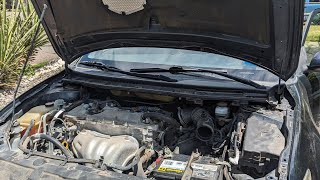
On a 2011-2016 Scion tC, code P0101 is most often caused by a dirty Mass Airflow (MAF) sensor. Cleaning it with dedicated MAF cleaner for about $10 is the first and most common fix. If that fails, a replacement Denso sensor (the OEM manufacturer) costs around $70-$100 and is a 1/5 difficulty DIY job. Aftermarket air intakes are also a very frequent trigger for this code.
- P0101 on your Scion tC almost always points to an issue with the Mass Airflow (MAF) sensor.
- The most likely and cheapest fix is to clean the MAF sensor with a can of dedicated MAF sensor cleaner.
- Check for a dirty air filter and look for obvious cracks in the plastic air intake hose before buying any parts.
- If you have an aftermarket cold air intake, it is a strong suspect. Check for leaks or consider reinstalling the stock airbox to diagnose.
- If you must replace the sensor, use the OEM brand (Denso) to avoid further issues. The replacement is a very simple DIY job that takes about 10 minutes.
What's Unique About the 2011-2016 Scion tC
For the second-generation Scion tC with the 2.5L 2AR-FE engine, the P0101 code is a very common and straightforward issue. The MAF sensor, made by Denso, is generally reliable but sensitive to dirt and oil. This code frequently appears after installing an aftermarket cold air intake if the intake tube diameter is different from stock, if the MAF sensor is not seated perfectly airtight, or if an over-oiled filter contaminates the sensor element. Unlike some other manufacturers, there are no widespread reports of this code being caused by complex software issues requiring an ECM reflash on this specific platform.
Symptoms You May Notice
- Check Engine Light is on
- Traction control light may also illuminate
- Rough or unsteady idle, sometimes fluctuating between 500-900 RPM
- Hesitation or stumbling during acceleration
- Reduced engine power or 'limp mode'
- Poor fuel economy
- Difficulty starting the engine
- Black smoke from the exhaust if running rich
- Replacing the MAF sensor before cleaning it. Cleaning is effective in a majority of cases and is very inexpensive.
- Replacing oxygen (O2) sensors. While a fuel trim issue might be present (often triggering P0171 or P0172), the P0101 code points directly to the MAF sensor's performance as the likely root cause.
Most Likely Causes
- Dirty or Contaminated MAF Sensor 🔴 High Probability → Shop Fuel Injection Air Flow Meter The MAF sensor's hot wire design can easily become contaminated by dirt, dust, or oil (especially from over-oiled aftermarket air filters), altering its readings and causing them to be out of the expected range.
How to confirm: Visually inspect the two small sensing wires inside the MAF sensor. If they appear coated in grime or dirt, they need cleaning. This is the most common cause.
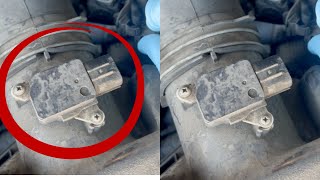
Typical fix: Remove the sensor (2 Phillips screws) and spray the sensing elements thoroughly with a dedicated Mass Airflow Sensor cleaner. 🎬 Watch: Step-by-step guide to cleaning your Scion tC MAF sensor. Let it dry completely for at least 20 minutes before reinstalling.
Est. part cost: $8-$15 for a can of MAF cleaner. - Vacuum Leak 🟡 Medium Probability Leaks can occur in the air intake boot between the MAF sensor and the throttle body, or from any vacuum hoses connected to the intake manifold. This allows unmetered air to enter the engine, causing the MAF to report less air than the engine is actually receiving, triggering the code.
How to confirm: Visually inspect the intake hose for cracks, especially in the accordion sections. For smaller leaks, a smoke test is the most effective method. Alternatively, spraying carburetor cleaner near suspected leak points while the engine is running will cause a change in engine RPM if a leak is present.
Typical fix: Replace the cracked intake boot or leaking vacuum hose.
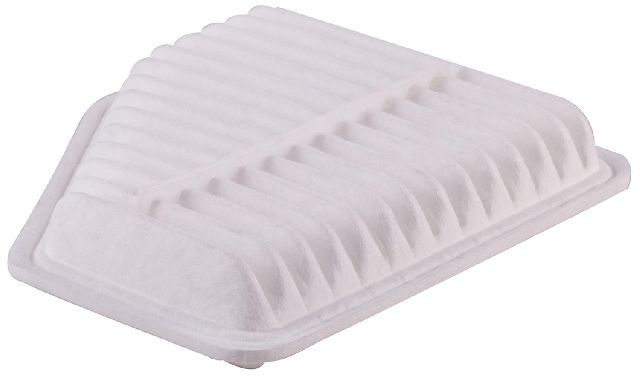
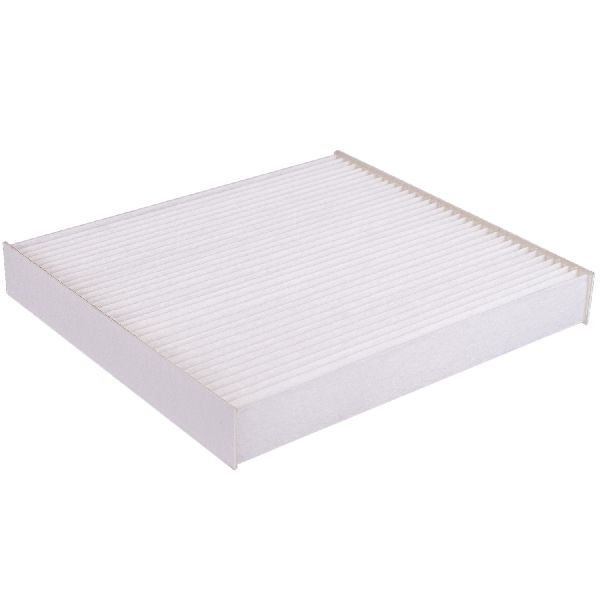
Est. part cost: $20-$60 for a new intake boot. - Dirty or Clogged Engine Air Filter 🟡 Medium Probability → Shop Air Cleaner Assembly
How to confirm: Remove the engine air filter and inspect it. If it is visibly dirty, clogged with debris, or has not been replaced in over 15,000 miles, it should be replaced.
Typical fix: Replace the engine air filter. This is a basic maintenance item that is often overlooked and can restrict airflow enough to cause a P0101.
Est. part cost: $15-$30 - Faulty MAF Sensor ⚪ Low Probability → Shop Fuel Injection Air Flow Meter
How to confirm: If the code returns immediately after cleaning the sensor and you have confirmed there are no vacuum leaks or wiring issues, the sensor itself has likely failed. A scan tool can monitor the MAF reading in grams/second (g/s); a healthy 2AR-FE should read approximately 2.0-4.0 g/s at a stable, warm idle. A faulty sensor may show erratic, zero, or unchanging readings as RPMs increase.
Typical fix: Replace the MAF sensor. It is held in by two Phillips screws and an electrical connector. Always disconnect the battery for 15 minutes after replacement to reset the ECU's fuel trims.
Est. part cost: $70-$190
Rare But Worth Checking
- Aftermarket Cold Air Intake (CAI): → Shop Engine Air Intake Resonator If a CAI was recently installed, it is a primary suspect. The tube diameter around the sensor might be incorrect, the sensor may not be seated with a perfect seal, or an oiled filter may have contaminated the sensor. Reinstalling the factory airbox is a definitive diagnostic step.
- Clogged Catalytic Converter: A severely restricted exhaust can reduce airflow through the engine, causing the MAF readings to be lower than expected and triggering a P0101 code. This is usually accompanied by a significant loss of power, especially at high RPMs, and potentially other exhaust-related codes.
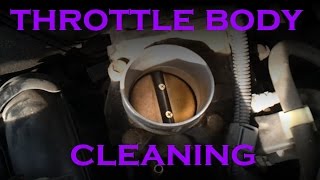
- Dirty Throttle Body: → Shop Fuel Injection Throttle Body A dirty throttle body can restrict airflow at idle and low speeds, which can sometimes contribute to a P0101 code by creating a mismatch between expected and actual airflow. Cleaning the throttle body is sometimes recommended alongside cleaning the MAF sensor. 🎬 See how to easily clean the throttle body on this model.
Diagnosis Steps
- Read the code with an OBD-II scanner and check for any other codes like P0171 or P0172.
- Inspect the engine air filter. If it's dirty, replace it.
- Visually inspect the entire air intake system from the airbox to the throttle body. Look for cracks in the flexible boot, loose clamps, or disconnected hoses.
- If you have an aftermarket intake, pay close attention to the seal where the MAF sensor mounts. An improper seal is a common cause of leaks.
- Unplug and remove the MAF sensor (held by two Phillips screws).
- Inspect the sensor's internal wires. If they look dirty, spray them generously with dedicated MAF sensor cleaner. Do not touch the wires.
- Allow the sensor to air dry completely for at least 20 minutes. Do not use compressed air.
- Reinstall the sensor, disconnect the battery for 15 minutes to clear codes and reset fuel trims, then perform a test drive.
- If the code returns, the next step is to check for vacuum leaks using a smoke machine or the carb cleaner method.
- If no vacuum leaks are found and the wiring to the sensor is intact, the MAF sensor itself is likely faulty and should be replaced with a Denso or OEM part.
Parts You'll Likely Need
- Mass Airflow (MAF) Sensor
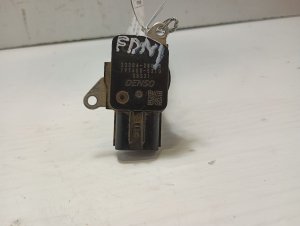
(OEM #22204-28010)— This is the sensor that measures airflow. If cleaning doesn't resolve the issue, the sensor itself has likely failed. Denso is the original equipment manufacturer for Scion/Toyota. This part number is the most likely correct OEM part for this vehicle, though several confusingly similar numbers exist.
Trusted brands: Denso (OEM), NGK/NTK, Delphi
OEM price range: $140-$225
Aftermarket price range: $70-$120 - MAF Sensor Cleaner — This is a special solvent designed to clean the sensitive wires of the MAF sensor without leaving a residue. It is the first and most common fix for P0101. 🎬 Watch this quick video to fix P0101 for under $10.
Trusted brands: CRC, WD-40 Specialist
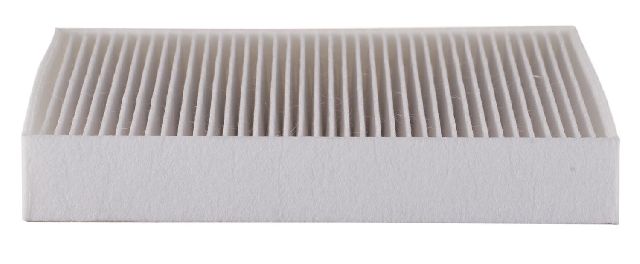
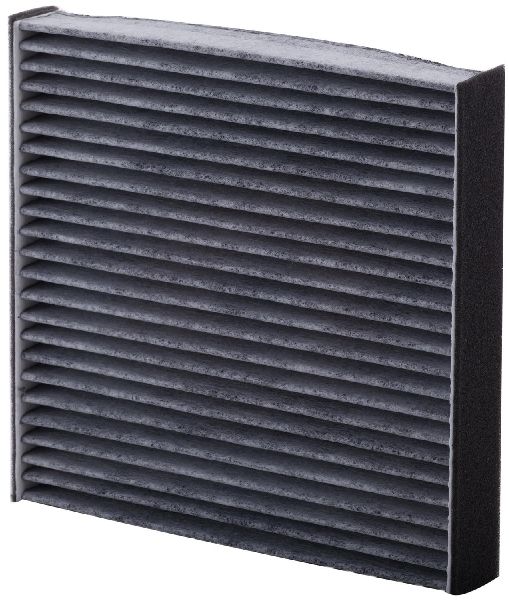
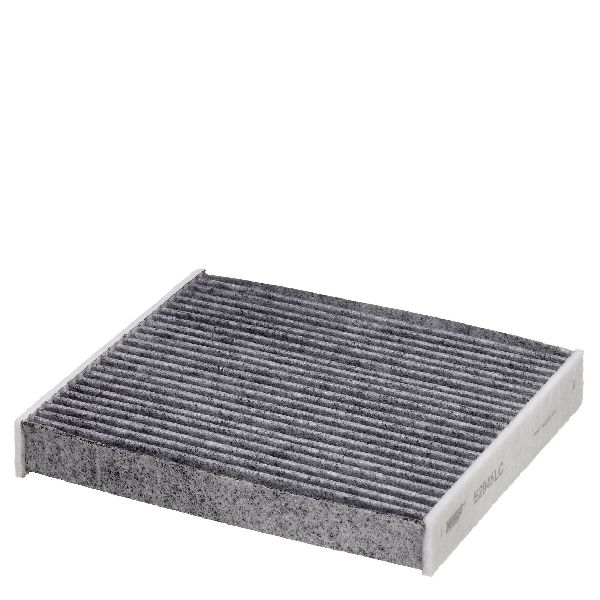
Aftermarket price range: $8-$15 - Engine Air Filter
(OEM #17801-YZZ02 (Denso))— A clogged air filter can restrict airflow and contribute to a P0101 code. It's a basic maintenance item that should be checked first.
Trusted brands: Denso, Wix, Purolator
OEM price range: $20-$35
Aftermarket price range: $15-$25
Related Codes That Often Appear With This One
- P0171 — System Too Lean (Bank 1). A vacuum leak or a MAF sensor that is under-reporting airflow will cause the engine to run lean, often triggering P0171 alongside P0101.
- P0172 — System Too Rich (Bank 1). A MAF sensor that is over-reporting airflow (less common, but possible with some failures) will cause the engine to run rich, which can trigger P0172.
- P0606 — ECM/PCM Processor Error. This code can sometimes appear alongside P0101, especially if the MAF issue is persistent. In some cases, it's a generic code triggered by the primary fault, but it can cause confusion.
Technical Service Bulletins (TSBs) & Recalls
- No specific TSBs were found for the 2011-2016 Scion tC regarding a P0101 code during research. A TSB (T-SB-0092-15) exists for P0101 on some supercharged Toyota Tundra models, but it is not relevant to this platform.
Platform-Specific Known Issues
- Aftermarket Cold Air Intakes (CAI): → Shop Engine Air Intake Resonator The most commonly cited reason for P0101 on the Scion tC in forums is the installation of a CAI. Issues range from incorrect pipe diameter throwing off sensor readings, poor seals around the MAF sensor housing causing a vacuum leak, and oiled filters contaminating the sensor element.
Mechanic-Grade Diagnostic Values
- MAF Sensor Reading (g/s) at Idle — expected: A common mechanic's rule-of-thumb is to multiply the engine displacement in liters by 1.7-1.9. For the 2.5L 2AR-FE, this gives an expected range of 4.25 to 4.75 g/s at warm idle with no loads. The general range is 2-7 g/s.. Failure: A reading significantly lower than expected (e.g., <2.0 g/s) often indicates a vacuum leak (unmetered air). A reading that is erratic or does not increase smoothly with RPM suggests a faulty sensor.
- MAF Sensor Signal Voltage (VG) at Idle — expected: Approximately 0.9V to 1.5V at warm idle. Voltage may be slightly higher (e.g., 1.4V) when the engine is cold and will decrease as it warms up.. Failure: Voltage that is stuck, zero, or fluctuates wildly at a steady idle points to a sensor or wiring problem. Voltage should increase smoothly and linearly as the engine RPM increases.
- ECM Airflow Comparison (Internal Logic) — expected: The ECM continuously compares the actual airflow measured by the MAF sensor to an estimated airflow value it calculates based on engine speed and throttle position. The ratio of these two values should be close to 1.0.. Failure: A P0101 code is set (after two consecutive trips) if the ratio of measured airflow to estimated airflow is outside a predetermined range, such as below 0.85 or above 1.17, indicating the MAF reading is illogical.
Scan Tool Commands That Help
- OBD-II Scanner / Manual Procedure: ECU Fuel Trim and Idle Relearn — After cleaning or replacing the MAF sensor or throttle body, the ECU's learned fuel trims and idle values must be reset. This is typically done by disconnecting the battery's negative terminal for at least 15 minutes. Afterwards, the engine should be started and allowed to idle without any loads (no A/C, lights, etc.) until it reaches operating temperature, allowing it to relearn the correct idle speed and airflow parameters.
Wiring & Ground Locations
- MAF Sensor Connector Pins — The 5-pin connector on the MAF sensor itself, located in the intake tube just after the air filter box.. Knowing the function of each pin is critical for testing. Based on similar Toyota models, the functions are typically: Pin 1: +B (12V Power from EFI relay), Pin 2: VG (Signal voltage to ECM), Pin 3: E2G (Signal ground reference to ECM), Pin 4: THA (Intake Air Temp signal to ECM), Pin 5: E2 (Sensor ground). A failure in the power, ground, or signal wire will cause a P0101 or related code.
- ECM Body Ground — On the related 2AR-FE engine in the Toyota Camry, a primary ECM ground is located on the body, accessible after disconnecting the ECM connector. A resistance check between the ground pins on the harness connector and the chassis should be less than 1 ohm.. A poor ground connection for the ECM can cause a floating ground reference, leading to incorrect sensor readings from the MAF and other sensors, potentially triggering a P0101 code even if the sensor and its direct wiring are good.
Real Owner Repair Stories
- Reddit user in r/SciontC (2011 Scion tC w/ Cold Air Intake, 166,800 km) — P0101 code appeared. After fixing a leak and replacing the MAF, the idle fluctuated between 500-900 RPM and a new code, P0171 (System Too Lean), appeared.
❌ Tried (didn't work) Cleaning the MAF sensor and throttle body., Fixing an initial vacuum leak found via smoke test where the CAI meets the throttle body.
✅ What actually fixed it The user replaced the MAF sensor which resolved the P0101, but then led to a P0171, indicating the diagnostic path may continue. The user was planning to take it to a dealer, suspecting a fuel issue or intake manifold gasket leak was the next logical step. - Reddit user in r/SciontC (2009 Scion tC (1st Gen, but relevant symptoms), 115,000 miles) — Persistent P0101 code, sometimes with P0606 (PCM Processor Error). Terrible gas mileage (~15 MPG) and unstable idle (600-750 RPM).
❌ Tried (didn't work) Cleaning the original MAF sensor., Replacing the air filter., Replacing the MAF sensor with a new Denso unit.
✅ What actually fixed it The original poster did not confirm the final fix, but another user in the thread reported that identical idle issues on their tC were resolved by having a garage clean the throttle body and perform an idle reset.
"I Checked Everything" — The Actual Cause
- In a well-documented case on a Toyota Tundra (which shares engine logic), a persistent P0101 code returned even after replacing the MAF sensor with a new OEM part and confirming no vacuum leaks. The actual cause was significant carbon buildup inside the throttle body. The buildup restricted airflow, especially at partial throttle, causing the actual airflow to be lower than what the ECM expected for that throttle plate angle, triggering the P0101. A thorough, off-vehicle cleaning of the throttle body finally resolved the code.
When the Usual Fixes Don't Work
- While cleaning or replacing the MAF sensor is the most common fix, there are numerous owner accounts where this does not solve the problem. In one case involving a 2011 tC, a user fixed a vacuum leak and replaced the MAF sensor, but the P0101 code was then replaced by a P0171 lean code, indicating the true problem was elsewhere in the system, possibly a larger, unmetered air leak like an intake manifold gasket. In another case, a user replaced the MAF with a new Denso part to no effect; a fellow owner's suggestion pointed to a dirty throttle body as the likely culprit for the same symptoms.
OEM Part Supersession History
22204-0T040→22204-0V020— Part revision/update by Toyota.
Heads up: While 22204-0V020 is a valid supersession, multiple Toyota parts catalogs suggest that 22204-28010 is the correct primary part number for the 2011-2016 Scion tC 2.5L. This causes significant confusion. Always verify by VIN if possible.22204-0V010→Unknown— Appears as another potential part number for this vehicle, adding to the confusion.
Heads up: This part number is listed by some vendors for the 2011 tC but is less commonly cited than 22204-28010.
Diagnostic Flowchart
Real Owner Stories
Aggregated from forums and TSBs cited above. Mileages and costs reflect what owners reported in those sources.
2011 Scion tC 2.5L 2AR-FE — 103644 miles
Symptoms: Check engine light with P0101 code, later followed by a P0171 code with the traction control light on. After replacing the MAF sensor, the idle fluctuated between 500-900 rpm.
What fixed it: Owner did not report a final fix; was planning to take the vehicle to a dealership for diagnosis after fixing a CAI vacuum leak, cleaning the throttle body/MAF, and replacing the MAF sensor all failed to resolve the issue.
Source hint: reddit.com/r/SciontC/comments/w953j3/2011_tc_diagnosis/
Related OBD-II Codes
Frequently Asked Questions
Does the Toyota TSB T-SB-0092-15 for P0101 apply to my 2011-2016 Scion tC?
I just installed a Cold Air Intake (CAI) on my Scion tC and got a P0101. What went wrong?
What should the MAF sensor reading be on a healthy 2.5L 2AR-FE engine?
Why is my traction control light on along with the check engine light for P0101?
Do I need to reset anything after cleaning or replacing the MAF sensor on my tC?
What brand of MAF sensor should I buy if I need to replace it on my 2011-2016 tC?
Helpful Videos
![How to Fix P0101 Engine Code in 2 Minutes [1 DIY Method / Only $9.74]](https://img.youtube.com/vi/RaWpb3www8s/mqdefault.jpg)
Used OEM Parts in Stock
New Aftermarket Parts Available

The information in this article is provided for general reference and educational purposes only. Vehicle specifications, procedures, and part compatibility can vary by production date, trim level, and region. Always consult your vehicle's factory service manual and verify part numbers before purchasing or performing repairs. Safety-critical components such as airbags, seat belts, and braking systems should be installed by a qualified professional.
- Scion tC:
- 🧭 Diagnostic Flowchart
- 🎬 Helpful Videos
- 🛍️ Shop This Part
- What's Unique About the 2011-2016 Scion tC
- Symptoms You May Notice
- Most Likely Causes
- Rare But Worth Checking
- Diagnosis Steps
- Parts You'll Likely Need
- Related Codes That Often Appear With This One
- Technical Service Bulletins (TSBs) & Recalls
- Platform-Specific Known Issues
- Mechanic-Grade Diagnostic Values
- Scan Tool Commands That Help
- Wiring & Ground Locations
- Real Owner Repair Stories
- "I Checked Everything" — The Actual Cause
- When the Usual Fixes Don't Work
- OEM Part Supersession History
- Real Owner Stories
- 2011 Scion tC 2.5L 2AR-FE — 103644 miles
- Related OBD-II Codes
- Frequently Asked Questions
- 🎟️ Get 5% Off