

P0101 on 2016-2020 Volkswagen Passat: MAF Sensor Causes and Fixes
P0101 on a 2016-2020 Passat most often means there is a leak in the air intake system or the Mass Air Flow (MAF) sensor is dirty. The most common source of a leak is a failed PCV valve/oil separator. Before replacing the expensive MAF sensor, inspect all intake hoses for leaks, check the PCV valve for failure (listen for whistling or feel for strong suction at the oil cap), and try cleaning the MAF sensor. A replacement Bosch MAF sensor costs between $120 and $290, while a new PCV valve is aroun
- P0101 on your Passat is more likely an air leak than a bad sensor. Check all intake hoses first.
- A can of MAF sensor cleaner is a cheap and effective first step. Never use other chemicals or touch the sensor wires.
- Leaks in the turbocharger hoses (charge pipes) are a known issue for this vehicle and a primary cause of P0101.
- If you must replace the sensor, use a quality OEM brand like Bosch. Cheaper aftermarket sensors are often poorly calibrated and may not fix the issue.
What's Unique About the 2016-2020 Volkswagen PASSAT
The 2016-2020 Passat uses the turbocharged EA888 engine family (1.8T and 2.0T). A primary weak point on this engine is the Positive Crankcase Ventilation (PCV) valve, also known as the oil separator. The internal diaphragm can tear, creating a significant unmetered air (vacuum) leak that the MAF sensor cannot see, directly causing a P0101 code. This is arguably the most common cause on this platform. Additionally, as a turbocharged engine, the charge air system is another frequent failure point. Volkswagen issued a Technical Tip (21-20-01TT) for the 2020 Passat, advising technicians to check for leaks in the turbocharger boost hoses before replacing the MAF sensor for a P0101 code, confirming that unmetered air is a major concern.
Diagnostic Flowchart
Tap your situation to follow the diagnostic path that matches what you're seeing on this vehicle.
Generation note: This range covers the facelifted North American Passat (NMS). Model years 2016-2017 primarily used a 1.8T EA888 Gen 3 engine. From 2018-2020, this was replaced by a 2.0T EA888 Gen 3 'B-Cycle' engine. While the engines differ, the primary causes for P0101 are identical, with a strong emphasis on checking for a failed PCV valve and leaks in the intake/charge air system on both turbocharged variants.
Symptoms You May Notice
- Check Engine Light is on
- Rough or unstable idle
- Hesitation or stumbling during acceleration
- Reduced engine power and sluggish performance
- Decreased fuel economy
- Black smoke from the exhaust
- Engine may stall, especially at low speeds
- Audible whistling or sucking noise from the engine bay at idle (indicative of a failed PCV valve)
- Immediately replacing the MAF sensor without first checking for air leaks. A vacuum leak from a failed PCV valve is a very common cause for this code on the Passat, and a new sensor will not fix it.
Most Likely Causes
- Failed PCV Valve / Oil Separator Very high Probability → Shop PCV Valve The diaphragm inside the PCV valve on the EA888 engine is a known weak point and is considered a common failure item. When it tears, it creates a large vacuum leak, allowing unmetered air into the intake manifold, which is a direct cause of P0101.
How to confirm: With the engine running at idle, listen for a distinct whistling sound. Another test is to try to remove the oil filler cap. If there is very strong suction holding it down, or if the engine stumbles or stalls when the cap is removed, the PCV valve has likely failed. A smoke test will definitively show a leak from the PCV housing.
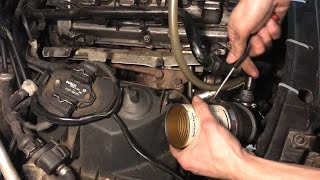
Typical fix: Replace the entire PCV valve assembly. It is located on top of the engine. Use the latest revised OEM part number to ensure longevity. This is a common DIY job. 🎬 Watch: How to diagnose and replace a faulty PCV valve
Est. part cost: $120-$180 - Air leak in the intake or charge air system 🔴 High Probability As a turbocharged vehicle, the Passat has numerous pressurized hoses and connections between the turbo, intercooler, and intake manifold. These can loosen, crack, or pop off, causing a significant leak that triggers P0101. VW issued a Technical Tip (21-20-01TT) specifically for this issue on the 2020 Passat.
How to confirm: Visually inspect all air ducts from the air filter box to the throttle body. A smoke test is the most effective way to find leaks by pressurizing the intake system with smoke and watching where it escapes.
Typical fix: Re-secure any loose clamps or popped-off hoses. Replace any cracked or damaged hoses. A cracked intake air hose is a common finding.
Est. part cost: $5-$150 - Dirty or contaminated MAF sensor 🟡 Medium Probability → Shop Fuel Injection Air Flow Meter The MAF sensor's sensitive hot wire can become contaminated by dirt, oil from the PCV system, or residue from over-oiled aftermarket air filters. This contamination insulates the wire, causing inaccurate readings.
How to confirm: Remove the MAF sensor from the intake tube. Visually inspect the small wires inside the sensor housing for any dirt, debris, or oily film. With a scan tool, check the MAF reading at idle with the engine warm. A normal reading should be between 2.0 and 5.0 g/s. Readings outside this range suggest a problem.
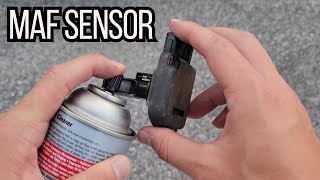
Typical fix: Carefully spray the sensor's internal wires with a dedicated Mass Air Flow sensor cleaner. Do not touch the wires. Allow it to dry completely before reinstalling. 🎬 Watch: The easy way to clean your MAF sensor
Est. part cost: $10-$15 - Faulty Mass Air Flow (MAF) sensor ⚪ Low Probability → Shop Fuel Injection Air Flow Meter
How to confirm: If cleaning the sensor and confirming there are no air leaks does not resolve the code, the sensor's internal electronics have likely failed. You can confirm this by monitoring MAF readings with an advanced scan tool; if the readings are erratic, stuck at a certain value, or do not increase smoothly with RPM, the sensor is bad.
Typical fix: Replace the MAF sensor. It is highly recommended to use an OEM part from a brand like Bosch to ensure correct calibration.
Est. part cost: $120-$290
Rare But Worth Checking
- Cracked or failing intake manifold: → Shop Engine Intake Manifold The plastic intake manifold on the EA888 engine can develop cracks or have issues with the internal runner flaps, creating a vacuum leak that can trigger P0101. This may also be accompanied by a P2015 code for the runner position sensor.
- Damaged wiring or poor connection at the MAF sensor: → Shop Fuel Injection Air Flow Meter Before replacing a sensor, always check that the connector is securely plugged in and inspect the wiring harness for any visible signs of damage, fraying, or corrosion.
- Clogged or dirty engine air filter: → Shop Air Cleaner Assembly A severely clogged air filter can restrict airflow enough to cause the MAF readings to be out of the expected range. This is a basic maintenance item that should be checked first.
Diagnosis Steps
- Read the code with an OBD-II scanner to confirm P0101 is present. Note any other codes, especially P0171, P0299, or P2015.
- With the engine idling, listen for a high-pitched whistle. Carefully try to remove the oil filler cap. If it's held on by strong suction or the engine idle changes dramatically, suspect a failed PCV valve.
- Perform a thorough visual inspection of the entire air intake tract, from the air filter box to the throttle body. Look for loose clamps, disconnected hoses, or cracks, especially in flexible rubber sections.
- Inspect the engine air filter. If it is dirty or clogged, replace it.
- If no obvious issues are found, perform a smoke test on the intake system. This is the most reliable way to find hidden vacuum leaks from the PCV system, intake manifold gaskets, or small hose cracks.
- If no leaks are found, remove and clean the MAF sensor using only a dedicated MAF sensor cleaner. Let it dry completely before reinstalling.
- With a scan tool, monitor the MAF sensor reading (g/s) at idle and while driving. At a warm idle, it should be stable and between 2.0-5.0 g/s. The reading should increase smoothly as you accelerate.
- If the MAF reading is erratic or incorrect and all other possibilities are exhausted, replace the MAF sensor with a new, high-quality part.
- Clear the trouble codes with the scanner and perform a test drive to ensure the code does not return.
Parts You'll Likely Need
- PCV Valve / Oil Separator
(OEM #06K103495AP (or latest supersession, e.g., 06K103495BL). Verify by VIN.)— This is the most common failure point on the EA888 engine leading to a P0101 code. The internal diaphragm fails, causing a large vacuum leak.
Trusted brands: Genuine Volkswagen, RKX
OEM price range: $140-$180
Aftermarket price range: $50-$120 - Mass Air Flow (MAF) Sensor
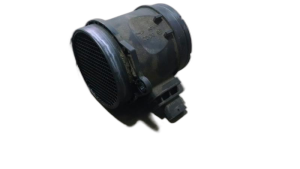
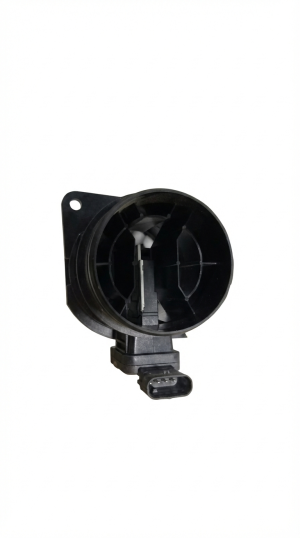
(OEM #06K906461 (Verify by VIN))— If cleaning the sensor and fixing any air leaks doesn't solve the problem, the sensor itself has likely failed and requires replacement.
Trusted brands: Bosch, Hitachi
OEM price range: $120-$290
Aftermarket price range: $40-$150 - MAF Sensor Cleaner — Often, the sensor is just dirty and cleaning it can resolve the P0101 code without needing to replace the part.
Trusted brands: CRC, Liqui Moly
Aftermarket price range: $10-$15
Related Codes That Often Appear With This One
- P0171 — This code for 'System Too Lean (Bank 1)' often appears with P0101 because the root cause is frequently a vacuum leak (like a bad PCV valve). The leak allows unmetered air into the engine, which the MAF sensor doesn't measure, leading to a lean condition.
- P0299 — This code for 'Turbocharger Underboost' can appear with P0101 if the root cause is a significant leak in the charge air (boost) pipes. The leak prevents the turbo from building proper pressure and also causes an unmetered air situation for the MAF sensor.
- P0507 — This code for 'Idle Air Control System RPM Higher Than Expected' can be triggered by the same vacuum leak that causes P0101, as the unmetered air forces the idle speed to increase.
Technical Service Bulletins (TSBs) & Recalls
- VIN-4-A-PIN AUGU (2016): Lists MIL-ON P0101 as a known issue.
- 21-20-01TT (2020): Advises checking for charge air system leaks before replacing the MAF sensor for P0101.
Platform-Specific Known Issues
- Volkswagen has issued Technical Service Bulletin (TSB) VIN-4-A-PIN AUGU which lists 'MIL-ON P0101 AND OR P0100' as a known issue for the 2016 Passat.
- Volkswagen also released Technical Tip 21-20-01TT for the 2020 Passat, which specifically advises pressure testing the charge air system and looking for a loose or popped-out boost hose as a primary step when diagnosing DTC P0101.
Mechanic-Grade Diagnostic Values
- MAF Sensor Airflow at Idle — expected: 2.0 - 5.0 g/s. Failure: Readings outside this range, or readings that do not increase smoothly with RPM.
- MAF Sensor Signal Voltage at Idle (Backprobed) — expected: ~0.9 - 1.5 Volts DC. Failure: Voltage that is stuck, erratic, or significantly different from the expected value.
- MAF Sensor Power Supply Pin (Key On, Engine Off) — expected: 12V+ (Battery Voltage). Failure: No or low voltage indicates a wiring or ECU power supply issue.
- MAF Sensor Ground Pins Resistance to Chassis Ground — expected: < 4 ohms. Failure: High resistance indicates a bad ground connection in the harness.
- Long Term Fuel Trim (LTFT) at steady speed — expected: Close to 0% (ideally within +/- 10%). Failure: Consistently high positive values (e.g., +15% to +25%) suggest the ECU is adding fuel to compensate for unmetered air, a common cause of P0101.
Scan Tool Commands That Help
- VCDS (VAG-COM): Basic Settings - Group 060 (for Drive-by-Wire) — To perform a Throttle Body Adaptation (TBA). This should be done after cleaning the throttle body, disconnecting the battery, or replacing the ECU. An unadapted throttle body can cause idle and performance issues that may be misdiagnosed as a MAF problem.
- VCDS (VAG-COM): Measuring Value Blocks (MVB) - Group 003 — To monitor live MAF sensor data (Field 3 shows actual airflow in mg/h or g/s) and compare it to the specified value. This helps determine if the sensor is reading incorrectly.
Wiring & Ground Locations
- MAF Sensor Connector (G70) — In the intake tube, immediately following the air filter box.. This is the primary connection for the sensor. A loose or corroded connector will directly cause a P0101 code. The pins for power, ground, and signal must be tested here.
- Ignition Coil Ground — The factory ground relies on the stud that holds down the ignition coil pack on the valve cover.. The soft aluminum threads on the valve cover are prone to stripping, leading to a weak ignition coil ground. This can cause misfires and general running issues that may be confused with a MAF problem. Aftermarket grounding kits often relocate this ground to a chassis point behind the passenger headlight for better reliability.
- Main Chassis Ground Lug — On the passenger-side frame rail, near the fender, behind the headlight.. This is a common, reliable grounding point used by aftermarket coil grounding kits and can be used as a reference point for testing other grounds in the engine bay.
Real Owner Repair Stories
- Golfmk6.com forum user 'BigRobSA' (2010 VW GTI (with EA888 engine, similar to Passat)) — P0101 code with very high negative (rich) fuel trims at partial throttle (-18% to -22%).
❌ Tried (didn't work) Replacing the MAF sensor multiple times., Switching between a stock airbox and a Forge Twintake intake system.
✅ What actually fixed it The user found that modifying the aftermarket intake to better align the MAF sensor with the airflow path improved the fuel trims, indicating the aftermarket intake design was causing turbulent air across the sensor and leading to the P0101 code. The final fix was adapting the intake hardware.
OEM Part Supersession History
06K103495T, 06K103495AF, 06K103495AS→06K103495BL— The latest revision, 06K103495BL, features an improved diaphragm for better durability and reliability, addressing the common failure point of the original PCV valves.
Helpful Videos

Used OEM Parts in Stock
New Aftermarket Parts Available

The information in this article is provided for general reference and educational purposes only. Vehicle specifications, procedures, and part compatibility can vary by production date, trim level, and region. Always consult your vehicle's factory service manual and verify part numbers before purchasing or performing repairs. Safety-critical components such as airbags, seat belts, and braking systems should be installed by a qualified professional.
- Volkswagen PASSAT:
- 🧭 Diagnostic Flowchart
- 🎬 Helpful Videos
- 🛍️ Shop This Part
- What's Unique About the 2016-2020 Volkswagen PASSAT
- Symptoms You May Notice
- Most Likely Causes
- Rare But Worth Checking
- Diagnosis Steps
- Parts You'll Likely Need
- Related Codes That Often Appear With This One
- Technical Service Bulletins (TSBs) & Recalls
- Platform-Specific Known Issues
- Mechanic-Grade Diagnostic Values
- Scan Tool Commands That Help
- Wiring & Ground Locations
- Real Owner Repair Stories
- OEM Part Supersession History
- 🎟️ Get 5% Off