

P0102 on 2009-2017 Audi Q5 2.0L TFSI: MAF Circuit Low Causes and Fixes
For a 2009-2017 Audi Q5 2.0T, code P0102 is most often caused by a failed PCV valve creating a vacuum leak or a dirty MAF sensor. Before replacing any parts, check for strong vacuum at the oil cap (bad PCV) and try cleaning the MAF sensor. A new OEM PCV valve (Part No. 06H103495AK) costs around $150-$250.
- On the Audi Q5 2.0T, P0102 is more likely caused by a vacuum leak than a bad MAF sensor.
- The most common source of a vacuum leak is a failed PCV valve; check for a whistling sound and strong suction at the oil cap while the engine is running.
- Always clean the MAF sensor with dedicated MAF sensor cleaner as the first and cheapest step before replacing parts.
- If you also have a P0171 or P2187 'System Too Lean' code, it's almost certain you have a vacuum leak.
- If you must replace the MAF sensor, use a reputable OEM brand like Bosch to avoid compatibility issues.
What's Unique About the 2009-2017 Audi Q5
On the Audi Q5's 2.0L TFSI (EA888) engine, P0102 is very frequently a symptom of another common failure rather than a bad MAF sensor itself. The Positive Crankcase Ventilation (PCV) valve, also called an oil separator, has a diaphragm that is prone to tearing. This creates a significant, unmetered vacuum leak inside the engine, causing the MAF sensor to read low (triggering P0102) while the oxygen sensors detect a lean condition from the extra air, often setting a companion code like P0171 (System Too Lean). The widespread oil consumption issue on these engines can also cause excessive carbon and oil vapor buildup, potentially accelerating the failure of the PCV system. Always investigate the PCV valve before replacing the MAF sensor on this specific engine.
Symptoms You May Notice
- Check Engine Light is on
- Reduced engine power and sluggish acceleration
- Rough, erratic, or 'hunting' idle
- Hesitation or stumbling when accelerating
- Engine stalling, especially when coming to a stop
- A distinct whistling or squealing sound from the engine bay, often indicating a failed PCV valve diaphragm.
- Worse than usual fuel economy
- Black smoke from the exhaust in some cases
- Replacing the MAF sensor without first checking for a failed PCV valve or other vacuum leaks. The MAF sensor is often blamed when it is simply reporting the effects of a leak elsewhere. One owner on AudiForums.com reported replacing the MAF sensor did not fix the P0102 code, which persisted until the underlying vacuum leak was found.
Most Likely Causes
- Failed PCV Valve / Oil Separator 🔴 High Probability The diaphragm inside the PCV valve on the 2.0T TFSI engine is a known failure point, frequently tearing and creating a large internal vacuum leak. The part is made of plastic and rubber that degrades over time from heat and oil vapors.
How to confirm: With the engine idling, listen for a loud whistling or sucking noise from the PCV valve area on top of the engine. Carefully try to lift the oil filler cap; if there is very strong suction holding it down, the PCV diaphragm has failed. This is the most definitive and common test.
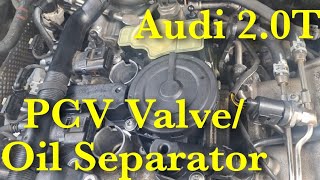
Typical fix: Replace the entire PCV valve assembly. 🎬 Watch: Step-by-step PCV valve replacement guide Use the latest OEM revision (part number 06H103495AK) to ensure longevity. This is a common DIY repair that takes 1-2 hours.
Est. part cost: $150-$250 for OEM, $50-$120 for aftermarket - Dirty or Contaminated MAF Sensor 🔴 High Probability → Shop Fuel Injection Air Flow Meter Oil vapors from the crankcase ventilation system or residue from over-oiled aftermarket air filters can contaminate the sensor's delicate wire.
How to confirm: Visually inspect the MAF sensor's internal wire element. If it appears dirty, oily, or coated in grime, it needs cleaning. This is the easiest and cheapest first step.
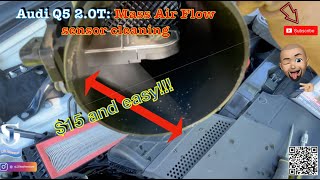
Typical fix: Remove the sensor and clean it thoroughly with a dedicated Mass Airflow Sensor cleaner spray. Do not use brake or carburetor cleaner, as they will damage the sensor. Allow it to dry completely before reinstalling. 🎬 Watch: How to clean your MAF sensor
Est. part cost: $10-$15 for cleaner - Vacuum Leak (Other than PCV) 🟡 Medium Probability Intake hoses and vacuum lines can become brittle and crack over time due to heat and age. The rear breather tube connecting to the turbocharger is another common leak point.
How to confirm: Visually inspect all air intake hoses between the MAF sensor and the throttle body for cracks, splits, or loose connections. A professional smoke test is the most effective way to find hard-to-see leaks.
Typical fix: Replace the cracked or leaking hose/gasket.
Est. part cost: $20-$150 depending on the hose - Faulty MAF Sensor ⚪ Low Probability → Shop Fuel Injection Air Flow Meter
How to confirm: If the PCV is good, the sensor is clean, and there are no vacuum leaks, the sensor itself may have failed. Monitor the sensor's output (in grams/second) with an OBD-II scan tool; the reading should increase smoothly with RPM. A sensor that is stuck on a low value (e.g., 0.0 g/s) or provides erratic readings is faulty.
Typical fix: Replace the MAF sensor. It is highly recommended to use an OEM-quality brand like Bosch.
Est. part cost: $150-$250
Rare But Worth Checking
- Damaged Wiring or Connector: The wiring harness or the connector pins for the MAF sensor can become corroded or damaged, causing an intermittent or low signal. Wiggle the connector and harness while monitoring the MAF signal on a scan tool to check for changes.
- Severely Clogged Engine Air Filter: → Shop Air Cleaner Assembly An extremely dirty air filter can restrict airflow to the point that it causes a P0102 code. Check the filter as part of your initial inspection. 🎬 Watch: How to replace the air filter and MAF sensor
Diagnosis Steps
- Read all fault codes using an OBD-II scanner. Pay close attention to any accompanying lean codes like P0171 or P2187.
- With the engine running, listen for a distinct whistling noise. Carefully attempt to remove the oil filler cap. If it is held on by strong suction, the PCV valve has failed and should be replaced.
- If the PCV test is negative, turn off the engine. Visually inspect the air filter and the entire intake tract from the airbox to the throttle body for obvious cracks, loose clamps, or disconnected hoses.
- Remove the MAF sensor. Inspect the sensing element. If it appears dirty, clean it with dedicated MAF sensor cleaner and allow it to dry completely before reinstalling.
- Clear the codes and test drive the vehicle. If the code returns, the next step is to check for less obvious vacuum leaks.
- Perform a smoke test on the intake system to definitively identify any hidden leaks from gaskets or small cracks in hoses.
- If no leaks are found, use a scan tool to monitor the MAF sensor's live data. At a warm idle, a 2.0T engine should read around 2-4 grams/second. This value should increase smoothly as you raise the engine RPM. If the value is stuck, very low, or erratic, the sensor is likely bad.
- As a final step, check the MAF sensor connector for 12V power, good ground, and a 5V reference signal using a multimeter.
Parts You'll Likely Need
- PCV Valve / Oil Separator
(OEM #06H103495AK (supersedes 06H103495AE, 06H103495J))— This is the most common point of failure on the 2.0T TFSI engine that leads to a vacuum leak and triggers code P0102.
Trusted brands: Audi (Genuine OEM), Vaico, Febi Bilstein, RKX (upgraded diaphragm)
OEM price range: $200-$250
Aftermarket price range: $100-$180 - Mass Airflow (MAF) Sensor
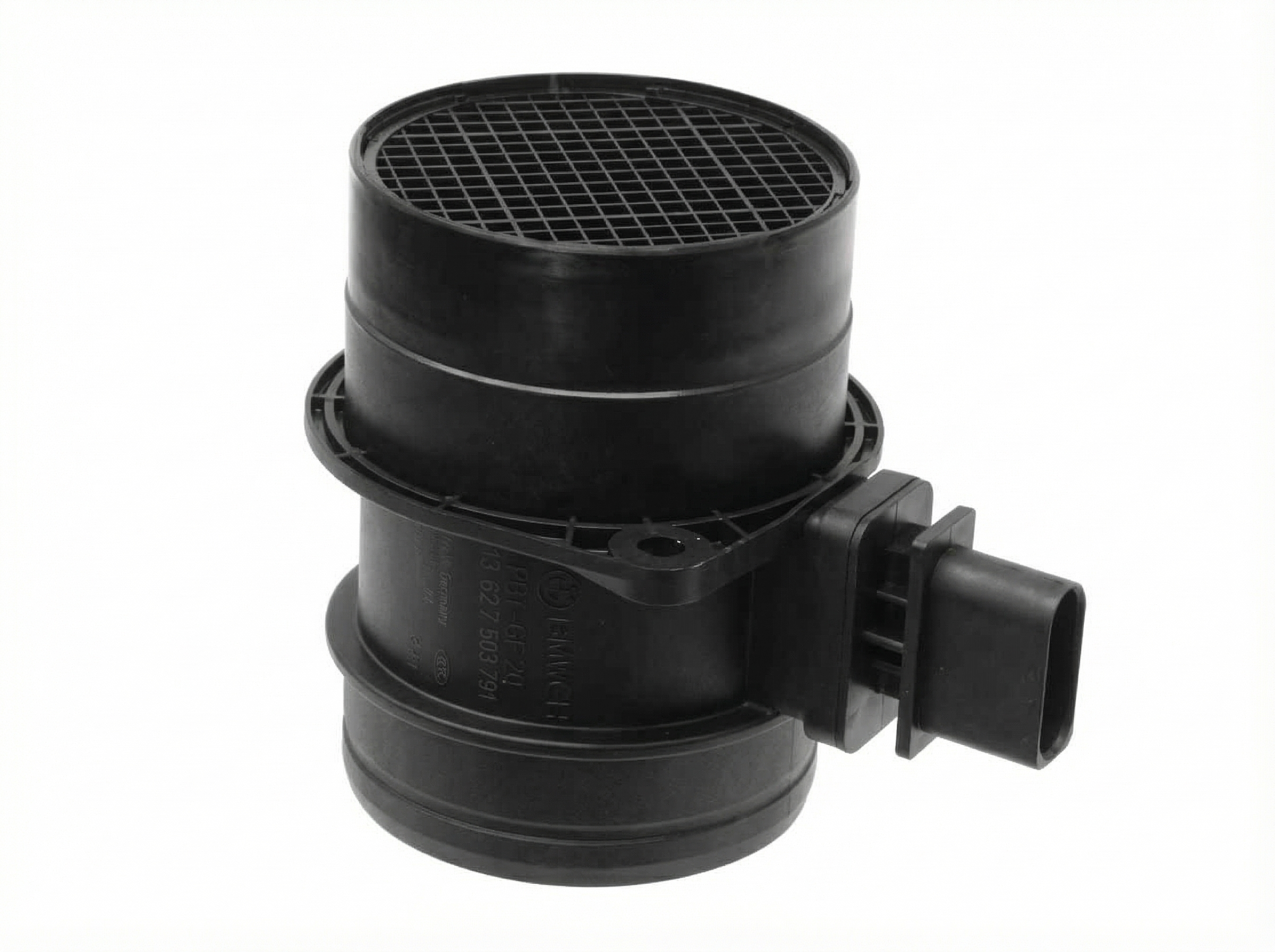
(OEM #06J906461D)— This is the part to replace if it has been confirmed faulty after cleaning and ruling out all vacuum leaks.
Trusted brands: Bosch (OEM supplier), Hitachi, Delphi
OEM price range: $200-$250
Aftermarket price range: $75-$150 - Mass Airflow Sensor Cleaner — Required for cleaning a dirty MAF sensor, which is a very common cause and the first diagnostic step.
Trusted brands: CRC, Liqui Moly
Aftermarket price range: $10-$15
Related Codes That Often Appear With This One
- P0171 — Stands for 'System Too Lean (Bank 1)'. This code is very common with P0102 on this engine. The vacuum leak (e.g., from the PCV) lets in unmetered air, causing the MAF to report low flow (P0102) while the O2 sensor detects the lean condition from the extra air (P0171).
- P2187 — Stands for 'System Too Lean at Idle (Bank 1)'. This is another common companion code caused by a vacuum leak from a torn PCV diaphragm.
- P0507 — Stands for 'Idle Control System RPM Higher Than Expected'. A vacuum leak can cause the engine idle to surge or remain high, triggering this code.
Mechanic-Grade Diagnostic Values
- Mass Air Flow (g/s) at warm idle (VCDS Measuring Block) — expected: 2.0 - 4.0 g/s. Failure: A reading of 0.0 g/s or a value that does not increase with RPM points to a faulty sensor or wiring. A reading that is low but not zero often indicates an unmetered air leak.
- MAF Sensor Connector Voltage (Pin 2 to Ground) — expected: 12V (Battery Voltage). Failure: No or low voltage indicates a problem with the power supply from the ECU relay or a break in the power wire.
- MAF Sensor Connector Voltage (Pin 3 to Ground) — expected: 5V Reference. Failure: No or incorrect voltage points to an issue with the ECU's 5V reference circuit or a wiring fault.
- MAF Sensor Connector Ground (Pin 1) — expected: Good continuity to chassis ground. Failure: High resistance or an open circuit on the ground wire will cause incorrect sensor readings.
- Long Term Fuel Trim (LTFT) - Bank 1 (VCDS Measuring Block) — expected: Close to 0%, typically within +/- 5%. Failure: A high positive value (e.g., +15% to +25%) indicates the ECU is adding significant fuel to compensate for unmetered air, strongly suggesting a vacuum leak.
Scan Tool Commands That Help
- VCDS (VAG-COM) or ODIS: Engine-01 -> Measuring Blocks -> Group 002 — This is used to view live data from the MAF sensor (G70). The second field shows the mass air flow in grams per second (g/s). This is the primary method for verifying if the sensor is reading correctly, stuck, or responding to RPM changes.
- VCDS (VAG-COM) or ODIS: Engine-01 -> Measuring Blocks -> Group 032 — This block shows the learned fuel trim values at idle (first field) and under partial load (second field). High positive values (e.g., >10%) confirm the engine is running lean, which, when paired with a low MAF reading (P0102), strongly points towards a vacuum leak.
Wiring & Ground Locations
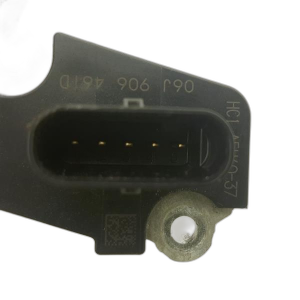
- MAF Sensor Connector (G70) — On the air intake tube, immediately after the air filter box.. This 5-pin connector (Part No. 4F0973705) provides power, ground, and signal lines to the MAF sensor. On the 2.0T, typically only 3 pins are used: Pin 1 (Ground), Pin 2 (12V Power), and Pin 3 (Signal). Corrosion or damage to these pins or wires is a direct cause of P0102.
- Ground Point 12 — In the engine compartment on the left side, near the suspension strut tower.. This is a primary chassis ground point in the engine bay. A loose or corroded connection here can cause erratic behavior from various engine sensors, including the MAF.
- Ground Point 609 — Located in the plenum chamber (the area below the windshield wipers) on the right side.. This ground point serves the Engine Control Module (ECM). A poor ground here can cause a wide range of phantom codes and incorrect sensor readings, including a P0102.
Real Owner Repair Stories
- Shop Owner on YouTube (2009 VW CC 2.0T (EA888 Engine, same as Q5)) — Check engine light with codes P0171 (System Too Lean) and P119A (Fuel Pressure Sensor Malfunction).
❌ Tried (didn't work) Initial thought was a fuel pressure issue due to the P119A code.
✅ What actually fixed it A smoke test revealed a massive vacuum leak from a failed rear main seal between the engine and transmission. The video explains that the failed seal allows unmetered air into the crankcase, which is connected to the intake via the PCV system, causing a lean condition and low MAF readings. The PCV valve was also replaced as a preventative measure, as its failure can cause the pressure that blows out the rear main seal. - Reddit user r/Audi (2014 Audi Q5 2.0T, 87k miles) — High oil consumption (1 qt per 500 miles), timing chain codes.
❌ Tried (didn't work) The dealer could not diagnose the oil consumption issue until the timing chain was fixed.
✅ What actually fixed it The timing chain was replaced for $4500. While this was for a different primary code, it highlights a critical related issue. The post-repair oil consumption was still high, pointing to the known piston ring issue on these engines. Excessive blow-by from bad rings can overwhelm the PCV system, leading to oil contamination of the intake and MAF sensor, which can be a contributing factor to P0102.
"I Checked Everything" — The Actual Cause
- A common scenario is a smoke test that only checks the intake tract but misses crankcase leaks. If the PCV valve test (oil cap suction) is negative and a standard smoke test of the intake hoses is clean, the next step should be to introduce smoke directly into the crankcase (via the oil filler neck or dipstick tube). A major leak from the rear main seal, which sits between the engine and transmission, will be revealed this way and is a known, if difficult, cause of P0102 and lean codes on the EA888 engine.
OEM Part Supersession History
06H103495AE, 06H103495J, and others→06H103495AK— Multiple revisions were made to the PCV valve/oil separator to improve the durability of the internal diaphragm and address the high failure rate.
Heads up: While older versions will physically fit, it is critical to use the latest available revision (like 'AK' or newer) to prevent premature failure. Aftermarket versions exist, but quality can be inconsistent; OEM is recommended for longevity.
Model Year Variations Within This Range
- 2009-2012: Earlier models primarily used the 'CAEB' engine code. These are well-known for issues with timing chain tensioner failure and high oil consumption due to piston ring design. These issues can indirectly cause P0102 by leading to PCV system problems or timing-related faults.
- 2013-2017: Later models, particularly after the 2013 facelift, often use 'CPMA' or 'CPMB' engine codes. These engines featured updates to address the oil consumption and timing chain tensioner issues, though PCV valve failure remains a common problem across all years. The intake manifold design also changed.
Diagnostic Flowchart
Other Known Issues on This Vehicle
Issues unrelated to this code that are worth knowing about as an owner of this generation:
- Excessive Oil Consumption 🔴 High — Widespread on 2009-2013 models (CAEB engine code), often appearing around 50,000-60,000 miles. Caused by defective piston rings. (Ref: Subject of multiple class-action lawsuits which led to settlement programs and extended warranties, though most are now expired.)
- Timing Chain Tensioner Failure 🔴 High — Common on earlier EA888 Gen 2 engines (approx. 2009-2013). The original tensioner can fail without warning, causing the chain to jump and leading to catastrophic engine damage. (Ref: A known design defect. An updated tensioner (P/N 06K109467K) resolves the issue. Also the subject of a class-action lawsuit.)
- Cracked Plastic Water Pump / Thermostat Housing 🟠 Medium → Shop Integrated Thermostat Housing Assembly — The plastic assembly becomes brittle with heat cycles and can crack, causing coolant leaks and overheating. Failure can occur anytime after 60,000 miles. (Ref: No recall, but a very common repair. Aftermarket aluminum replacement housings are a popular and recommended upgrade.)
- Intake Valve Carbon Buildup 🟠 Medium — As a direct-injection engine, fuel doesn't wash over the intake valves. This leads to carbon accumulation over 50,000-80,000 miles, causing misfires and reduced performance. (Ref: No recall; this is considered a maintenance item. Requires walnut blasting to clean the valves effectively.)
Used vs. New Parts: Buying Guide for This Vehicle
When a used part is the smart pick: For this specific repair, buying used parts is generally not recommended. The primary failure items (PCV valve, MAF sensor) are wear-and-tear components or sensitive electronics. A used PCV valve has an unknown remaining lifespan and is likely already degraded. A used MAF sensor carries a high risk of being out of calibration or failing shortly after installation.
Donor-vehicle mileage cap: roughly under 50000 miles for the part to have meaningful remaining life.
What to inspect on the donor part:
- For a MAF sensor, ensure the donor vehicle had no MAF-related or air/fuel mixture fault codes.
- Visually inspect the MAF sensor element for any physical damage or signs of heavy oil contamination.
- For a PCV valve, it is almost never worth the risk. The internal diaphragm's condition cannot be verified externally.
OEM-only on this vehicle (don't cheap out):
- PCV Valve / Oil Separator: Due to the extremely high failure rate and the critical function, using a genuine OEM part with the latest revision is strongly advised to avoid repeat failures.
- Mass Air Flow (MAF) Sensor: While OEM-supplier brands like Bosch are excellent, cheap, unbranded aftermarket MAF sensors are notorious for being poorly calibrated and causing persistent performance issues. Stick to the OEM supplier (Bosch) or genuine Audi parts.
Aftermarket brands forum-validated for this vehicle:
- Bosch (for the MAF sensor, as they are the OEM supplier)
- Vaico, Febi Bilstein (Often considered higher-quality aftermarket options for the PCV valve, but OEM is still preferred)
Brands owners have reported issues with on this vehicle:
- Unbranded, no-name MAF sensors and PCV valves from online marketplaces. These frequently fail out of the box or within a few months.
Real Owner Stories
Aggregated from forums and TSBs cited above. Mileages and costs reflect what owners reported in those sources.
Audi Q5 2.0T TFSI
Symptoms: The car had a check engine light, TPMS, ABS, Stability Control, and parking brake lights all illuminated on the dash.
What fixed it: Soldering on a new MAF harness resolved the dashboard lights and the primary fault.
Source hint: Ross-Tech Forums
Audi Q5 2.0T
Symptoms: A distinct whistling noise coming from the engine bay.
What fixed it: Replacing the PCV valve assembly (often misattributed to other sources, but confirmed as a classic symptom of PCV failure).
Source hint: AudiWorld Forums: 'Q5 whistling noise'
Audi A4 (B8) 2.0L TFSI
Symptoms: P0102 mass airflow sensor input too low; owner replaced the MAF sensor but the code remained.
What fixed it: The source highlights the importance of checking for vacuum leaks first rather than just replacing the sensor.
Source hint: AudiForums.com: 'P0102 mass airflow sensor input too low'
Related OBD-II Codes
Frequently Asked Questions
My 2012 Audi Q5 has a whistling noise and a P0102 code; is there a specific part revision I should use?
Can I use any cleaner to fix a contaminated MAF sensor on my Q5?
Is the P0102 code related to the common oil consumption issues on 2009-2013 Audi Q5 models?
How can I tell if my P0102 is caused by the PCV valve or the MAF sensor itself?
Are there any other common failures on the Q5 2.0T that I should check while diagnosing P0102?
Helpful Videos


We Have This Part in Stock

The information in this article is provided for general reference and educational purposes only. Vehicle specifications, procedures, and part compatibility can vary by production date, trim level, and region. Always consult your vehicle's factory service manual and verify part numbers before purchasing or performing repairs. Safety-critical components such as airbags, seat belts, and braking systems should be installed by a qualified professional.
- Audi Q5:
- 🧭 Diagnostic Flowchart
- 🎬 Helpful Videos
- 🛍️ Shop This Part
- What's Unique About the 2009-2017 Audi Q5
- Symptoms You May Notice
- Most Likely Causes
- Rare But Worth Checking
- Diagnosis Steps
- Parts You'll Likely Need
- Related Codes That Often Appear With This One
- Mechanic-Grade Diagnostic Values
- Scan Tool Commands That Help
- Wiring & Ground Locations
- Real Owner Repair Stories
- "I Checked Everything" — The Actual Cause
- OEM Part Supersession History
- Model Year Variations Within This Range
- Other Known Issues on This Vehicle
- Used vs. New Parts: Buying Guide for This Vehicle
- Real Owner Stories
- Audi Q5 2.0T TFSI
- Audi Q5 2.0T
- Audi A4 (B8) 2.0L TFSI
- Related OBD-II Codes
- Frequently Asked Questions
- 🎟️ Get 5% Off