

P0102 on 1998-2001 Ford Ranger 2.5L: Causes for MAF Circuit Low Code
On a 1998-2001 Ranger with the 2.5L engine, P0102 is most often caused by a dirty Mass Airflow (MAF) sensor or a vacuum leak from a cracked intake hose. Cleaning the sensor with dedicated MAF cleaner for under $15 is the most common and effective first step. If the code is paired with P0171, a vacuum leak is almost certain.
- This guide applies specifically to 1998-2001 Ford Rangers with the 2.5L Lima engine.
- Before buying any parts, the first and most important step is to clean the MAF sensor with a dedicated cleaner.
- Thoroughly inspect the large rubber air intake hose and all smaller vacuum lines for cracks, which are very common on these older trucks.
- If P0171 (System Too Lean) is also present, it strongly indicates a vacuum leak is the root cause.
- If you must replace the sensor, using a quality brand like Motorcraft is recommended to avoid issues with incompatible aftermarket parts.
What's Unique About the 1998-2012 Ford Ranger
The 2.5L Lima engine in this generation of Ranger is a workhorse, but its age is a key factor for this code. After two decades, the rubber and plastic components in the engine bay become brittle and prone to cracking. While a dirty MAF sensor is a universal issue, these Rangers are particularly susceptible to vacuum leaks from the large, ribbed air intake duct and various PCV hoses. Owners frequently fix this code with a simple MAF sensor cleaning or by finding and sealing a cracked hose, often avoiding the cost of a new sensor.
Generation note: The user-specified range of 1998-2012 covers the third generation of the Ford Ranger. However, the 2.5L Lima I4 engine was only offered from 1998 until mid-2001. In mid-2001, it was replaced by the 2.3L DOHC Duratec engine. Therefore, this guide is specifically applicable to the 1998-2001 Ford Ranger and its twin, the Mazda B2500.
Symptoms You May Notice
- Engine stalls or dies immediately after starting, unless the accelerator is pressed.
- Rough, unstable idle.
- Hesitation or lack of power during acceleration.
- Black smoke from the exhaust.
- Check Engine Light is on.
- Poor fuel economy.
- Replacing the MAF sensor without first attempting to clean it.
- Replacing the MAF sensor when the true cause is a cracked and inexpensive vacuum hose.
- Installing a cheap aftermarket MAF sensor that is faulty out of the box, leading to continued troubleshooting.
Most Likely Causes
- Dirty or Contaminated MAF Sensor 🔴 High Probability → Shop Fuel Injection Air Flow Meter Over time, oil vapor from the crankcase ventilation system and fine dust can coat the sensor's delicate hot wires, insulating them and causing inaccurate low readings. This is the most common fix reported by owners.
How to confirm: Visually inspect the small wires inside the MAF sensor housing (requires a T-20 Security Torx bit for removal). If they appear dirty, oily, or have debris on them, cleaning is necessary.
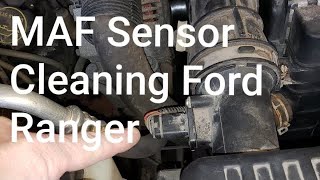
Typical fix: Remove the sensor and clean it ONLY with a dedicated Mass Airflow Sensor cleaner spray. 🎬 Watch: A quick guide on cleaning your Ranger's MAF sensor. Do not touch the wires. Let it air dry completely before reinstalling.
Est. part cost: $10-$20 - Vacuum Leak 🔴 High Probability The rubber air intake hose between the air filter box and the throttle body is known to crack with age, especially in the ribbed 'accordion' sections. Smaller vacuum lines like the PCV hoses and the PCV valve grommet are also common failure points due to heat and age. In a cross-manufacturer reference, NHTSA ODI #10383032 describes a P0102 code resulting from a pinpoint leak in a resonator hose, which led to the vehicle stalling at stop signs.
How to confirm: Visually inspect all intake and vacuum hoses for cracks, splits, or loose connections. Listen for a hissing sound with the engine running. A more effective method is to carefully spray short bursts of brake cleaner or unlit propane around suspected leak areas; a change in engine idle indicates a leak. A smoke test is the most definitive way to find hidden leaks.
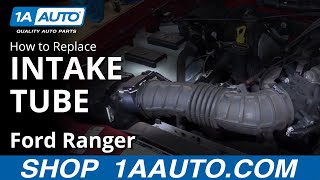
Typical fix: Replace the cracked or leaking hose. The large intake duct (OEM Part F87Z-9B659-DA) is a common failure point. 🎬 See this walkthrough for replacing a cracked air intake tube. The PCV valve and its hoses are also inexpensive and wise to replace.
Est. part cost: $15-$75 - Faulty MAF Sensor Wiring or Connector 🟡 Medium Probability → Shop Fuel Injection Air Flow Meter After 20+ years, the wiring harness and plastic connector can become brittle from engine heat, leading to broken wires or poor pin connections right at the sensor.
How to confirm: With the key on and engine off, check for 12V power at the Red wire on the MAF connector. With the engine running, wiggle the MAF sensor connector and wiring harness. If the engine stumbles or stalls, a wiring issue is likely. Use a multimeter to check for power, ground, and signal voltage at the connector per the service manual.
Typical fix: Repair the broken wire or replace the connector pigtail.
Est. part cost: $15-$40 - Clogged Engine Air Filter ⚪ Low Probability → Shop Air Cleaner Assembly
How to confirm: Remove and inspect the air filter. If it is visibly black, full of debris, or clogged, it is restricting airflow.
Typical fix: Replace the engine air filter.
Est. part cost: $15-$30
Rare But Worth Checking
- Failed MAF Sensor: → Shop Fuel Injection Air Flow Meter While less common than being dirty, the sensor's internal electronics can fail. This should only be considered after cleaning, wiring checks, and vacuum leak inspections have been performed. Be wary of cheap aftermarket sensors; some owners report receiving bad-out-of-the-box parts that do not fix the issue.
- Clogged Catalytic Converter: A severely clogged exhaust can create backpressure that restricts airflow into the engine, leading to a low MAF reading. This is usually accompanied by a significant loss of power, especially at higher RPMs, and potentially a sulfur smell from the exhaust.
- Internal Engine Damage: In rare instances, P0102 can be a secondary symptom of severe engine failure. As a cross-manufacturer reference, NHTSA ODI #11539323 notes a case where P0102 was retrieved alongside other codes, and it was determined that coolant had intruded into the engine block, requiring a full engine replacement.
Diagnosis Steps
- Check for other stored trouble codes. If P0171 is present, strongly suspect a vacuum leak.
- Visually inspect the entire air intake system from the air filter to the throttle body. Look for cracks in the large rubber tube (especially underneath), disconnected hoses (PCV system), and loose clamps.
- Inspect the engine air filter. Replace if it is dirty or clogged.
- Carefully remove the MAF sensor (requires T-20 Security Torx bit). Inspect the sensor elements for dirt, oil, or debris.
- If dirty, clean the sensor using only aerosol Mass Airflow Sensor cleaner. Do not touch the wires. Allow it to dry completely.
- Reinstall the sensor, clear the P0102 code, and perform a test drive to see if the code returns.
- If the code returns, inspect the MAF sensor's electrical connector for corrosion or damage. With the engine running, gently wiggle the connector and harness to check for intermittent connections.
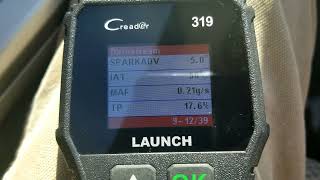
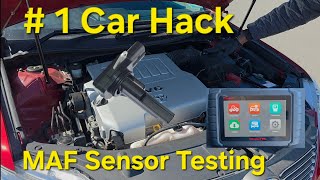
- Using a multimeter with the key on, engine off, back-probe the MAF connector. You should find 12V on the Red wire and 5V on another (reference voltage). With the engine idling, the signal wire (often Tan/Light Blue) should read approximately 0.6-1.0 volts, increasing smoothly with RPM. 🎬 Watch: How to properly test MAF sensor signals with a scan tool.
- If wiring and voltages are good and no vacuum leaks are found, the MAF sensor itself may have failed and requires replacement. Using an OEM Motorcraft part is highly recommended.
Parts You'll Likely Need
- Mass Airflow Sensor Cleaner — This is the most common and inexpensive first step, as a dirty sensor is the leading cause of P0102 on this vehicle.
Trusted brands: CRC, Liqui Moly
Aftermarket price range: $10-$20 - Mass Airflow Sensor
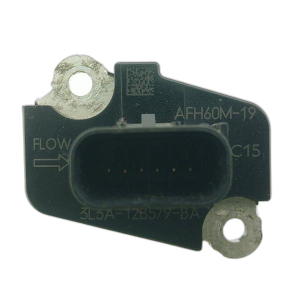
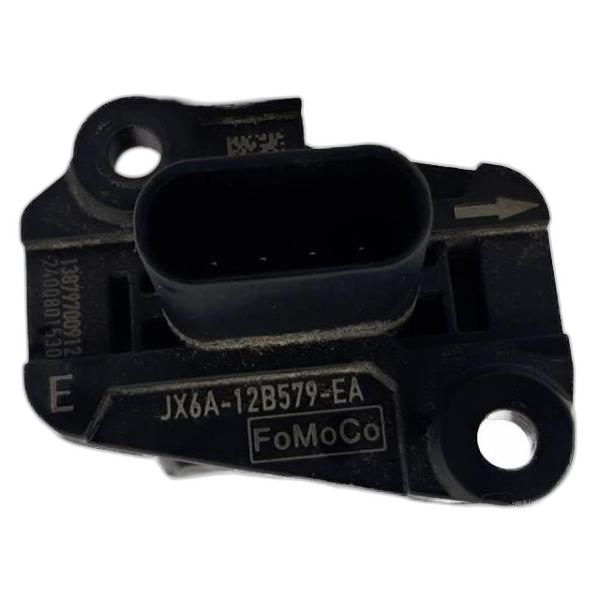
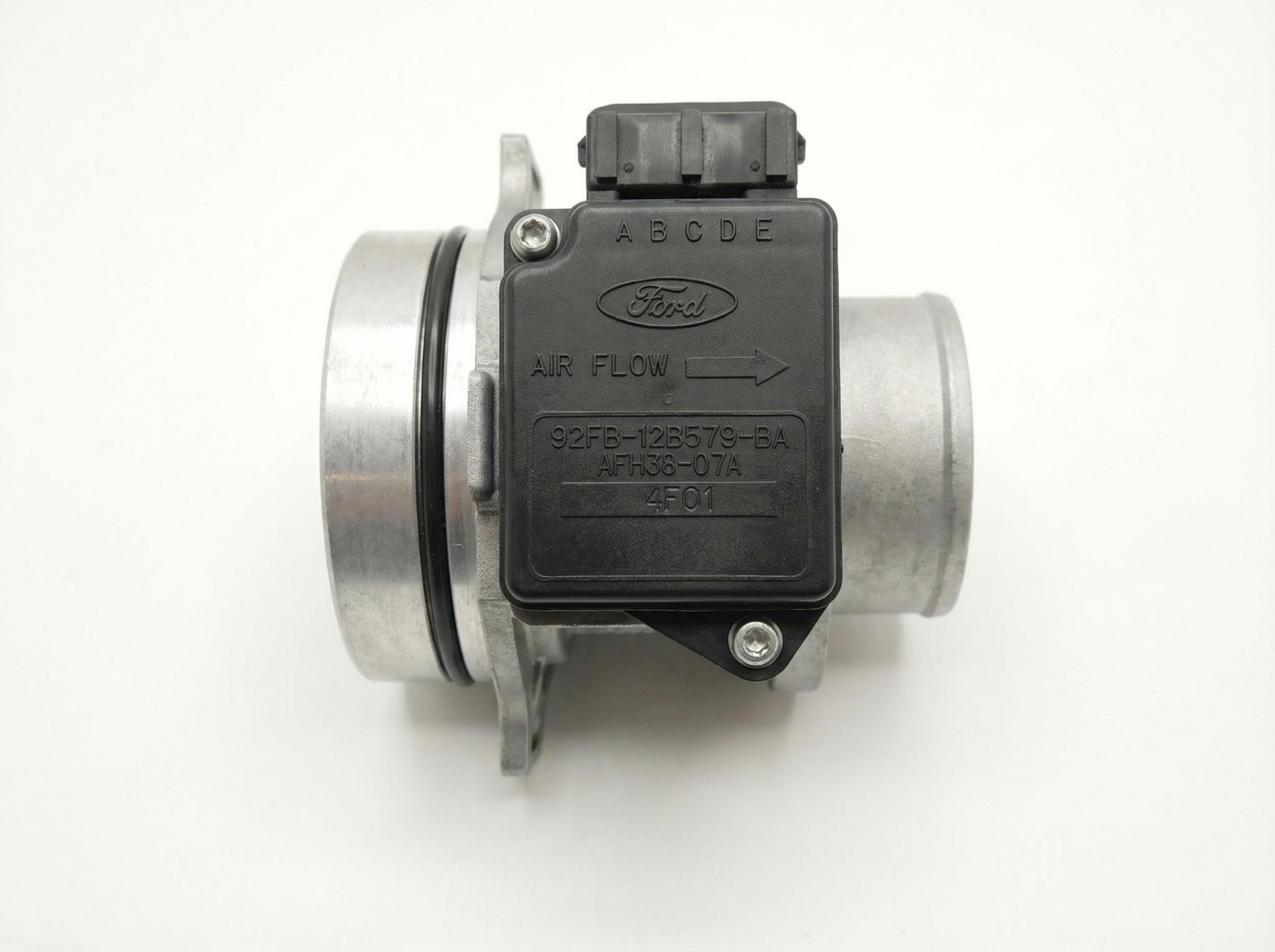
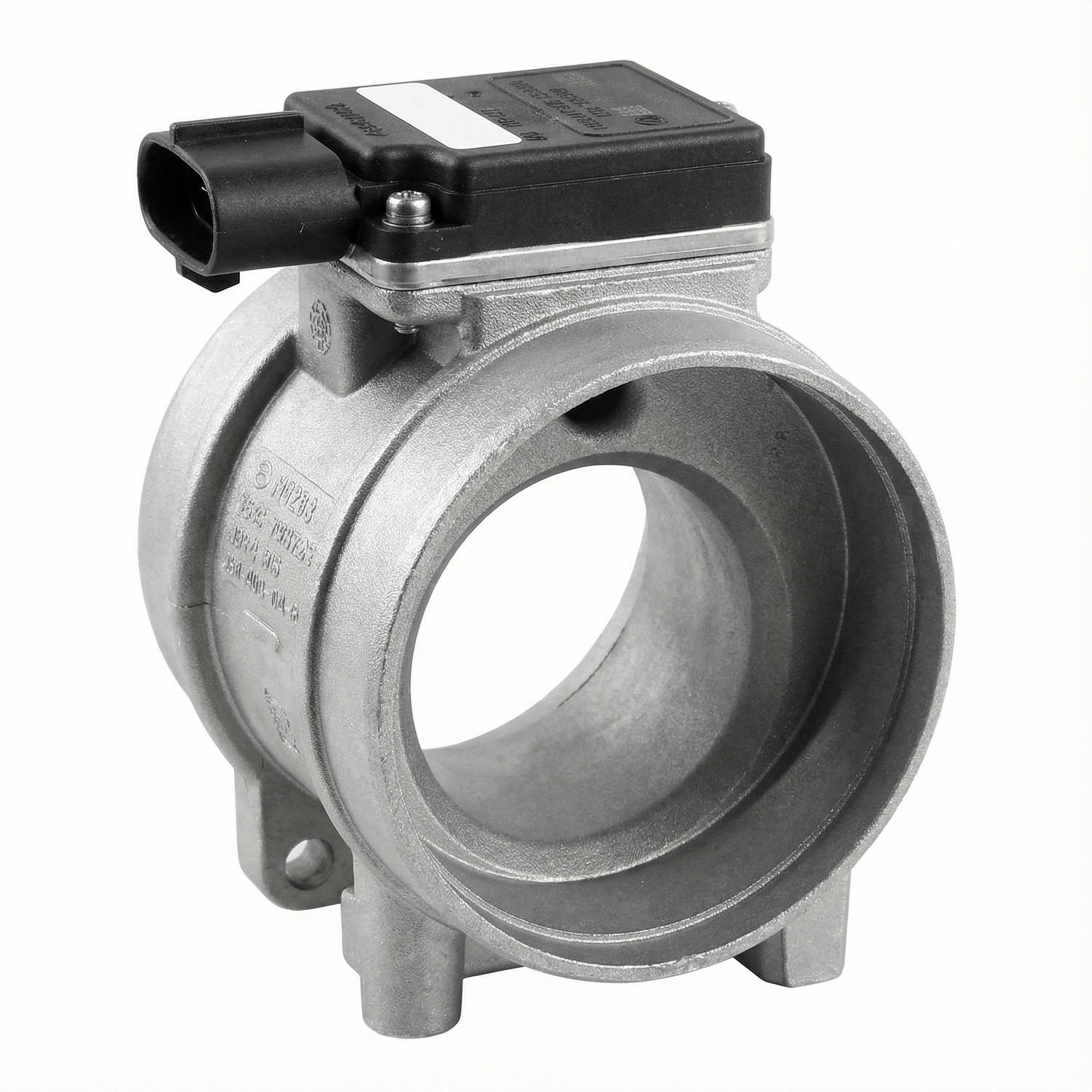
(OEM #F67Z-12B579-EA)— If cleaning the sensor and checking for vacuum leaks does not resolve the code, the sensor itself may have failed. OEM is strongly recommended.
Trusted brands: Motorcraft (OEM), Delphi, Walker Products, Hitachi
OEM price range: $120-$180
Aftermarket price range: $50-$100 - Air Intake Hose
(OEM #F87Z-9B659-DA)— The large rubber hose between the MAF sensor and throttle body is a common point for cracks, causing a significant vacuum leak.
Trusted brands: Motorcraft (OEM), Dorman, Spectre
OEM price range: $50-$100
Aftermarket price range: $25-$60 - PCV Valve and Hoses — The PCV valve, grommet, and associated hoses are often overlooked sources of vacuum leaks. They are inexpensive and located under the intake manifold, making them difficult to inspect but easy to crack.
Trusted brands: Motorcraft, Standard Motor Products
OEM price range: $20-$50
Aftermarket price range: $10-$30
Related Codes That Often Appear With This One
- P0171 — System Too Lean (Bank 1). This code often appears with P0102 when a vacuum leak is the cause. The leak allows unmetered air into the engine after the MAF sensor, so the MAF reports low air (P0102) while the oxygen sensor detects too much oxygen, triggering the lean code (P0171).
Platform-Specific Known Issues
- Bad Out-of-the-Box Aftermarket MAF: A user on TheRangerStation.com forums shared an experience where they replaced a faulty MAF with a new aftermarket part, but the P0102 code persisted. The new part was also defective and provided a static, unchanging signal. The issue was only resolved after installing a third, functional sensor. This highlights the risk of using non-OEM sensors.
Mechanic-Grade Diagnostic Values
- MAF Sensor Live Data (Scan Tool PID) — expected: Approximately 2.5 grams/second (g/s) at normal operating temperature idle. The reading should be close to the engine's displacement in liters.. Failure: A reading significantly below 2.5 g/s, or a reading of 0.0 g/s, indicates a fault. A reading that does not increase smoothly with RPM is also a sign of failure.
- MAF Sensor Signal Wire Voltage — expected: Approximately 0.8V - 1.0V DC at warm idle. Voltage should increase smoothly and gradually as the throttle is opened.. Failure: Voltage is near 0V or stuck at a static value when the engine is running.
- MAF Sensor Power Supply Wire Voltage — expected: 12V (Battery Voltage) on the Red wire with Key On, Engine Off.. Failure: Voltage significantly less than battery voltage indicates a wiring issue, fuse problem, or fault in the power supply circuit.
- MAF Sensor Ground Wire Resistance — expected: Near 0 ohms when testing continuity between the Black/White wire and a known good chassis ground.. Failure: High resistance (OL or many ohms) indicates a broken or corroded ground connection, which is a common cause of low sensor voltage codes.
Wiring & Ground Locations
- MAF Sensor Connector Pins (1998-2001 2.5L) — The 4-pin electrical connector on the Mass Airflow Sensor, located on the air intake tube just after the air filter box.. Correctly identifying power, ground, and signal wires is essential for diagnosis. Pin A (Tan/Lt Blue) is the MAF signal, Pin B (Lt Blue/Red) is the MAF return/ground, Pin C (Black/White) is a ground, and Pin D (Red) is the 12V power supply from the PCM Power Relay.
- G100 — Located on the lower left-hand (driver's side) front of the engine compartment, below the battery.. This is a primary chassis ground. A loose or corroded connection here can cause a variety of electrical issues, including erratic sensor readings and codes like P0102.
- G101 — Located on the left-hand (driver's side) of the upper radiator support.. This ground point is critical for many components in the engine bay. Verifying it is clean and tight is a key step in diagnosing any electrical fault.
- G104 — Located on the lower left-hand (driver's side) front of the engine compartment, on the frame rail.. This is a major frame ground point. A bad connection here can lead to intermittent and hard-to-diagnose electrical problems.
- PCV Valve & Hoses — Tucked under the intake manifold, often on a small black oil separator canister between cylinders 2 and 3. It is difficult to see from the top.. The hoses connected to the PCV valve are a very common source of hidden vacuum leaks. Because of its location, it is often overlooked during a visual inspection.
Real Owner Repair Stories
- Ranger-Forums.com user 'tumark' (1998 Ford Ranger with a swapped 2001 2.5L engine) — Engine starts but dies immediately unless gas is applied. P0102 code present.
❌ Tried (didn't work) Unplugging and reconnecting the MAF sensor., Replacing spark plugs and wires., Swapping in a used ignition coil pack.
✅ What actually fixed it The user removed the MAF sensor, sprayed the sensor wires with electronics cleaner, let it dry, and reinstalled it. This completely resolved the stalling and the code did not return. - Reddit user 'travissetsfire' (Ford Ranger (year/engine not specified, but symptoms match)) — With MAF plugged in, engine starts, fires, and dies instantly. With MAF unplugged, it idles poorly and dies when the throttle is touched.
❌ Tried (didn't work) Replacing the MAF sensor with a new one., Replacing spark plugs., Replacing fuel pump., Replacing air filter., Replacing battery.
✅ What actually fixed it After replacing many parts with no success, the user, for 'shits and giggles', put the ORIGINAL old MAF sensor back on the truck. The truck fired right up and was drivable, indicating the 'new' aftermarket MAF sensor was faulty out of the box. - CarKiller.com forum user (2009 Ford Ranger 4x4 XLT (Note: This is a newer model but the diagnostic principle is identical)) — P0102 code, running lean, delayed throttle response. Runs great when MAF sensor is unplugged, but acts up when plugged back in.
❌ Tried (didn't work) Replacing the ECM., Replacing the air flow sensor.
✅ What actually fixed it The issue was unresolved in the thread, but the key symptom—running better with the MAF unplugged—strongly points to either a faulty MAF sensor providing incorrect (but present) data, or a massive vacuum leak downstream of the sensor. When unplugged, the PCM uses default values, ignoring the bad data or the effect of the leak.
OEM Part Supersession History
F67Z-12B579-EA→F67Z-12B579-MRM— The original part has been discontinued and replaced by a remanufactured Ford part.
Diagnostic Flowchart
Other Known Issues on This Vehicle
Issues unrelated to this code that are worth knowing about as an owner of this generation:
- Timing Belt Maintenance 🔴 High — The 2.5L Lima is a non-interference engine, meaning a snapped belt usually won't destroy the engine. However, the belt is a standard maintenance item recommended for replacement around 100,000 miles. Neglecting it will lead to being stranded.
- Recessed Exhaust Valve Seats 🟠 Medium — A known issue on the dual-plug Lima heads where the exhaust valve seats can wear and recede into the cylinder head. This causes symptoms like a rough idle when coming to a stop, intermittent stalling after acceleration, and eventually a persistent misfire. It is a fairly common problem at higher mileage (150k+ miles).
- Frame Rust 🔴 High — Particularly in regions that use road salt, older Rangers are susceptible to severe frame rust, especially around the rear leaf spring hangers and fuel tank. While not covered by a specific recall for this generation, it's a widely documented problem requiring careful inspection.
- Camshaft Position Synchronizer Failure 🟠 Medium — The unit that drives the oil pump and contains the camshaft position sensor can wear out, leading to a characteristic 'chirping' or 'squeaking' sound. If it fails completely, it can cause the engine to shut off and may damage the oil pump drive.
Used vs. New Parts: Buying Guide for This Vehicle
When a used part is the smart pick: A used OEM Motorcraft MAF sensor from a junkyard can be a cost-effective gamble, especially if you can test it on your vehicle before purchase or if it comes with a short warranty. Given the high rate of failure for new aftermarket sensors on these trucks, a used original part is often a better bet than a cheap new one. Used intake hoses or PCV components are not recommended as the age-related brittleness is the primary failure mode.
Donor-vehicle mileage cap: roughly under 150000 miles for the part to have meaningful remaining life.
What to inspect on the donor part:
- Look for a donor vehicle that appears well-maintained and is from a dry, non-salt-belt region to minimize corrosion.
- Inspect the MAF sensor connector on the donor vehicle's harness for signs of corrosion, melting, or broken locking tabs.
- If possible, visually inspect the sensor elements inside the used MAF; they should be clean and free of oil or debris.
OEM-only on this vehicle (don't cheap out):
- Mass Airflow Sensor
Aftermarket brands forum-validated for this vehicle:
- Hitachi
- Delphi
Brands owners have reported issues with on this vehicle:
- Unbranded, 'white-box' sensors from online marketplaces are frequently reported as dead-on-arrival or failing shortly after installation.
Real Owner Stories
Aggregated from forums and TSBs cited above. Mileages and costs reflect what owners reported in those sources.
1998 Ford Ranger (with 2001 2.5L engine)
Symptoms: Engine starts but dies immediately; can only be kept running by giving it gas. Check engine light is on with code P0102.
What fixed it: Removed the MAF sensor and sprayed the sensor wires directly with cleaner, then allowed it to dry before reinstalling.
Source hint: Ranger-Forums.com thread 'P0102' (2005)
1997 Ford Ranger 2.5L
Symptoms: Vehicle will not idle and threw code P0102.
What fixed it: Diagnostic focus shifted to checking for low voltage at the MAF connector after a sensor replacement failed to fix the issue.
Source hint: Ford-Trucks.com thread '97 Ranger won't idle code P0102' (2008)
Ford Ranger 2.5L Lima I4
Symptoms: P0102 code persisted even after replacing the MAF sensor with a new aftermarket unit; the new part provided a static, unchanging signal.
What fixed it: Installing a third, functional sensor (OEM recommended) resolved the issue.
Source hint: TheRangerStation.com forums
Ford F-150 (Cross-Manufacturer Reference)
Symptoms: Truck stalled at a stop sign and at other times while driving. Diagnostic trouble code P0102 was retrieved.
What fixed it: Technicians identified a pinpoint leak in the resonator hose and replaced the resonator to resolve the stalling issue.
Source hint: NHTSA ODI #10383032
Related OBD-II Codes
Frequently Asked Questions
My 2.5L Ranger stalls immediately after starting unless I hit the gas. Is this common for code P0102?
Can I use any cleaner to fix my MAF sensor wires?
What specific tool do I need to remove the MAF sensor on my 1998-2012 Ranger?
Is there a specific intake part that frequently fails and causes vacuum leaks on the 2.5L?
I replaced my MAF sensor but the P0102 code is still there. Could the new part be bad?
Does the Mazda B2500 have these same P0102 issues?
Helpful Videos
We Have This Part in Stock

The information in this article is provided for general reference and educational purposes only. Vehicle specifications, procedures, and part compatibility can vary by production date, trim level, and region. Always consult your vehicle's factory service manual and verify part numbers before purchasing or performing repairs. Safety-critical components such as airbags, seat belts, and braking systems should be installed by a qualified professional.
- Ford Ranger:
- 🧭 Diagnostic Flowchart
- 🎬 Helpful Videos
- 🛍️ Shop This Part
- What's Unique About the 1998-2012 Ford Ranger
- Symptoms You May Notice
- Most Likely Causes
- Rare But Worth Checking
- Diagnosis Steps
- Parts You'll Likely Need
- Related Codes That Often Appear With This One
- Platform-Specific Known Issues
- Mechanic-Grade Diagnostic Values
- Wiring & Ground Locations
- Real Owner Repair Stories
- OEM Part Supersession History
- Other Known Issues on This Vehicle
- Used vs. New Parts: Buying Guide for This Vehicle
- Real Owner Stories
- 1998 Ford Ranger (with 2001 2.5L engine)
- 1997 Ford Ranger 2.5L
- Ford Ranger 2.5L Lima I4
- Ford F-150 (Cross-Manufacturer Reference)
- Related OBD-II Codes
- Frequently Asked Questions
- 🎟️ Get 5% Off